
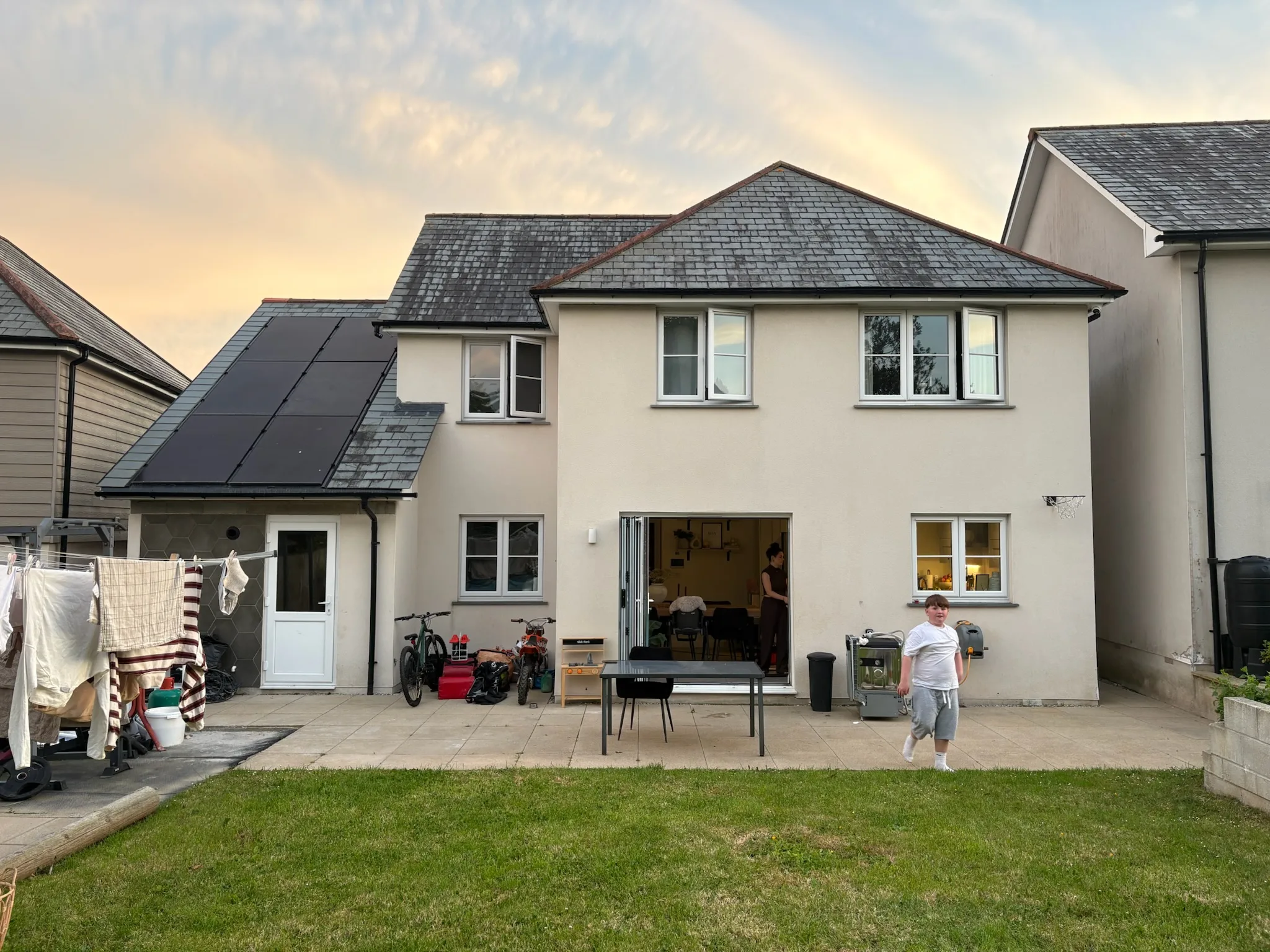
SolarEdge Solar System in Penryn
A SolarEdge solar installation for a property extension in Penryn, combining GSE flush-mounted and on-roof panels across two roof orientations, with battery-ready infrastructure, remotely controlled water heating and EV charging from excess solar generation.
A customer in Penryn, Cornwall, was building an extension and wanted to make practical use of the additional roof area for solar panels. With electricity prices rising, the aim was to incorporate solar generation into the property while the extension work was under way.
The available installation area covered two differently facing roofs. The customer wanted a GSE flush-mounted solar system on the rear of the property and an on-roof system on the front. The project therefore needed an arrangement that could bring the two roof areas together within one coordinated solar installation.
The customer chose a SolarEdge system with optimisation fitted across all the panels. A SolarEdge Home Hub inverter provided a battery-ready foundation, while a SolarEdge immersion heater and SolarEdge car charger allowed excess solar generation to be directed towards hot water or the customer’s new electric car. These priorities could be managed remotely through the SolarEdge app.
Using the new extension roof area
The extension created new roof space that the customer wanted to use rather than leave unproductive. Solar was considered as part of the wider building work, with the panel layout divided between the rear and front roof areas.
At the rear of the property, the customer specified a GSE flush-mount system. This type of arrangement integrates the panels into the roof area rather than mounting them entirely above the finished roof covering. The installation photographs show the mounting trays, roof membrane, timber battens and solar cabling during this stage of the work, as well as the panels positioned on the completed roof area.
For the front of the property, the requirement was for an on-roof system. Mounting rails and brackets were used to support the panels above the roof covering. This approach suited the customer’s requested arrangement and allowed both the front and rear roof areas to contribute to the same SolarEdge system.
Solar generation across two roof orientations
One of the main technical considerations was that the panels were split across two roofs facing in different directions. The customer invested in SolarEdge optimisation on every panel so that the two roof areas could operate as part of the overall installation.
Panel-level optimisation was particularly relevant to the layout because the arrays were not all positioned on one uniform roof plane. The SolarEdge equipment provided a coordinated way to manage generation from the separate roof areas without treating the property as though it had only one orientation.
The resulting arrangement reflected the building itself: a flush-mounted array on the rear roof and an on-roof array on the front. This retained the customer’s preferred mounting methods while making use of the available roof space created by the extension.
A battery-ready SolarEdge Home Hub system
The installation was based around a SolarEdge Home Hub inverter. The customer wanted the solar work to support the property’s immediate needs while also leaving a straightforward route towards energy storage later.
The Home Hub system is battery ready, so storage can be added when the customer has finished the extension and decides the time is right. This meant the customer did not have to add a battery during the building work simply to keep that option available.
Planning for storage at this stage was important to the customer’s longer-term approach. The solar installation could be put in place as part of the extension project, while the decision about when to add a battery could remain separate. No battery performance, capacity or future installation date was assumed as part of the work described here.
Using excess solar for hot water
In addition to the roof-mounted panels and Home Hub inverter, the customer invested in a SolarEdge immersion heater. This gave the property another way to use available solar generation by sending excess energy to heat the hot water.
The immersion heater could be controlled remotely, allowing the customer to manage this function without needing to operate it directly at the equipment. When excess solar was available and hot-water heating had been selected as the preferred use, that energy could be directed to the immersion heater.
This formed part of a wider approach to using solar electricity within the property. Rather than considering only the generation from the roof, the customer also considered where available excess energy could be used.
SolarEdge charging for the customer’s electric car
The customer had also invested in a new electric car and chose a SolarEdge car charger as part of the system. The charger could use excess solar generation to charge the vehicle, subject to the priorities selected by the customer.
Those priorities could be set through the SolarEdge app. Depending on the customer’s chosen settings, excess solar could be directed towards heating hot water or charging the electric car. This gave the customer control over which connected load should take priority at a particular time.
The immersion heater and car charger therefore complemented the main solar installation without changing the core arrangement of the two roof arrays. Together, they provided practical options for using generation at the property, while the battery-ready inverter retained the possibility of adding storage at a later stage.
A coordinated solar installation for the Penryn property
This Penryn project brought several requirements together within one SolarEdge system. The customer wanted to use the roof space created by an extension, combine two differently facing roof areas and use two different panel-mounting methods. The rear required a GSE flush-mounted installation, while the front required an on-roof array.
SolarEdge optimisation was used across all panels to support the split-roof arrangement. The Home Hub inverter provided a battery-ready base, enabling the customer to consider adding storage after the extension was finished rather than making that decision immediately.
The remotely controlled SolarEdge immersion heater and SolarEdge car charger added two ways to use excess generation. Through the SolarEdge app, the customer could decide whether hot-water heating or charging the new electric car should take priority, depending on their requirements.
The project demonstrates a practical approach to residential solar and renewable electrical work in Penryn: making use of new roof space, selecting mounting systems for the different parts of the property and preparing the electrical system for possible future storage without assuming when that next stage will take place.
Solar and renewable electrical work in Cornwall
Maenporth Electrical Ltd is based at Maenporth and works across Falmouth, Penryn and the wider Cornwall area. The company undertakes solar and renewable installations alongside industrial electrical work, commercial electrical services, electrical testing, planned maintenance, EV charging and domestic electrical work.
For enquiries about solar systems, battery-ready infrastructure or EV charging, contact Maenporth Electrical Ltd on 01326 250297.