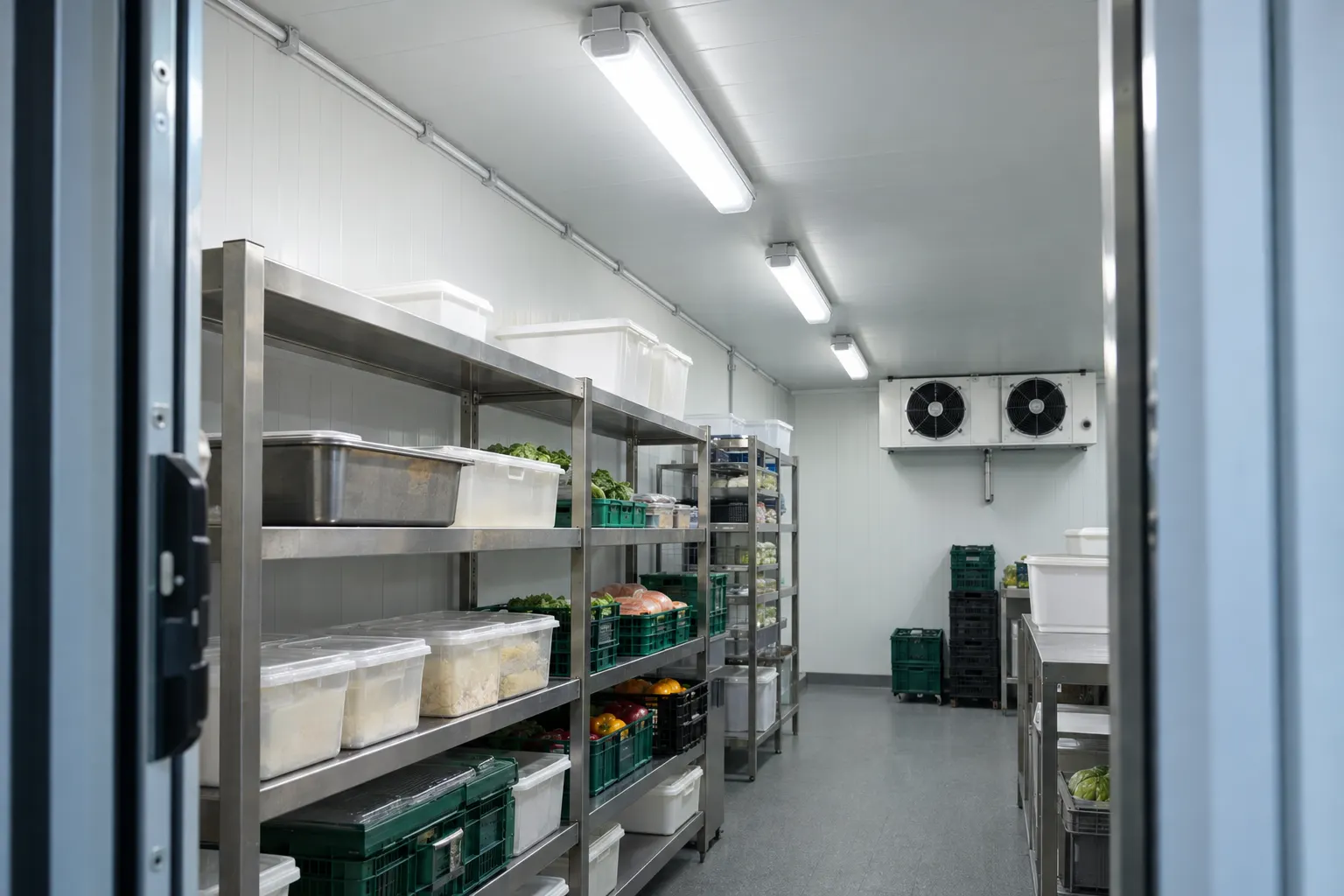
A sealed LED fitting is not automatically suitable for a freezer. Cold room lighting must match the temperatures it will encounter, the cleaning regime and the work people need to see. Brightness and an IP rating are only part of that decision.
For site and facilities managers, the useful starting point is a room-by-room specification. A chilled store, a commercial freezer and a wet preparation area may need different solutions, even when they sit beside one another.
What the lighting and hygiene rules actually require
The food-hygiene requirements for premises call for adequate natural and/or artificial lighting. In rooms where food is prepared, treated or processed, overhead fixtures must also be constructed and finished to prevent dirt accumulation and reduce condensation, undesirable mould growth and particle shedding.
Regulation 8 of the Workplace (Health, Safety and Welfare) Regulations requires suitable and sufficient lighting for workplaces within scope. HSE's L24 guidance relates this to working and moving safely.
The food-hygiene provisions do not prescribe one universal IP rating, lux level, impact rating or shatter-resistant fitting. Selection still needs a room-specific assessment.
Separate chilled rooms, freezers and wet processing areas
Record how each space operates rather than applying one specification throughout the building.
- Chilled storage: record the operating temperature and whether food is packaged or exposed. Note condensation associated with door openings or changes in use.
- Commercial freezers: identify the lowest ambient temperature, any defrost cycle and the conditions a fitting must start and operate in.
- Wet processing: describe exposed-food locations, preparation tasks and moisture or splashing during production.
- Routine wash-down: record the actual cleaning process, including chemicals, water temperature and whether jets reach the fittings.
One room may fall into more than one group. Cold storage lighting should therefore be specified room by room, not copied from a neighbouring corridor or preparation area.
Match the complete fitting to temperature and cleaning
Low-temperature operation
Record more than the thermostat setting. Tell the designer about the lowest expected temperature, changes during defrost or shutdown, and whether the lights will be switched on while the room is already cold. The proposed equipment needs checking against those actual conditions, not a generic freezer description.
For commercial freezer lighting, request the manufacturer's data for the exact model and configuration. The ambient limits of low-temperature LED luminaires are model-specific. Check the complete assembly, including the driver, controls and any emergency version, against the room's operating and starting conditions.
Do not assume that adding a sensor or choosing an emergency variant leaves the temperature rating unchanged. Ask for any limitations to be made clear in the proposal.
Cleaning exposure
For wash-down-area lighting, provide the cleaning chemicals, concentrations, contact times, water temperature and spray or jet exposure. The manufacturer should confirm compatibility with that regime, not just supply a general description such as waterproof.
A fitting outside the direct spray path still needs its exposure assessed. Check the method used by the cleaning team, including occasional deep cleans, rather than relying only on the room's everyday appearance.
When discussing commercial lighting services, ask for the proposed models and their environmental limits to be recorded against each room.
Assess hygiene, ingress, impact and visibility separately
BS EN 60529 classifies enclosure protection against access to hazardous parts and ingress of solids and water. An IP rating does not, by itself, establish low-temperature operation, chemical compatibility, suitability for a particular wash-down regime or acceptable lighting performance.
Separately, consider cleanable surfaces, dirt traps and the consequences of damage above exposed food. Decide whether impact protection or measures to contain fragments are needed through the site's food-safety and damage-risk assessments. Protection from water, protection from knocks and hygienic construction are different questions.
Consider the whole installed arrangement, including mounting brackets and cable entries, when assessing cleanability. A smooth fitting can still be poorly placed if the surrounding arrangement is difficult for the site's cleaning team to reach.
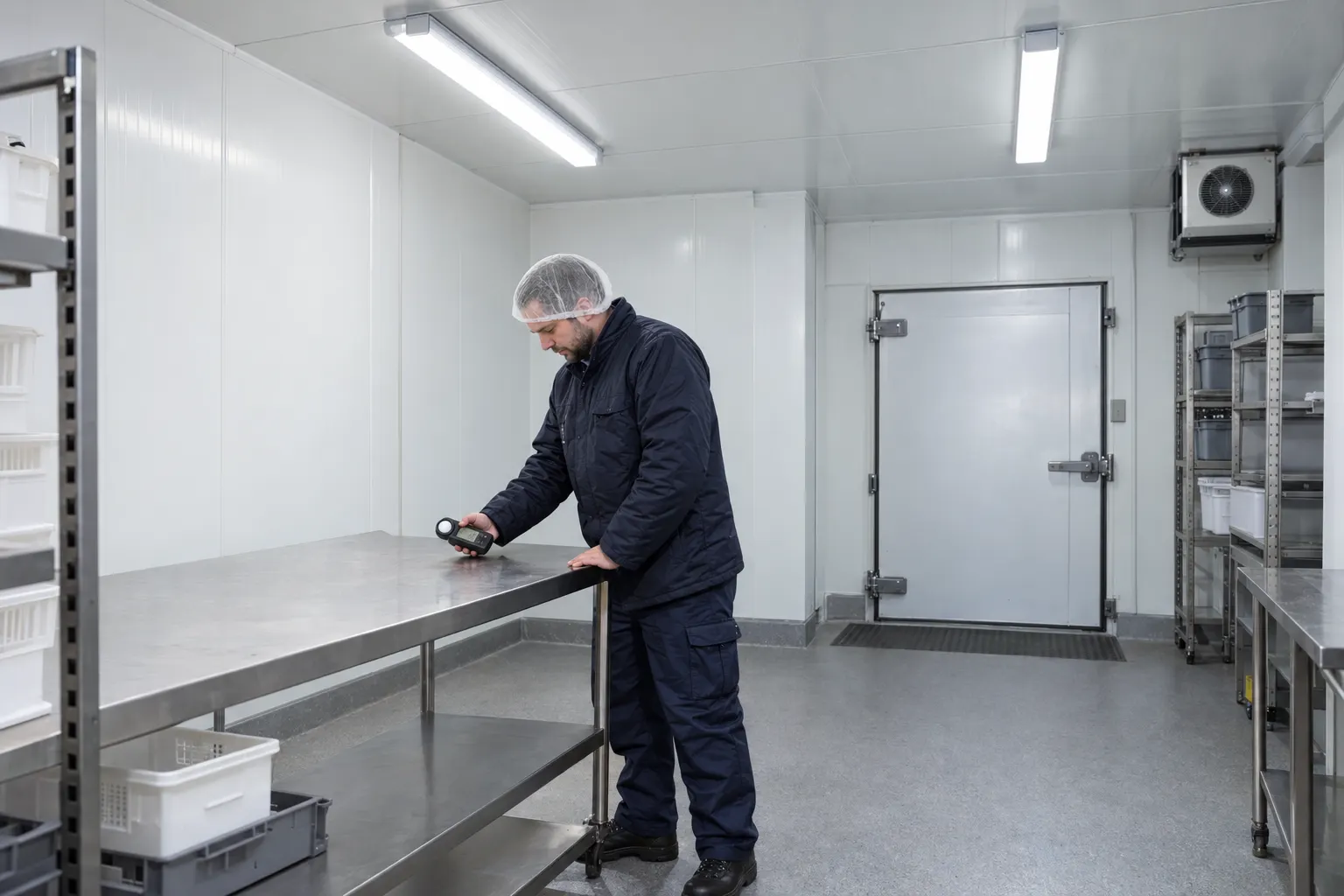
Food-processing lighting must also let people see the task clearly. Identify whether staff need to read vertical shelf labels, check packaging on a bench or inspect prepared food. These are different viewing positions, so a layout that looks adequate at floor level may not resolve the actual difficulty.
Pallets and racking can obstruct light, while reflective surfaces can cause glare. Assess shelf faces, benches and routes in the expected stocked layout, rather than judging brightness from the doorway. Include photographs of existing problem positions in the brief.
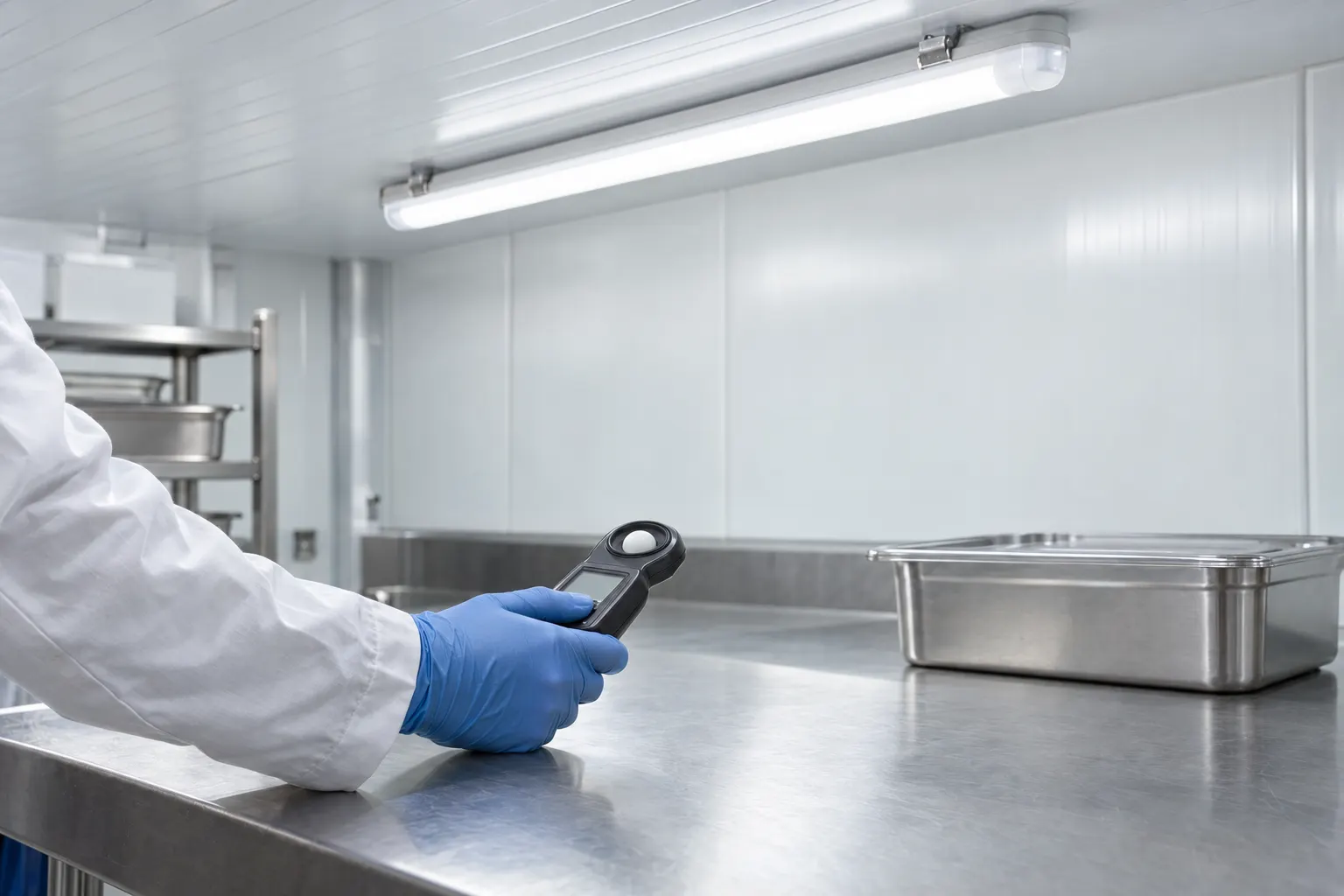
Ask for the proposed light levels and distribution at those working positions, with racking and other obstructions allowed for. SLL Lighting Guide 19 covers cold, freezing and wash-down environments, including light levels, uniformity and glare. It is professional design guidance, not legislation.
Plan maintenance around access and food operations
Before installation, agree how fittings will be reached, cleaned and replaced. Racking, stored goods and production routines can make an otherwise straightforward lighting fault disruptive. Establish whether work needs stock relocation or a planned shutdown and who will protect exposed food.
Choose a cleaning and inspection approach consistent with the manufacturer's instructions and the site's hygiene procedures. Record fitting models, environmental ratings and replacement information so that a later substitution does not quietly remove the original temperature or cleaning suitability.
Ask how replacement drivers, covers or complete fittings will be obtained, and what a failure would mean for room use. That makes availability and access part of the purchasing decision, not an afterthought.
A planned electrical maintenance arrangement can include lighting condition checks and access planning alongside other site electrical work. Agree what staff should report, such as flickering, moisture inside a fitting, damaged covers or persistent shadows. Electrical investigation and replacement belong with competent people, not improvised repairs during cleaning.
Prepare a useful brief before requesting a lighting proposal
Give your contractor information that allows room-specific selection, rather than simply asking for replacement cold room light fittings. A useful brief includes:
- Room use: storage, freezing, preparation or processing, with packaged and exposed-food areas identified.
- Temperature: normal operation, lowest expected ambient and relevant defrost or other temperature changes.
- Cleaning: method, frequency, chemical details and exposure of fittings to water or jets.
- Layout: room dimensions, ceiling height, racking, workstations and access routes.
- Visual tasks: what staff need to read, handle or inspect, including existing glare or shadow problems.
- Equipment requirements: any controls or emergency-lighting provision that must be considered.
- Access and timing: stock movements, hygiene restrictions and available maintenance windows.
- Existing information: fitting details, relevant drawings and photographs taken safely from normal access positions.
Ask for a room-by-room schedule of fittings, the supporting manufacturer information, the lighting design assumptions and the access plan. This gives everyone a clear basis for agreeing the work before equipment is ordered.
Discuss your site's lighting requirements
For help planning commercial lighting, call Maenporth Electrical Ltd on 01326 250297. Based at Maenporth, we serve Falmouth, Penryn and wider Cornwall. Have your room temperatures, cleaning details and layout ready so the discussion starts with the actual site conditions.