
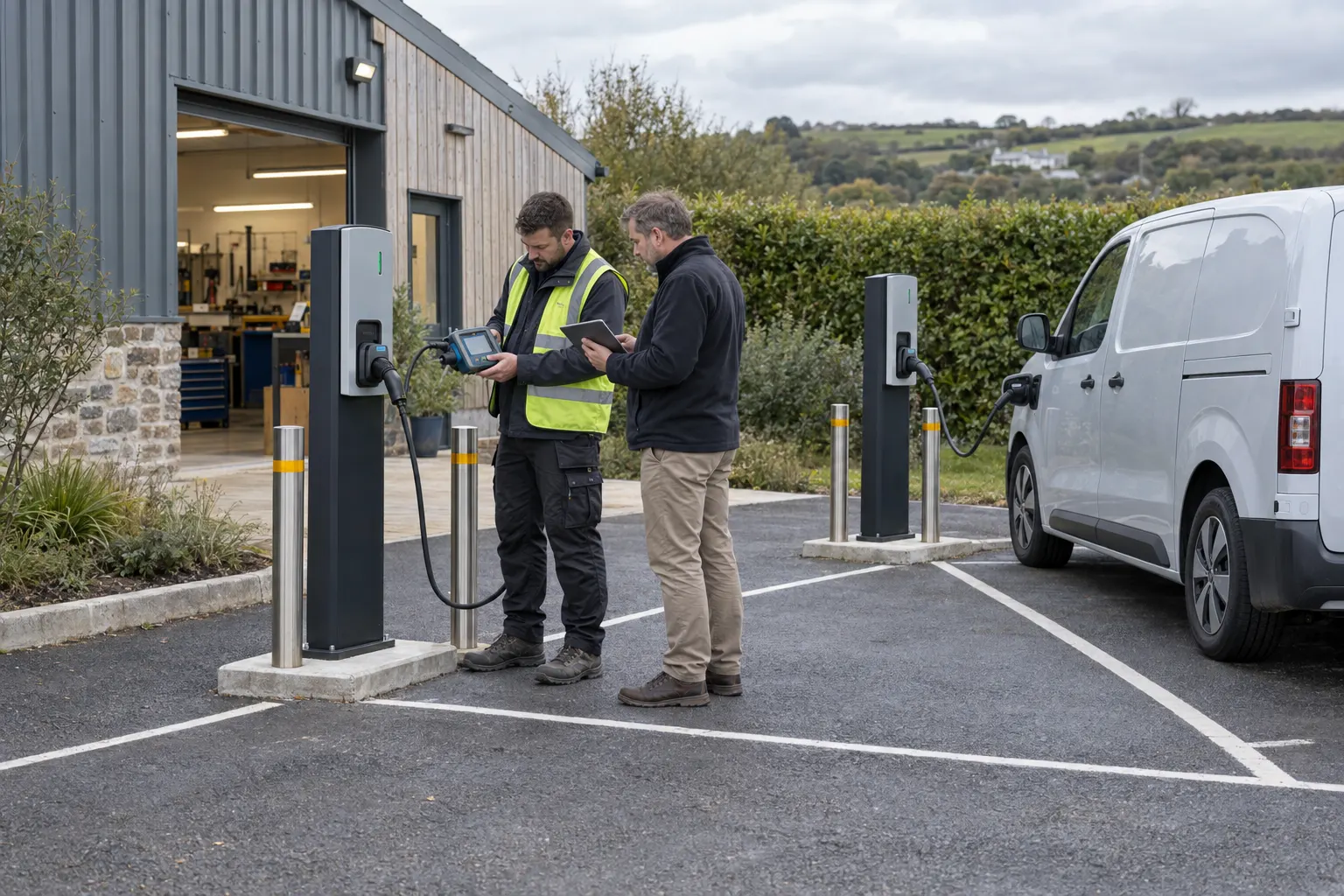
Commercial EV charger maintenance needs more than a date in the diary. A site manager needs to know what will be checked, who handles faults and why the next inspection is due at a particular interval.
There is no blanket rule that every workplace charger must have an annual service. A useful plan combines manufacturer guidance, actual site conditions and previous findings. For factories, holiday parks, leisure facilities and larger rural premises, it also needs to account for access and downtime.
What commercial EV charger maintenance covers
Depending on the equipment and manufacturer’s instructions, commercial EV charger servicing may cover the condition of the enclosure, mounting, cables and connectors, alongside appropriate functional checks and testing by a competent person.
The aim is to identify and address deterioration and defects that could create danger, as well as problems affecting service. A successful charging session or an app showing ‘online’ is not a substitute for appropriate maintenance.
Agree what happens if faults are found. Inspection, diagnosis and repair may be separate parts of the scope, so a quote for a ‘service’ should explain its limits and how further work is authorised.
Why there is no universal annual service interval
HSE’s electrical equipment maintenance guidance says the type and frequency of checks and testing depend on the equipment, its environment and the results of previous checks. The Electricity at Work Regulations require systems to be maintained, so far as reasonably practicable, to prevent danger.
That does not create a universal annual EV charger servicing requirement. An annual visit may be appropriate for a particular site, but it should be a considered choice rather than an assumed legal deadline.
Check manufacturer instructions, warranty conditions and service agreements separately. Requirements under those arrangements are not the same as a universal statutory interval, but they still need consideration when agreeing the schedule.
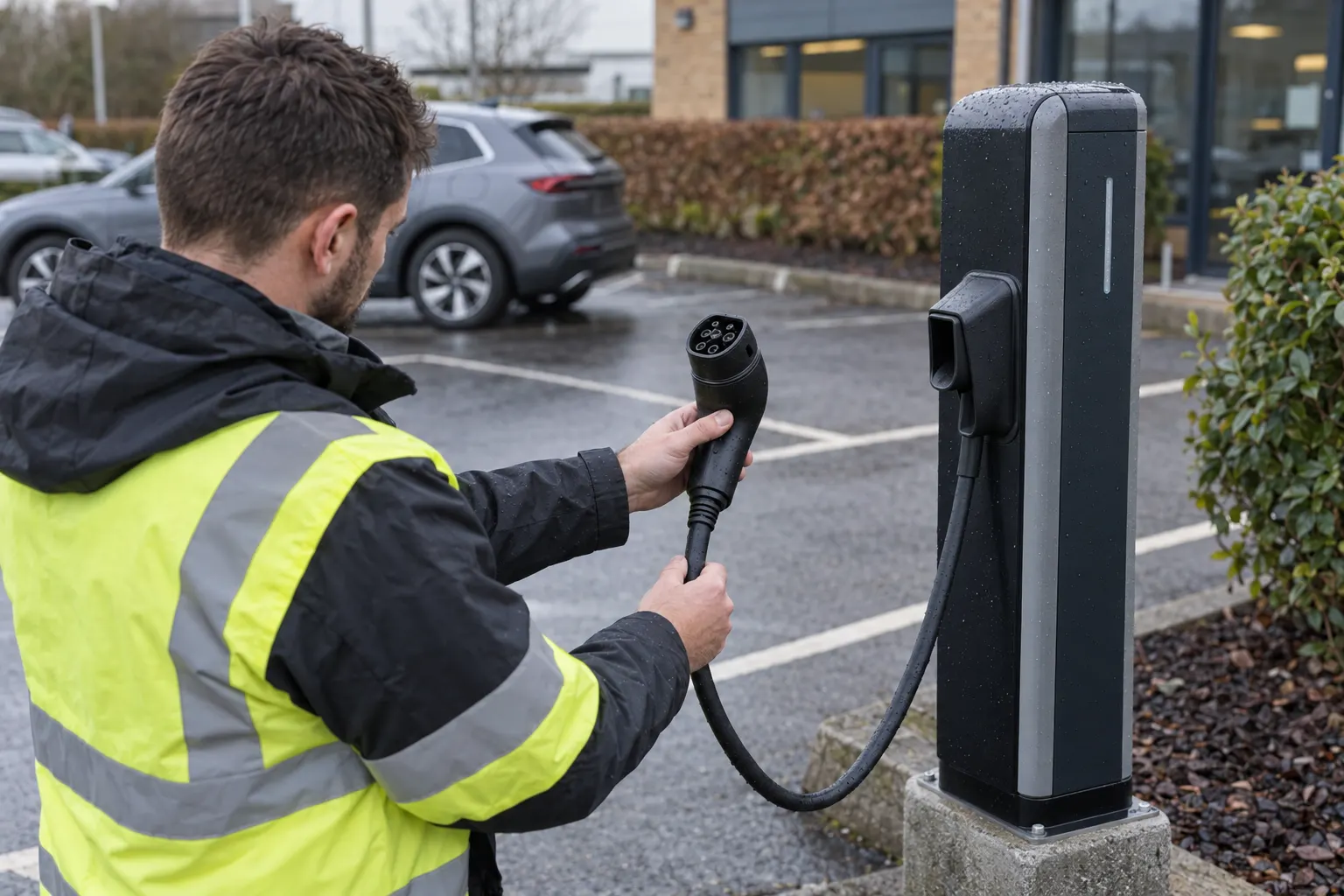
Build a schedule around the charger and its surroundings
Set an EV chargepoint maintenance schedule for each unit or a genuinely comparable group. Chargers installed on the same day may face different use and exposure.
A risk-based schedule is a timetable you can explain using equipment and site evidence. It may include different activities at different intervals, rather than one annual visit intended to cover everything.
Discuss these factors with the person planning the maintenance:
- Manufacturer guidance. Use the instructions for the actual make and model. A generic charger checklist is not a substitute for equipment-specific advice.
- Usage. Workplace EV charger maintenance should reflect how often equipment is used and handled. At visitor sites, consider seasonal demand and changes in use.
- Environment. Assess foreseeable vehicle impact, weather, wet conditions, dust and any corrosive exposure actually present. Do not rely on a postcode as a risk assessment.
- History. Review previous findings, recurring faults and reported damage. A pattern of deterioration is a reason to reconsider the arrangement, not simply repeat it.
Revisit the plan when the site changes. More staff charging, a new parking layout or heavier vehicle movements nearby can alter the assumptions behind the original schedule, even if the chargers themselves have not changed.
For Cornwall sites, an exposed holiday-park bay and a sheltered staff car park may need different approaches. Neither the county nor the sector automatically determines EV charger inspection frequency.
Agree an initial interval with competent advice, record the reasons and review it against findings. Keep a route for reporting faults between visits; the next appointment is not a reason to leave a new defect unassessed.
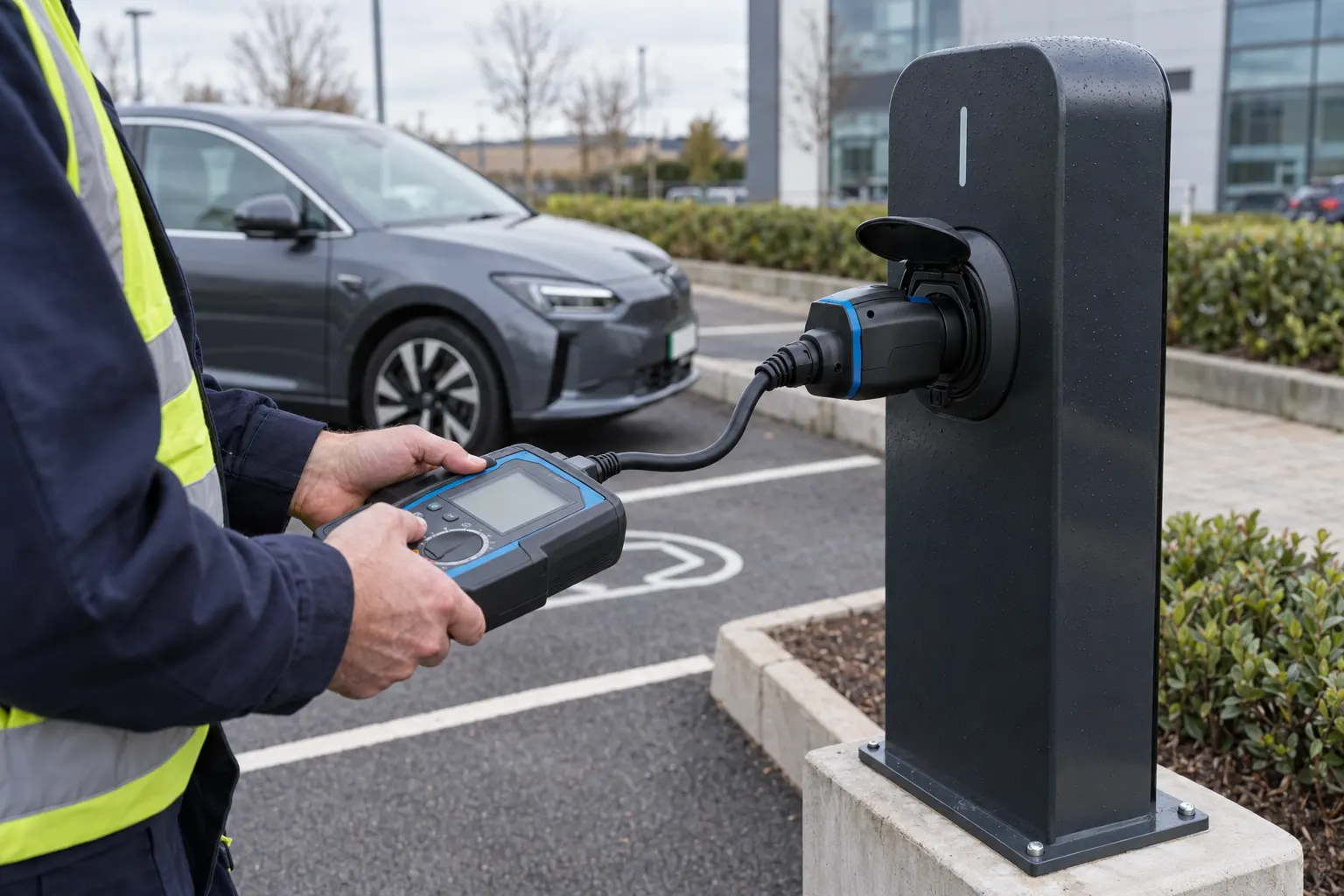
Keep three maintenance scopes distinct
Planned maintenance for EV charging equipment can involve three separate services. One booking does not automatically cover all of them.
The charger itself
Confirm which hardware inspections and functional checks are included and whether repairs or replacement parts are separate. Tell the provider the make and model before booking, so they can confirm their scope and any need for manufacturer support. Do not assume software access or manufacturer authorisation.
The fixed electrical installation
The circuit supplying the charger and its protective measures need appropriate inspection and testing arrangements. A charger service is not automatically a periodic inspection of the wider installation; an installation report is not automatically a complete charger service record.
Software and operator support
Connectivity, user accounts, payment services and remote diagnostics may sit with an operator or platform provider. Agree who receives reports and how an unresolved problem will be passed to the right specialist.
Being available remotely is not the same as being able to inspect or repair the electrical equipment on site.
Bring these scopes into the site’s wider planned electrical maintenance programme, while keeping their responsibilities and records clear.
What to record and agree before the next visit
A useful record follows the charger, not just the person who last booked a visit. Gather the information below before arranging work:
- Charger identification, location, make and model, plus available manuals.
- Previous service findings, relevant installation reports and outstanding actions.
- Fault dates, affected units and descriptions of lost service or damage.
- The site contact and details of any manufacturer or operator support.
- Access arrangements and the impact of taking chargers out of service.
Agree the scope in writing, including exclusions, reporting, who authorises repairs and who follows up defects. Ask whether the report will distinguish completed work from recommended work, and identify any restrictions on further use.
Confirm which units will be accessible and who can authorise any necessary downtime. If work cannot be completed, the report should make that clear rather than leaving a partial visit looking like a full service.
For a factory, access may need to fit shift operations; a holiday park may prefer work before its busiest season. Those are practical booking considerations, not reasons to postpone attention to suspected danger.
Afterwards, keep the findings, actions and reasoning behind the next review date together. Records help reveal recurring problems and assess whether maintenance is effective. They are a useful management tool, not a substitute for resolving outstanding defects.
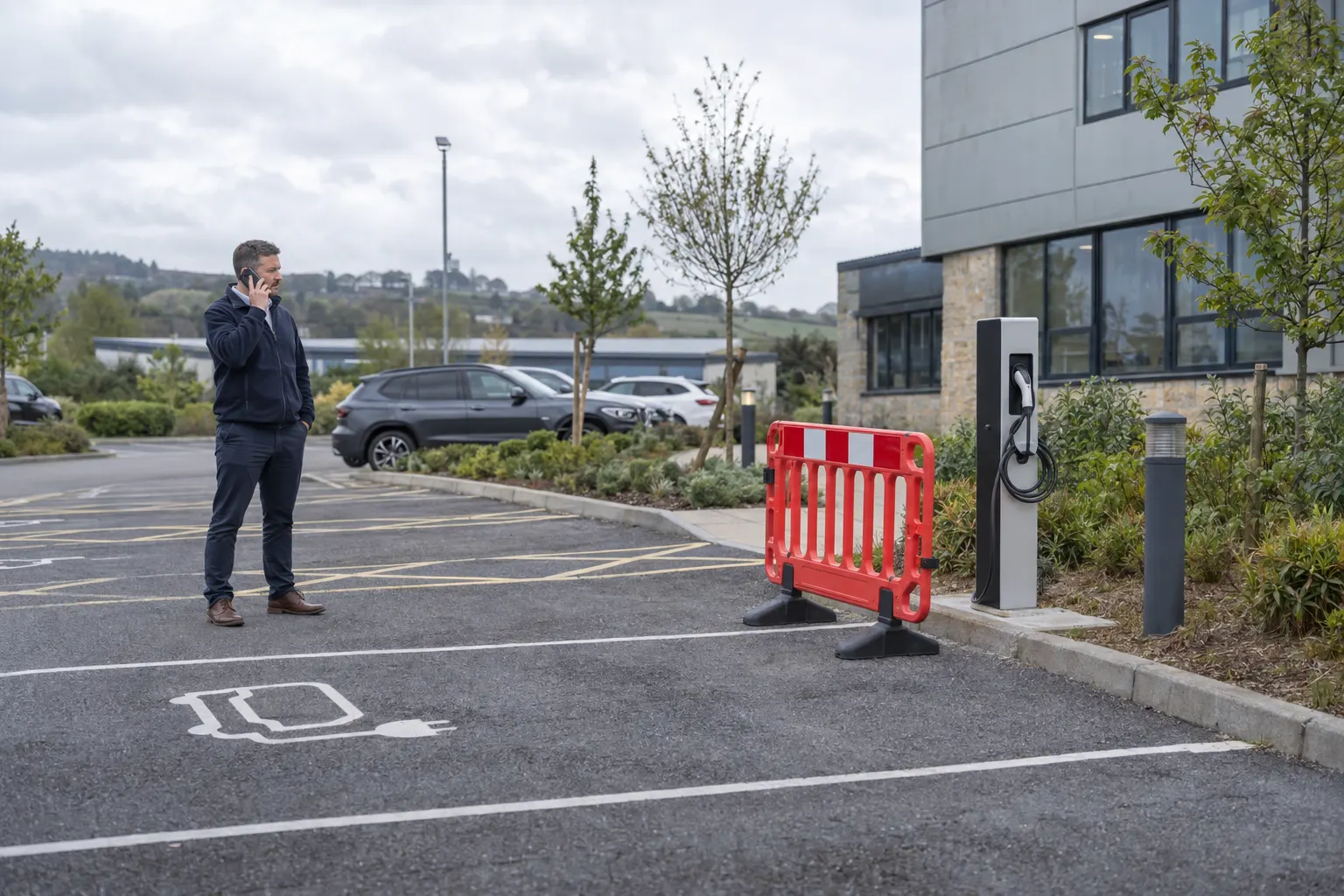
When to take a charger out of use
Visible cable or connector damage, a broken or loose enclosure, signs of overheating or repeated electrical tripping should not wait for the next booked service. Report the concern and arrange for the charger to be kept out of use through the site’s safety procedure.
Staff should report damage or loss of service, not remove covers, test equipment or attempt repairs or resets. Any necessary electrical isolation and assessment should be handled by a competent person.
A failed app session is different from obvious physical damage, but persistent problems still need the correct support. Agree whether a report goes first to the operator or to a contractor for electrical fault finding, with suspected electrical danger referred promptly to competent help.
Maenporth Electrical Ltd is based at Maenporth and serves Falmouth, Penryn and wider Cornwall. To discuss your site’s EV charging and wider electrical maintenance needs, call 01326 250297.