
Plug-in solar for small businesses is attracting attention following Octopus Energy’s small-business offer announced on 16 November 2026. But a kit being marketed to businesses is not proof that it suits every commercial property.
The useful question is whether a small system can offset some daytime demand at your premises through a suitable connection route. Treat the product, network connection, electrical installation and likely savings as separate checks—not as one promise covered by the word plug-in.
What changed for plug-in solar in 2026?
The 2026 plug-in solar amendments came into force on 27 August 2026. They define qualifying solar-only plug-in microgenerators with a maximum rated AC output of 800W.
The business caveat is scope. The statutory definition is tied to domestic premises, while the government’s interim product specification describes single-phase equipment intended for a domestic environment. The government’s impact assessment considers possible small and micro-business use, but that is not blanket permission for commercial or industrial installations.
Household buyer checklists can flag useful questions, but cannot settle a commercial site’s legal or electrical position.
The route excludes systems designed to store imported electricity for later supply. Do not assume a plug-in battery or hybrid package is included, or treat ordinary plug-in solar as power-cut backup.
What the 800W AC limit means
An 800W AC plug-in solar kit is defined by its maximum rated AC output, not simply by the wattage printed on its panels. The interim specification separately sets maximum mains output at 800VA and 3.5A, while allowing PV-module DC capacity up to 2,000W.
These are distinct ratings. Extra panel capacity does not raise the permitted AC ceiling. Actual production depends on sunlight, shade and operating conditions; 800W is neither a continuous supply nor an annual generation figure.
For scale, output at 800W for one hour would equal 0.8kWh. That is an illustration of power versus energy, not a generation forecast or a basis for estimating annual savings.
Where plug-in solar may fit a small business
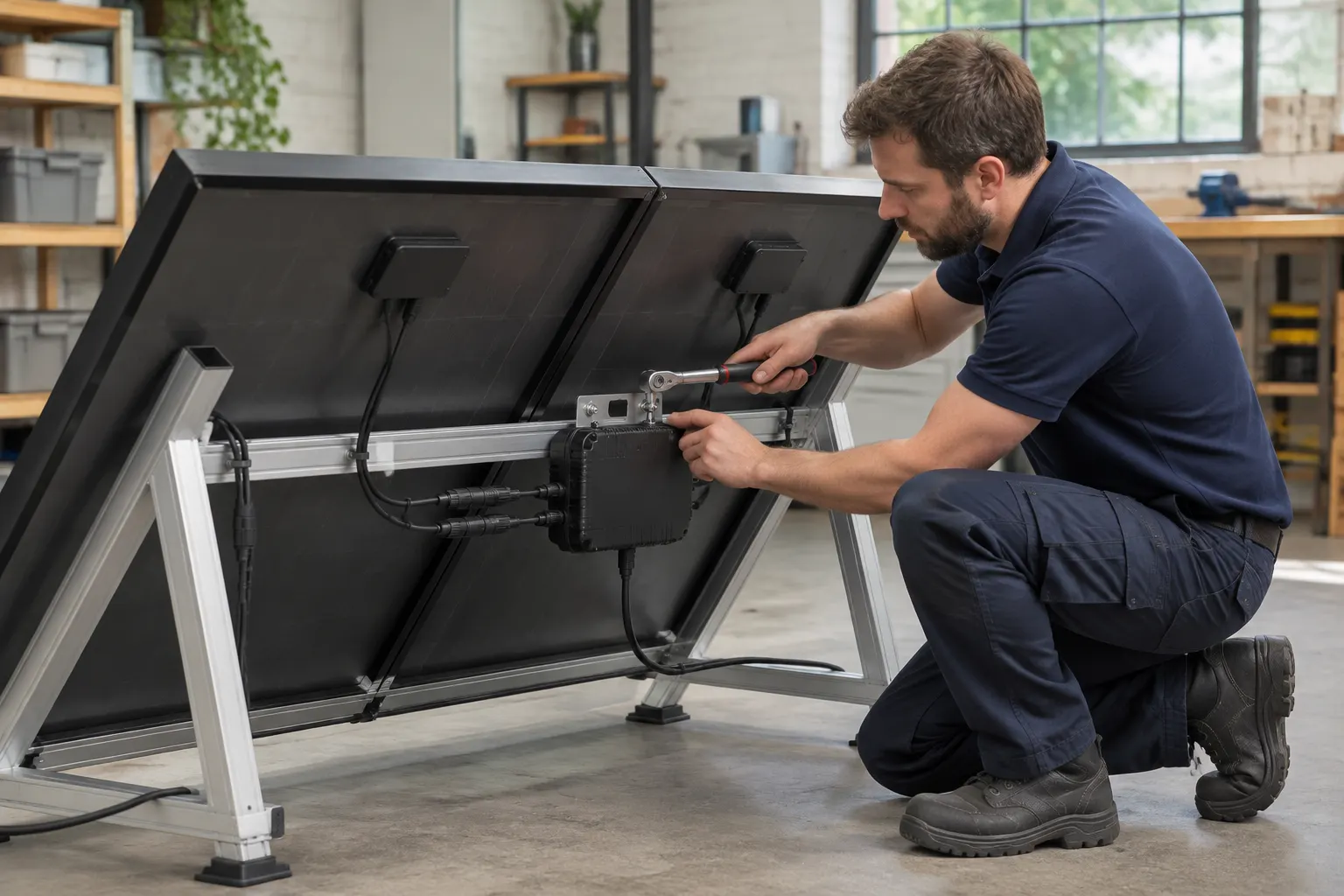
Potential users include premises with modest, regular daylight demand, such as a small office or a reception building’s background load. Suitability still depends on the product and premises meeting the applicable conditions.
Look at demand remaining after any existing solar generation, not just total electricity use. A large annual bill does not prove you have unserved demand at lunchtime. An intermittently used unit or a business mainly open after dark needs a different assessment.
This is a different proposition from supplying a quarry process, factory machinery, commercial kitchen or a holiday park’s whole electrical demand. It should not be treated as a solution for operational continuity.
For larger daytime demand, compare the limited plug-in format with a site-designed system through our solar PV services. Start with the electrical load you need to serve rather than the easiest product to buy.
Check the product and the G98 connection route
Before buying commercial plug-in solar panels, obtain the exact model’s documentation and intended-use conditions. Confirm with the supplier and relevant distribution network operator (DNO) that the product and premises can use the applicable route.
Keep model details, compliance information and the manufacturer’s instructions together, so the contractor and network operator assess the same equipment—not a generic product category or an advert for a similar kit.
The current G98 plug-in solar provisions, A1 Issue 2, allow one plug-in microgenerator of 800W or less per customer installation. That does not mean one per socket, room or outbuilding.
DNO notification is mandatory. Before connection, confirm the network operator’s current procedure and timing, agree who will submit the notification and retain the paperwork. Do not assume a retailer handles it for you.
If the site already has solar
Existing permanently wired generation must be considered against the aggregate 16A-per-phase limit. A plug-in kit is not an automatic extra allowance above an existing commercial PV system.
On shared, multi-meter or three-phase sites, ask the DNO how the proposed connection should be assessed. Do not assume separate buildings or meters create separate allowances.
Check the premises, not just the socket
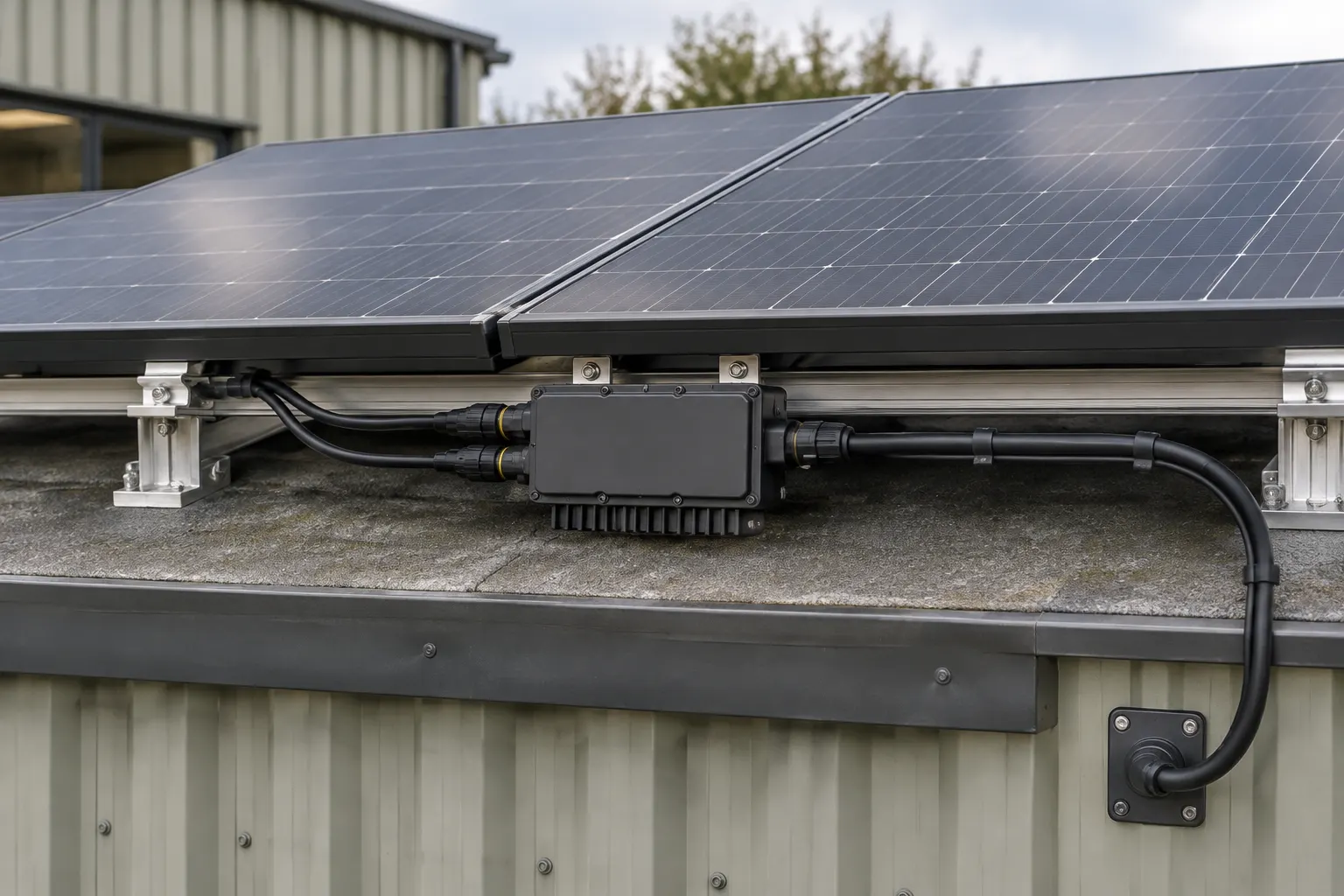
An accessible socket does not establish whether plug-in solar for business premises is electrically suitable. Have a competent electrical contractor assess the relevant installation, including the circuit, protective arrangements and socket condition.
An existing electrical report is useful background, but it is not confirmation that a new generator can be connected. The assessment needs to address the proposed equipment and connection.
Where condition or records are uncertain, our electrical testing and compliance services can help establish the starting point. A network-compliant generator does not, by itself, establish premises safety.
Before purchasing, also resolve:
- Owner or landlord permission, lease restrictions and insurance requirements.
- The planning position for the business property and proposed mounting.
- Positioning and cable protection that keep escape routes clear and account for staff, customers and vehicle movements.
- A connection arrangement without extension leads or multi-way adaptors, which the specification excludes.
Cornwall Council’s solar planning guidance describes domestic permitted-development routes. Do not assume that guidance grants permission for a business installation.
Mounting for Cornwall’s exposed conditions
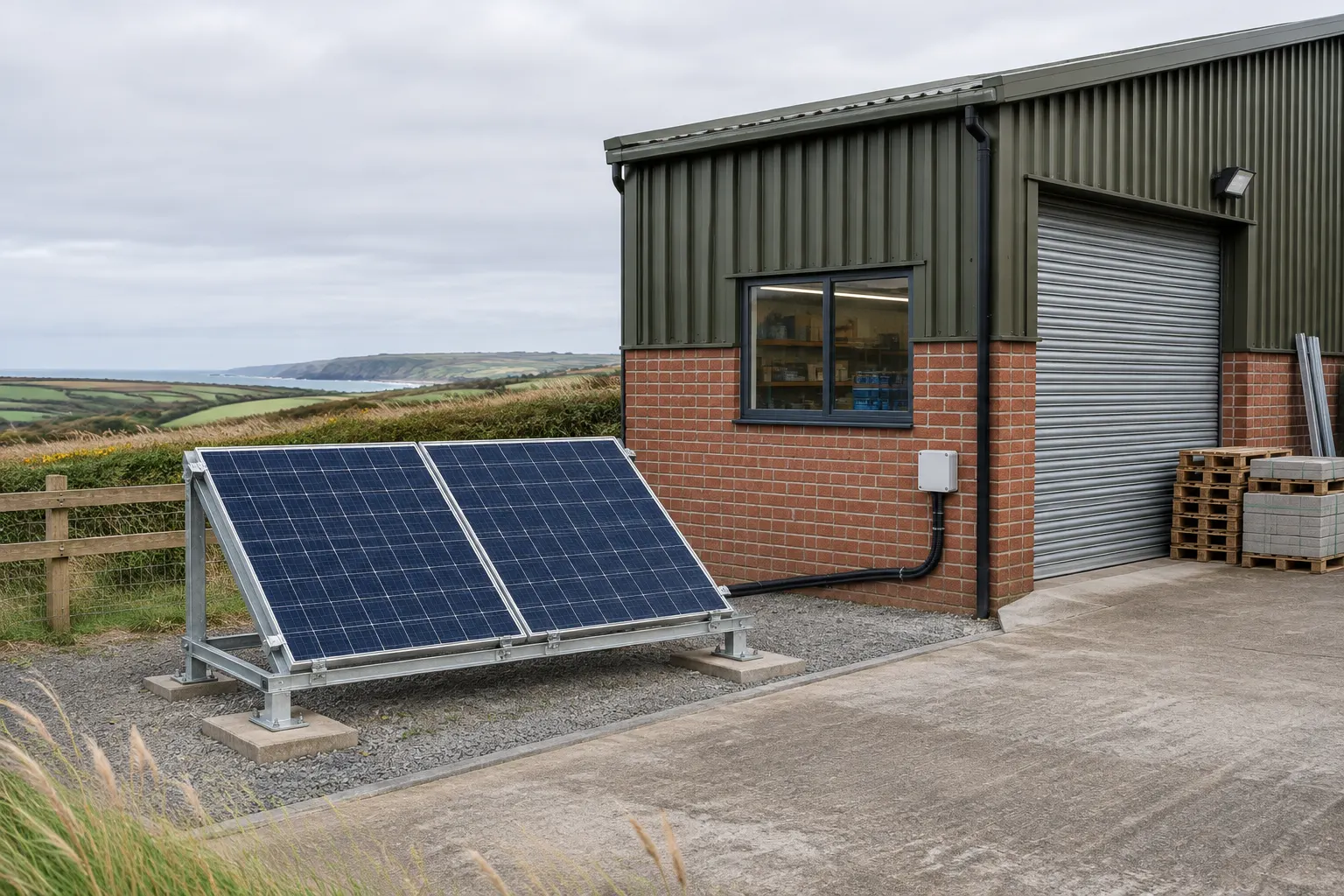
Read the manufacturer’s mounting instructions and stated wind, snow and applicable corrosion limits before committing to a location. The specification requires environmental limits to be declared; it does not make every kit suitable for every coastal or agricultural setting.
On an exposed Cornwall site, have the proposed supports and fixings checked against the product requirements, and flag salt-laden air or livestock-related exposure to the supplier. A weatherproof-looking enclosure is not evidence of marine suitability.
Outdoor components and socket-outlets must meet the specification’s ingress-protection requirements. Cable routing and protection from damage need assessment alongside the panels and mounting.
Do not assume the same kit can simply be moved from a sheltered courtyard to an exposed pitch. Re-check its declared conditions and the proposed mounting whenever the location changes.
Build a business case around usable generation
Start with actual daytime consumption, shade and available mounting space. Ask how much generation is likely to coincide with demand, including weekends and seasonal closures. Annual electricity totals alone cannot show that match.
For a seasonal reception or leisure business, use opening months and occupied hours rather than assuming one busy week represents the year. Ask whether quoted savings assume every unit generated is used on site.
Ask the quote to separate equipment from any mounting, electrical assessment and site-preparation work. If the contractor identifies socket or circuit work, include that cost before comparing options. A low kit price is not necessarily the whole project cost.
Compare the full purchase, assessment and site-preparation costs with a cautious estimate of avoided imports. Do not count on export income without checking applicable metering and payment arrangements, or treat supplier headline savings as typical.
If you are comparing small business solar panels, base the decision on connection suitability, usable generation and total cost—not panel wattage alone. Settle unresolved product, network or mounting questions before ordering.
For advice on solar PV and your premises’ electrical suitability, call Maenporth Electrical Ltd on 01326 250297. Based at Maenporth, we serve Falmouth, Penryn and wider Cornwall.