
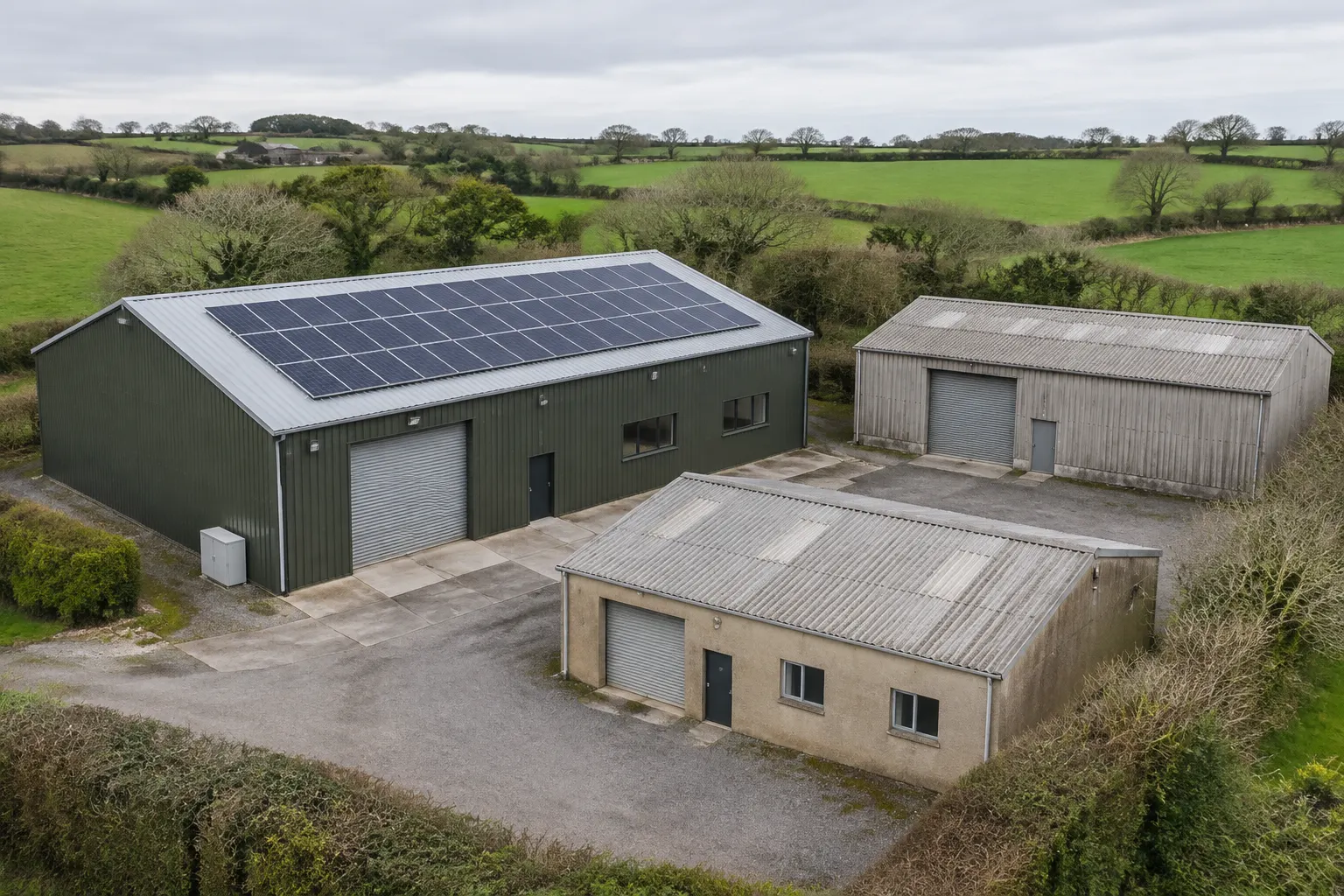
One solar PV array can often serve loads in several buildings. The deciding factor is not how close the roofs are, but how the buildings are electrically connected, metered and occupied.
Planning commercial solar across multiple buildings therefore starts with the supply arrangement, not the panel count. A factory with several buildings behind one electricity supply presents a different problem from a rural business park with separately supplied tenants.
For Cornwall’s larger commercial and rural sites, establishing that distinction early helps avoid designing an array around demand it cannot serve.
What does serving several buildings actually mean?
If several buildings share a suitable customer-side electrical network, roof-mounted or ground-mounted solar may offset imported electricity used across it. Panels do not necessarily need to be installed on every building.
Export from one supplier-metered building does not automatically cancel import at another. Sharing a landlord or electricity supplier does not join their networks. When comparing solar PV services, ask which loads the proposal will physically serve and where generation will connect.
A feasibility review can compare a shared array with separate building-level installations where appropriate. The cheapest panel location is not necessarily the lowest-cost way to supply the required loads.
Start with the supply and metering boundaries
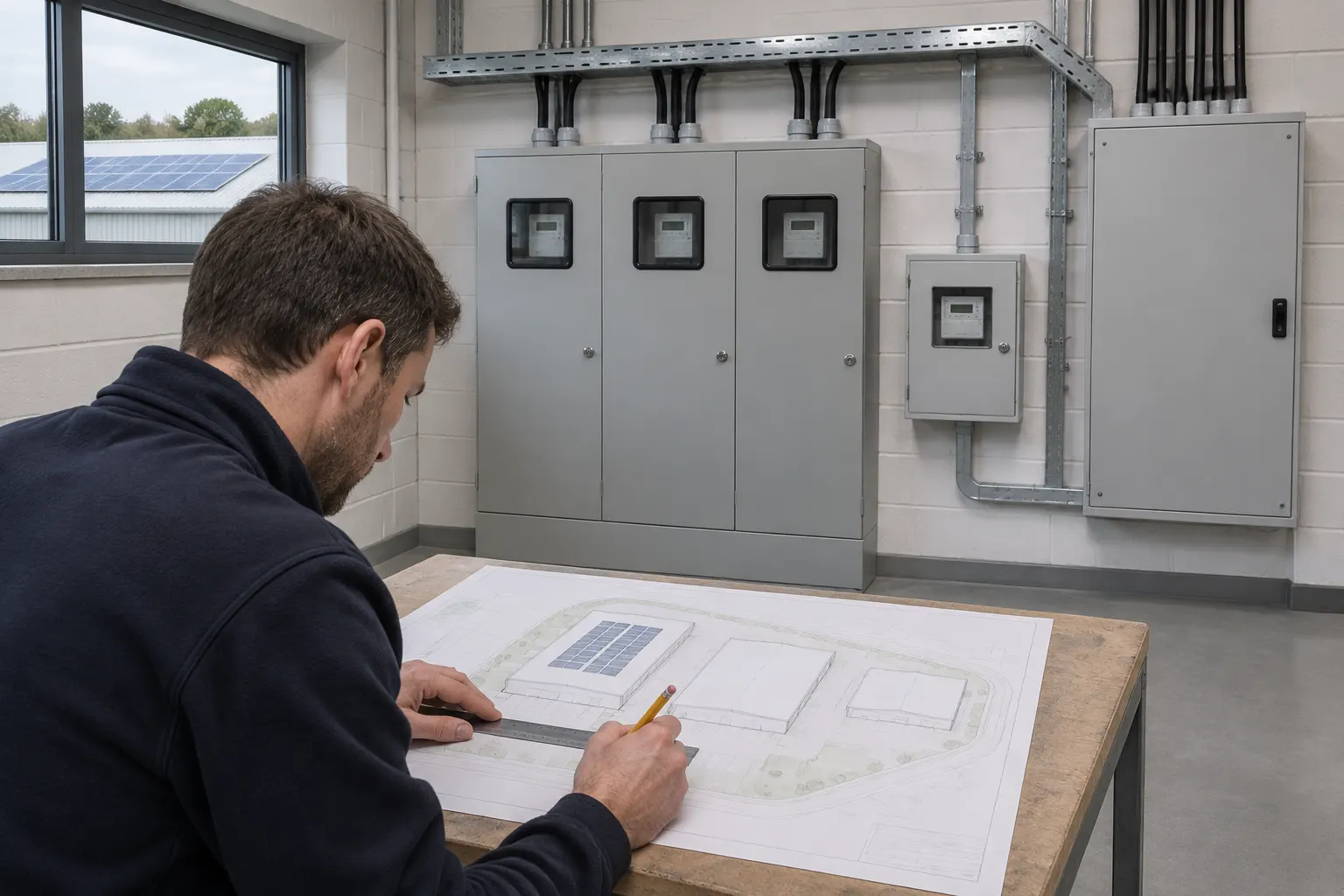
Start with a supply sketch based on existing records. Distinguish the public network, the site’s distribution and any private submeters.
Buildings on one customer-side network
Establish which distribution boards feed each building and whether the existing network can accommodate generation. A meter in each building may be a site submeter rather than a separate electricity supplier’s meter, so counting meters alone is not enough.
Different occupiers can still introduce supply and contractual questions, even behind one incoming connection.
Buildings with separate supplies
Can solar power another building with its own supply? Potentially, but the connection needs a specific design. It is not a matter of simply linking the buildings’ existing circuits. Identify the intended connection points, separate occupiers and equipment ownership before agreeing an array size.
When a private wire is part of the design
A private wire is a direct cable linking generation to a nearby consumer. Private-wire solar for businesses may involve a new route between buildings or sites, but it is not a shortcut around supply rules.
Assess the arrangement rather than relying on the label. Common ownership or a shared site boundary does not automatically settle licensing, lease or contractual issues.
The government guidance on electricity licence exemptions explains why the specific exemption and its conditions need checking. Private network operators must still comply with the Electricity Safety, Quality and Continuity Regulations. For complex or multi-occupier arrangements, obtain specialist legal and energy-market advice alongside electrical design.
Match output to demand in each building
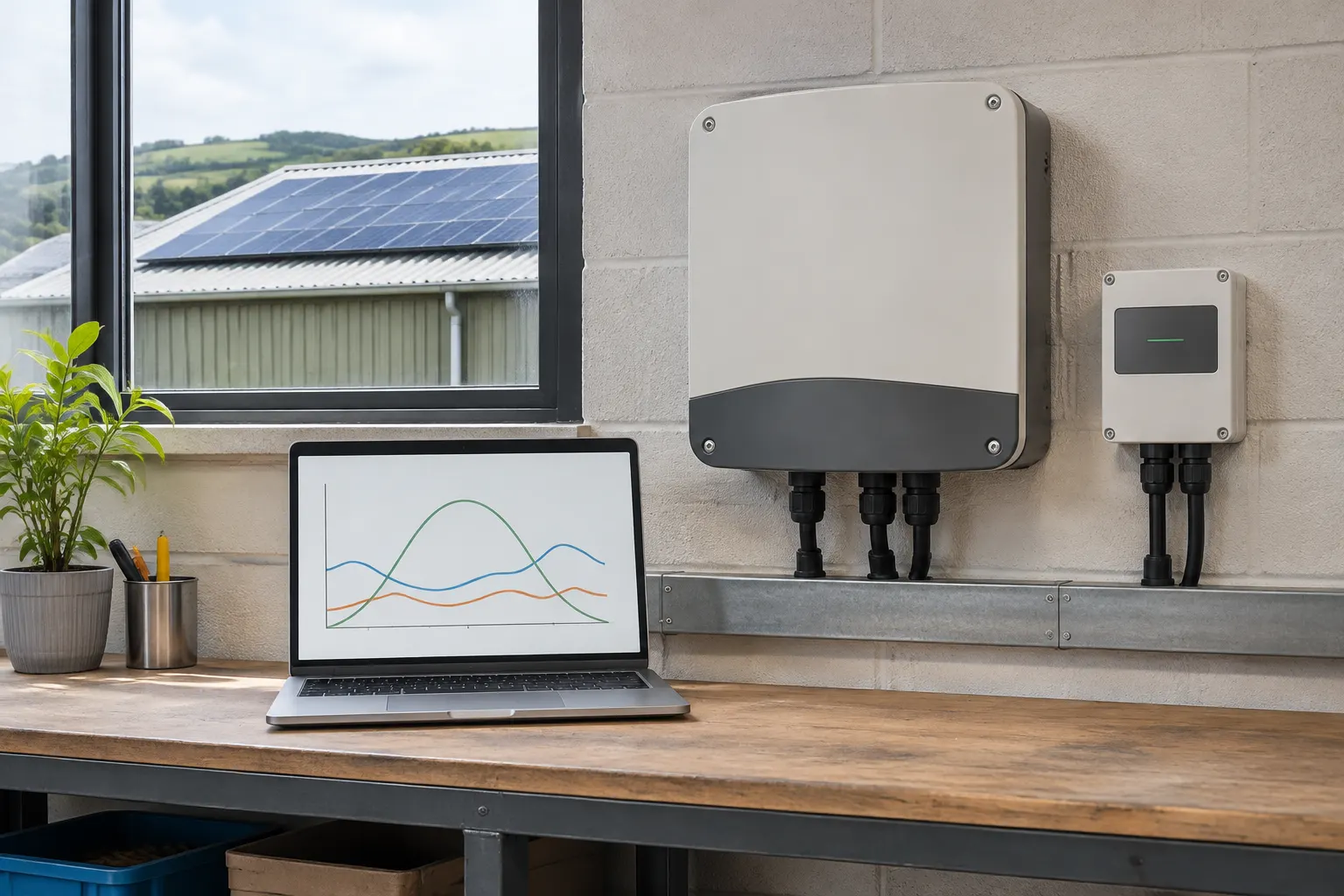
Designing solar for multi-building sites means looking beyond the combined annual bill. Review demand for the intended buildings against expected generation, ideally using half-hourly consumption data where available.
A workshop operating on weekdays and a leisure building with evening demand offer different opportunities. Seasonal occupancy can also change how much generation a holiday park uses at the time it is produced.
Only count another building’s demand once the proposed connection and commercial arrangement make it accessible. Where building-level data are missing, the designer should identify any monitoring needed rather than assume equal usage.
Check the cable route and distribution equipment
The shortest line on a plan may not be the most practical route. Roads, buried services, third-party land, access restrictions and future development can all affect feasibility and cost.
An electrical survey should assess distribution capacity, voltage drop, protection, isolation, earthing and existing switchgear. It should also establish how equipment can be safely isolated for maintenance and how access will be retained.
Include this work in the scope of the commercial electrical services being specified, rather than treating the cross-building connection as a minor addition to the panel installation.
Include cable losses and the work needed at both ends in the financial comparison. Excavation, reinstatement, service crossings and any planned shutdowns should be visible in the scope, rather than left as assumptions to resolve after the PV equipment is chosen.
The DNO still needs to assess the connection
A private wire does not bypass the connection process with the distribution network operator (DNO), permit unrestricted export or guarantee that reinforcement will be unnecessary. The commercial solar electrical connection and export arrangements need their own assessment.
Confirm the site’s DNO by postcode. National Grid Electricity Distribution’s guidance says G99 may apply to generation or storage above 16 A per phase, or where G98 requirements are not met. For inverter-connected PV, it identifies the inverter’s continuous steady-state AC output as the relevant rating, not simply the panels’ total DC capacity.
The applicable route depends on the actual installation, including existing generation or storage. A proposed export limit does not replace that assessment.
Separate owners or occupiers change the agreement
Technical feasibility does not settle the commercial terms of a private-wire power supply. Establish who owns the array, cable and meters; who buys the electricity; and who is responsible for faults, maintenance and access.
Agree how consumption will be measured and charged, how losses are treated and what happens when a building is empty, a tenant leaves or equipment needs replacing. Leases and land rights must support the intended arrangement over its planned life.
If a single array relies heavily on one tenant’s daytime operation, test the business case with that demand reduced or absent. This exposes a commercial dependency that a whole-site annual total can hide.
Compare total installed and ongoing costs, including route works, metering, professional advice and maintenance, not just the quoted panel price. Any savings depend on actual use and the agreed terms.

Prepare this information before a feasibility review
A useful starting pack includes:
- A site plan showing buildings, ownership boundaries and possible cable routes.
- Existing electrical diagrams and the location of incoming supplies and meters.
- Available consumption data for each intended building, including seasonal or operational changes.
- Details of existing solar, batteries and any agreed export limits.
- Lease information, access restrictions and the identity of each proposed electricity user.
- Future loads, such as machinery or EV charging, with realistic timescales.
Use existing records; do not open electrical equipment to collect details.
What the review should resolve
Ask for a comparison of the viable connection options, with route works and metering included. Each option should state which loads it serves, what depends on DNO approval or occupier agreements, and what information is still missing. That is more useful than a panel count and a headline savings figure.
For a site-level discussion, call Maenporth Electrical Ltd on 01326 250297. Based at Maenporth, we provide solar and commercial electrical services across Falmouth, Penryn and wider Cornwall.