
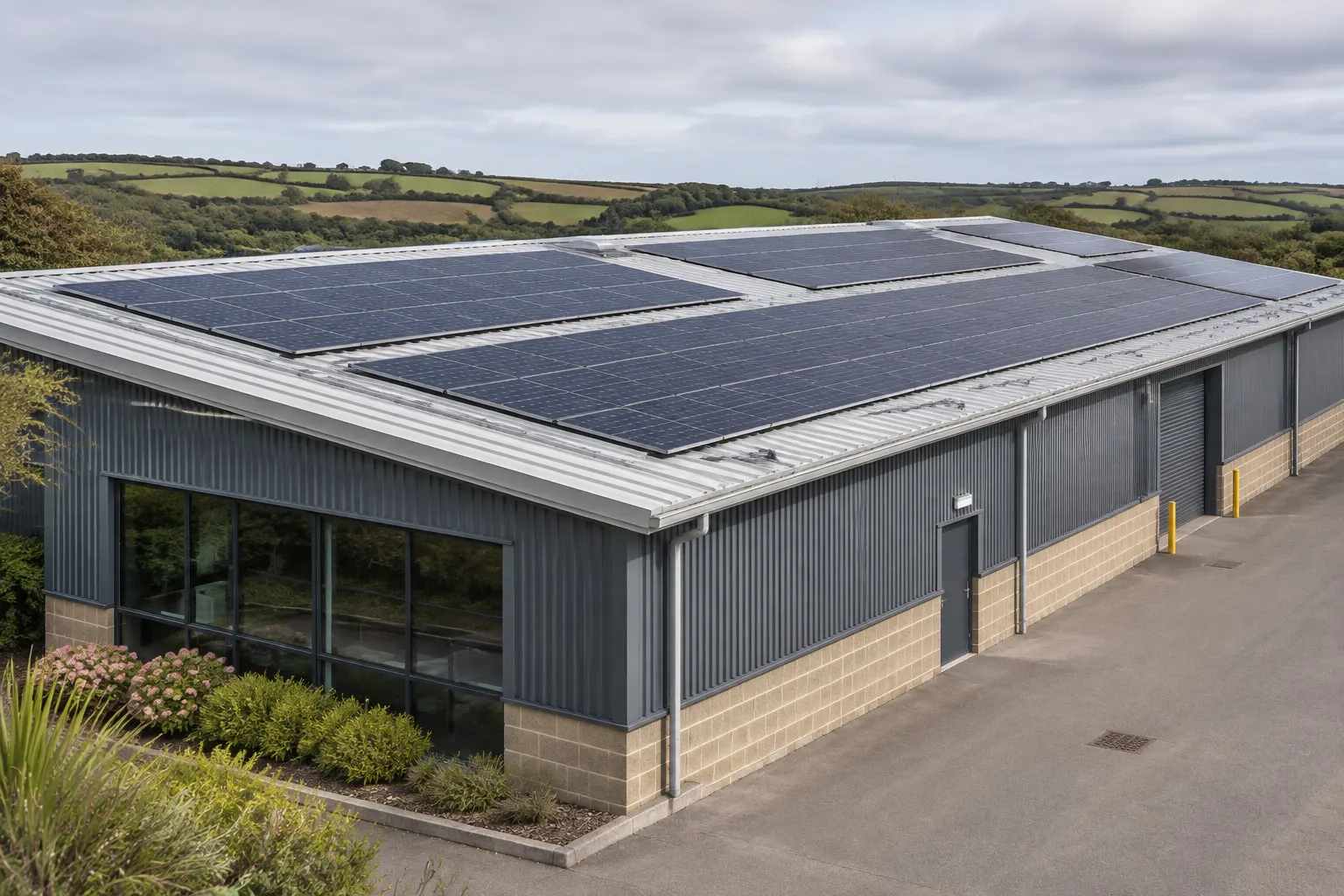
Commercial solar handover documents should do more than confirm that a system has been commissioned. They should help the people responsible for the premises understand what has changed and give staff and emergency responders reliable site information.
For a commercial solar fire risk assessment review, the task is to connect that electrical information to the existing premises assessment and site fire-safety plan. Use this checklist to organise records, contacts and responsibilities after installation, without assuming the whole assessment must be replaced.
When the existing assessment needs a review
In England, Article 9 of the Fire Safety Order requires the Responsible Person to make a suitable and sufficient assessment and review it regularly, particularly where it may no longer be valid or there has been a significant relevant change. Adding rooftop PV can be such a change; consider its effect on the particular premises.
Reviewing the fire risk assessment after installing solar panels does not automatically mean commissioning a new, standalone document. Government workplace guidance says a review need not mean starting again. Keep the assessment and review findings recorded, with any required actions.
Cornwall Fire and Rescue Service recommends a review at least annually and identifies alterations, significant changes in working practices, and a fire or near miss as review triggers. That annual recommendation is local guidance, not a fixed statutory interval. Obtain competent help if the review exceeds the Responsible Person’s expertise.
Assemble the electrical handover evidence
For a planned installation, agree the information to be provided before commissioning. For an existing array, check that the file matches what is actually installed, not just the original proposal.
The technical file
Useful information to request includes:
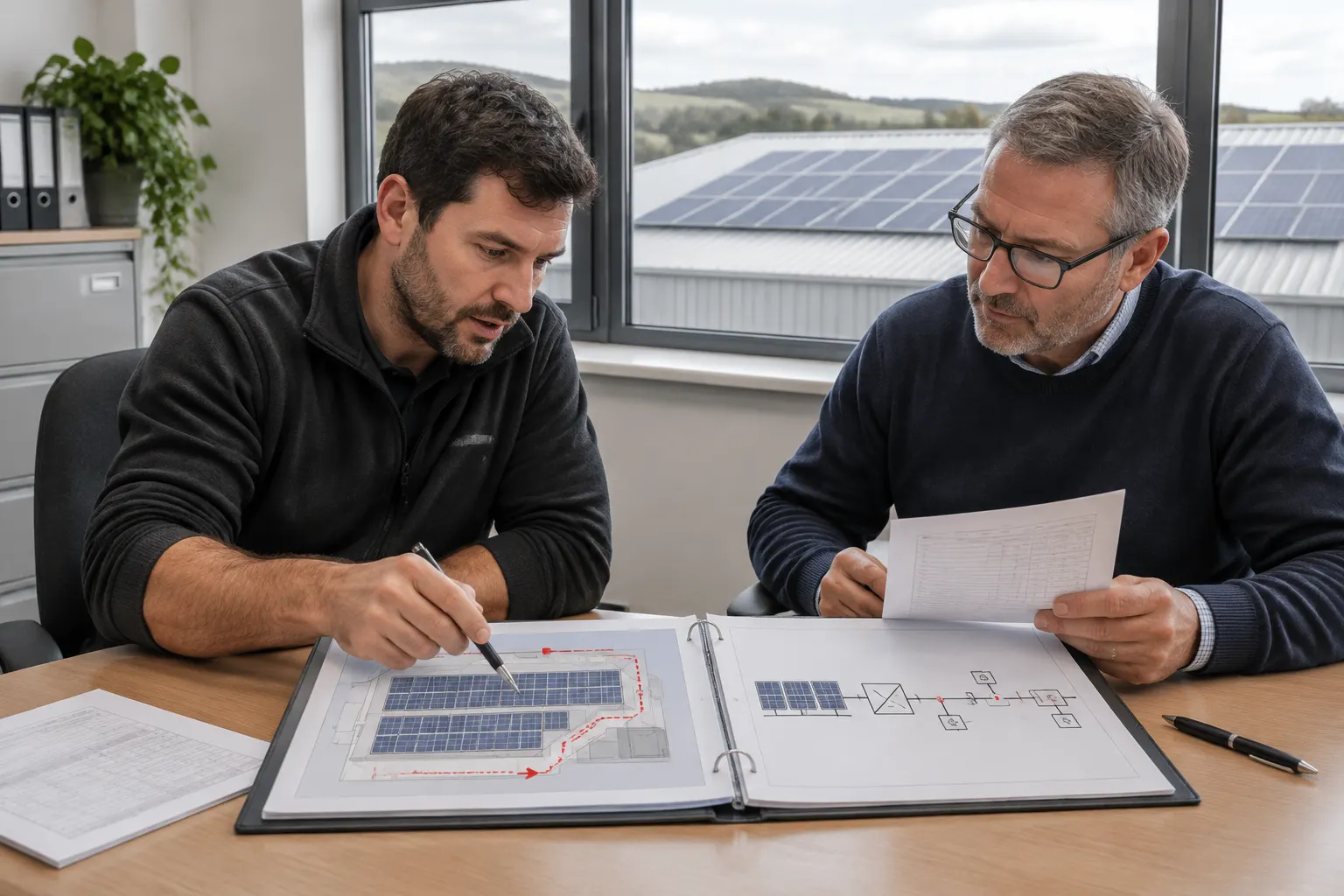
- As-installed layouts showing the relevant roof arrays, building references, inverter and control-equipment locations. On multi-building premises, each drawing should identify the system it describes.
- Electrical diagrams identifying relevant cable routes and isolation points, with the scope and limitations of each device confirmed by the electrical contractor.
- Equipment and commissioning records for the system actually fitted, with operating and maintenance information. Keep proposed designs separate so they are not mistaken for the final installation.
- Site access information explaining how responders can be directed to the relevant building and equipment, coordinated with the premises emergency arrangements.
- Current contacts for the site lead, system owner where different, and electrical maintenance provider, including the agreed route for reporting faults.
Put a revision date on the working set and agree who holds it. Resolve gaps with the contractor rather than filling them in from memory.
Check that the people using the file can open it without an unavailable login or specialist software. Where the building owner, occupier and PV owner differ, agree how updated information will be shared. Do not assume every party holds the same drawing revision.
The review may also need to consider roof construction, building use and existing fire precautions. Agree who will supply any missing information; electrical drawings alone cannot answer every fire-risk question.
Make the solar PV emergency response plan usable
Commercial rooftop solar fire safety depends partly on making the right details available at the site. Operational information should not be buried in a folder held only by the contractor.
RC62 is voluntary industry guidance for larger commercial and industrial rooftop PV, not legislation. Its responder-information recommendations cover equipment and isolation locations, site access and contacts.
A short information sheet for responders
Update the existing premises emergency plan, using a concise PV information sheet where helpful. Show where the array and control equipment are, how agreed access works, and which isolation information accompanies the plan. Keep the full technical file available as supporting detail.
Agree where the summary is held, who updates it and how staff can provide it during an incident. Reflect these arrangements in staff briefings and training.
Check that the arrangements work out of hours as well as during a normal shift. If the usual manager is absent, another briefed person should still know where records are held and whom to contact. Agree safe access to those records; nobody should enter an affected area to retrieve a folder.
State the limits of PV isolation clearly
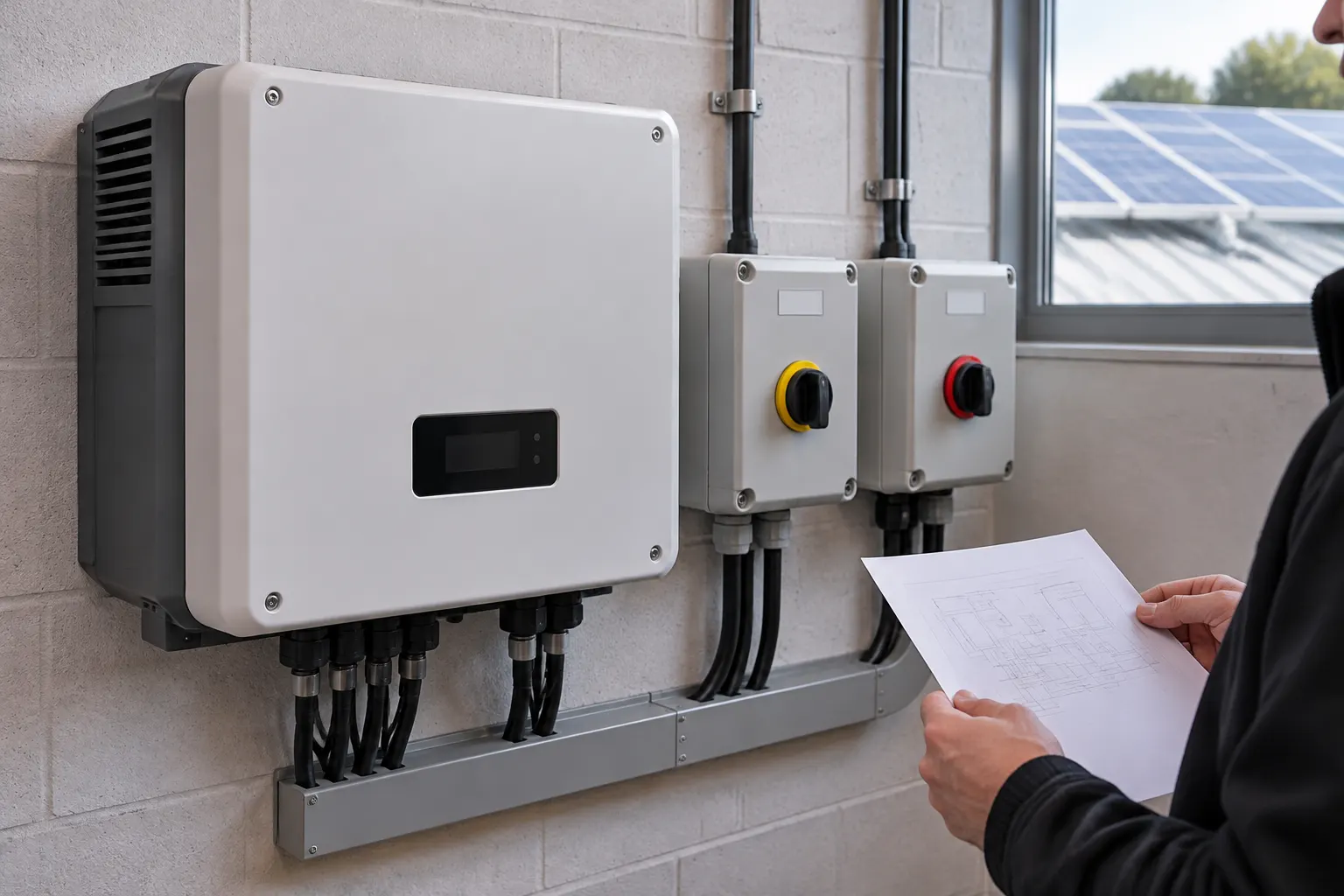
Switching off the building’s mains supply or shutting down an inverter does not necessarily make the roof array electrically safe. PV modules can continue producing DC electricity while exposed to light, and parts of the PV circuit may remain energised.
PV isolation information for firefighters should describe the installed equipment and its limitations, not simply say “solar off”. Have the electrical contractor confirm which parts each device disconnects and what may remain live. Staff should not investigate this by opening enclosures or improvising switching procedures.
RC62’s recommendations on dedicated fire-service switches are conditional, not a universal instruction to fit one. Proposed changes need site-specific consideration by the appropriate competent specialists. Battery energy storage is outside RC62’s scope; where batteries are present, their hazards and emergency arrangements need separate consideration.
Keep access, records and responsibilities current
Changes elsewhere on site can make sound handover records unreliable. Roof work, an inverter replacement, altered access or a changed maintenance contractor should prompt a check of the PV records and whether the premises assessment needs reviewing.
For a factory or holiday park, seasonal storage or changed delivery arrangements can also alter the approach to electrical equipment, even though the PV system itself has not changed.
Keep agreed access routes and relevant equipment unobstructed, and make sure records identify each system on multi-building sites. Build record updates into planned solar maintenance services, so equipment changes do not leave the emergency information out of date.
Give each action a clear owner
Separate three tasks: confirming the electrical facts, assessing their fire-safety implications and updating site procedures. Agree who handles each, with the Responsible Person retaining responsibility for the premises assessment. An electrical handover is not sign-off of that assessment, and a fire-risk review is not a substitute for competent investigation of an electrical fault. Record the actions and who will close them.
Put recent rooftop-fire research in context
A Building Safety Regulator-commissioned literature review, updated on 13 February 2026, examines how rooftop PV can affect fire behaviour, roofs and firefighting operations. Its conclusions are the authors’ and do not necessarily represent government policy.
It is research, not a new legal rule or a blanket instruction to retrofit existing arrays. Use it to inform site-specific discussions with a competent assessor where concerns arise, rather than assuming every array is unsafe or selecting hardware changes from a headline.
Discuss the electrical scope
For commercial solar electrical work, call Maenporth Electrical Ltd on 01326 250297. Based at Maenporth, we serve Falmouth, Penryn and wider Cornwall. Keep specialist fire-risk and fire-engineering decisions with people competent for that work.