
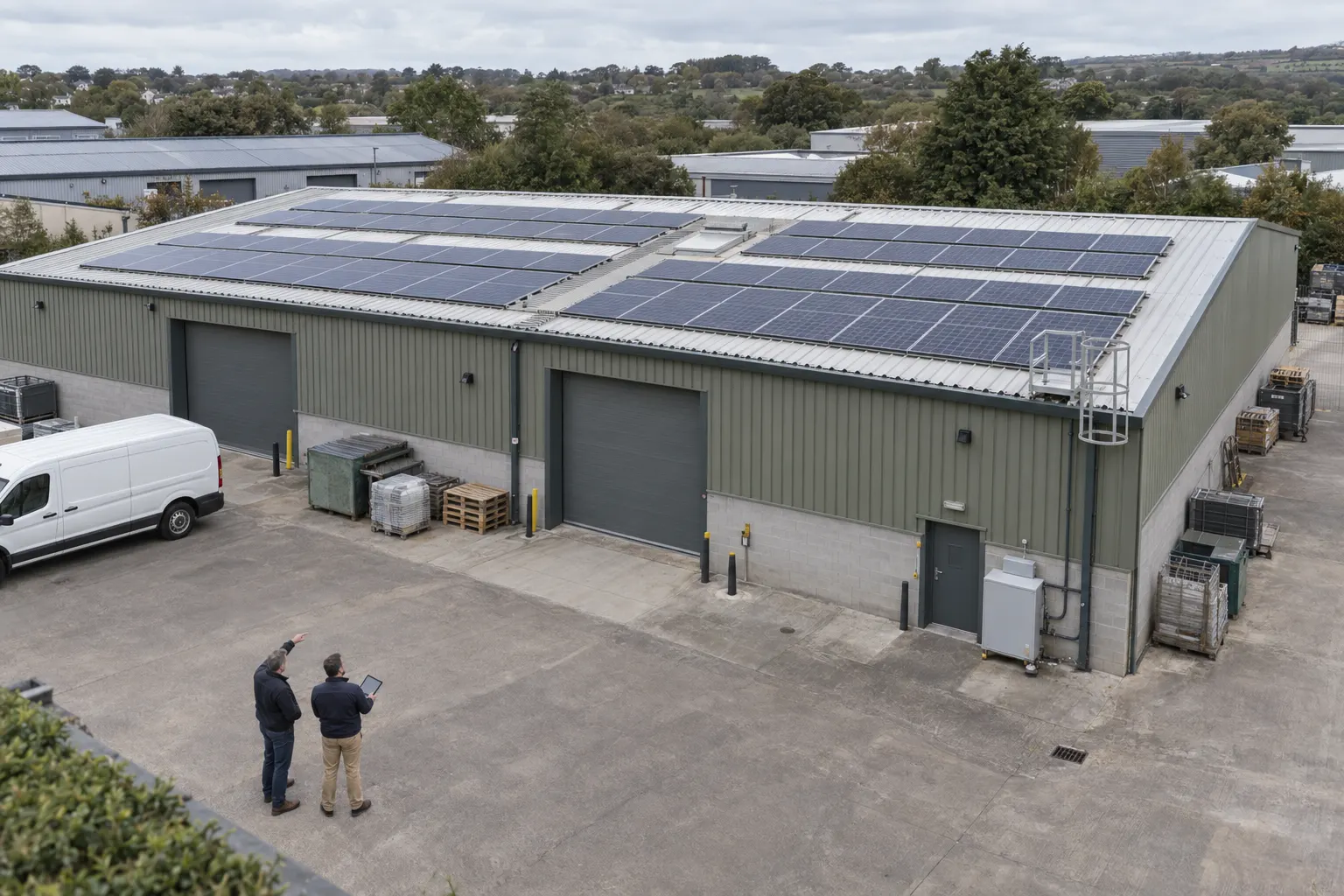
Adding rooftop solar changes what your site team needs to know about the building. For a Falmouth factory, holiday park or leisure business, the practical question is whether the fire-risk assessment, emergency plan and electrical records still describe the site accurately.
Commercial solar fire safety starts with the premises’ existing arrangements, not an automatic requirement for a separate PV fire-risk assessment. The useful next step is to agree what needs reviewing, who provides the technical information and how staff will find it in an emergency.
Does rooftop solar require a new fire-risk assessment?
In England and Wales, the Regulatory Reform (Fire Safety) Order 2005 applies to non-domestic premises. The responsible person may be an employer, owner, landlord, occupier or someone else with control. Their duties include a suitable and sufficient fire-risk assessment, appropriate precautions and emergency planning.
The assessment should be reviewed regularly, and where there is reason to suspect it is no longer valid or a significant change affects it. Consider the PV installation within that process, using competent advice where needed.
This is not just a question for new projects. If an existing array is absent from the site’s records, establish what information is missing and ask whether the assessment and emergency arrangements need updating.
What recent UK roof-fire research does and does not show
The Building Safety Regulator’s rooftop PV fire-safety research was published on 22 December 2025 and updated on 13 February 2026. It reviews experimental evidence, incident data and regulatory approaches. Its findings and recommendations do not represent government policy or create a new PV-specific legal requirement.
A separate government summary reports different outcomes across specific pitched-roof test samples. Those results cannot be generalised to every panel, mounting system, flat commercial roof or real-world fire.
The useful conclusion is to examine the actual roof and PV design, rather than treating the tests as a fire-likelihood estimate for your premises.
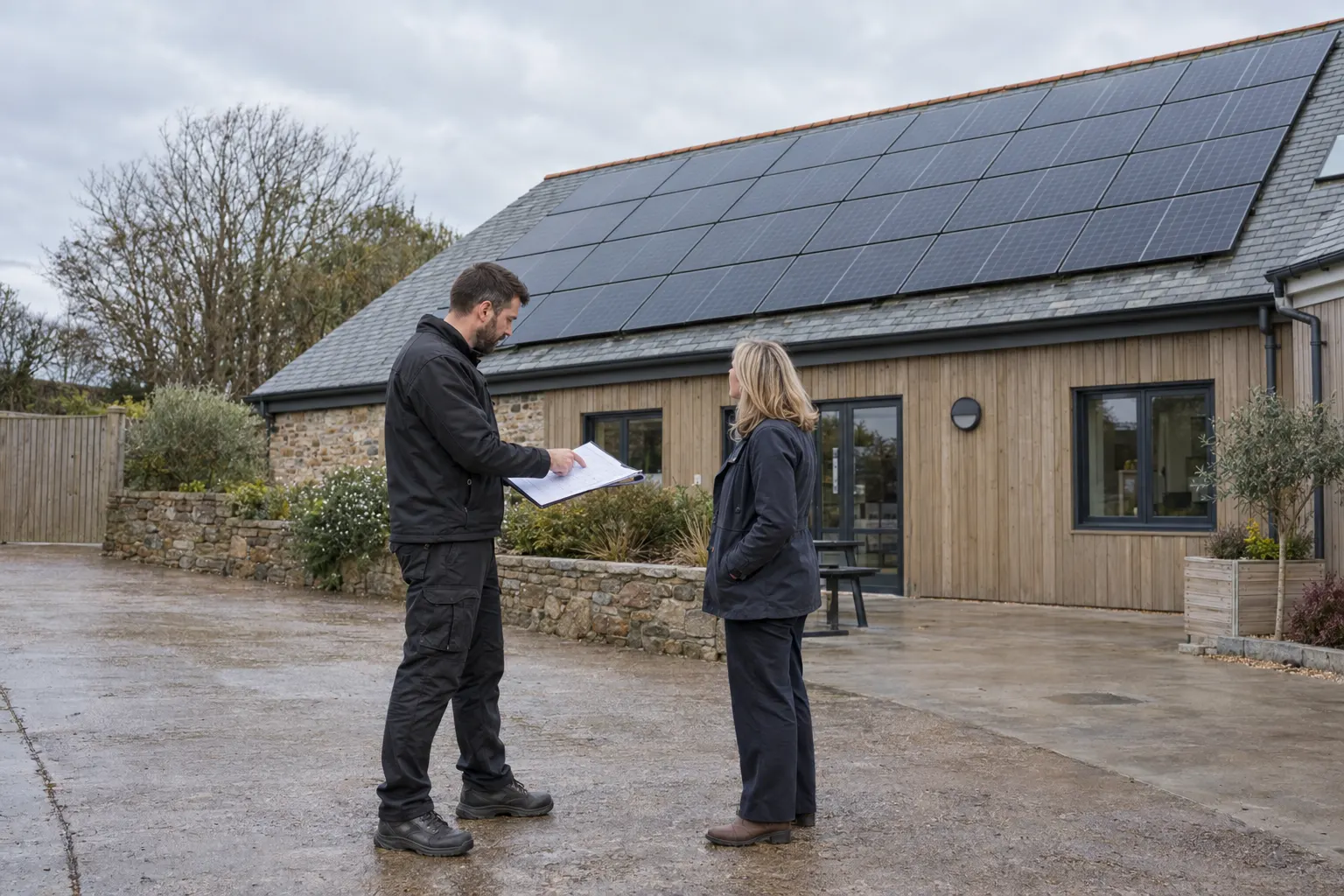
Review the roof, array layout and electrical design together
RC62, the joint code of practice on PV fire safety, offers recommendations for commercial, industrial and other larger systems. It is guidance, not legislation; particular clearances and switching arrangements need competent, project-specific decisions.
Roof and array layout
Ask how the roof construction and fire performance have been considered alongside the mounting system and array layout. Existing fire compartmentation and access arrangements belong in that discussion, rather than assessing the panels alone.
Where roof construction or previous alterations are uncertain, identify the gap rather than treating an old drawing as confirmation. The design team and fire-risk assessor can then agree what information is needed from the owner or an appropriate specialist.
Electrical equipment and cable routes
Ask the PV contractor to explain equipment locations, cable routes and isolation arrangements in relation to the building’s use. Include these questions in the brief for commercial solar PV design and installation, while changes can still be coordinated with the wider project.
RC62 does not cover battery energy storage systems or roof-integrated PV. If either forms part of the project, separate, appropriate fire-safety guidance and assessment are needed; a rooftop PV checklist is not sufficient.
What staff and responders need to know about PV isolation
PV modules can still produce DC electricity when exposed to light, even if the AC side has been isolated. Staff must not assume that switching off the building’s supply makes every part of the solar installation safe.
PV system emergency isolation information should explain what the isolation arrangements control and what may remain energised. This belongs in staff briefings and information for emergency responders, without turning the emergency plan into instructions for unqualified people to operate equipment.
In an emergency, follow the site’s alarm and evacuation procedures and tell responders that PV is present. Electrical checks, isolation and fault-finding should remain with competent, authorised people.
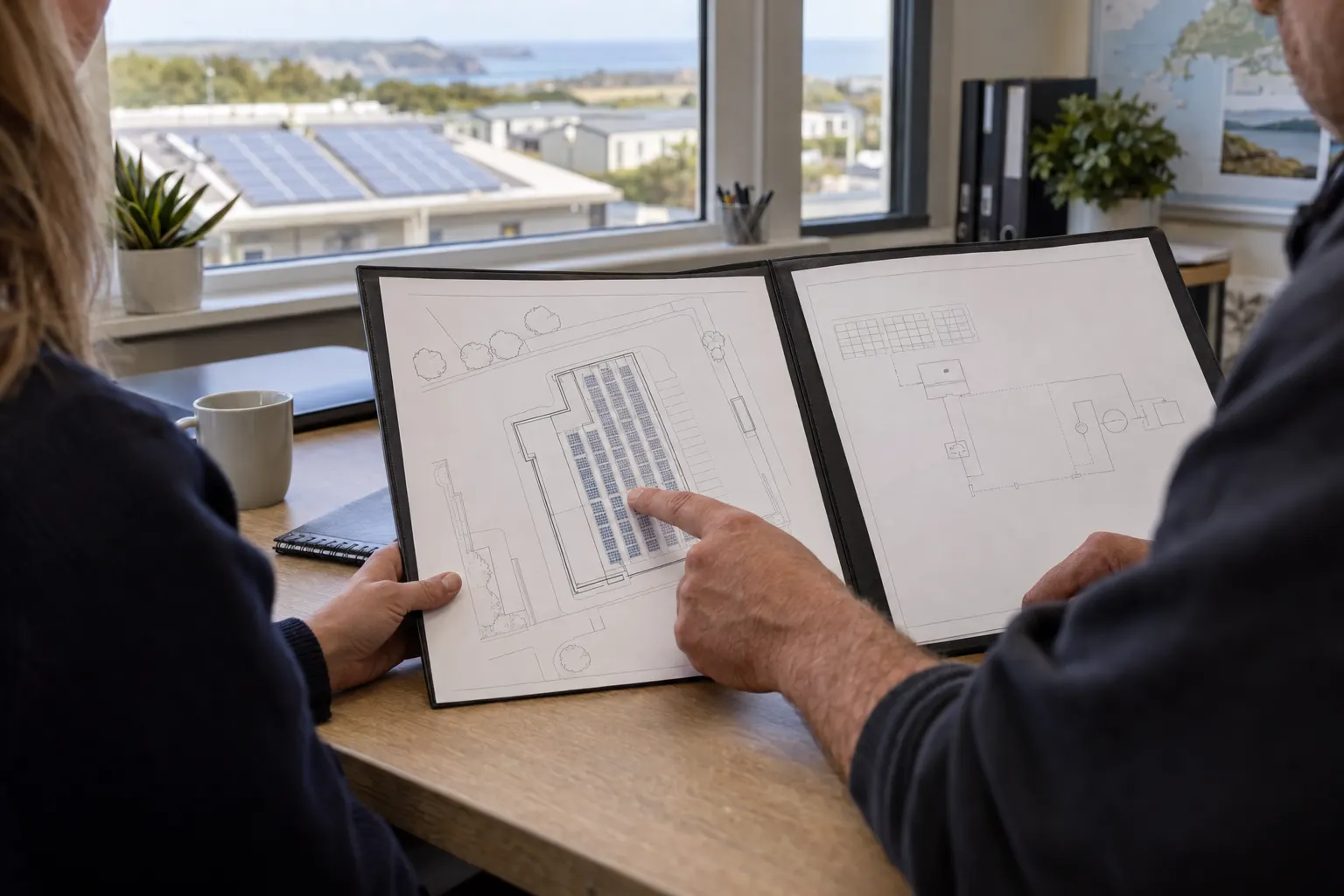
Build a usable PV handover and emergency information pack
Rooftop solar emergency planning for businesses depends on records that match the installation. The following is a coordination checklist, not a universal statutory document list. Agree the detail and format with those responsible for the site:
- Site and array plan. Identify the building, roof areas carrying panels and relevant access arrangements, particularly where a site has several buildings.
- Electrical system information. Retain current drawings showing relevant cable routes, inverter and other equipment locations, and the documented isolation arrangements and limitations.
- Emergency access to information. Specify where the pack is kept, who can retrieve it and how it will be made available to responders.
- Contacts and responsibilities. Record the responsible person, relevant site contacts and the PV contractor or maintenance contact, including agreed out-of-hours arrangements.
- Handover and maintenance records. Keep commissioning information, operating guidance, inspection findings and records of subsequent alterations together.
- Staff briefing record. Confirm that relevant staff know the PV system is present, its isolation limitations and where to find the agreed information.
For a holiday park or multi-building factory, use consistent building names across the PV drawings and emergency plan. That helps duty staff identify the relevant array without having to interpret an unfamiliar electrical drawing during an incident.
A handover pack is not useful if it disappears into one person’s inbox. Make suitable arrangements for duty staff to access it, including when the usual facilities contact is off site.
Keep the responsible person, assessor and contractor roles distinct
The responsible person should coordinate the review and make sure actions have an owner. Where specialist input is needed, a competent fire-risk assessor addresses premises-wide risks and emergency arrangements. The PV or electrical contractor supplies system-specific information and undertakes competent technical work; that is not a substitute for the site’s fire-risk assessment.
Before installation, agree who will turn the contractor’s system information into updates to the site’s fire-safety records. At handover, check that the operating team has the final information and that any unresolved questions have a named person responsible for following them up.
Where premises are leased or control is shared, agree which owner, occupier or landlord supplies roof and building records, and who keeps the final information. Liaison with the insurer or fire service may also be appropriate to the project, but is not a blanket requirement for every installation.
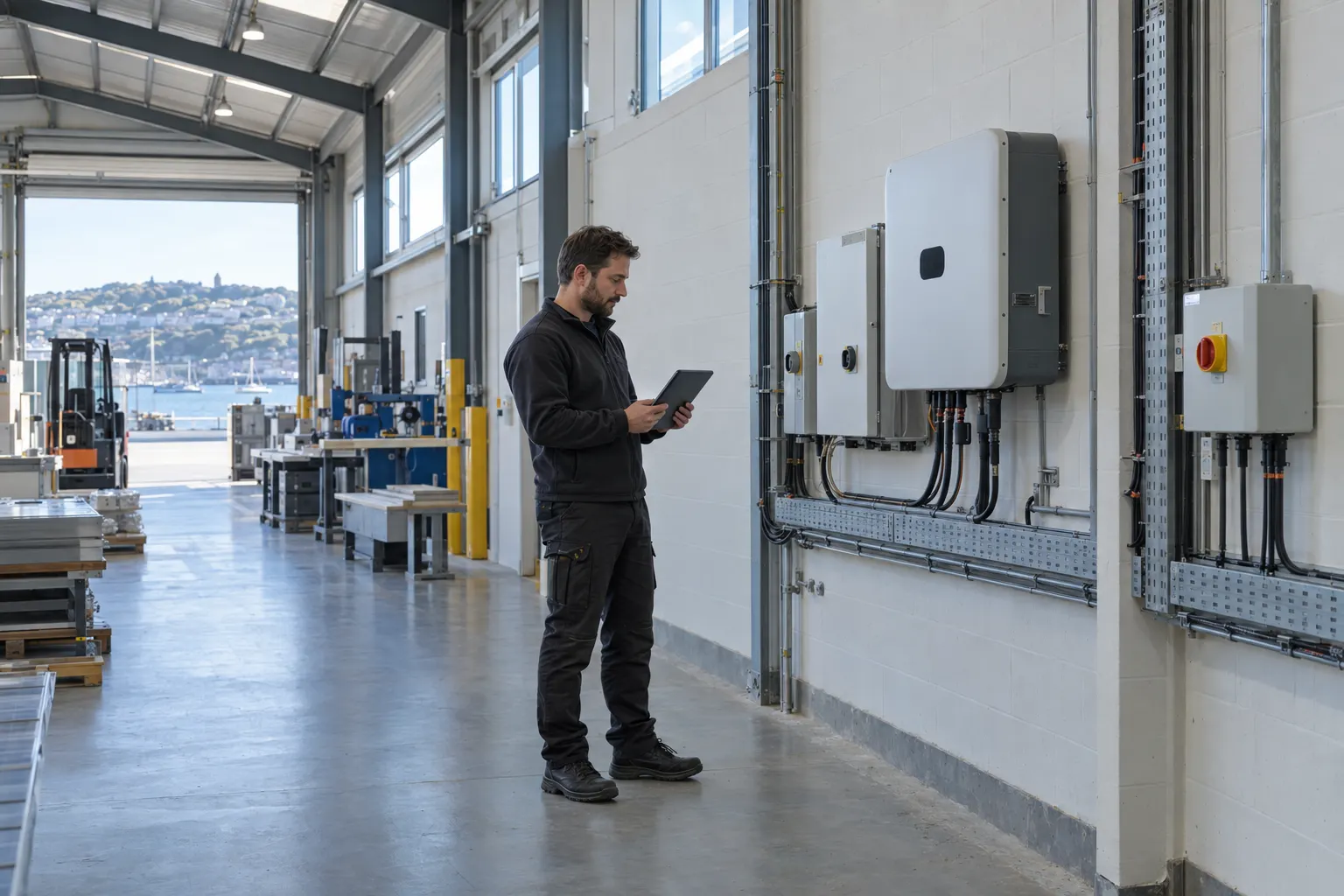
Keep the fire-safety information current through maintenance
Agree who will keep records updated after inverter replacement, cable-route changes, roof work or alterations to the array. Where a change affects the assessment or emergency arrangements, arrange an appropriate review rather than filing the electrical paperwork alone.
Include record updates in your solar maintenance arrangements, so equipment changes and outstanding actions stay visible. Inspection and maintenance should be carried out by competent people, with the scope and timing suited to the installation, site conditions and relevant guidance.
For an existing system, start by asking whether you can locate its drawings, isolation information and latest maintenance record. Missing paperwork is a coordination task for the responsible person and contractor—not a prompt for staff to open equipment or trace cables themselves.
Call Maenporth Electrical Ltd on 01326 250297 to discuss installation, testing or maintenance for your rooftop PV system. Based at Maenporth, we serve Falmouth, Penryn and the wider Cornwall area.