
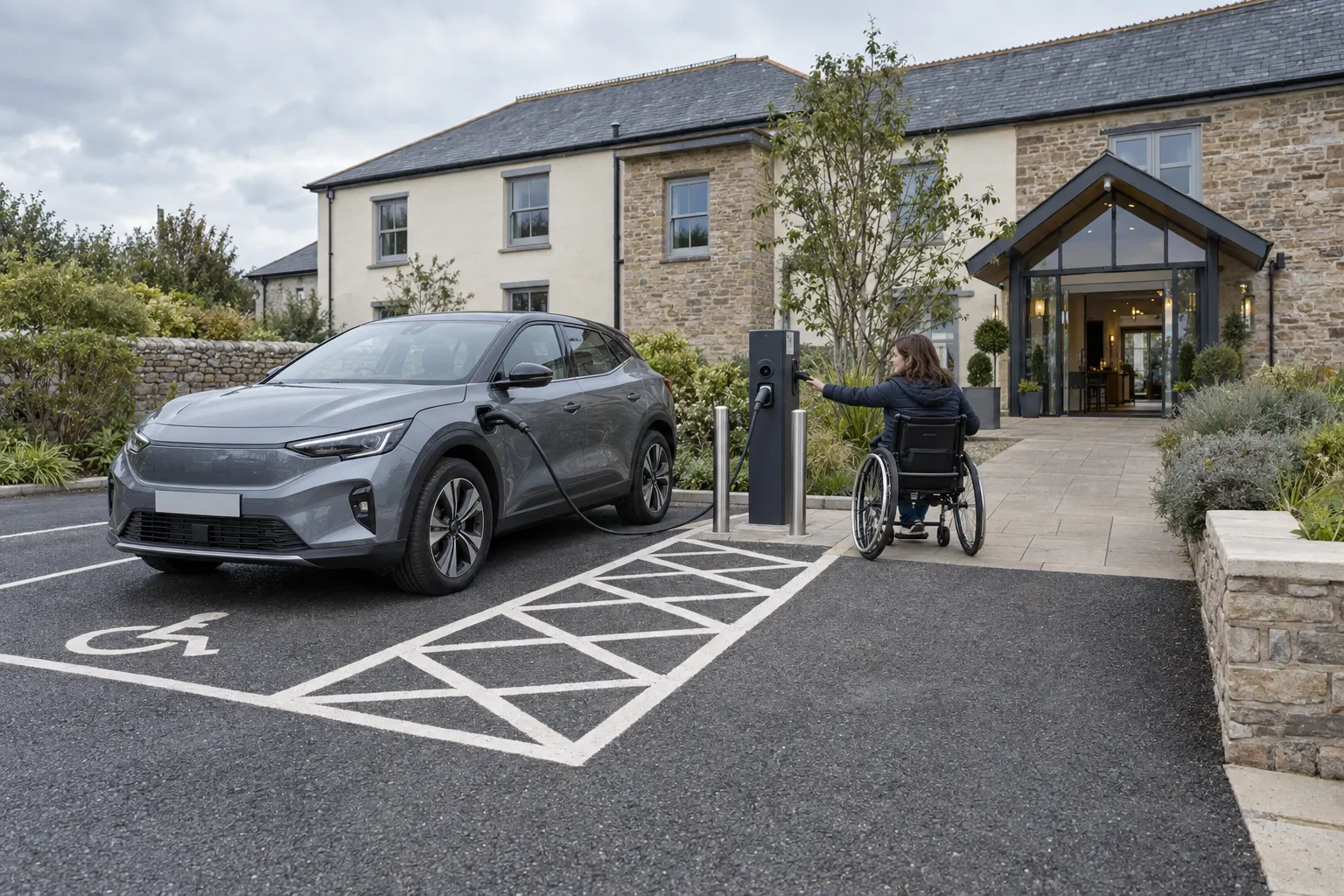
An EV charger can be electrically sound and still leave a visitor unable to charge. A heavy cable, a tight parking bay or a kerb between the car and the controls can break the journey.
For hotels, holiday parks and golf or leisure venues planning accessible EV charging bays in Cornwall, the unit is only part of the brief. At a Falmouth site, start with what a visitor needs to do independently, from finding the bay to unplugging and leaving.
This guide covers publicly accessible, visitor-facing charging. Staff-only or otherwise private installations can have a different regulatory scope. For wider operator and site-planning questions, see our guide to public EV charging for Cornwall visitor sites.
What should an accessible charging bay make possible?
The aim is a usable sequence: park, get out with any mobility aid, reach the equipment, connect, start and stop charging, disconnect and return to the vehicle.
Do not reduce accessibility to a wheelchair symbol. Visitors with limited strength, dexterity, reach or vision can encounter different barriers. Consider companions too, and the route to reception or other facilities while charging.
Consider the return journey: a driver should not have to squeeze past a connected cable to get back into their car. Involve disabled users while layouts and equipment choices can still change.
What PAS 1899 covers and what to verify
BSI’s PAS 1899:2022 specification for accessible public EV chargepoints covers the physical environment, chargepoint placement, equipment design and information provision. It is not just a product specification.
It is not a blanket statutory requirement. Confirm the current edition and applicable legal requirements when commissioning work, and use the full specification for detailed criteria. An accessible charger alone does not establish that the finished bay and its surroundings meet it.
BSI’s November 2025 review identified difficulties with interpretation and procurement, alongside gaps in accessibility information. Ask designers and suppliers which requirements their proposals address, how they will demonstrate this and what limitations remain.
That evidence needs to relate to the complete arrangement, not simply the chargepoint brochure. Keep unresolved accessibility issues visible in the project brief.
Public Charge Point Regulations operator duties are separate and depend on the charging arrangement and equipment. This guide is not an accessibility audit, legal opinion or certification.
Plan the route and space around the vehicle
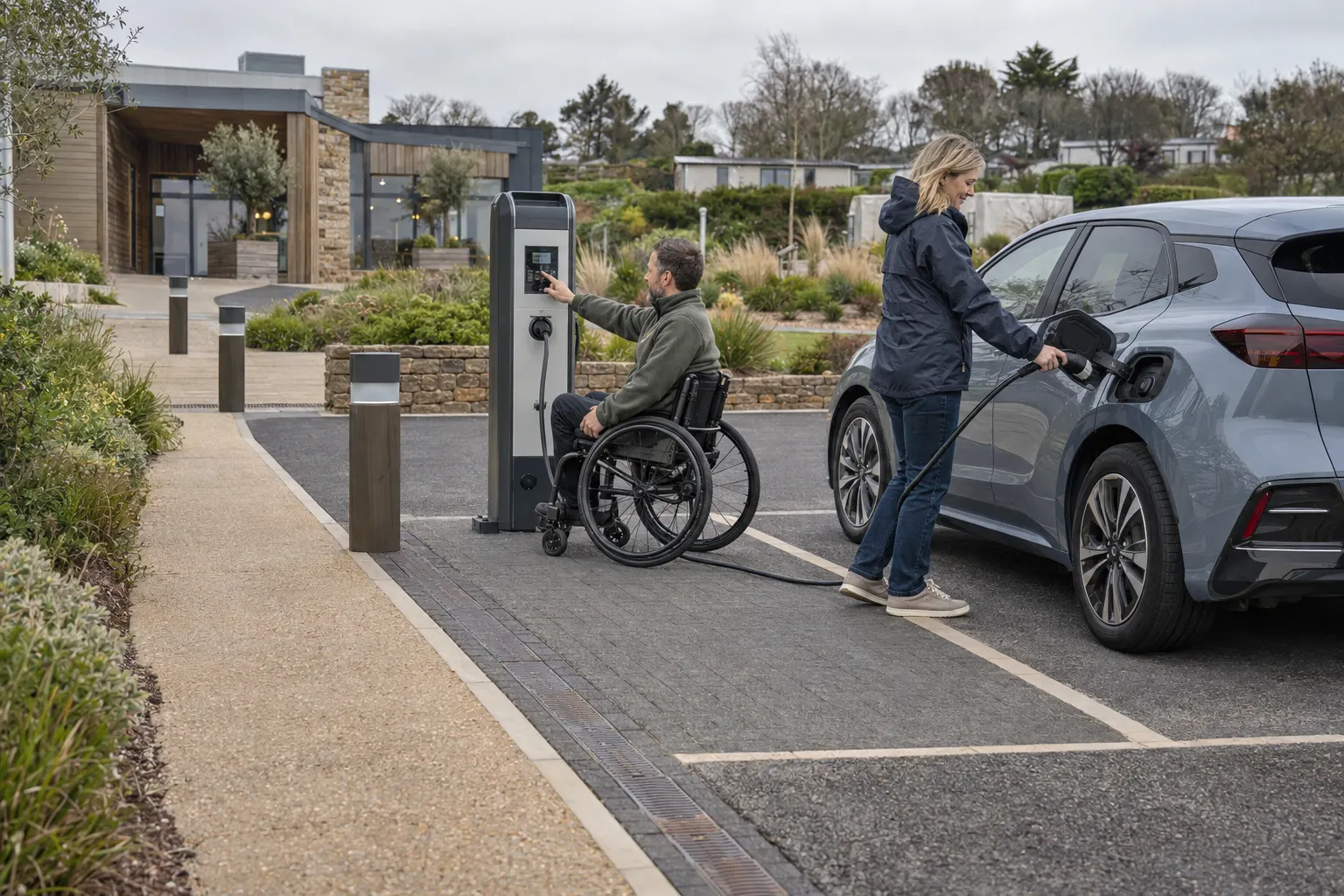
Start with a drawing that includes arrival, parking, the chargepoint and the onward pedestrian route. Do not choose the bay solely because it offers the shortest electrical cable route.
Check space with a vehicle parked, not just an empty rectangle. Doors, mobility aids, rear access and differing vehicle inlet positions all affect whether the space works. A neighbouring parked vehicle, bollard or wheel stop must not remove the manoeuvring area intended for the user.
A firm, even surface and a step-free route matter. Examine gradients, drainage and kerb transitions with the access adviser. Position protective barriers so they protect equipment without obstructing access to it.
Follow the journey onwards to reception, toilets or leisure facilities. Check crossings and shared vehicle routes rather than assuming the nearest entrance provides an accessible route.
At a holiday park or leisure venue, include seasonal furniture, bins and other movable items in the layout review. The approach must remain usable during normal operation, not only on installation day.
Check whether the charger is usable in practice
Cable and connector handling
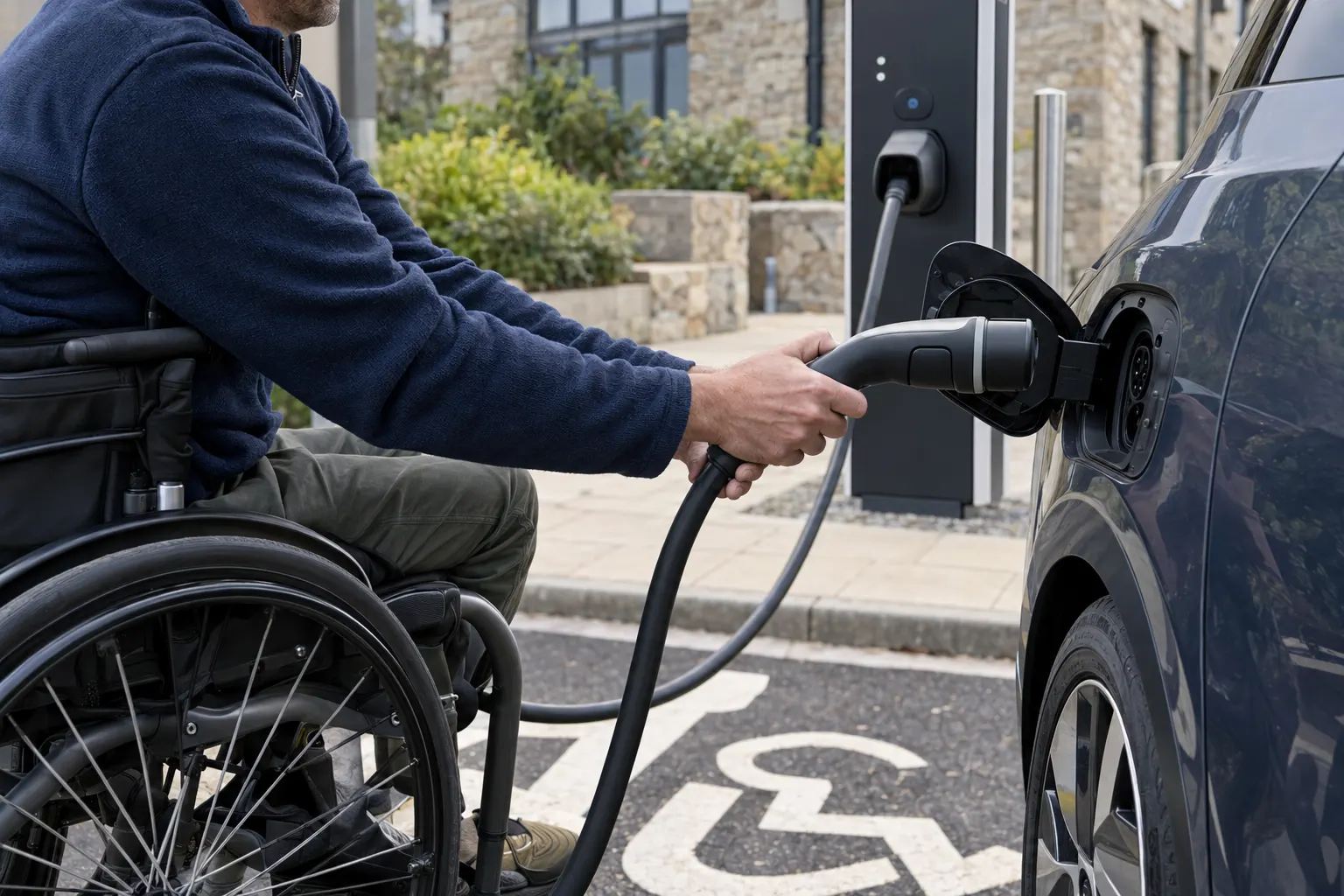
Motability Foundation research reports barriers including cable weight and the force needed to connect a charger. Ask to try the proposed cable and connector, rather than relying on a product image.
Consider grip, release mechanisms, the distance the cable must travel and where it rests during use. Can it reach likely vehicle inlet positions without being stretched or trailing across a pedestrian route? Any cable support must itself be easy to operate.
A demonstration should include taking the connector from its holster, reaching the vehicle inlet and returning it afterwards. A reachable connector can still be awkward to lift out or release.
Controls and the charging sequence
Assess controls, screens and any payment interface from seated and standing positions. Look for a clear approach, comfortable reach, readable information and an understandable start-and-stop sequence. Check visibility in daylight and after dark without introducing glare.
Review the whole interaction, including error messages and how a visitor gets help. Staff assistance is useful backup, but should not be the only way someone can complete a normal session.
Make accessibility information useful before arrival
Visitors need more than a generic accessibility symbol. Before they travel, provide accurate descriptions and photographs of the bay, surrounding space, route, charger and any access restrictions. Photographs should show the approach and space around a parked vehicle, rather than just the unit.
Useful details include surface type, whether the route is step-free and limits on access times. If assistance is available, explain how to request it. Avoid a blanket claim of being fully accessible where features or limitations have not been assessed.
On site, signs should direct drivers to the right bay and explain its use clearly. Instructions and help information need to be easy to find and read. Agree who updates the website and operator listing if the layout or access arrangements change.
Agree who is responsible before equipment is ordered
Accessibility can fall between contracts if everyone assumes another supplier covers it. Agree responsibilities before ordering hardware.
The site owner should coordinate parking, pedestrian routes and operating arrangements. Agree which aspects of the charging interaction and visitor information the operator will handle. The electrical contractor needs the agreed layout early so equipment positions, cable routes and lighting can be coordinated.
For an existing car park, include access improvements in the same brief as the electrical work. Confirm who is responsible for those changes before fixing the chargepoint position, rather than leaving them for another phase.
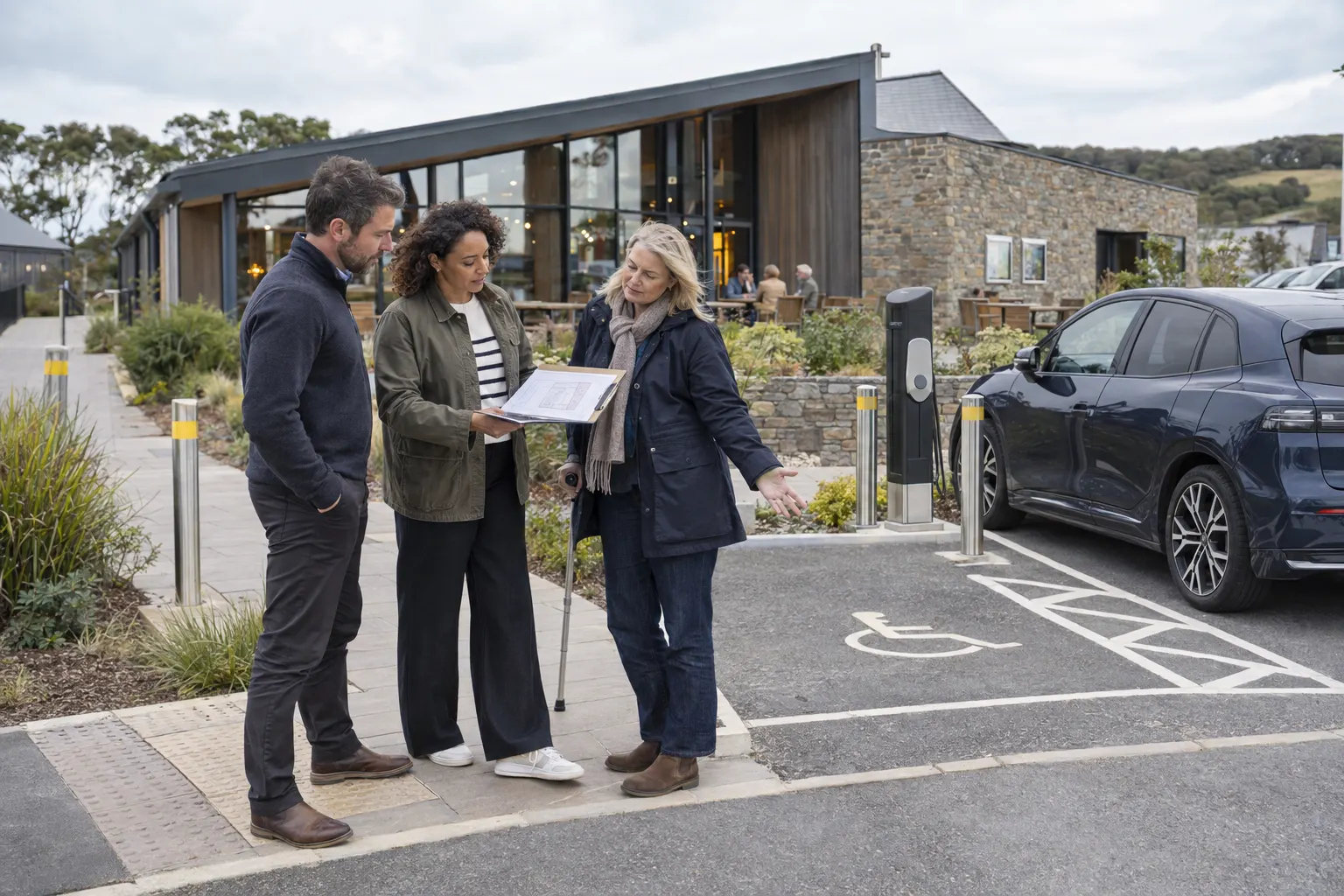
Bring in a competent accessibility professional where appropriate. Record design decisions, limitations and who will check the finished arrangement. Keep electrical work, accessibility review and operator obligations distinct; one sign-off does not automatically cover all three.
An EV charging accessibility checklist for your brief
Use these points as a starting brief, not a claim of compliance:
- Describe who will use the charging, when the site is open and where visitors go afterwards.
- Provide a layout showing vehicle space, chargepoint positions, protective barriers and pedestrian routes.
- Request evidence of how the layout and equipment address the current PAS specification, including any limitations.
- Arrange a practical review of cable handling, controls and the full charging sequence.
- Agree pre-arrival information, on-site directions, help arrangements and responsibility for keeping access clear.
- Name who will review the design and check the completed bay before it is advertised as accessible.
Planning commercial EV charger installation in Falmouth? Talk to Maenporth Electrical about our EV charging services and the electrical work for your proposed layout. Based at Maenporth, we serve Falmouth, Penryn and wider Cornwall. Call 01326 250297 to discuss your site.