
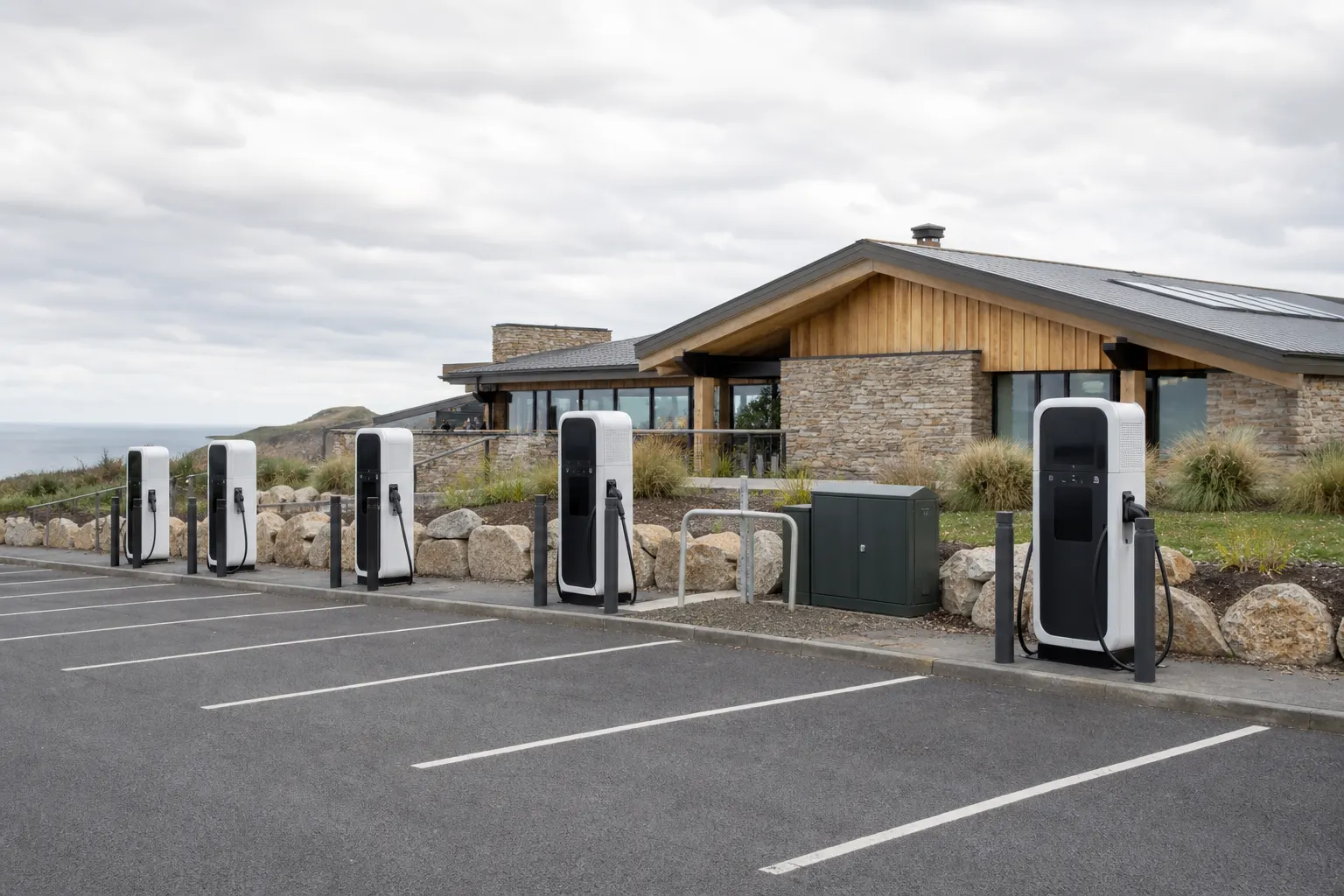
For hotels, holiday parks, campsites, golf clubs, attractions and leisure venues, EV charging can become part of the customer experience rather than simply another electrical appliance in the car park. Guests need to understand who can use it, how they pay and what to do if something goes wrong. The site operator needs confidence that the electrical supply, charging platform and commercial arrangement can support the service.
That makes public EV charging in Cornwall a different proposition from fitting chargers reserved solely for employees or fleet vehicles. The distinction matters because publicly accessible charge points can bring specific consumer-facing obligations as well as the usual electrical design considerations.
A useful project brief should therefore cover the complete charging service, from incoming power and parking layouts to payments, communications and long-term support.
Is the charge point public or private?
The first question is not how fast the charger should be. It is who will be permitted to use it.
Government guidance treats charge points in privately owned car parks as public where the general public can access them. It specifically gives hotel and supermarket car parks as examples. Restricted opening hours do not necessarily make a charger private, nor does limiting the car park to customers of a particular business.
By comparison, a workplace charge point that is never accessible to the general public is outside the scope of the Public Charge Point Regulations 2023. A staff-only charger behind controlled access may therefore be treated differently from a unit offered to hotel guests, day visitors or passing drivers.
Mixed-use sites need particular care. A Cornwall holiday park might want some chargers for guests, others for employees and a separate connection for business vehicles. Defining those user groups at the start helps determine the hardware, access controls, payment system and operating responsibilities required.
Businesses should review their proposed arrangement against the official Public Charge Point Regulations guidance and obtain specialist advice where the scope is unclear.
Public charging involves more than accepting payment
A customer-facing charger needs an operating model. The site owner must decide whether charging will be free, included with another service, billed directly or managed by a third-party charge point operator.
For in-scope public charging, current requirements can include transparent pricing, contactless payment, payment roaming, open data and access to a staffed helpline. The exact duties depend on factors including charger power, deployment date, whether users pay and which organisation is legally acting as the charge point operator.
Contactless access
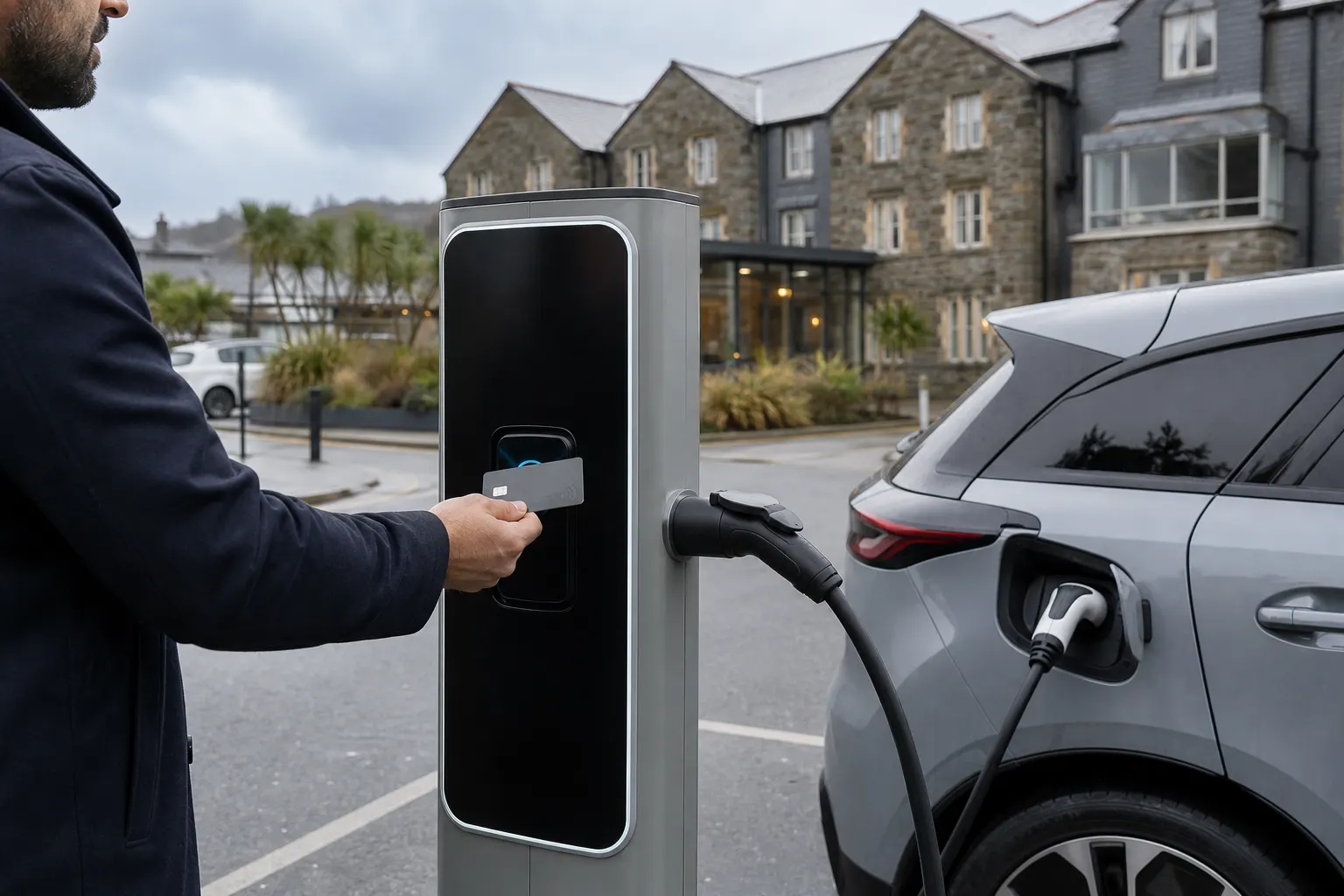
New public charge points rated at 8kW or above and deployed after 24 November 2024 must offer contactless payment. Public rapid charge points rated at 50kW or above are also subject to contactless requirements. A payment terminal may serve multiple nearby chargers at one charging site, provided the arrangement meets the applicable rules.
This has practical consequences for product selection and communications. A charger chosen only because it has a low purchase price may not support the payment experience or backend services needed for public use.
Clear pricing and roaming
The maximum charging price must be shown clearly in pence per kilowatt-hour for public charge points. Customers should be able to see the relevant price without first entering into a contract with the operator.
Public charge point operators must also provide access through at least one third-party roaming provider, subject to the detailed scope and exemptions in the regulations. Contactless payment and roaming are separate features: one allows ad-hoc card payment, while the other lets drivers use a compatible app or RFID service across different charging networks.
Support and live information
Public charging is not finished when the electrical installation is energised. The operating arrangement may also need a free-to-use, staffed 24-hour helpline and accurate open data showing information such as charger location, connector type and availability.
These requirements are a strong reason to assess the proposed backend platform before hardware is ordered. The physical charger, communications connection, payment service and support contract must function as one system.
Match charging power to how visitors use the site
Faster is not automatically better. The right charging speed depends on how long vehicles normally remain parked, how many charging sessions are expected and what the existing supply can support.
At an overnight accommodation site, several lower-powered AC chargers may serve guests more effectively than one high-powered unit. A leisure venue with visits lasting a few hours may need a different balance. A site hoping to attract passing drivers could require higher charging power, but that changes the electrical, operational and commercial requirements substantially.
Before selecting equipment, consider:
- the typical and shortest customer dwell times;
- the number of parking bays likely to need charging now and later;
- whether chargers are reserved, bookable or available on arrival;
- whether visitors are expected to move vehicles after charging;
- the likely pattern of simultaneous use during busy periods;
- whether staff, fleet and public charging need separate access rules;
- how customers will pay and obtain support;
- whether mobile or data connectivity is dependable at the charger location.
This usage profile should form part of the initial site survey and wider commercial electrical work, not be left until the chargers have already been specified.
Check the electrical capacity across the whole premises
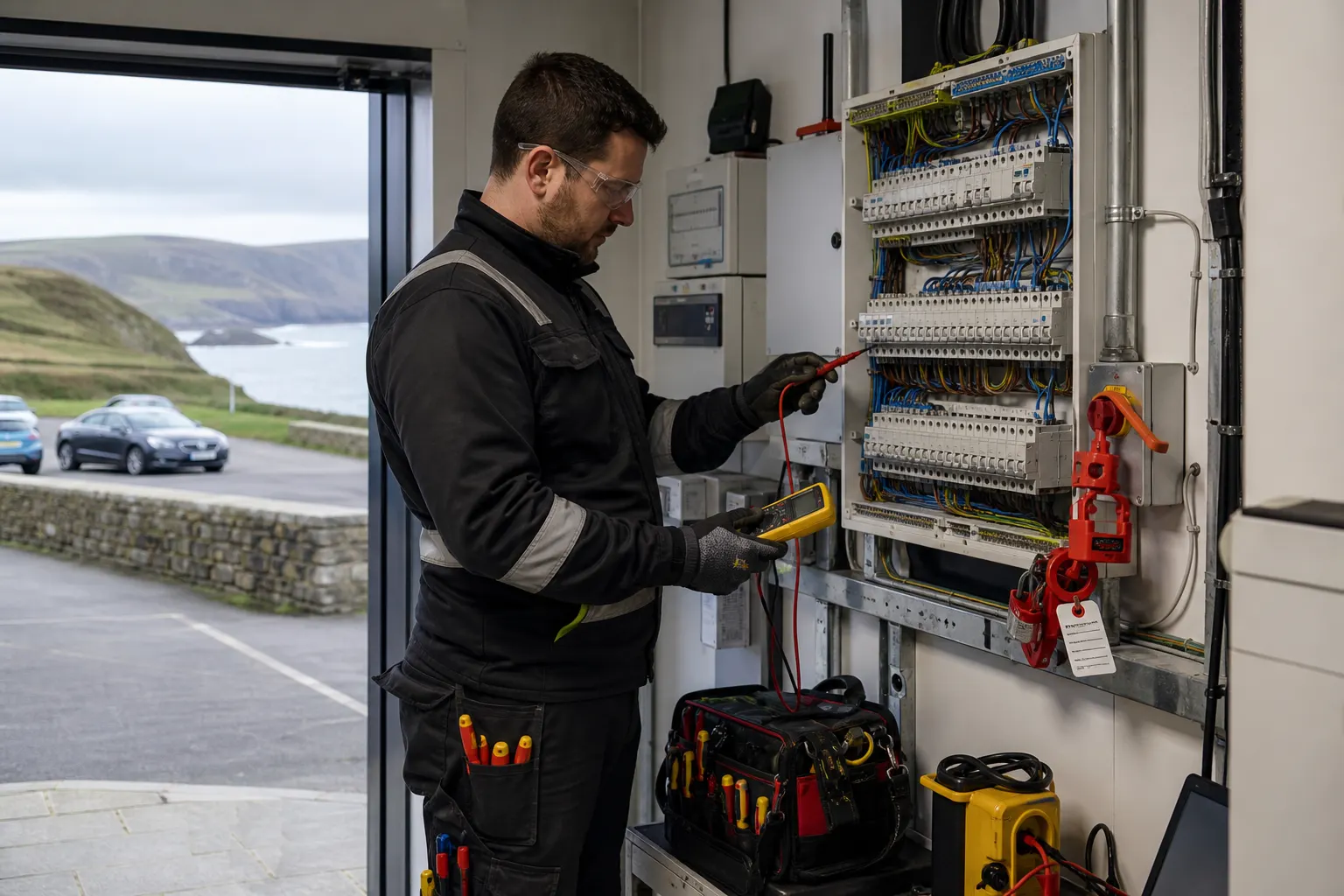
A charger rating shows its potential demand, but it does not show whether the premises can supply several vehicles alongside kitchens, swimming pools, heating, workshops, laundry equipment or other significant loads.
A proper assessment may need to consider the incoming supply, existing maximum demand, distribution equipment, cable routes, earthing arrangements, protective devices and the condition of the installation. Long routes across a rural or holiday site can also make cable sizing and civil works a major part of the project.
Where unrestricted charging would place excessive demand on the supply, load management may help. A managed system can vary the available charging power according to site demand or share a defined capacity between several vehicles. This can support a phased installation, but it must be designed around realistic peak conditions rather than optimistic assumptions.
If additional import capacity is required, early discussion with the relevant network operator may be necessary. This should happen before the business commits to charger numbers, power levels or opening dates.
Design the parking area for daily operation
The charger must work in the car park as well as on a drawing. Bays should be easy to identify and reach without charging leads creating avoidable obstructions. The arrangement should account for different vehicle charging-port positions, accessible use, impact protection, drainage, lighting and safe pedestrian routes.
At exposed Cornwall sites, equipment selection and placement should also reflect the local environment. Coastal air, driven rain, wind exposure and regular public use can all influence enclosure choice, mounting details and the maintenance regime.
It is also worth planning passive infrastructure for future bays. Ducts, distribution capacity and suitable routes installed during the initial groundworks may make later expansion less disruptive, even if chargers are not fitted to every space immediately.
Decide who operates and maintains the service
The business owning the car park is not always the legal charge point operator. A third party may control the charging platform, payments, maintenance and customer support. Contracts should state clearly who is responsible for faults, refunds, data, pricing changes, software subscriptions and regulatory reporting.
Maintenance arrangements should cover more than visible damage. Charge points rely on protective electrical equipment, network communications, payment functions and software. For public rapid charging networks, the statutory reliability requirement is measured across the operator’s relevant network rather than as a guarantee that every individual charger will achieve 99% availability.
Site owners should establish how faults are detected, who receives alerts and what response is available during the busiest part of the season. EV charging should also be incorporated into appropriate inspection and planned electrical maintenance arrangements for the wider premises.

Prepare a useful brief before requesting prices
A quotation will be more meaningful when the contractor understands the intended service. Useful information includes a site plan, proposed bays, opening hours, customer dwell times, current and future charger numbers, access restrictions, payment preferences and any known supply information.
It is equally important to identify the project objective. Providing a convenient overnight amenity is different from operating a destination charging hub or supporting a commercial vehicle fleet. Each requires a different combination of power, hardware and management.
Maenporth Electrical Ltd can discuss the electrical and site considerations for EV charging at commercial and visitor premises across Cornwall. To start a conversation about a proposed installation, call 01326 250297.