

An Electrical Installation Condition Report can leave a site manager with anything from a short list of recommendations to a substantial programme of remedial work. The difficult part is not simply obtaining the report. It is deciding what must happen first, what needs further definition and how the work can be completed without creating unnecessary operational disruption.
That challenge becomes more significant on factories, quarries, holiday parks, leisure facilities and larger rural sites. Distribution may extend across several buildings, outdoor equipment may face demanding conditions, and isolating one board can affect machinery, pumps, lighting, refrigeration, communications or customer facilities elsewhere.
A structured approach to EICR remedial work in Cornwall turns the report into a practical site plan rather than a disconnected list of electrical observations.
Start with the classification code but do not stop there
Each safety-related observation on an EICR should carry a classification that indicates its significance. These codes provide the starting point for prioritisation:
- C1 means danger is present. Immediate action is required to remove or control the danger.
- C2 means potentially dangerous. Urgent remedial action is required.
- C3 means improvement is recommended. It does not, by itself, make an installation unsatisfactory.
- FI means further investigation. The visible evidence or test results indicate that additional investigation is advised before the matter can be fully assessed.
A C1 or C2 should never be reduced to a routine budgeting item simply because the affected circuit is inconvenient to isolate. Equally, a long list of C3 recommendations should not automatically be priced as though every item carries the same urgency.
The observation itself matters. It should identify the location, circuit or equipment concerned and explain the reason for the classification clearly enough for remedial work to be scoped. Maenporth Electrical can support businesses with commercial and industrial electrical testing and the planning that follows an inspection.
Check which edition of BS 7671 applies to the report
BS 7671:2018+A4:2026 was published on 15 April 2026. The preceding version incorporating Amendments 2 and 3 remains valid during the transition period until 15 October 2026. This means reports produced during the transition may refer to either valid edition, so the declaration and report notes should be checked rather than assumed.
Amendment 4 also clarifies the treatment of FI observations. Under its model EICR, C1 and C2 observations result in an unsatisfactory outcome, while FI is advisory and does not automatically make the overall assessment unsatisfactory. An FI should still be considered carefully: it means the original inspection could not reach a complete conclusion about a relevant issue.
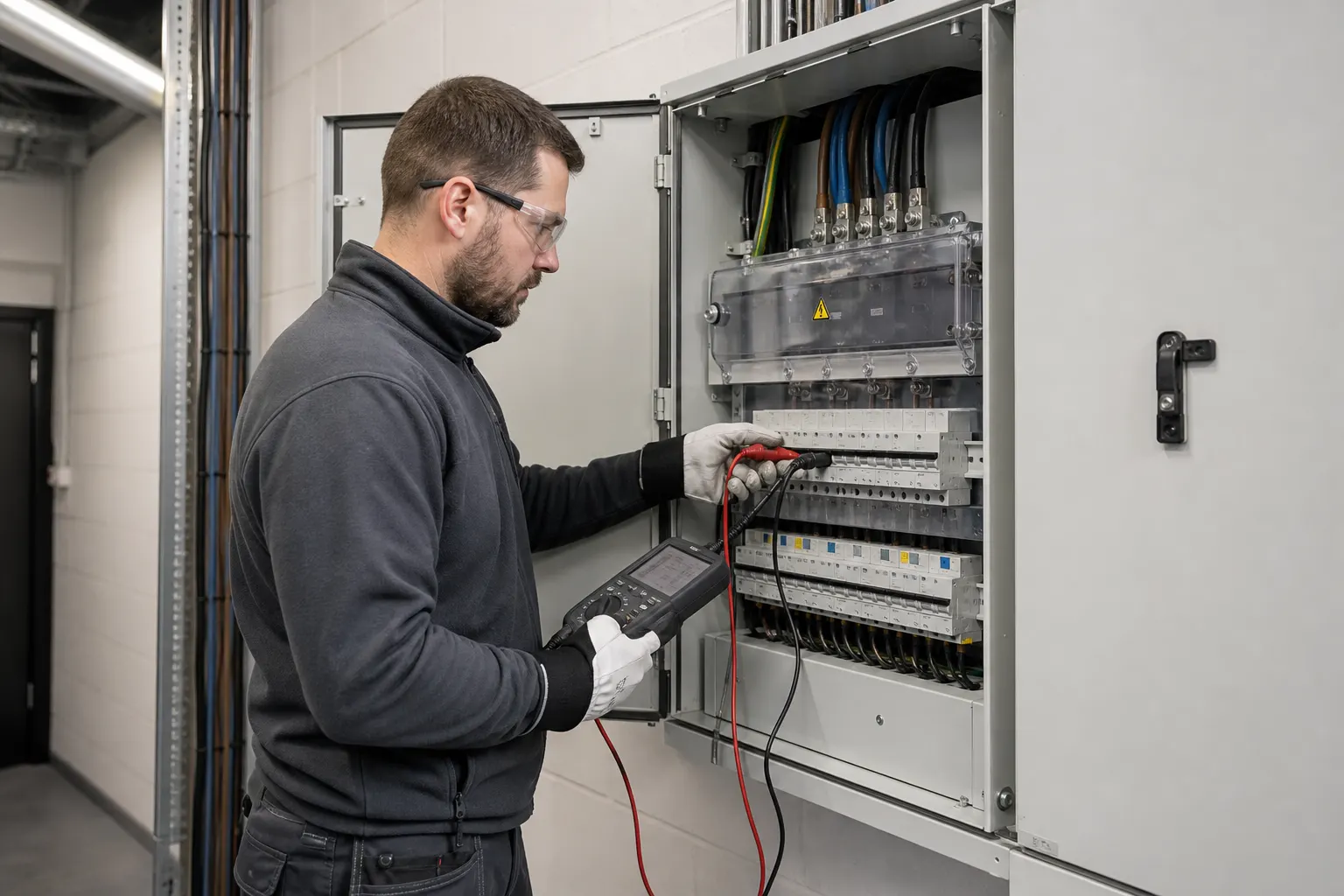
This is one reason to retain the full report, including the schedules of inspections, circuit details and test results. The summary page alone is not enough to plan technical work accurately.
Prioritise the real site risk
Classification codes establish urgency, but the remedial plan must also consider how the affected part of the installation is used. A defect on an isolated spare circuit has a different operational context from one affecting a production line, a water pumping system or a distribution board supplying occupied accommodation.
Useful questions include:
- Who could be exposed if the condition remains unresolved?
- Is the circuit currently energised, accessible or in regular use?
- Does it serve safety-related or business-critical equipment?
- Could one defect indicate a wider issue across similar equipment?
- Will remedial work require isolation of other boards or processes?
- Are replacement parts, specialist access or manufacturer input required?
- Can the work be combined with an existing shutdown or maintenance window?
The aim is not to downgrade electrical safety because a site is busy. It is to establish the safe controls, sequence and resources needed to complete the work properly.
Turn observations into defined work packages
An EICR records the condition found during inspection and testing. It is not necessarily a detailed remedial specification. Before quotations can be compared meaningfully, each observation may need to be translated into a defined package of work.
Confirm the location and affected circuit
Older or modified sites may have incomplete circuit schedules, inconsistent board names or equipment supplied from an unexpected location. Confirming the correct circuit at the planning stage reduces uncertainty when the shutdown begins.
Identify dependencies
A distribution board replacement might require more than changing the enclosure. Cable condition, protective devices, earthing arrangements, fault levels, discrimination, access and the suitability of connected circuits may all affect the final scope.
Separate repair from investigation
An FI observation is not a finished repair specification. Investigation may involve tracing a circuit, accessing concealed sections or carrying out additional tests before the appropriate corrective action can be established. A sensible plan allows for that uncertainty instead of assuming the cheapest possible repair.
Define verification and documentation
The scope should state how completed work will be inspected, tested and certified. Where necessary, affected circuits should be retested so that the business has clear evidence of what was corrected and the condition following the work.

Plan isolations around the whole operation
On a complex site, the practical cost of remedial work is often influenced by access and downtime as much as materials. Early coordination with production, facilities, IT, security, accommodation or site operations can prevent avoidable delays.
A workable isolation plan may need to address:
- the equipment and areas that will lose power;
- safe shutdown and restart procedures for connected machinery;
- temporary arrangements where these are technically appropriate;
- access to locked rooms, plant areas or occupied units;
- coordination with other contractors or equipment manufacturers;
- weather constraints for exposed outdoor installations;
- the sequence for testing, energisation and operational checks.
Live working should not be treated as a convenient alternative to planning an outage. The HSE guidance on the Electricity at Work Regulations explains that systems must be maintained to prevent danger so far as reasonably practicable and that inspection and testing form an essential part of preventive maintenance.
Use the findings to improve planned maintenance
Remedial work should address the immediate observations, but the report can also reveal patterns. Repeated loose connections, damaged accessories, moisture ingress or deteriorated enclosures may indicate that the maintenance programme, equipment selection or inspection frequency needs to change.
This is particularly relevant where equipment is exposed to dust, vibration, impact, salt-laden air, moisture, cleaning processes or frequent connection and disconnection. Conditions can vary considerably across the same site, so applying one inspection interval to every asset may not reflect the actual risk.
Retaining previous reports and test results allows changes to be compared over time. If a particular area repeatedly produces defects, the better long-term response may be to improve protection, alter equipment selection or introduce targeted interim inspections rather than repeatedly repairing individual symptoms.
Account for Cornwall site conditions
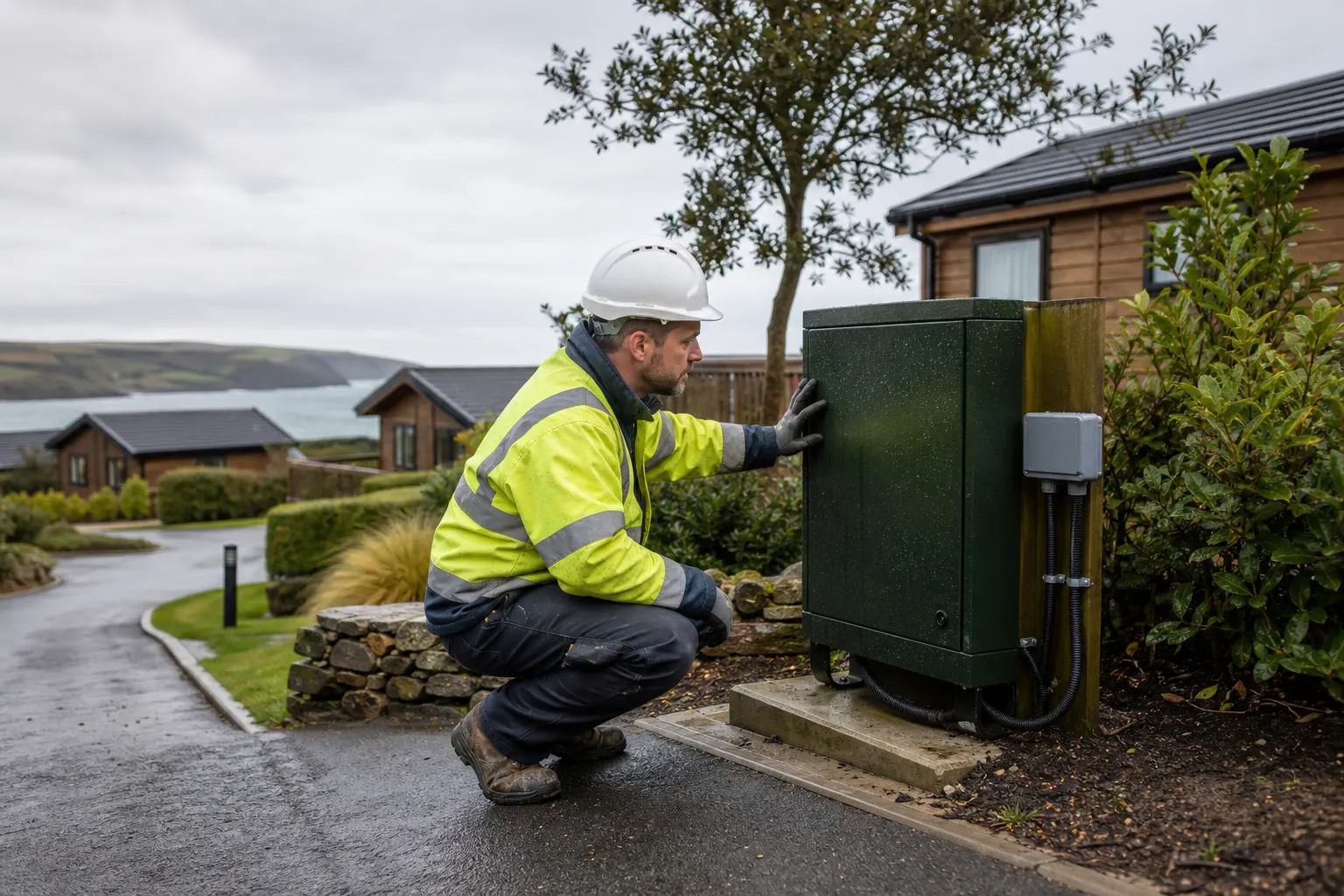
Many Cornwall businesses operate across exposed, outdoor or distributed locations. Holiday parks may combine accommodation, service buildings, external supplies and seasonal loads. Quarries and industrial sites can involve dust, vibration and heavy equipment. Coastal premises may face persistent moisture and corrosive conditions.
These factors do not change what an EICR code means, but they can influence how quickly deterioration progresses and how remedial work should be designed. An enclosure, accessory or cable route that performs adequately in a clean internal room may be unsuitable for an exposed service area.
Site context should therefore be considered when selecting replacement equipment and setting future inspection or maintenance arrangements. Simply replacing like for like may reproduce the same weakness.
Close the loop after remedial work
Once work is complete, keep the relevant certification, test results and details of any observations that remain outstanding. Update board schedules and site records where circuits or equipment have changed. If only part of a larger programme has been completed, the remaining actions should have named responsibilities and realistic target dates.
The objective is a clear record showing what was found, what was made safe, what was repaired and what still requires attention. That record supports future testing and helps prevent the same investigation being repeated at the next visit.
If your business needs help interpreting an EICR or planning commercial and industrial remedial work in Falmouth, Penryn, Newquay, Carnon Downs or elsewhere in Cornwall, contact Maenporth Electrical or call 01326 250297 to discuss the site, report and operational constraints.