
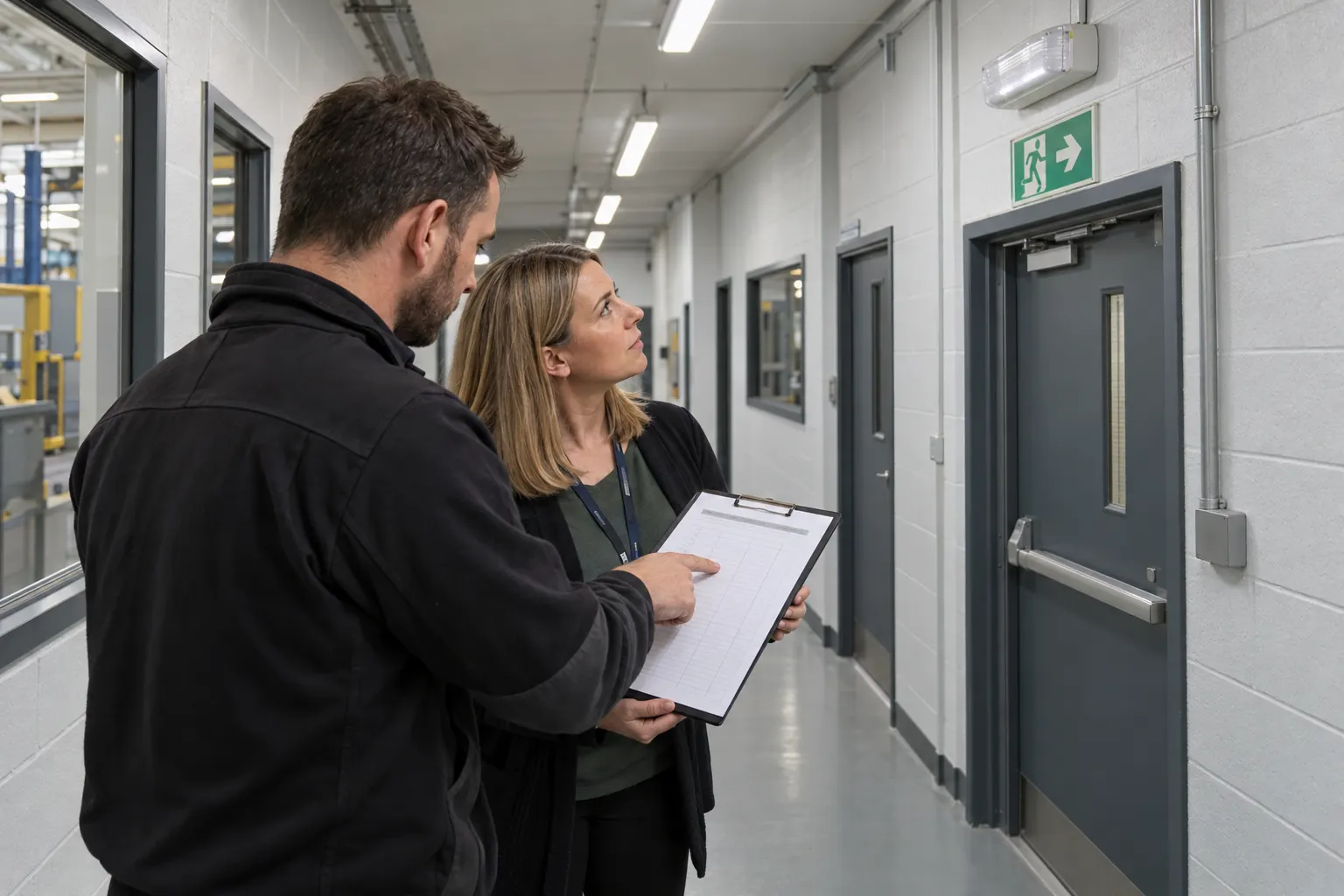
A failed emergency lighting test needs an immediate assessment of risk, not just an entry in the maintenance diary. The first question is whether people can still escape safely if normal lighting fails. Give the report to the person responsible for fire safety so that precautions and repairs can be decided.
A failed fitting does not automatically mean the whole site must close. Equally, normal lights working today do not prove that escape will remain safe during a supply failure. For a factory, holiday park or commercial premises, the response needs to follow the affected route, the people using it and the remaining emergency-lighting provision.
What a failed duration test tells you
A fitting that starts in emergency mode but goes out before the required duration has not demonstrated the necessary endurance. That is different from a fitting which does not illuminate at all, but neither result identifies the cause on its own.
Check the report rather than relying only on a verbal summary. Was the defect found during a functional check or a duration test? Which fitting or system was affected, and what was actually observed? An entry saying emergency lighting duration test failed is an outcome, not a battery diagnosis.
Ask the competent tester to confirm the required duration using the system documentation, equipment instructions and current BS 5266-1:2025 code of practice. Do not borrow a test duration from another building or treat a generic schedule as a universal legal rule.
Map the failure to the escape route and its users
Where necessary, escape routes and exits needing artificial illumination must have adequate emergency lighting. Home Office fire-safety guidance calls for an immediate risk assessment and identification of remedial action when essential fire-safety equipment is faulty or out of service.
Give the person responsible for fire safety a usable location, not just a total of failed lights. Capture:
- The building, floor or area, and the fitting reference where one exists.
- The route or feature affected, such as a corridor, stair, change of level or final exit.
- Who uses it, including unfamiliar visitors, lone workers, guests and people needing assistance to evacuate.
- When it is used, including evening shifts, early starts or overnight occupation.
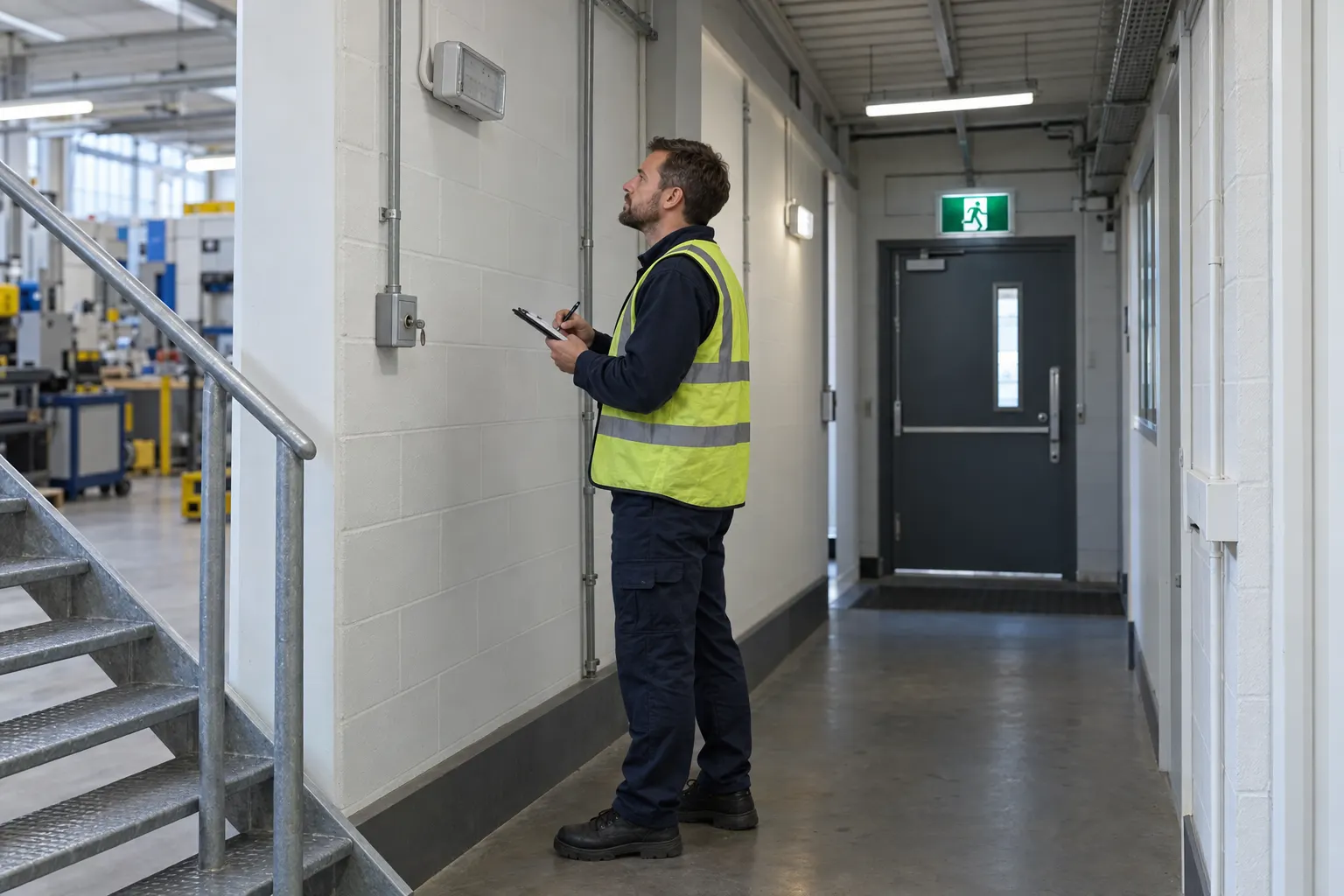
Consider the whole escape route, not just the patch beneath the failed light. A nearby working fitting does not by itself demonstrate adequate coverage. On a holiday park, for example, assess each affected guest or communal building rather than assuming the site has one uniform risk.
Control the risk while repairs are pending
The person responsible for fire safety, supported by competent fire-safety advice where needed, should decide what use can continue and under what conditions. The assessment should produce actions, named owners and a review point, rather than simply a repair request. Do not leave that decision until a repair appointment.
Depending on the findings, measures may include restricting access, changing occupancy arrangements or using an assessed alternative escape route. Any temporary emergency-lighting arrangement needs professional assessment for suitability. Do not assume that torches, temporary mains lighting or daylight will resolve the risk.
Where adequate escape arrangements cannot be maintained, the affected use may need to stop. Record the controls and brief the relevant supervisors, tenants or guest-facing staff. Revisit the decision if use or conditions change before repair.
Allow for readiness after a discharge test
A full-discharge test can leave emergency lighting not fully functional while batteries recharge. This can affect fittings which completed the test as well as those which failed. Confirm the actual recharge and readiness arrangements for the installed equipment when planning occupation, repairs and retesting; do not assume one recharge period applies everywhere.
Diagnose the fault before choosing repair or replacement
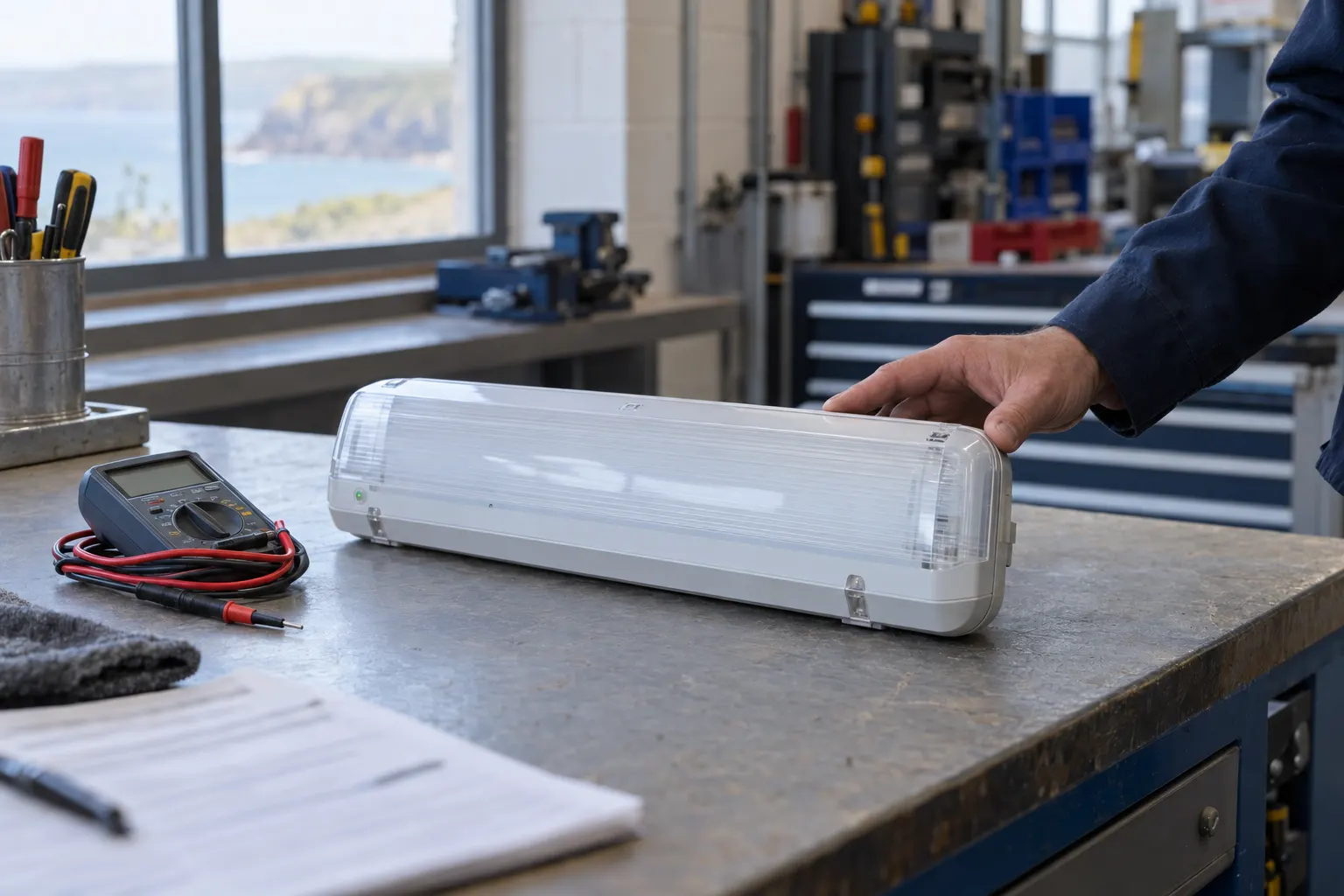
Commercial emergency lighting fault finding starts with the report and the installed system, not a shopping list of batteries. Share the test record, previous faults, available drawings and any known recent electrical work or supply interruptions with the contractor. These are clues, not proof of a cause.
Arrange electrical fault finding by someone competent in the emergency-lighting system. Assessment may need to distinguish a battery problem from a fault elsewhere in the fitting, its charging arrangements or the wider system. Do not open fittings, handle batteries or repeat electrical tests yourself to narrow it down.
The emergency lighting repair should address the confirmed defect without losing the intended emergency-lighting function. Ask the contractor to explain the proposed remedy, whether a compatible repair is appropriate and what verification will follow. Where replacement is needed, appearance alone is not a specification.
Agree access and any necessary restrictions before the visit, particularly where work affects an occupied corridor or a building used overnight.
Retest, record and close out the failure
Agree the evidence needed to close out electrical remedial work when commissioning it, not after the visit. A newly installed fitting or replaced component is not, on its own, proof that the original failure has been resolved.
Have the competent person complete the appropriate verification and retesting for the work and system. Confirm the result, any outstanding defects and readiness after any discharge. The person responsible for fire safety should review the evidence before removing interim controls.
Make the log useful to the next person
Keep the emergency lighting test log and remedial action record together, so the original failure remains traceable through to close-out. Record:
- The original test date, type, result and precise location or fitting reference.
- The risk assessment decision, temporary controls, action owner and review date.
- The diagnosis, work completed and any outstanding defects.
- The retest date, type and result, with the specified and achieved duration where relevant.
- The readiness confirmation and the decision to remove or continue interim controls.
File the contractor's report with the log rather than replacing the failure entry with a simple repaired note.
Look for repeat failures across buildings
Managing emergency lighting for multi-building sites also means comparing repeat defects by location and fitting type. Similar failures are a reason to investigate a pattern, not automatically to replace every unit. Coordinate further work and testing around each building's use so solving one problem does not create another readiness gap.
Discuss an emergency lighting repair
To discuss emergency lighting repairs in Cornwall, call Maenporth Electrical Ltd on 01326 250297. Based at Maenporth, we serve Falmouth, Penryn and the wider county. Have the failed-test report and affected building details ready.