
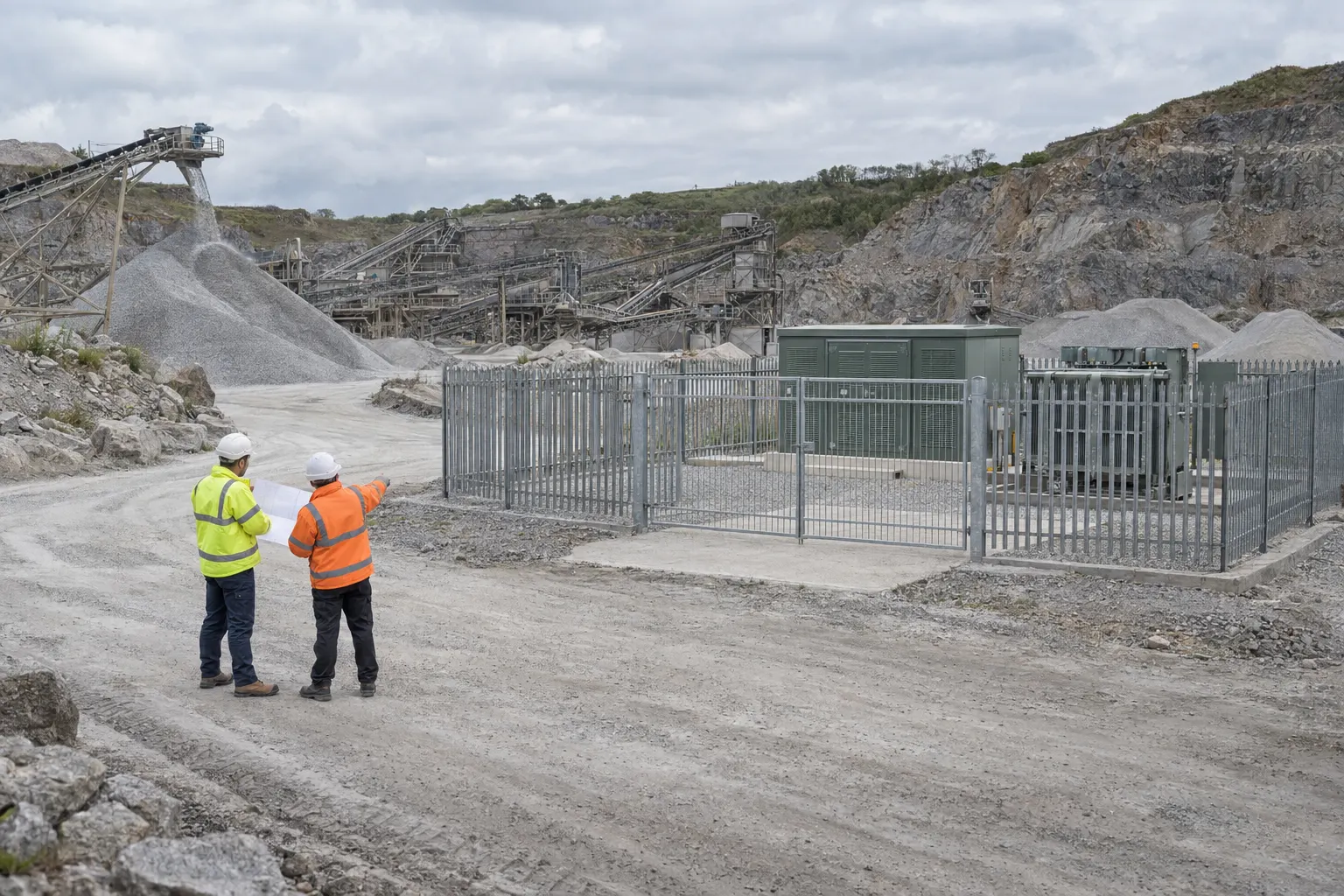
Planning an industrial HV connection should start with a clear project brief, not a transformer order. For a quarry, factory or larger rural site adding substantial demand, the first questions are what the network can provide, where the equipment could go and who will be responsible for it.
The aim before applying is not to finish the electrical design. It is to give the distribution network operator (DNO) and your project team enough reliable information to assess a workable supply.
LV or HV is not decided by one kVA figure
There is no universal demand figure at which an industrial site must change from low voltage (LV) to high voltage (HV). The right connection depends on the local network, the proposed load and the connection arrangement.
In Cornwall, National Grid Electricity Distribution (NGED) is the DNO. Its industrial and commercial connections guidance directs one-off commercial or industrial supplies above 70 kVA through the large-connection process. That is an application category, not an HV threshold.
If a major new load puts the existing supply in doubt, arrange an LV/HV assessment before committing to equipment or fixing the layout.
What the DNO connection offer needs to clarify
The DNO assesses the proposed demand against its network. A DNO connection offer for an industrial supply needs careful reading: identify the connection point and voltage, offered capacity, network works, charges and conditions.
Ask what is included, what must be supplied by the customer and which assumptions could change the proposal. Check any acceptance deadlines and dependencies. A network offer is not automatically a complete price or programme for the electrical infrastructure across your site.
If more than one arrangement is available, compare the full site scope and ongoing operating obligations, not just the connection charge. Ask why a particular voltage has been proposed and whether an alternative was assessed.

Prepare a demand brief, not just a plant list
For an industrial high-voltage connection enquiry, provide evidence of how the site will operate, not simply the sum of equipment nameplates. Gather:
- Existing supply information including agreed capacity, available drawings and recent demand records.
- Proposed loads with manufacturers’ electrical requirements and relevant motor-starting information.
- Operating patterns showing which loads run together, shift arrangements and seasonal peaks.
- Future phases with likely timing, plus existing or proposed generation and battery storage.
Give any demand records context: were they taken during normal production, a quiet season or a shutdown? Explain changes in working patterns so the project team does not treat an unrepresentative period as the basis for the new supply.
Distinguish measured figures from estimates, and committed loads from possible expansion. If reliable demand data is missing, ask your electrical adviser what monitoring is needed before treating an assumption as the design basis.
Plan the substation and site distribution together
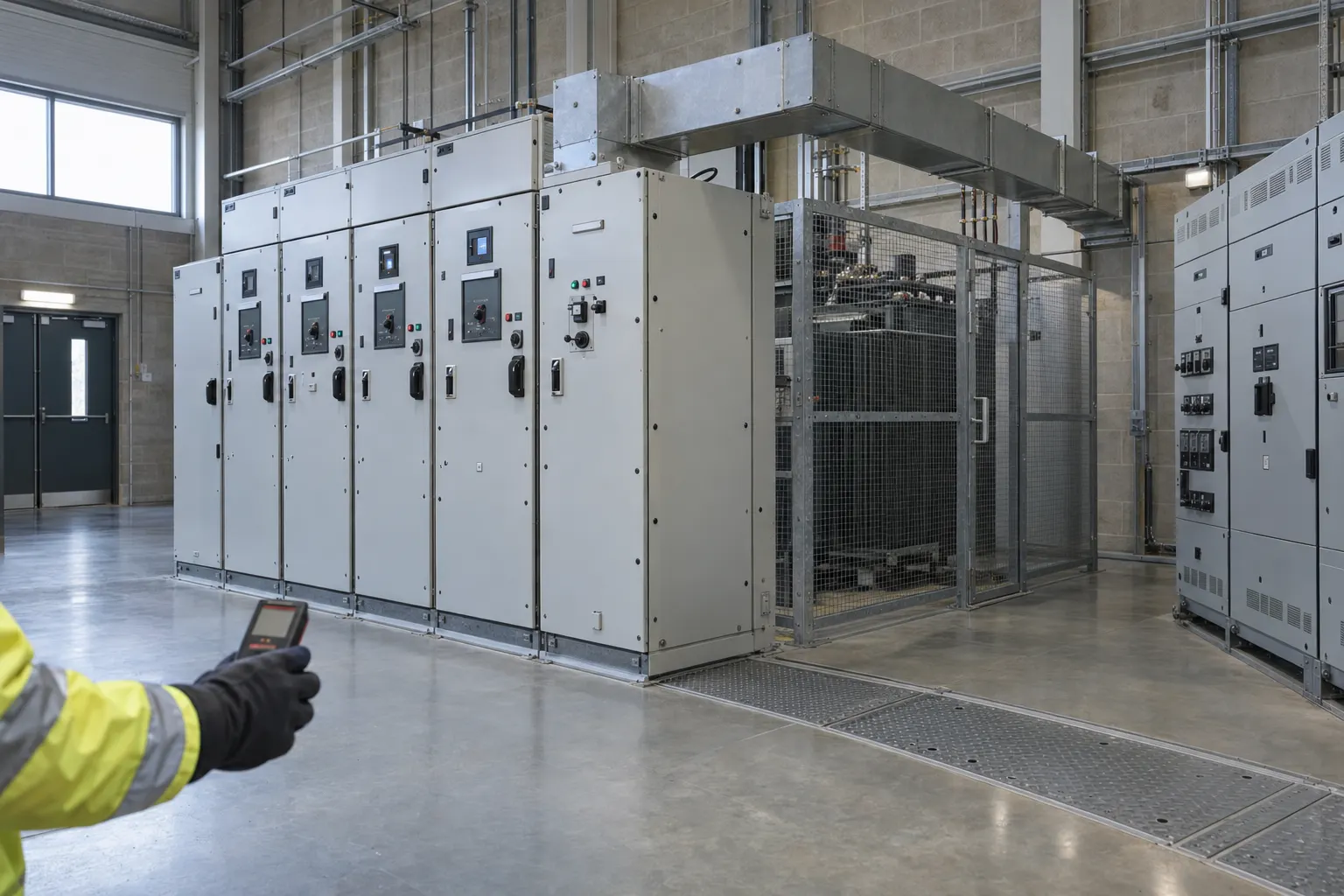
Industrial substation planning needs to connect the network proposal with the equipment your business will actually use. For 11 kV transformer planning, consider the HV switchgear, transformer, LV distribution, protection and earthing as an integrated specialist design.
Do not assume a transformer’s rating equals the agreed import capacity. Ask for drawings that identify the supply and ownership boundaries, cable routes and interfaces with existing distribution.
NGED’s published technical documents separate design and planning from installation and records for industrial and commercial connections up to 11 kV. Ask your specialist team which requirements apply and who will produce the necessary drawings and handover information.
Maenporth Electrical’s published quarry power upgrade documents a 1,500 kVA, 11 kV to 415 V transformer installation, with HV/LV equipment, protection, earthing, containment and associated groundworks. It is one example of an integrated project, not a typical size, price or solution for another site.
Check land, access and cable routes early
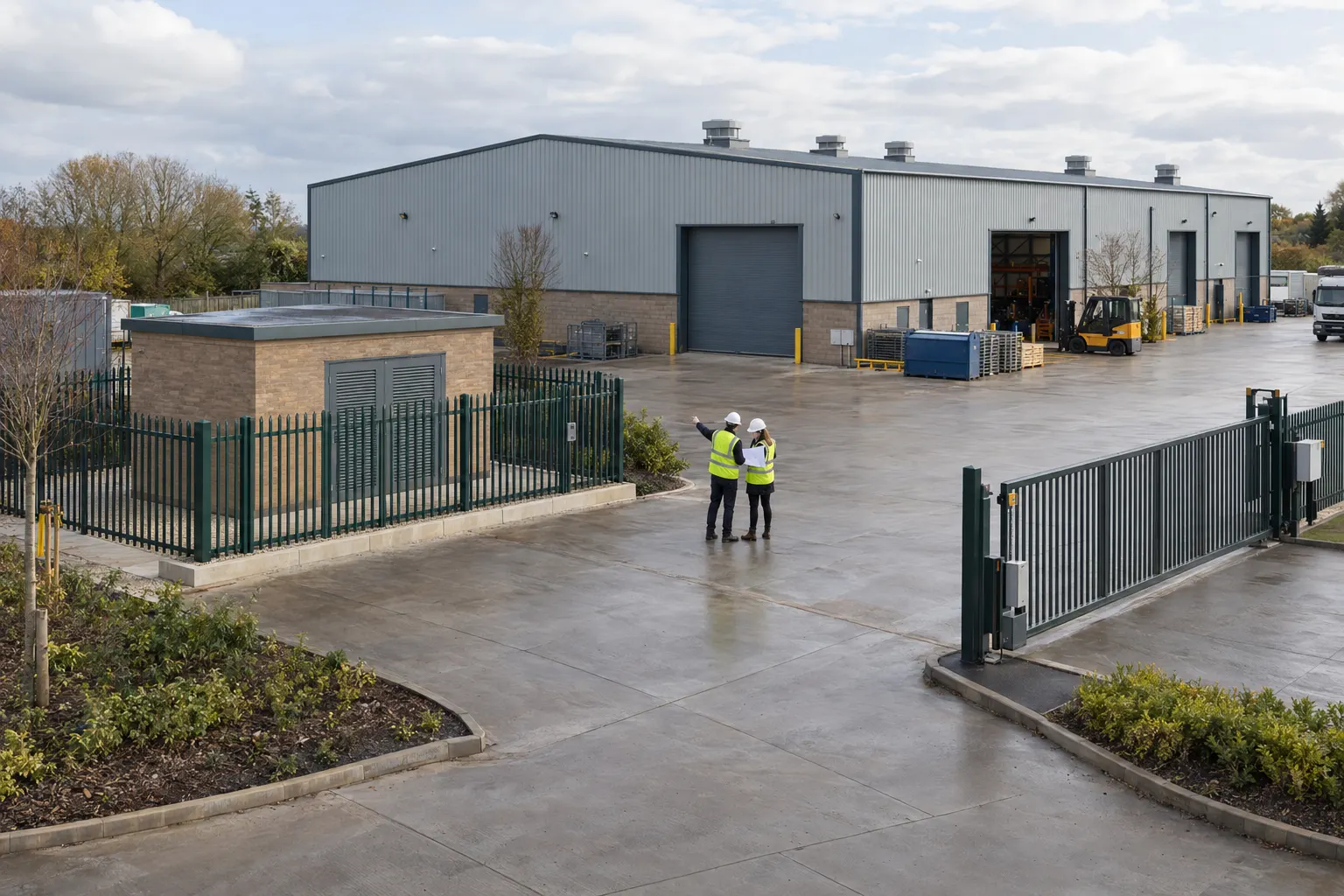
A suitable location must work for installation, operation and eventual replacement, not just fit the equipment footprint. Identify land ownership, access rights, delivery access, routes across the site and constraints such as existing services or drainage.
Clarify who designs and provides foundations, enclosures, trenches and other civil works. Resolve interfaces before fixing layouts: an apparently convenient substation position may create difficult cable routes or restrict future site use.
On a leased or shared site, identify whose agreement is needed for the substation footprint and cable route. Do not leave access for future maintenance until after construction.
Decide who will own, operate and maintain the equipment
A substation on your land does not, by itself, establish the supply voltage or who owns each component. Confirm whether the site will take an LV or HV supply and where network assets end and customer responsibilities begin.
HSE’s Keeping electrical switchgear safe (HSG230) addresses selection, use, operation and maintenance. HSE also notes that specialised HV switchgear maintenance is likely to require additional training and experience.
For customer-owned equipment, agree who arranges inspections, maintenance, fault response and authorised switching. Establish competent operational support before handover, including records and emergency contacts. HV work is not a task for unqualified site staff.
Build the budget and programme around confirmed scope
Check whether NGED’s current assessment and design charges apply before requesting a quotation. Do not assume the quotation process is free, or confuse offer-preparation charges with the price of construction.
Separate network connection costs and any reinforcement charges identified in the offer from customer-side expenditure. Allow for specialist design, equipment, site distribution changes, civil works, land arrangements, commissioning and any operational disruption.
Make exclusions and provisional items clear, particularly where cable routes, civil works or shutdown arrangements remain undecided. Include ongoing operational support and maintenance when comparing a customer-owned HV option with an alternative arrangement, rather than treating the initial connection charge as the whole cost.
Identify the programme constraints
Ask which milestones govern delivery: network approvals, land agreements, civil readiness, equipment availability and agreed outages. Confirm who controls each dependency and what must be ready before the next stage.
A requested operational date is not a confirmed connection date. Keep plant delivery and production changeover plans conditional on an agreed programme rather than relying on a generic lead time.
A pre-enquiry checklist for the project team
Before submitting the brief, check that you have:
- A site plan showing the boundary, any existing intake, possible substation space and cable routes.
- A demand schedule separating existing loads, new plant, operating patterns and future phases.
- Existing supply records, available drawings and clearly labelled assumptions.
- A proposed operational date, acceptable shutdown windows and known land or access constraints.
- A named project contact and a list of questions about scope, ownership, charges and responsibilities.
These details help turn an industrial HV connection enquiry into a defined project for assessment, without pretending the answer is known in advance.
Maenporth Electrical is based at Maenporth and serves Falmouth, Penryn and wider Cornwall. To discuss your project’s site-side requirements and our industrial electrical services, call 01326 250297 with your site plan and available demand information.