

Adding battery storage to existing commercial solar may be possible without replacing the whole PV installation. But retaining equipment depends on the inverter arrangement, controls, electrical capacity and network connection, not simply whether there is space for a battery.
For a factory, quarry, holiday park or leisure site, start with a feasibility assessment rather than a battery size. Establish what can remain, which upgrades might be needed and whether the operating data supports the investment before asking for a firm installation price.
Start with the existing PV system and its records
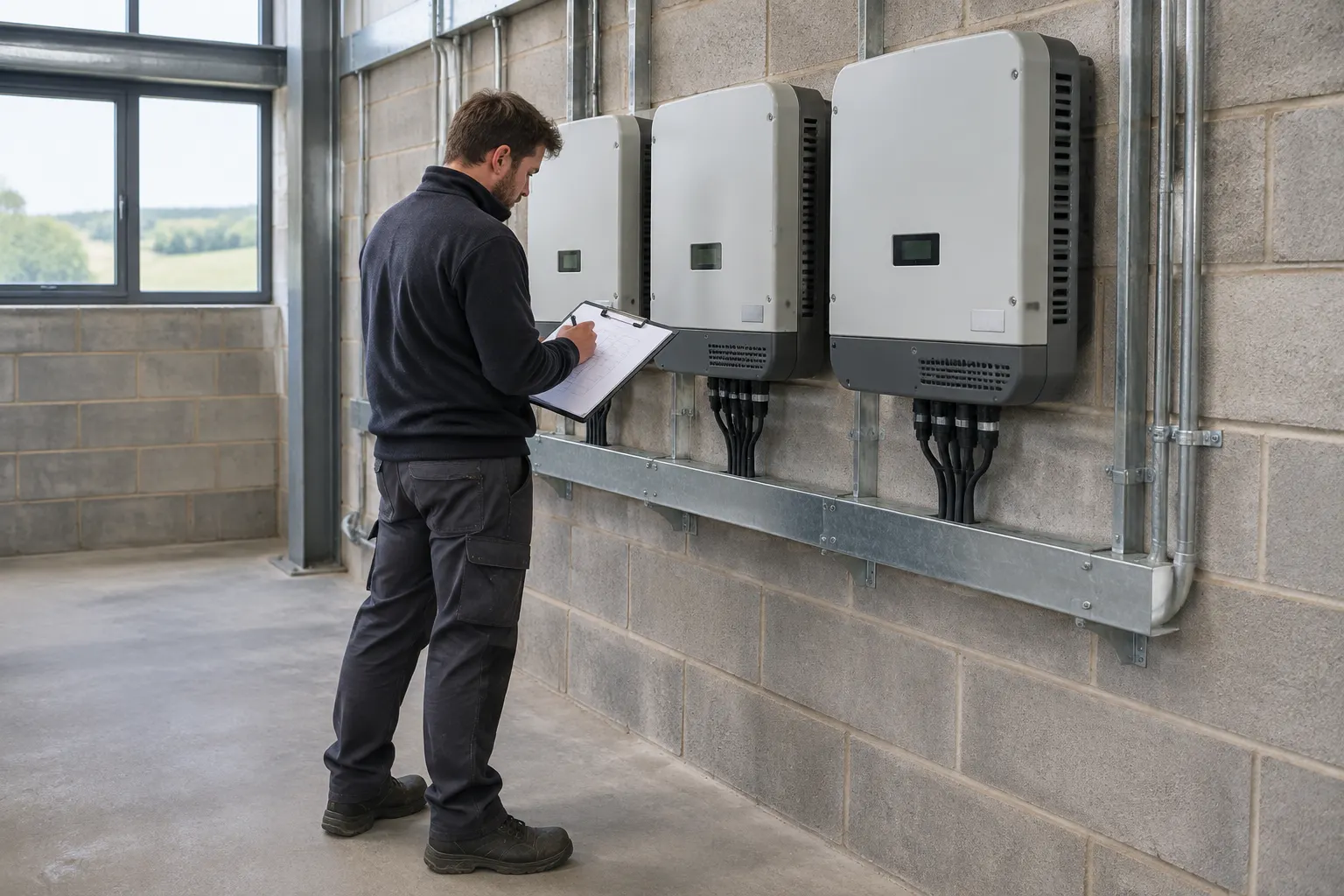
An array's panel capacity does not describe the whole installation. Before specifying a commercial solar battery retrofit, gather:
- PV inverter makes, models and ratings, plus current system diagrams.
- Commissioning and test records for the solar installation.
- Generation monitoring records and available interval import and export data.
- Existing distribution network operator (DNO) notification or approval and agreed export arrangements.
- Details of export-limitation equipment, meters and site energy-management controls.
Where a site has several inverters or more than one distribution board, establish how they connect together. Records should cover later additions or control changes, not just the original installation.
Missing paperwork does not automatically rule out storage, but a competent contractor may need to survey and verify the existing arrangement before providing a firm specification. Do not assume that equipment shown on an old drawing is still the equipment in service.
Compare AC-coupled and DC-coupled battery storage
The choice between AC-coupled and DC-coupled battery storage depends on the existing installation. Inverter and battery compatibility must be checked against the actual models and proposed controls.
Request confirmation of the supported battery and inverter combination, together with any required communications or control interfaces. A general statement that equipment is battery-ready is not a substitute for a design based on the installed models.
AC-coupled storage
An AC-coupled battery has its own power-conversion equipment connected on the AC side of the installation. This may allow the existing PV inverter to remain, but charging, metering and export controls still need a coordinated design.
DC-coupled storage
DC coupling connects storage into the renewable system's DC arrangement. It requires compatible equipment and may involve replacing the existing inverter or reconfiguring the installation.
Ask the designer to identify what stays and what changes under each viable option, including monitoring and communications. An inverter change should not be treated as inevitable, nor should retaining it be promised before checking compatibility. Compare the complete scope of work, not just the battery price.
Use site data to define the battery's job
Battery storage for existing commercial PV should be assessed against a clear aim: using more solar on site, shifting purchased electricity to a different time, or managing demand peaks. These need different operating strategies.
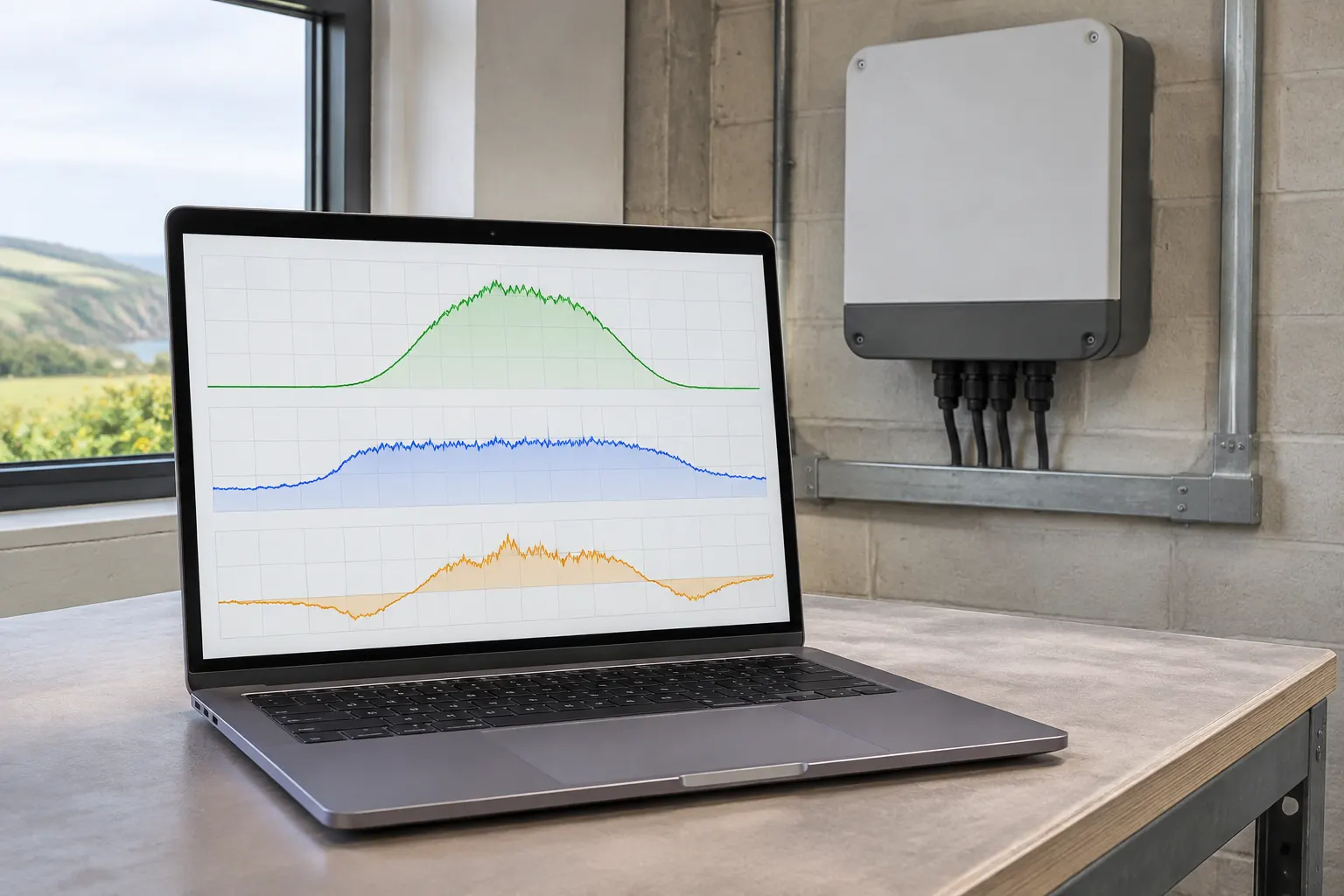
Compare interval demand, PV generation and imports and exports across representative working and non-working periods. Include seasonal changes: a holiday park with summer-evening demand needs a different assessment from a factory with steady weekday production. For seasonal sites, ask which months underpin the model rather than extrapolating from a single busy period.
Ask the proposal to show when surplus solar is available, when the site imports electricity and how those periods align with the proposed charging and discharging schedule. Annual totals cannot show those relationships.
Power, measured in kW, describes how fast the battery can charge or discharge. Usable energy, in kWh, describes the energy available for use. Both matter. Annual bills or panel capacity alone cannot establish the right size or payback; include import and export tariffs in the commercial assessment.
Ask which tariff and operating assumptions underpin any estimated return, particularly if opening hours or major electrical loads are expected to change.
Check electrical capacity, protection and controls
Adding storage changes more than the equipment list. A competent designer should review the proposed charging and discharging modes alongside the supply, distribution boards, cables, protection and earthing. Battery charging can add demand; its ability to discharge does not remove that assessment.
The PV inverter, battery controls, site metering and any export limiter need a coordinated scheme. Establish how the combined system measures power flow, how controls interact and who will commission and document it.
Ask how the integrated controls and agreed export settings will be verified and recorded at handover. The specification should make responsibility for that work clear, particularly if retained PV equipment and new battery equipment come from different suppliers.
On multi-building sites, confirm which supply and metering point the battery will serve. Make sure the assessment boundary matches the part of the business whose demand you intend to manage.
If distribution upgrades are needed, include industrial electrical services in the scope rather than pricing storage as a stand-alone addition.
BS 7671:2018+A4:2026 includes provisions for stationary batteries. New work needs to address the applicable requirements, but a standards update does not automatically mean the existing PV installation must be replaced.
Confirm the DNO and export-control route before ordering
For a Cornwall site, confirm the relevant DNO using the site's postcode, then establish the existing connection position and proposed storage operating mode.
National Grid Electricity Distribution (NGED) sets out a narrow fast-track route in its energy storage connection guidance for qualifying small single-phase systems, with conditions covering G98-compliant equipment and G100 export limitation. Its guidance directs other storage installations through the G99 generation application process.
Do not assume an existing PV approval covers the proposed battery. Confirm whether a G99 application for battery storage is needed for the actual configuration before committing to equipment.
The designer should assess the proposed PV and storage arrangement together, using the existing connection documents. Neither equipment compatibility nor retaining the same export limit establishes the correct approval route on its own.
Export limitation is not permission to connect. Where a G100 export-limitation scheme is proposed, NGED requires an application alongside the relevant generation forms. Its published process places installation and commissioning after connection approval, so allow for that sequence in procurement and programme planning.
Prepare a brief that supports a useful quote
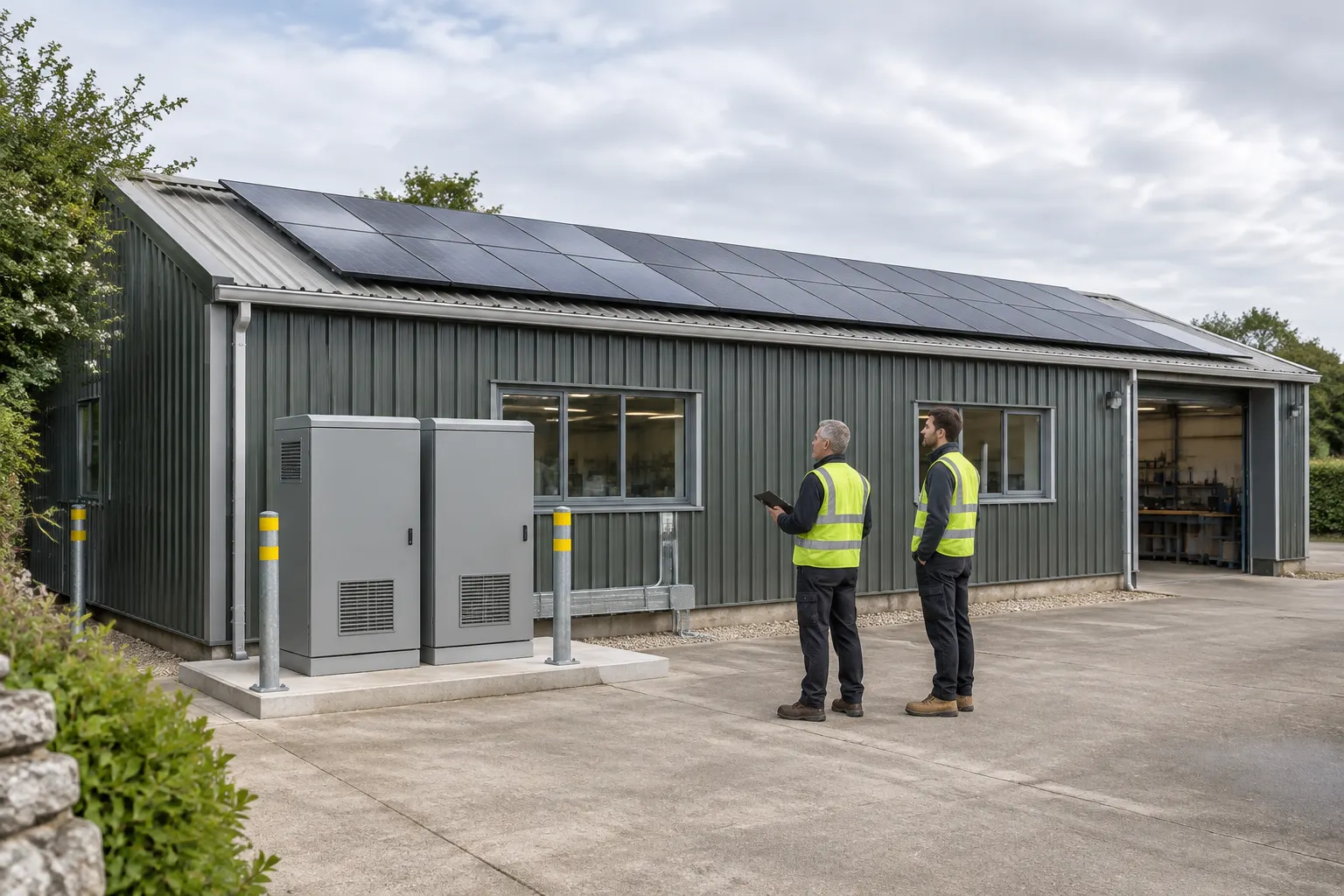
Give prospective designers the existing-system records, interval energy data, operating hours, tariffs and intended battery function. Ask the proposal to identify:
- Equipment retained, replaced or added, including controls and metering.
- Electrical upgrades, planned shutdowns and assumptions about the existing installation.
- DNO application and export-control responsibilities.
- Commissioning records, operating settings and handover information.
A useful quotation makes exclusions visible. If the survey identifies an unresolved connection issue, missing operating data or an electrical upgrade outside the battery installation price, ask for that item to be stated separately rather than hidden in a general allowance.
Keep technical feasibility and commercial value separate. A battery may be electrically workable yet not justified by the site's present demand and tariff. Equally, attractive modelled savings do not resolve an unsuitable inverter arrangement or an outstanding network decision.
There are three legitimate outcomes: add storage, complete electrical upgrades first, or defer the investment until the evidence supports it. A commercial battery retrofit feasibility assessment should leave all three options open.
To discuss battery storage for your existing solar installation, call Maenporth Electrical Ltd on 01326 250297. Based at Maenporth, we serve Falmouth, Penryn and wider Cornwall.