
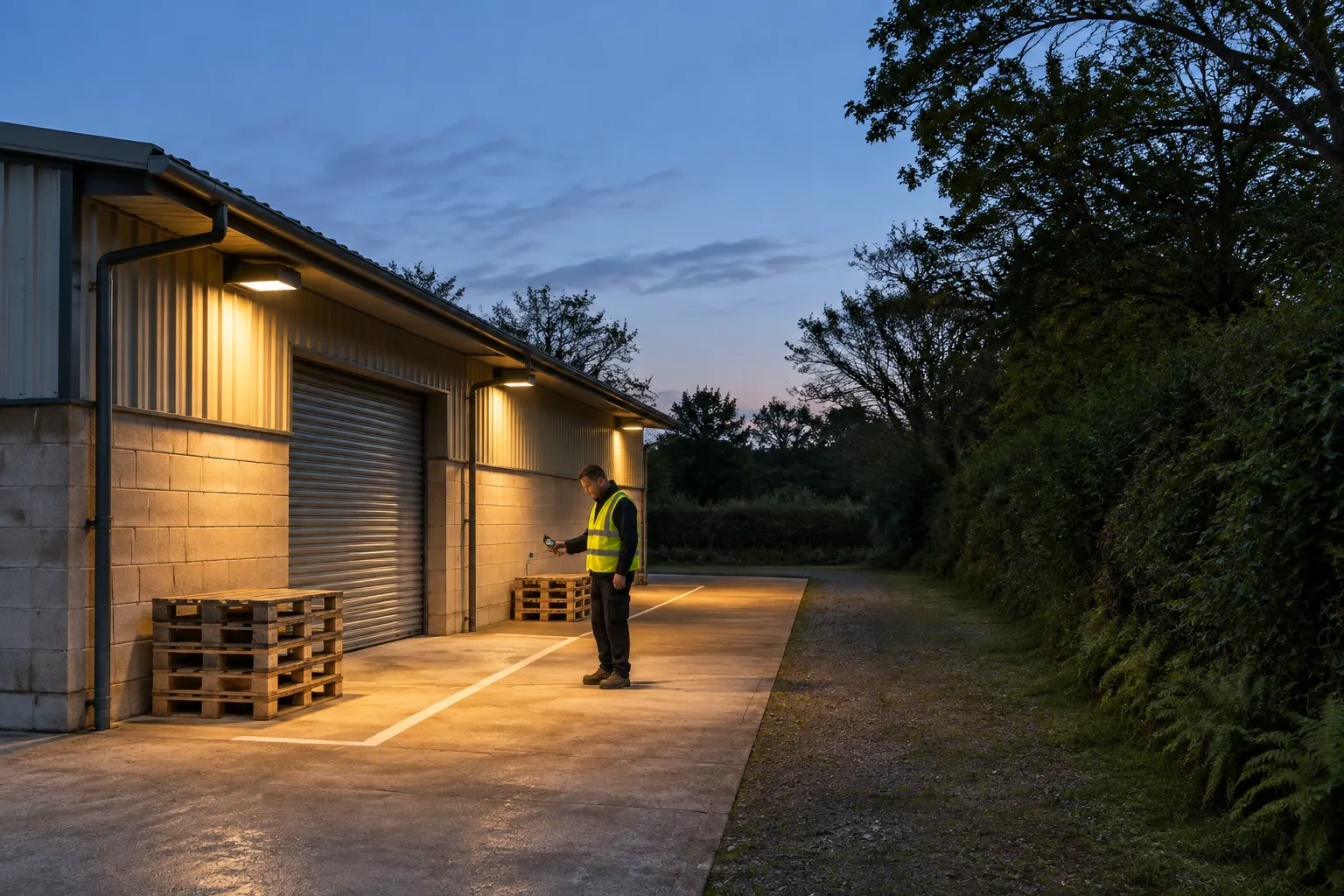
A yard can be bright and still be unsafe if drivers face glare or pedestrians move between pools of light and darkness. Equally, lighting a whole boundary can affect bat habitat without improving the working area.
A commercial outdoor lighting plan should define where light is needed, where darkness must be retained and how both will be achieved. For Cornwall sites near hedges, woodland or water, that means coordinating site operations, ecology and lighting design before ordering fittings. This is particularly relevant to new or materially changed schemes at yards, quarry entrances and leisure sites.
Define which working areas and routes need light
Start commercial yard lighting with a task-and-route brief: vehicle movements, loading, pedestrian crossings, parking and entrances, together with operating hours. A rarely used gate and a busy loading area may need different arrangements.
Include late deliveries, seasonal opening and shared pedestrian/vehicle routes. A leisure-site footpath used after the main buildings close needs a different schedule from an unused storage area.
HSE’s workplace transport guidance calls for suitable and sufficient lighting in yards, pedestrian areas and places with vehicle movements, with attention to glare and fitting positions. More light is not necessarily better if it dazzles a driver.
Use this operational brief when discussing commercial lighting services, so the scope reflects how the site actually works.
Map boundaries and wildlife routes before positioning fittings
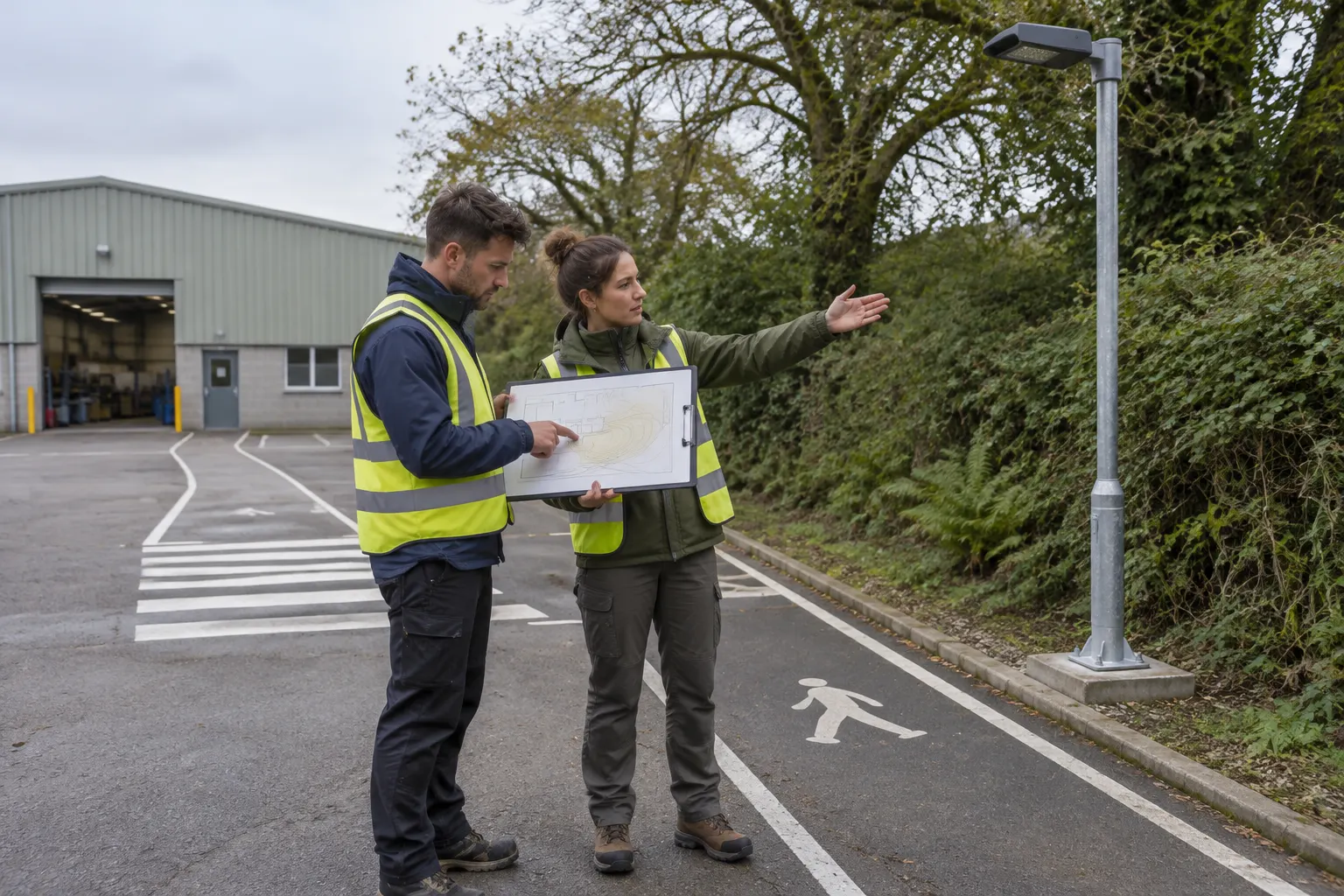
Mark hedges, tree lines, watercourses, neighbouring windows and existing dark areas on the site layout. Record lighting on adjacent land too: light spill from site lighting does not stop at the fence.
Include light from building windows where it could reach those features. A boundary hedge may be a wildlife route, not simply a screen for hiding fittings.
Do not assume that an absence of bat records means bats are absent. Natural England identifies lighting buildings or green spaces near bat habitats as a possible survey trigger.
Not every repair, replacement or new installation needs planning permission, a bat survey or a formal lighting assessment. Requirements depend on likely effects, the site and any planning conditions. Permitted-development rights do not override protected-species legislation.
Bring ecological advice and lighting design together early
Where sensitive habitat may be affected, involve a suitably qualified ecologist and lighting designer before fixing column positions or mounting heights. The ecologist identifies ecological constraints; the lighting professional develops and models a scheme around those constraints and operational needs.
Ask what survey evidence is needed and when it can be gathered. A lighting model cannot establish which species use the site.
Cornwall’s Planning for Biodiversity Guide is a material consideration in planning decisions. For relevant planning cases where bats or other sensitive receptors are present, it says to expect a lighting plan showing lux levels.
For bat-sensitive external lighting, agree protected routes before procurement. The commercial outdoor lighting design should incorporate ecological advice, not replace it.
What a commercial outdoor lighting plan should show
A useful plan is more than dots marking fittings. Check that it includes:
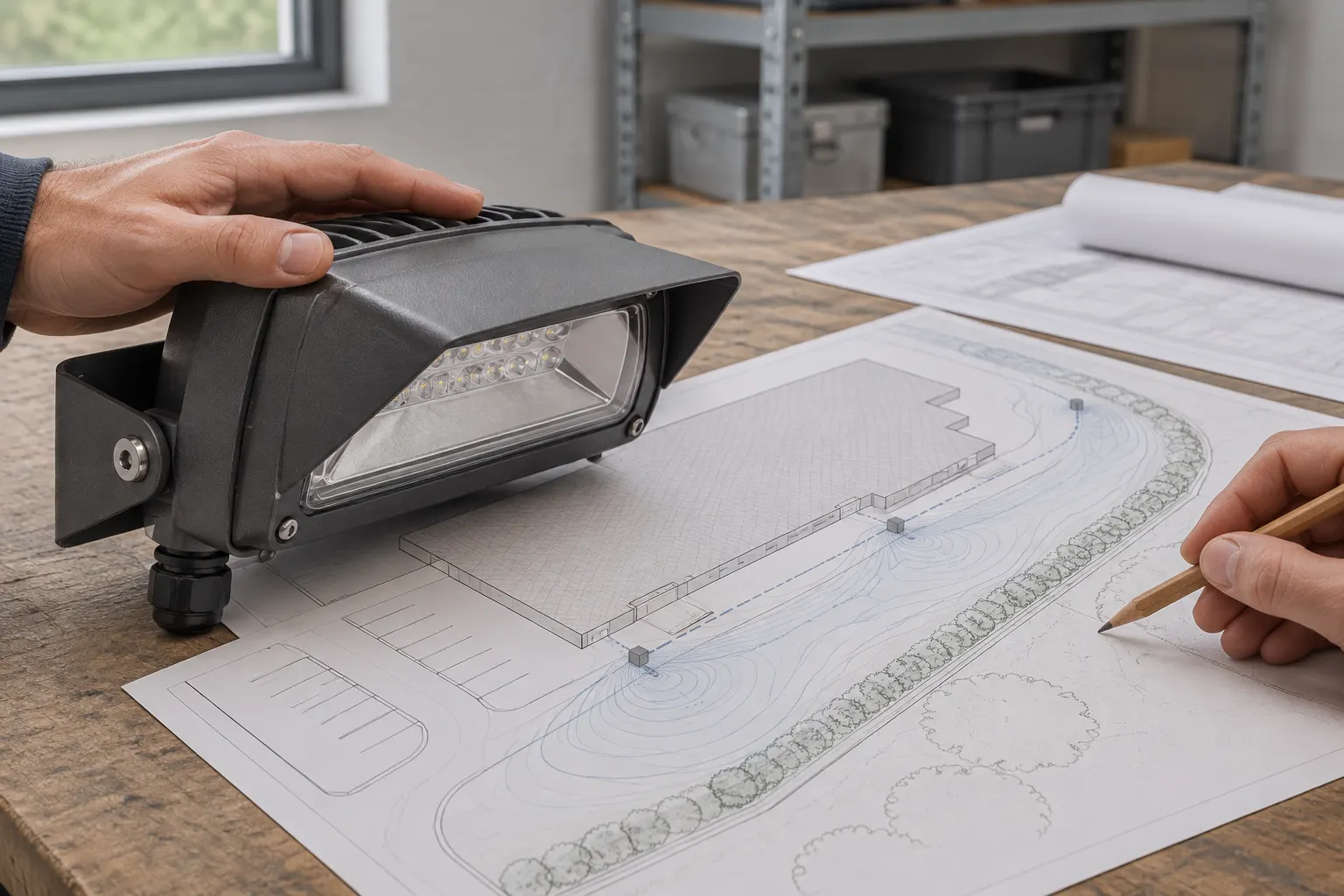
- A scaled layout showing working areas, sensitive boundaries and adjacent habitats.
- Fitting specifications and quantities, positions, mounting heights, orientation and shielding.
- Operating hours, dimming, sensor settings and any override arrangements.
- Predicted light levels across the site, including spill towards habitat and neighbouring windows.
The model should match the proposed luminaires and optics, rather than a generic fitting. Wattage alone does not tell you where light will land.
Read the contours in three dimensions
A lighting lux contour plan joins points of equal predicted illuminance, measured in lux. Ground-level results alone may miss effects at hedge height.
The guide recommends horizontal-plane plots at ground level and up to 3 metres, including plans at 0, 1 and 2 metres. Vertical plots may also be needed for hedges or tree lines.
It also calls for Day 1 contours using Maintenance Factor 1. This represents initial output without assuming a reduction through ageing or dirt; ecological checks should not rely only on reduced maintained-output predictions.
Ask the designer to explain the critical boundaries and working points. An acceptable average across the yard does not establish what happens at a particular hedge, window or crossing.
Limit light spill without leaving active areas unsafe
Direct light towards tasks and routes, rather than illuminating the whole perimeter. Suitable optics, shielding, positioning and aiming can help control spill. Avoid upward lighting in areas used by light-sensitive bats, as well as direct glare or line of sight from sensitive receptors to the light source.
For wildlife-sensitive security lighting, define what triggers each fitting and how long it stays on. Sensors, dimming and part-night operation are not universal ecological fixes: the guide says part-night lighting will not be accepted as mitigation for impacts on horseshoe bats.
If a proposed dark zone conflicts with an active vehicle route, take that conflict back to the ecologist and lighting designer. Simply leaving a working route dark is not an acceptable safety solution.
The answer may involve changing the route, moving fittings or separating working and protected areas, rather than simply reducing every fitting’s output. Check that any revised arrangement still works during the site’s actual operating hours.
Keep the installed scheme aligned with its plan and controls
At commissioning, have the contractor check the actual fittings, mounting heights, aiming, shielding and control settings against the agreed design. Include normal, dimmed and override modes, not only the setting used for the planning drawing. Substitutions or altered aiming can change the agreed distribution.
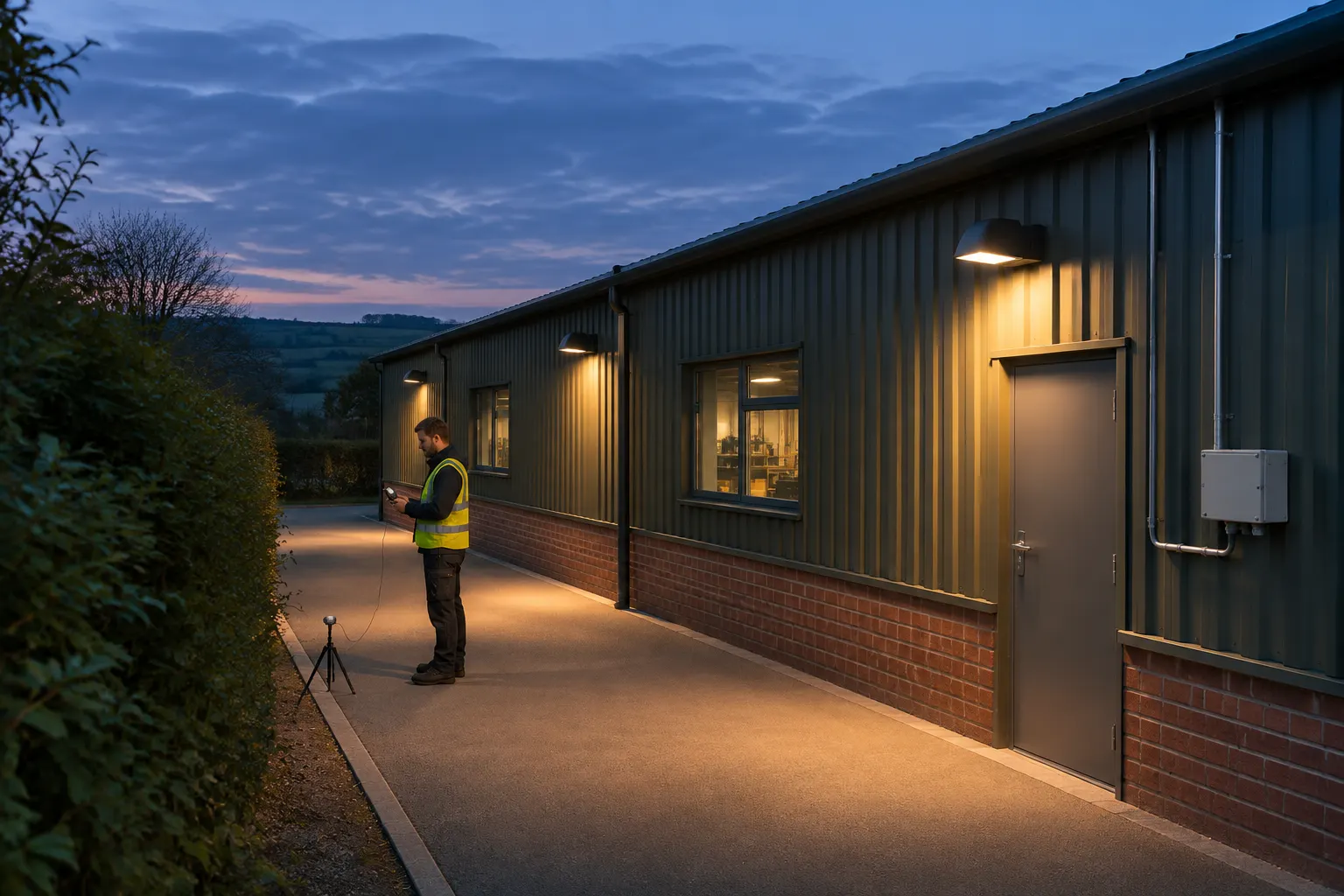
Agree any verification measurements with the lighting designer and ecologist, including locations and operating states. Where verification is required by a planning condition, agree who supplies the evidence. Keep as-installed drawings and a controls schedule so later staff know what must remain unchanged.
Record who can alter settings and how changes are reviewed. A permanently overridden sensor or an added floodlight can undermine the scheme. Include the lighting supply and future maintenance requirements in the wider commercial electrical work, rather than treating fittings as an isolated purchase.
After handover, review proposed changes to operating hours, routes and fittings against the plan. A later addition should not quietly turn an agreed dark corridor into a lit boundary.
Treat lux figures as site-specific targets, not a universal bat-safe threshold
Cornwall’s guide discusses 0.5 lux for dark zones, but also describes horseshoe bat corridors with average levels of about 0.04 lux. Do not treat either figure as a universal bat-safe limit: species and habitat matter, and the guide warns that there may be no threshold below which effects are negligible.
The guide recommends warm-white LEDs at 3000K or below wherever possible. That is not a blanket legal requirement, and colour temperature alone does not make a fitting wildlife-safe.
Have the ecologist establish the site-specific requirements and the lighting professional demonstrate how the proposed design addresses them. The aim is a workable scheme that protects the necessary darkness while providing suitable light for people using the site.
Maenporth Electrical serves Falmouth, Penryn and wider Cornwall. To discuss the electrical installation, controls and maintenance scope for your planned outdoor lighting, call 01326 250297. Bring your site layout, operating hours and any existing ecological advice or planning conditions.