
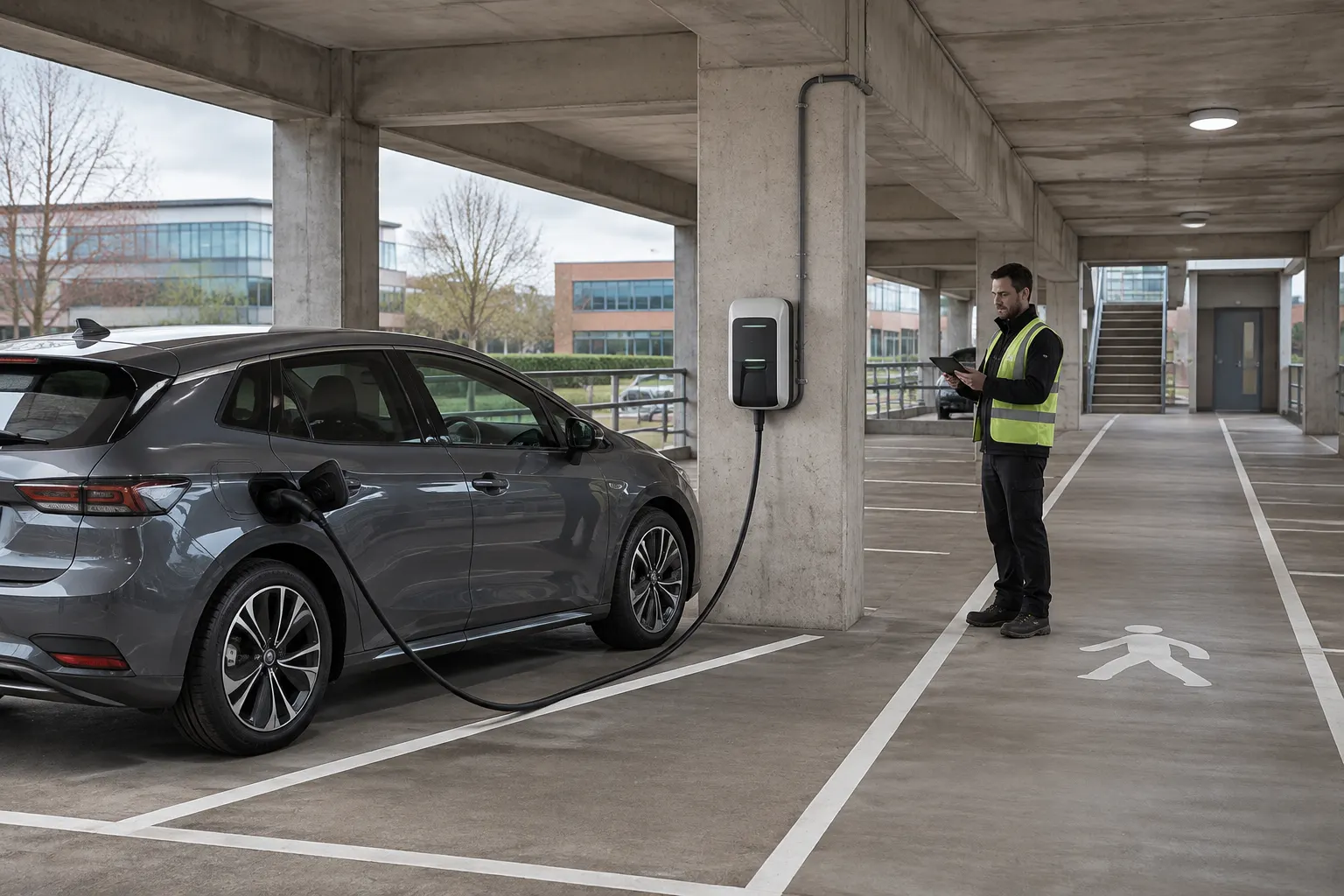
Adding chargepoints to a covered car park changes more than the electrical load. Charger positions, cable routes, escape routes and emergency arrangements need to work with the building’s existing fire strategy.
An EV charger fire risk assessment should inform the design before equipment is ordered, rather than become a check at the end. For Cornwall’s commercial and leisure premises, the practical task is to connect a competent fire-safety review with the electrical installation brief. That does not mean assuming EVs are inherently more fire-prone, or applying identical precautions to every car park.
When does the covered-car-park guidance apply?
The government’s interim guidance on EV charging fire safety in covered car parks applies in England, including Cornwall. It covers underground, enclosed and open-sided car parks for passenger cars and vans.
Open sides do not automatically put a structure outside its scope. However, the document does not cover residential garages, e-bikes, forklifts or buses, and its covered-parking recommendations should not be treated as blanket rules for wholly open-air sites.
It is interim guidance, not legislation or a legal compliance document. It also acknowledges an evolving evidence base. Its purpose is to support site-specific decisions, not supply a universal layout or equipment checklist.
Start with the existing fire strategy
The guidance calls for a fire risk assessment before EV charger installation, carried out by a competent person with sufficient experience of fire safety in car parks. It should consider effects on existing precautions and any new or increased hazards.
For an existing car park, gather the fire strategy, current premises assessment, relevant plans and maintenance records. The review should cover active and passive precautions, site management arrangements, and the maintenance and testing status of relevant measures.
That includes understanding measures intended to respond to a fire, such as detection where provided, alongside passive protection such as fire-resisting construction. The assessment should consider the whole car park, not only the charger. If records are missing, raise that early rather than treating the absence of information as confirmation that the proposed layout is acceptable.
The Responsible Person may be an employer, owner, landlord or occupier, depending on who controls the premises. They retain the legal duty to assess fire risk, keep a written record and review it regularly. Shared premises require coordination between responsible parties.
These duties are distinct from the interim guidance. Do not assume every charger at every site automatically requires a separate new statutory assessment; agree how the existing assessment needs to be reviewed and updated.
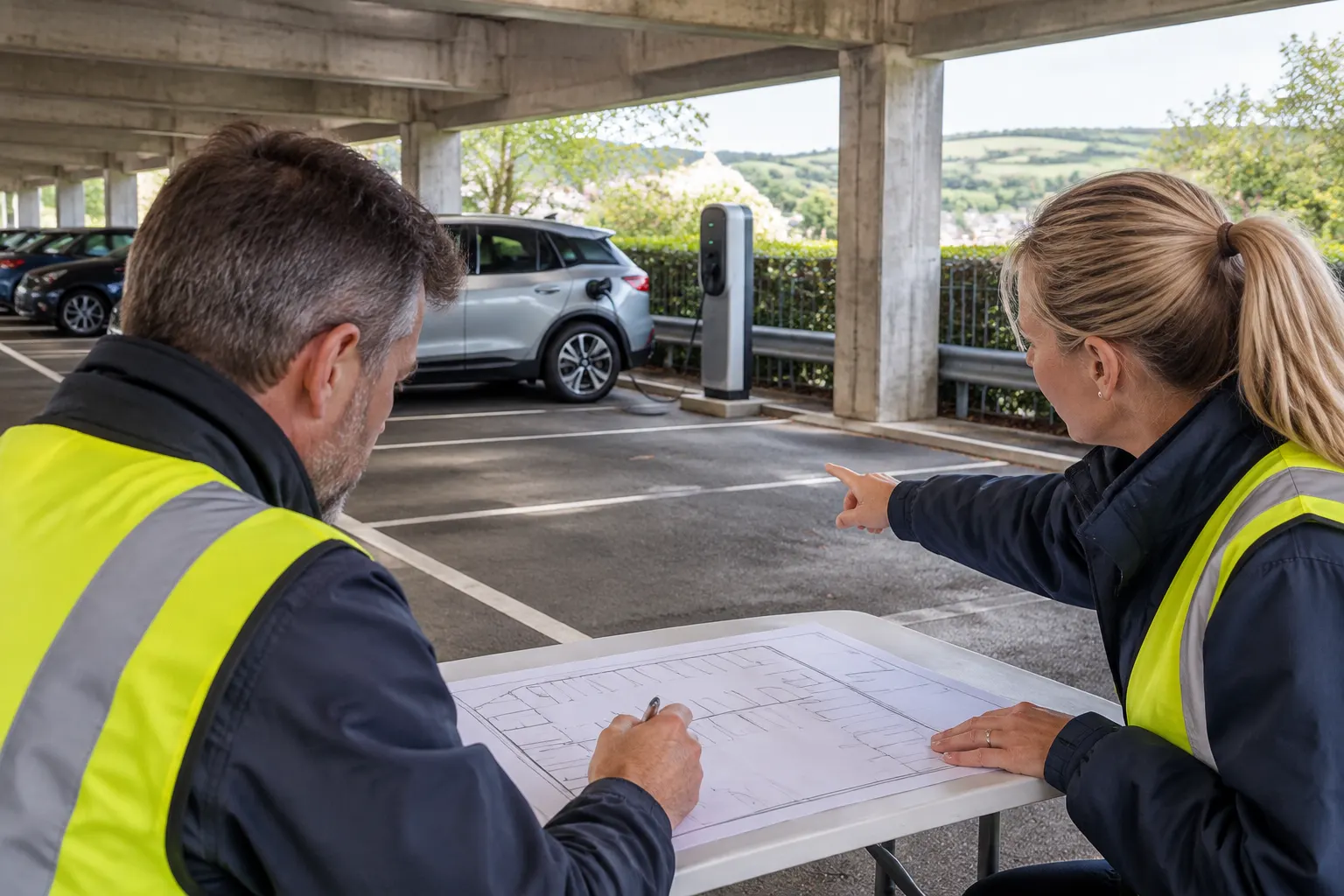
Review chargepoint positions, cable routes and access
The nearest wall to the electrical supply is not automatically the best EV charger location in a covered car park. A shorter cable run does not resolve questions about exits or vehicle movements. Ask the assessor and electrical designer to review the same proposed layout, including:
- Escape and pedestrian routes. Consider how bays, charging leads and equipment affect access to exits, stairs and routes through the car park.
- Fire-service access. Check the relationship between charging positions and the access needed for an incident response.
- Vehicle movements. Assess manoeuvring and collision risks, including whether chargepoints need site-specific impact protection.
- Cable routes. Identify the proposed runs and whether installation could affect fire-resisting construction or other existing precautions.
The outcome may change bay positions or the electrical scope. Universal separation distances, rooftop-only charging or a standard package of extra equipment are not substitutes for a site-specific assessment.
Describe normal site operations
Give the review team a realistic picture of the car park in use, not just an empty-bay drawing. Include peak visitor periods, delivery movements, pedestrian access between buildings and any planned changes to parking. At a leisure or visitor site, these operational details help the assessor understand how the proposed charging area will actually be used.
Agree emergency arrangements and fire-service information
Decide how the charging installation fits the site’s alarm, evacuation and incident procedures. The Responsible Person and fire assessor should establish what staff need to know, including how to identify charger locations and obtain relevant site information during an incident.
For shared premises, decide who holds the current plan and who can make it available to responders. Resolve access to relevant keys and information in advance rather than assuming the installer will be present during an incident.
Where charging remains available outside staffed hours, agree how incident reporting and emergency information will be handled.
Any arrangements for electrical isolation, detection or suppression should follow the assessment, with clear responsibilities for maintenance and testing. Do not assume automatic charger isolation, sprinklers or thermal cameras are necessary at every site, or that one measure resolves every risk.
Make the handover information usable
Keep the agreed layout, relevant isolation information, electrical certification and fire-review decisions together. Identify who maintains these records and briefs staff, especially where a landlord, operator and facilities team share responsibilities. Emergency instructions should reflect the actual installation rather than an unedited manufacturer’s leaflet.
Plan to review the assessment if bay layouts, charger numbers or building use change, rather than reusing the original drawing without checking its assumptions.
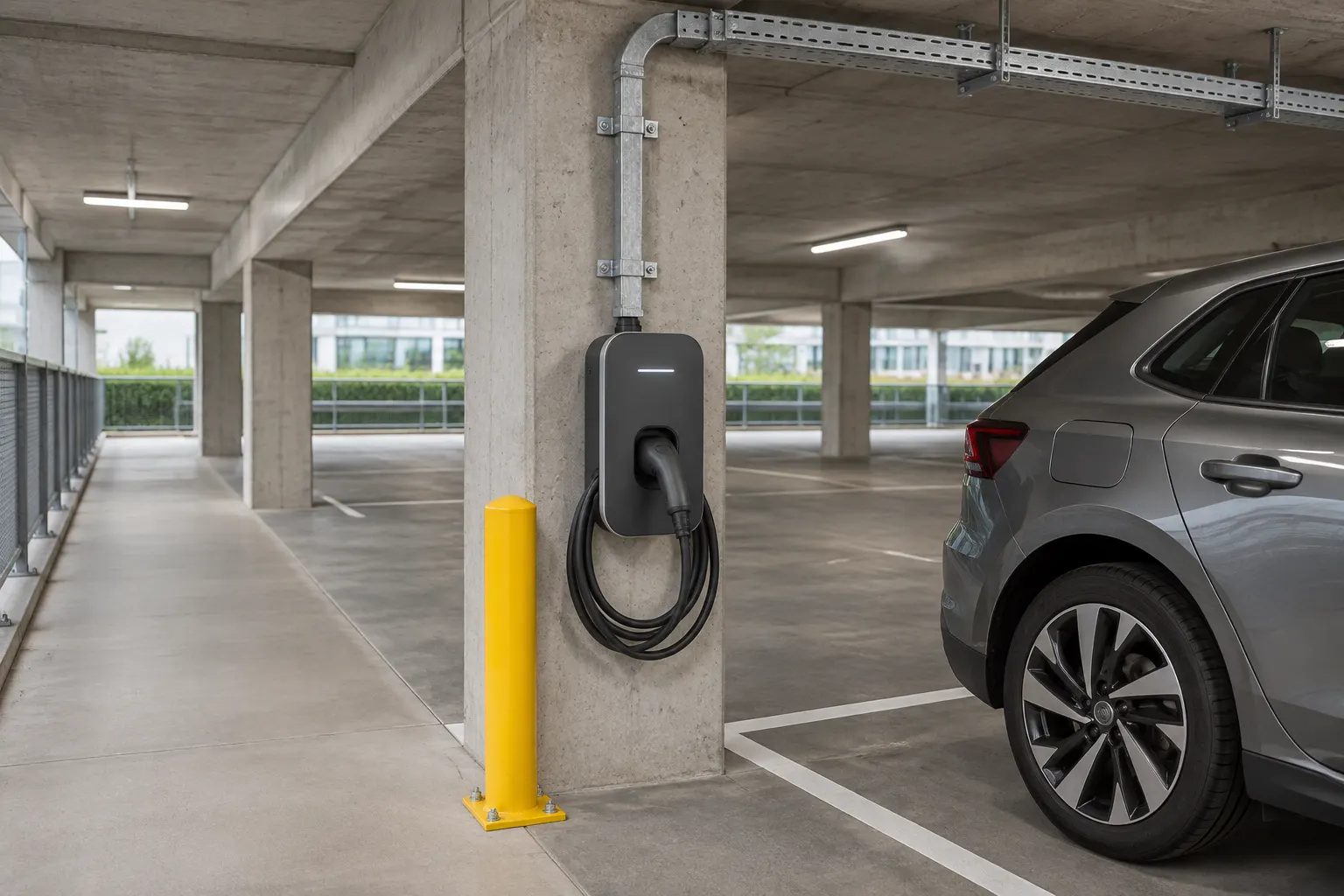
Keep the fire assessment and electrical scope distinct
The fire assessor evaluates the car park’s fire-safety arrangements. The electrical contractor designs, installs and tests the charging installation within an agreed scope. An electrical certificate is not a replacement for the premises fire risk assessment.
Supply arrangements, circuit protection, distribution changes and cable routes still need competent electrical design. Coordinate any wider commercial electrical work with the charging proposal so that the assessor and electrical designer work from consistent plans.
Record how the electrical design addresses the assessor’s relevant recommendations, and return material layout changes for review. Agree explicitly who will provide the competent fire assessment; do not assume it is included in an electrical installation quotation.
Part S requirements and the October 2026 proposals
The government’s consultation published on 21 October 2026 describes the Part S position for applicable projects: covered-car-park spaces require cable routes rather than chargepoints.
As at 12 November 2026, extending chargepoint requirements to new or substantially renovated covered car parks remained a proposal, not a current rule. The consultation was scheduled to close on 16 December 2026.
Confirm the current requirements with building control for the work you are actually planning. Part S infrastructure provisions and the premises fire-risk review address different matters; meeting one does not settle the other.
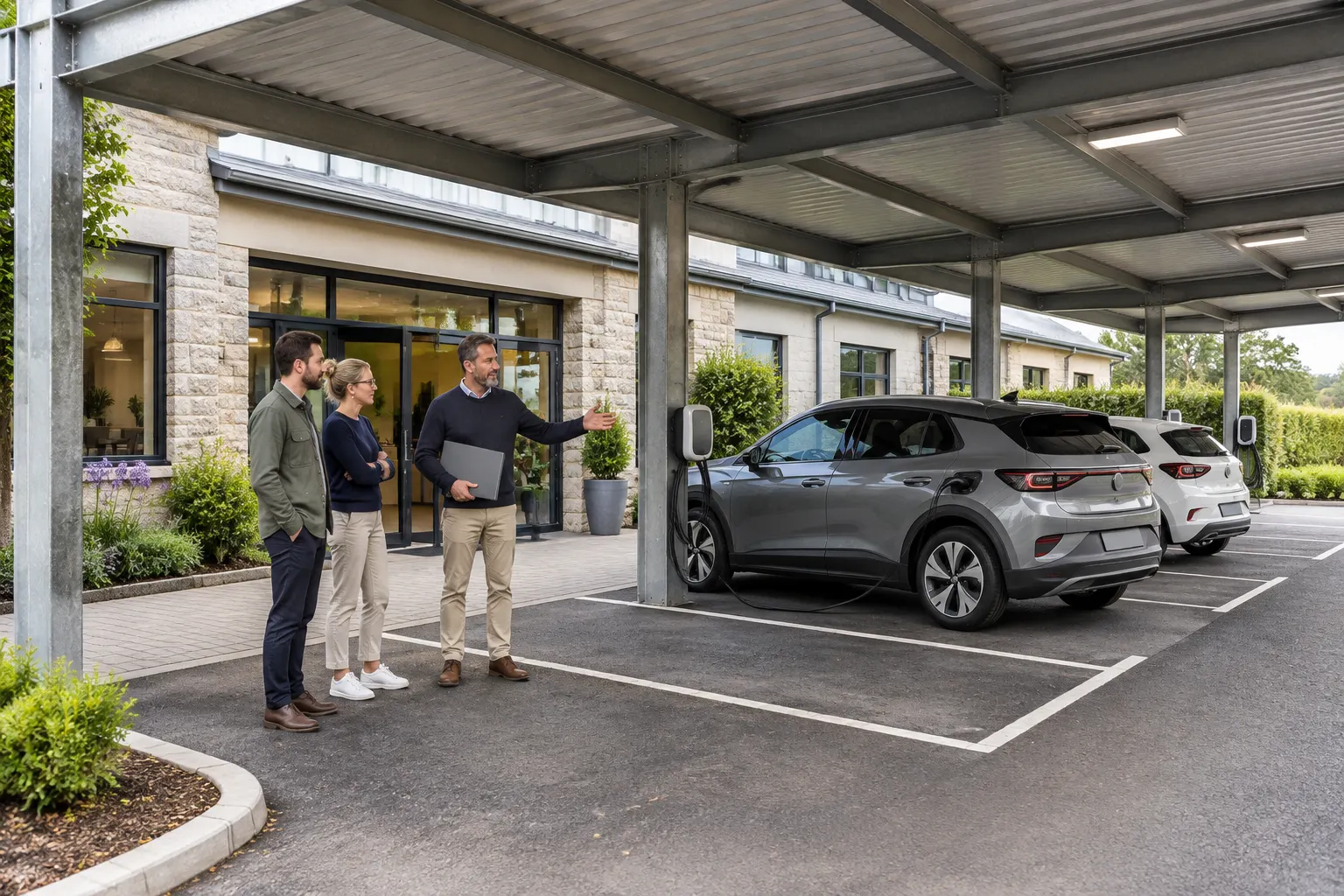
Bring a coordinated brief to the installation discussion
Before seeking a final installation price, assemble one brief containing the proposed layout, the assessor’s recommendations, the electrical scope and the agreed management arrangements.
State who will supply each record at handover and who owns any outstanding actions. This makes it easier to compare installation proposals on the same basis, without leaving essential fire-safety work as an unspecified extra.
For commercial EV charging in Cornwall, speak to Maenporth Electrical about the electrical scope. Based at Maenporth, we serve Falmouth, Penryn and wider Cornwall. Call 01326 250297 to discuss your site.