
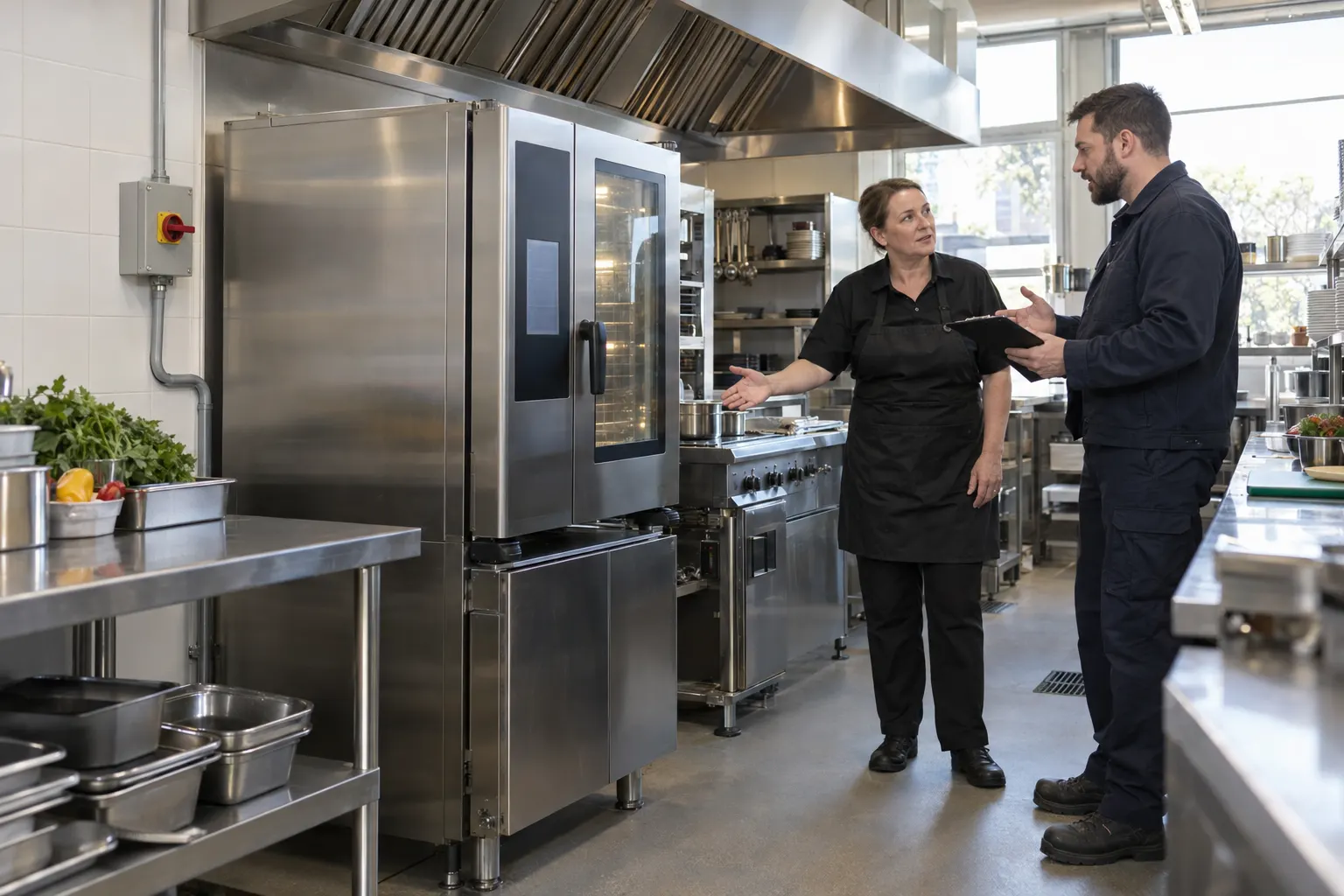
Commercial kitchen electrical safety starts before the service engineer arrives. With fixed-wired catering equipment, booking an appliance repair does not automatically settle who will isolate the supply, whether the circuit is correctly identified, or who will deal with an installation defect.
For a restaurant, hotel, pub or holiday-park kitchen, the practical task is to coordinate the site team, catering-equipment specialist and anyone responsible for electrical work. Agree the scope, safe working arrangements and handover before the visit, rather than discovering a gap when the kitchen needs the equipment back.
Identify the equipment and the limits of the service
Fixed-wired equipment is connected directly to the electrical installation rather than through a plug and socket. Ovens and dishwashers may be connected this way; use records or ask the specialist to confirm the arrangement.
The appliance service and the building's electrical work have different scopes. Ask whether any necessary disconnection and reconnection are included, and who will handle them. A contractor providing commercial electrical services may be needed for the supply circuit, local isolator or fixed wiring. Do not assume either contractor has included the other's work.
Also distinguish an initial diagnosis from a confirmed repair. A visit to establish the fault may not end with usable equipment; make that clear when planning the kitchen's operation and discussing expectations with the service company.
Agree how safe isolation will be managed
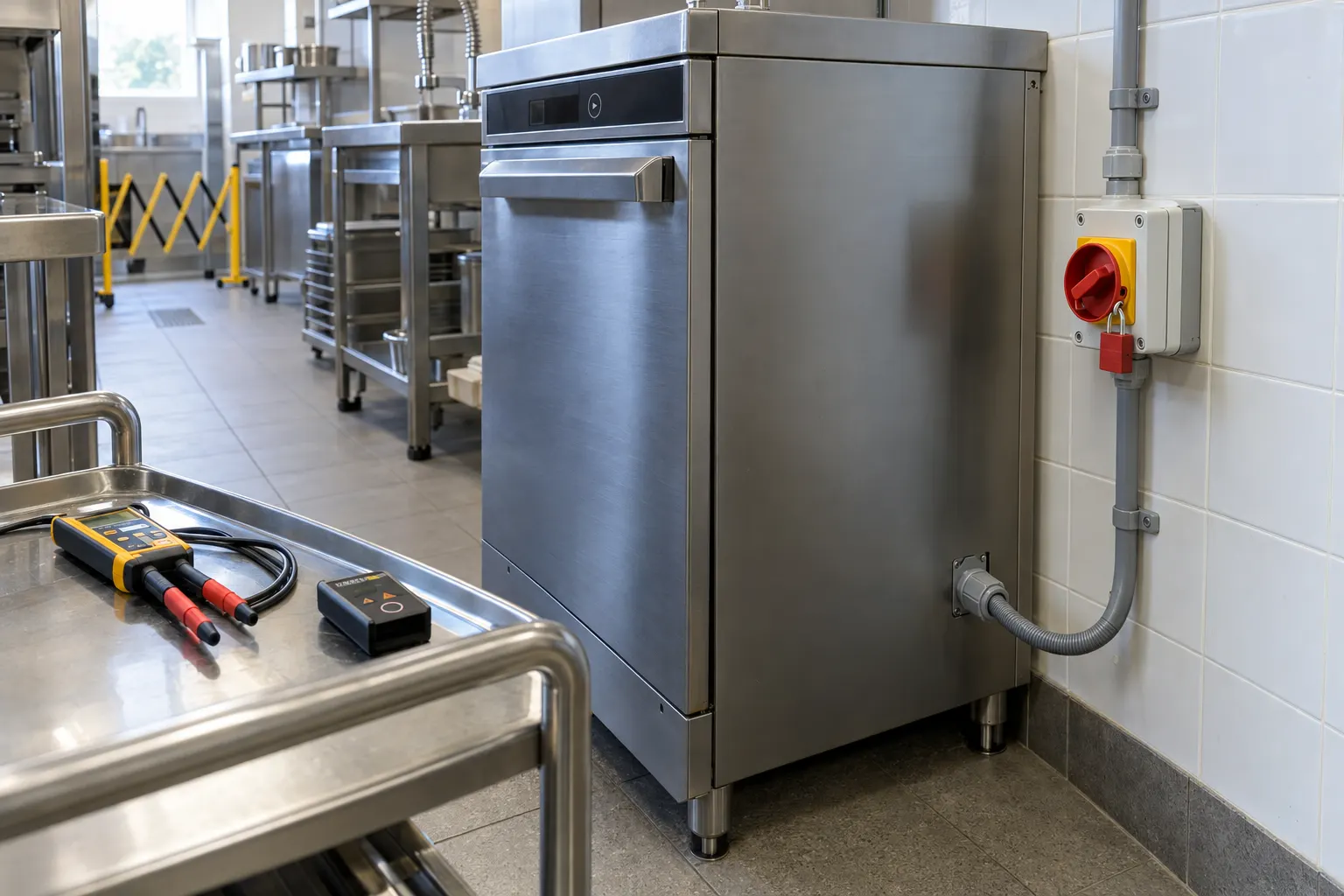
Safe isolation for fixed-wired catering equipment must be handled by competent people under a suitable safe system of work. Switching an appliance off at its controls is not the same as safely isolating its electrical supply.
HSE's guidance on work on electrical equipment emphasises preparation and securing isolated energy sources against inadvertent reconnection. The Electricity at Work Regulations also require systems to be maintained as necessary to prevent danger.
Where the appliance has other energy sources or stored energy, the specialist's plan must address those too. Electrical isolation is one part of preparing equipment safely for maintenance.
Before work starts, the operator or employer, catering-equipment specialist and electrical contractor should agree who will manage isolation, who needs access, how other staff will be informed and who controls the return to service. One person may cover more than one role if competent and authorised; neither job title nor a booking confirmation resolves those responsibilities.
If the equipment specialist depends on the electrical contractor attending first, confirm that sequence when booking.

Send a useful job pack ahead of the visit
Before a fixed-wired catering equipment service visit, share the information already held by the site:
- Equipment details: location, make, model, available manufacturer instructions and previous service reports.
- Fault history: what staff observed, when the problem occurs and any previous repairs or reported tripping.
- Electrical records: relevant circuit schedules, drawings, inspection findings and outstanding defects.
- Access arrangements: known locations of isolators and distribution boards, who can provide access, and any restrictions.
- Operational constraints: service times, nearby equipment that must remain available, and the contact who can approve changes to the work plan.
Describe observations without presenting an unconfirmed diagnosis. For example, report that a device tripped during use rather than assuming the appliance or the building's wiring has been proved faulty.
Include landlord or facilities contacts where access to shared electrical rooms is controlled separately. Existing labels and records help planning; they do not replace verification by the competent person doing the work. Staff should not remove covers or attempt to trace wiring to fill gaps.
Resolve unclear circuits or protective arrangements
If the circuit or isolation point cannot be established, work that depends on safe isolation should not start until competent people have verified suitable arrangements. An inaccessible or damaged isolator also needs assessment, not an improvised workaround.
Where work cannot proceed, ask for a written explanation of what prevented it and what needs assessing. That gives the next contractor a defined problem to investigate, rather than another booking with the same missing information.
If the specialist raises an RCD or RCBO concern
Ask for the concern about residual-current protection to be recorded and referred to a competent electrical contractor. Assessment needs to consider the actual installation, current requirements and manufacturer instructions, rather than assuming every kitchen circuit needs the same change.
Agree the next action, who will arrange it and whether the appliance must remain out of use. An appliance service should not be treated as approval of an unresolved supply-circuit defect.
Make room for safe work in a working kitchen
Electrical safety during catering equipment servicing depends on access as well as timing. Allow for investigation, safe working and handover, not just the estimated repair time.
Discuss access behind equipment, any heavy appliance movement, and how work will be kept separate from wet cleaning and food preparation. Keep staff and other contractors informed about the work area and any equipment they must not use.
For an out-of-hours visit, confirm who can open locked electrical rooms and who will remain available if the planned shutdown runs longer than expected. Include kitchen management, not just the person meeting the engineer at the door.
Confirm whether the planned isolation could affect neighbouring appliances or other operations; do not assume only the faulty unit will be affected. If the agreed window cannot accommodate safe work, revise the plan rather than asking the engineer to work around unsafe conditions.
Agree who will manage alternative catering arrangements if the kitchen cannot reopen on schedule.
Get a clear return-to-service handover
Before staff resume use, obtain a handover covering the completed work, checks carried out within the agreed scope, any restrictions and unresolved issues. The relevant competent people should confirm the status of their own work; the operator needs a clear statement of what can safely return to use.
Keep appliance-service findings separate from supply-circuit defects so completing the service does not accidentally close an installation issue. Record who is dealing with each outstanding item and pass any operating restrictions to the kitchen team, including the next shift.
These records make commercial kitchen equipment maintenance easier to coordinate at the next visit, especially when different contractors look after the appliance and the installation.

Know when the fixed installation needs separate assessment
A service visit may reveal concerns beyond the appliance, such as unclear circuit identification, damaged isolation equipment or repeated reports of tripping. These may need targeted electrical investigation; do not assume an appliance repair resolves them.
Where a wider assessment is appropriate, an Electrical Installation Condition Report (EICR) records the condition of the fixed installation within its stated scope. It is distinct from checks on portable appliances and specialist catering-equipment servicing. None is a substitute for the others. Do not assume that every kitchen needs an annual fixed-wiring inspection.
A previous satisfactory report does not authorise today's work or replace the service-specific isolation arrangements.
Agree future checks and maintenance around the equipment, its use, operating conditions, manufacturer guidance and findings, not simply the date of the next catering service.
Planning hospitality electrical maintenance? Maenporth Electrical Ltd is based at Maenporth and serves Falmouth, Penryn and wider Cornwall. Call 01326 250297 to discuss fixed-installation checks, isolation arrangements or electrical remedial work alongside your catering-equipment specialist's visit.