
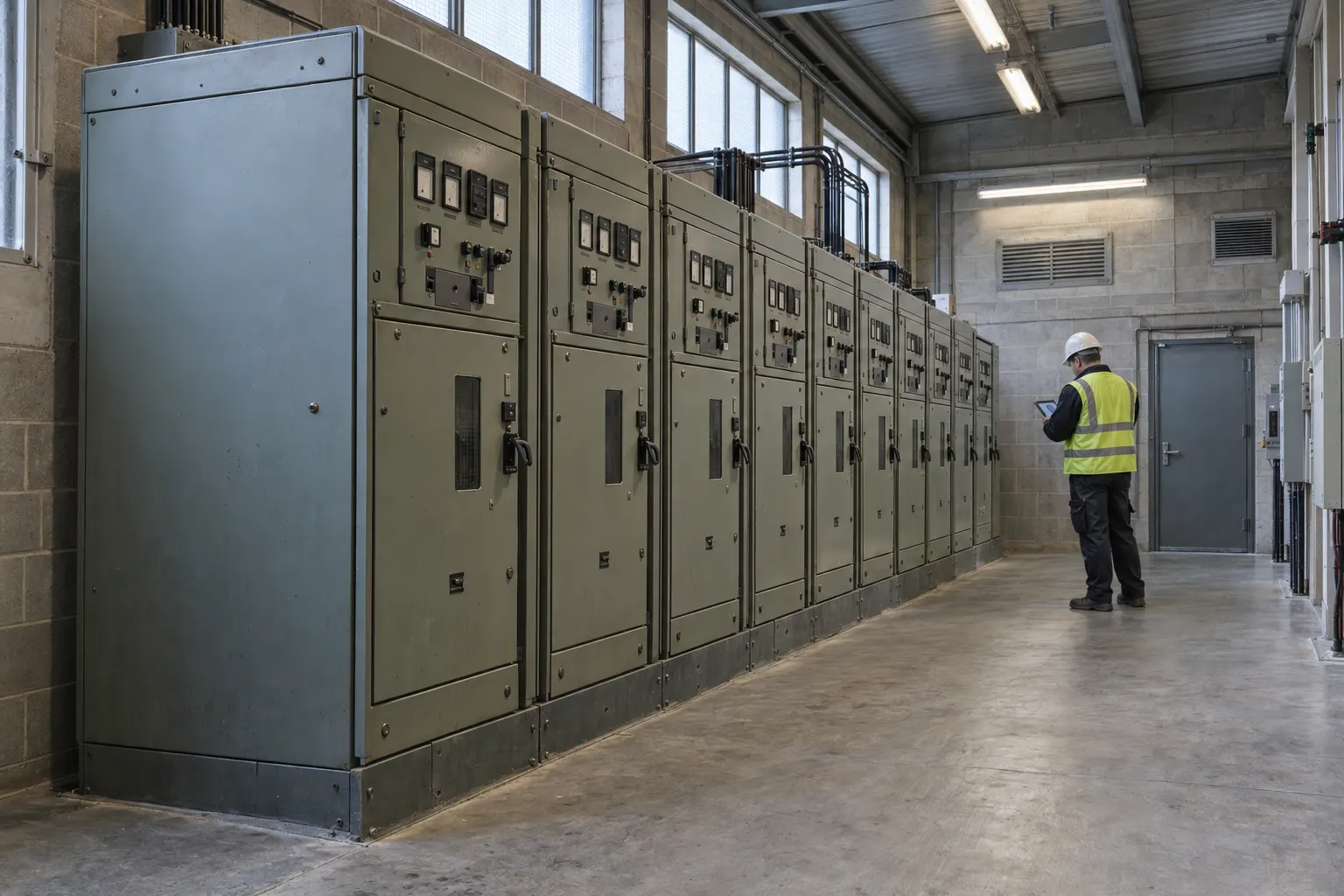
An up-to-date service date is not, on its own, an answer to HSE’s 2026 safety notice. GEC VMX switchgear maintenance needs an equipment-specific review of identification, test evidence and substation conditions.
For a quarry, factory or other Cornwall site with a private substation, the first step is to establish whether it controls equipment covered by the notice. The next is to arrange a review by a competent high-voltage (HV) specialist, rather than assuming routine servicing has addressed the specific concerns.
What the 2026 HSE notice covers
The HSE safety notice for GEC Type VMX high-voltage switchgear, ED01-2026, was issued in May 2026 and updated on 24 September 2026. It followed an investigation into a VMX vacuum circuit-breaker failure; HSE identified partial discharge as the most probable cause in that incident.
HSE identifies three VMX forms manufactured in the UK between 1985 and January 2003, including equipment associated with GEC, GEC Alsthom, Alstom and Areva T&D. These may be susceptible to partial-discharge issues where substation environmental conditions are inadequate.
Age or branding alone does not establish scope. HSE treats post-January 2003 Form C equipment separately and still stresses the required environmental conditions. The notice does not mean that all VMX units, all HV equipment or all old switchgear share one defect.
Confirm the equipment and maintenance boundary
Before commissioning an 11 kV switchgear maintenance review, establish who controls the equipment, who holds its records and where the site’s maintenance responsibility begins and ends. Do not assume everything inside a substation has the same owner or maintenance provider.
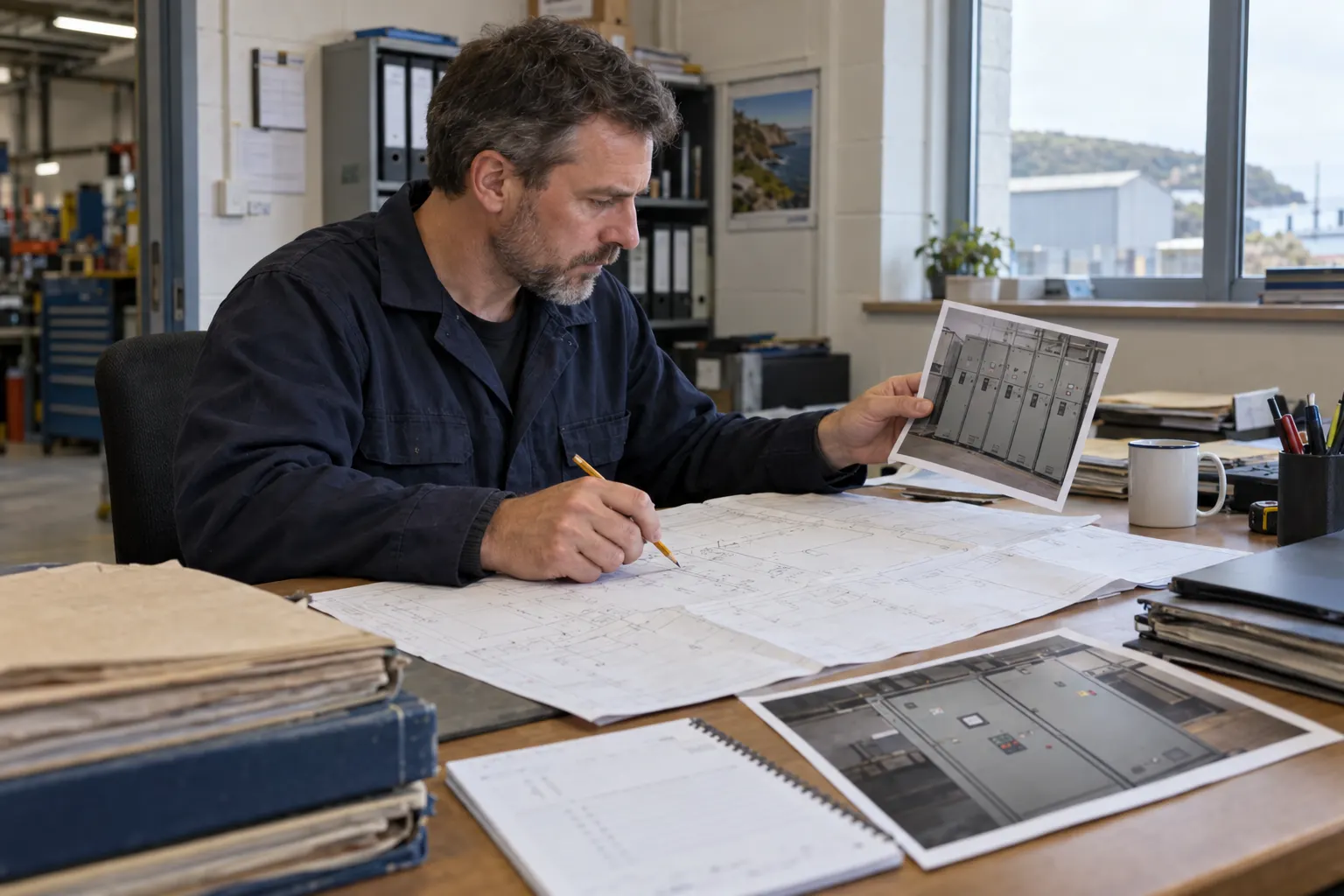
Start with existing drawings, asset records, service reports and any identification photographs already held. Ask the responsible HV specialist to confirm:
- The precise model or form, manufacture period and serial numbers.
- Which equipment falls within the notice’s scope.
- Any applicable modifications, operating limitations or improved maintenance practices for those serial numbers.
- Who will resolve gaps in identification or maintenance evidence.
If a date or serial number is missing, keep the scope marked as unconfirmed rather than assuming an exclusion. Any physical identification must be arranged through competent HV personnel under the site’s access controls, not by unqualified staff entering the substation or opening switchgear.
Understand what the different checks establish
One inspection or test cannot establish every aspect of switchgear condition. HSE highlights separate checks which should be considered together, not treated as interchangeable.
Partial discharge and environmental measurements
For in-scope equipment, the notice calls for an initial partial-discharge survey with humidity and temperature measurements. GEC VMX partial discharge testing should therefore be considered alongside the substation environment and manufacturer requirements, rather than as a stand-alone pass or fail.
HSE recommends partial-discharge testing on each entry to the substation for the equipment covered. It also says the frequency of periodic monitoring should be risk-assessed. This is equipment-specific guidance, not a universal statutory testing interval. Competent HV personnel should plan and carry out the monitoring under controlled access arrangements.
Vacuum integrity and serial-specific practices
The notice also calls for review of vacuum-interrupter integrity. A partial-discharge survey does not replace that review, just as a vacuum-interrupter check does not answer every question about discharge activity or environmental conditions.
Applicable modifications, limitations and improved maintenance practices remain part of the assessment. Keep the specialist HV scope distinct from any wider electrical testing and compliance visit; a general site report should not be assumed to include these VMX-specific checks.
Review records against actual substation conditions
Private substation maintenance records should show what has been done, what was found and what remains unresolved. A service date without the scope or results offers little basis for deciding whether the notice’s recommendations have been addressed.
Bring together previous partial-discharge findings, vacuum-interrupter evidence, modification history, outstanding defects and manufacturer environmental requirements. Ask for humidity and temperature evidence to be assessed against those requirements. Do not decide that conditions are acceptable simply because the building looks dry.
A report should identify which unit was assessed and what work or monitoring it actually covered; otherwise, ask for clarification before relying on it.
The review should turn gaps into named actions: what needs specialist confirmation, who will arrange it and how the result will be recorded. Put agreed follow-up into the site’s wider planned electrical maintenance programme so that monitoring, environmental measures and operating limitations remain visible.
For legacy HV switchgear maintenance, records also support continuity when staff or contractors change. They inform decisions; they do not substitute for assessing the equipment’s actual condition.
Plan competent follow-up around site operations
Commission a contractor with suitable competence for the equipment and proposed HV work. A general electrical maintenance appointment is not, by itself, confirmation that the provider can assess GEC VMX equipment or carry out the specialist tests.
Send the available records before booking work. Ask what can be reviewed from documents, what needs a site visit and what information is still missing. This makes the brief more useful than a request to “check the switchgear”.
Agree access controls and who has authority over switching or changes to operation. The competent assessment should establish any restrictions needed while identification gaps, findings or defects are resolved. Unqualified staff should not make those decisions.
For a quarry or factory, involve those responsible for production and essential services early. Ask the specialist whether planned work needs an outage and what must be resolved before any restrictions are lifted. A survey booking neither demonstrates safe continued operation nor automatically means a shutdown is necessary.
Request a written outcome identifying the equipment assessed, checks completed, limitations, further actions and the basis for future monitoring. Allocate each action to a responsible person rather than leaving the report as a completed diary task.
Make sure any agreed restrictions reach the people controlling access, production and contractor visits. They need to know which equipment is affected and who can authorise a change, without being asked to make technical HV decisions themselves.
Put the maintenance duty in context
The Electricity at Work Regulations 1989 require electrical systems to be maintained as necessary to prevent danger. HSE guidance explains that inspection and, where necessary, testing form part of preventive maintenance, with manufacturer guidance and experience informing frequency.
HSE describes maintenance records as useful for monitoring condition, rather than a legal requirement in themselves under these Regulations. For this notice, their practical value is clear: they help establish whether the relevant checks, modifications and limitations have been considered.
The useful question is not just “is the service up to date?” It is whether a competent review has addressed this equipment, these conditions and the specific actions highlighted by HSE.

Discuss your wider site maintenance
For wider industrial or commercial site testing and planned maintenance across Falmouth, Penryn and Cornwall, call Maenporth Electrical on 01326 250297. GEC VMX assessment and specialist HV work require a suitably competent provider, with capability and scope confirmed separately.