
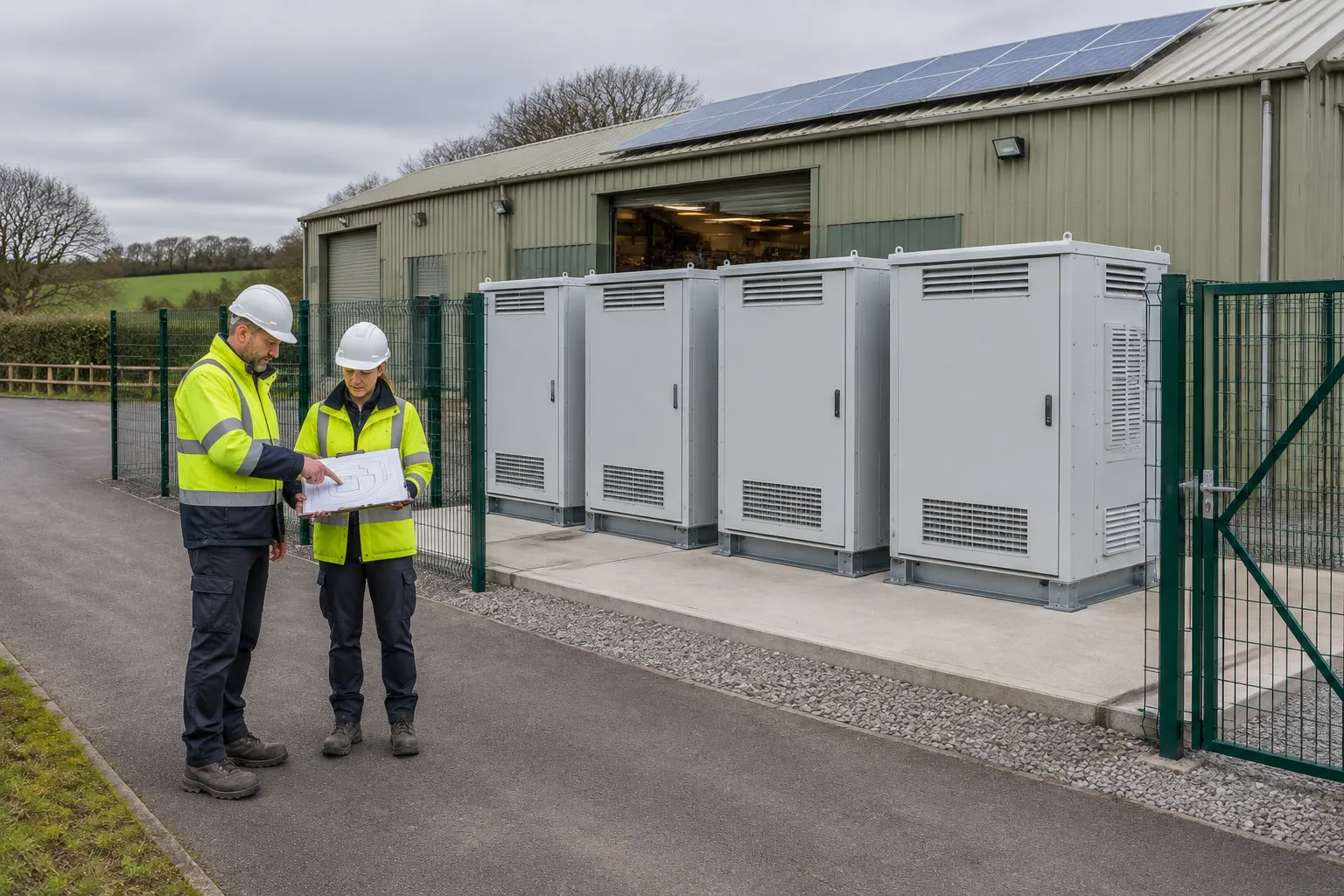
A commercial battery storage emergency response plan should work when the site manager is absent, an alarm arrives overnight and responders need the right entrance. A document that names the equipment but leaves those decisions unresolved is not enough.
For larger commercial and industrial battery energy storage systems (BESS), the priority is to connect equipment information with people, access and agreed actions. This guide focuses on operator readiness, not battery installation, fault resets or firefighting instructions.
First establish the battery’s scale, chemistry and setting
Start with the installed energy capacity, battery chemistry, manufacturer’s instructions and location. Record whether the system is outdoors or enclosed, what surrounds it and how it connects to other site supplies. Capacity means stored energy, not simply the inverter’s output rating.
Collect the commissioning and handover information before drafting the plan. Where information is missing or the installation has changed, flag the gap for the system supplier or appointed technical adviser rather than filling it with assumptions.
The NFCC planning guidance for fire and rescue services directly covers open-air lithium-variant BESS of at least 1 MWh. It is guidance, not a universal legal checklist for every commercial battery. For smaller or enclosed installations, ask competent advisers which guidance and arrangements apply.
Cornwall Council also publishes BESS-specific fire-safety guidance. Use that local context alongside site-specific electrical and fire-safety advice; do not assume one plan template suits a factory yard, a leisure site and a small indoor system.
Separate notification duties from fire-service engagement
Two thresholds answer different questions.
- 1 MWh concerns planning guidance. Government guidance encourages applicants for relevant BESS proposals at or above this capacity to engage the local fire and rescue service before applying. It also encourages planning authorities to consult the service.
- 25 tonnes concerns dangerous substances. Under the Notification and Marking of Sites (Dangerous Substances) Regulations, known as NAMOS, notification is required where a site holds a total of 25 tonnes or more of dangerous substances. This is not a battery-capacity threshold or a test based simply on equipment weight.
Have a competent adviser establish whether the dangerous-substances threshold applies to the site as a whole. Do not infer it from a battery’s MWh rating.
NFCC notes that fire and rescue services are not statutory planning consultees. Engagement is not automatic statutory sign-off, and planning permission remains a matter for the local planning authority.
For projects within its scope, NFCC recommends developing outline battery safety management and emergency response plans with the local fire and rescue service.
Match the plan to the installed equipment and working site
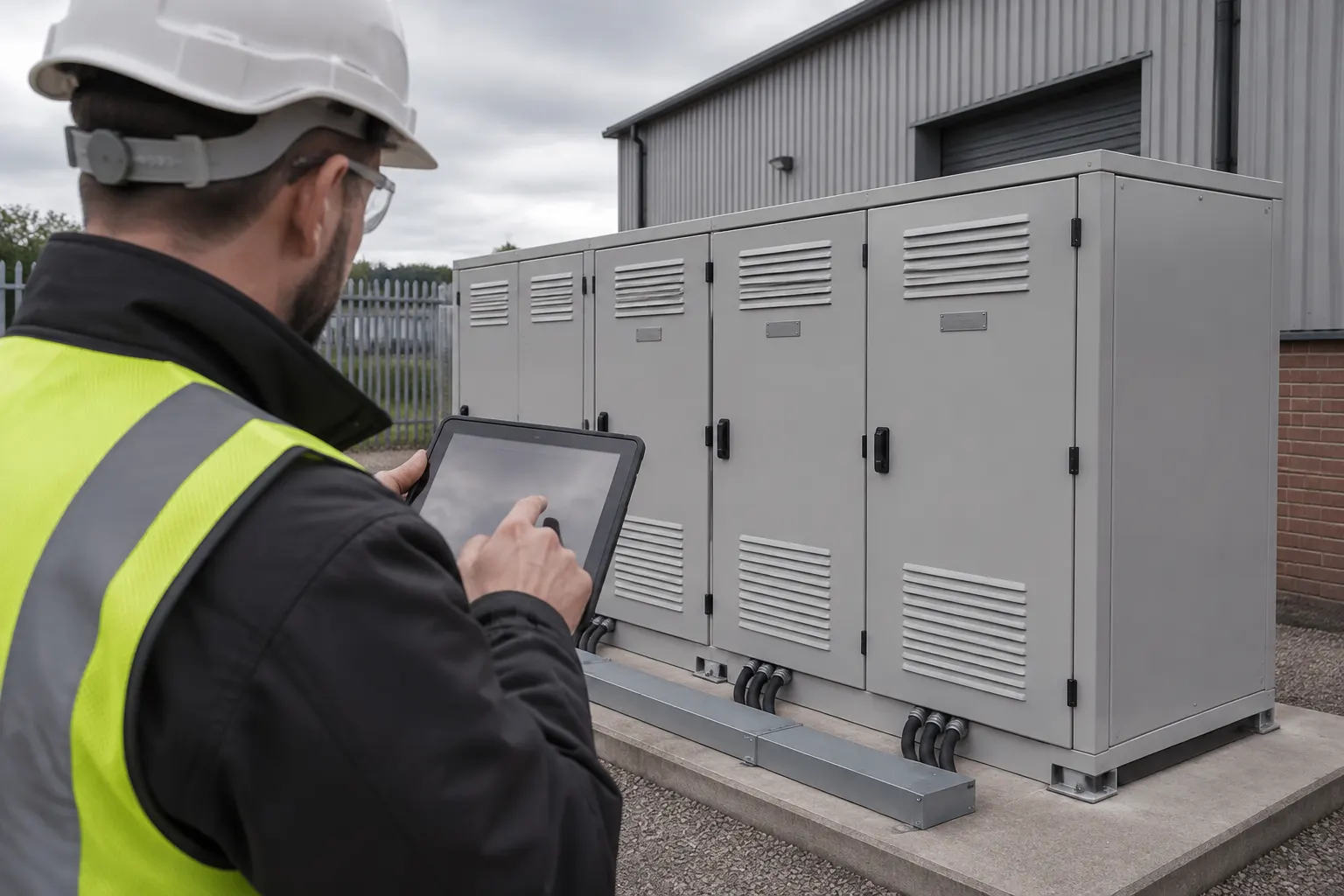
The BESS emergency response plan should describe the installation as it exists, not just reproduce a supplier’s generic manual. Give it a named owner and deputy, with clear responsibility for updating and sharing revisions.
Use a site-specific checklist covering:
- Battery identification, chemistry, capacity and the relevant manufacturer’s emergency information.
- Facility activities, operating hours and arrangements for staff, contractors and visitors.
- Site layout, battery location, identified hazards and neighbouring properties.
- Alarm arrangements, emergency contacts and escalation responsibilities.
- Access, designated firefighting facilities, drainage and authorised shutdown information.
Distinguish the operator’s immediate actions from information intended for responders and technical specialists. Staff need clear, agreed instructions for raising the alarm and leaving affected areas; responders need reliable information about the installation and site hazards. Do not bury both in an unstructured collection of manuals.
Where the battery interfaces with industrial distribution systems, the records should identify all connected sources, including solar and standby generation where present. Ask the appointed electrical adviser to confirm how these interfaces affect the documented emergency arrangements.
Assign alarm ownership and out-of-hours response
An alarm reaching a dashboard does not establish who will act. For battery storage emergency planning, write down who receives each relevant alarm, who follows up under the agreed procedure, who contacts emergency services and who meets responders.
Cover nights, weekends, shutdown periods and staff absence. If a monitoring provider, tenant, security team or maintenance contractor has a role, confirm it with them rather than assuming it is included.
For example, check whether a supplier’s remote monitoring agreement only reports alerts or also includes an on-site response. Make that boundary explicit. The plan should show who takes over when an alert is passed on, not simply list telephone numbers.
Check the escalation route if the first contact cannot be reached or an alarm is not acknowledged. Keep current contact information accessible to those responsible, including when the normal office is closed.
Staff training should reinforce the agreed alarm, evacuation and escalation arrangements. It should not encourage anyone to open enclosures, reset faults or attempt electrical isolation without appropriate competence and authorisation.

Give responders usable access and hazard information
Entrance and layout
Make the entrance, approach route, gate arrangements and battery location unambiguous. A postcode alone may be inadequate on a large rural or multi-building site. Show neighbouring premises and the working areas that could affect access or evacuation.
Check the arrangements against normal site use. Delivery vehicles, stored materials or a changed traffic route can make a previously clear approach unreliable. Agree how those changes will be reported to the plan owner.
Make current responder information available through the agreed site arrangements, rather than keeping the only copy in one person’s inbox.
Shutdown points and drainage
Identify emergency shutdown and isolator locations on current drawings. Record what each control does, its limitations and who is authorised to use it, based on manufacturer information and competent advice. A marked location is not an instruction for untrained staff to operate it.
Include firefighting facilities, drainage routes and relevant environmental information. Have specialists establish any site-specific controls. Staff should not be left to improvise drainage or pollution-control actions during an incident.
Review the plan as equipment and site operations change
Government-commissioned health and safety guidance recommends developing emergency arrangements early, then reviewing plans, training staff and testing safety equipment throughout operation. The plan needs an operational owner after installation, not just a place in the handover file.
Review it after battery or inverter changes, altered alarm routing, new access controls, drainage works or changes to neighbouring activities. Check it when operating hours, tenants or emergency contacts change too. Record the revision and make sure superseded copies are replaced.
Keep a record of training and safety-equipment checks alongside the plan, with the responsible provider identified. Use the manufacturer’s and competent advisers’ recommendations to establish suitable arrangements rather than adopting an unsupported standard interval.
A simple readiness exercise is to walk through an out-of-hours alarm on paper. Can the nominated person find the current instructions, reach the right contacts and explain where responders should enter? Record gaps and assign responsibility for closing them.
A paper exercise checks communication; it is not a substitute for specialist safety-system testing and should not involve improvised electrical switching.
Discuss your site’s electrical requirements
Maenporth Electrical Ltd serves Falmouth, Penryn and wider Cornwall. For the electrical work supporting a commercial renewables project, explore our renewable electrical services or call 01326 250297. Bring in the system supplier and competent fire-safety advisers for the emergency arrangements.