
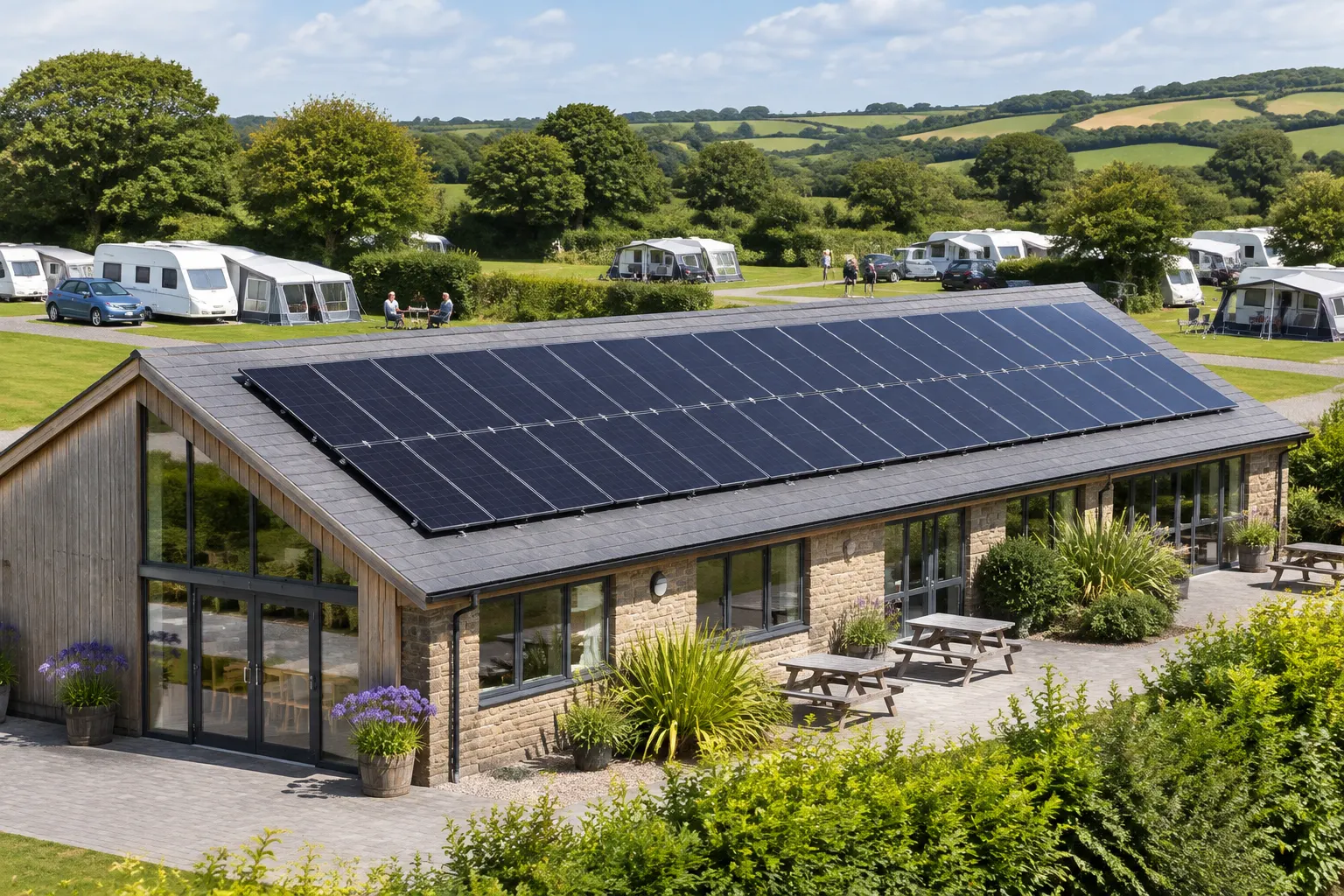
Winter closure does not automatically rule out commercial solar for holiday parks, but a busy summer is not enough to justify it either. What matters is how much electricity the park can use while the array is generating, on the supply it actually serves.
For a Cornwall site, the useful test is to compare the operating calendar and measured electricity demand with a location-specific PV estimate. That gives a clearer basis for choosing a system size than pitch count or an annual bill.
A summer season is a clue, not a business case
The government's 2024–25 Feed-in Tariff load-factor analysis shows stronger solar output in spring and summer than autumn and winter. That national pattern is context, not a forecast for a particular park.
Occupancy alone does not tell you when electricity is used. A full park might have heavy evening demand from cooking and electric water heating, while daytime laundry or electrically powered pool plant could overlap more closely with PV output. These are loads to verify, not assumptions to build into a quotation.
A campsite with few shared facilities can have a very different profile from a park with a pool, restaurant and laundry. The operating mix matters more than treating every occupied pitch as an identical load. Comparing solar panels for holiday parks by annual generation alone misses that distinction.
Put the occupancy calendar beside a PV estimate
A generation estimate should reflect the proposed array and location, rather than a generic Cornwall average. The European Commission's PVGIS grid-connected PV tool provides location-specific production estimates. It does not calculate your park's consumption or savings.
Make the assumptions visible: array capacity, roof orientation, shading and expected system losses. Treat weather-based output as an estimate, not a guarantee, and use consistent assumptions when comparing alternative sizes.
Set monthly estimates alongside opening dates, occupancy patterns and facility timetables. Note whether the pool opens before the main season, whether laundry continues on changeover days and when catering or EV charging is busiest.
A monthly comparison shows which parts of the trading year deserve closer investigation. It is a seasonal screening step, not a self-consumption calculation.

Use half-hourly data to find the daytime load
Ask your supplier or meter-data provider for half-hourly import data where available, ideally covering a full recent operating year. Compare demand and modelled output on compatible time intervals, with consistent timestamps.
Where records are unavailable, agree a suitable monitoring approach with the contractor rather than assuming demand is evenly spread.
Flag missing readings, unusual closures and changes planned for next season. If PV or storage is already installed, include its operating records too; import readings alone may not show the underlying demand.
For solar PV for caravan parks, identify which loads genuinely run during solar hours: pool pumps, refrigeration, laundry or reception equipment, where present. Any proposed change to operating hours must work for staff and guests before it is counted as a saving.
At each interval, compare estimated PV production with the electrical demand it can serve. Generation above that demand is surplus before storage or export constraints are applied. Total the electricity used directly across those intervals, rather than simply comparing annual totals.
Check which buildings and pitches the array can serve
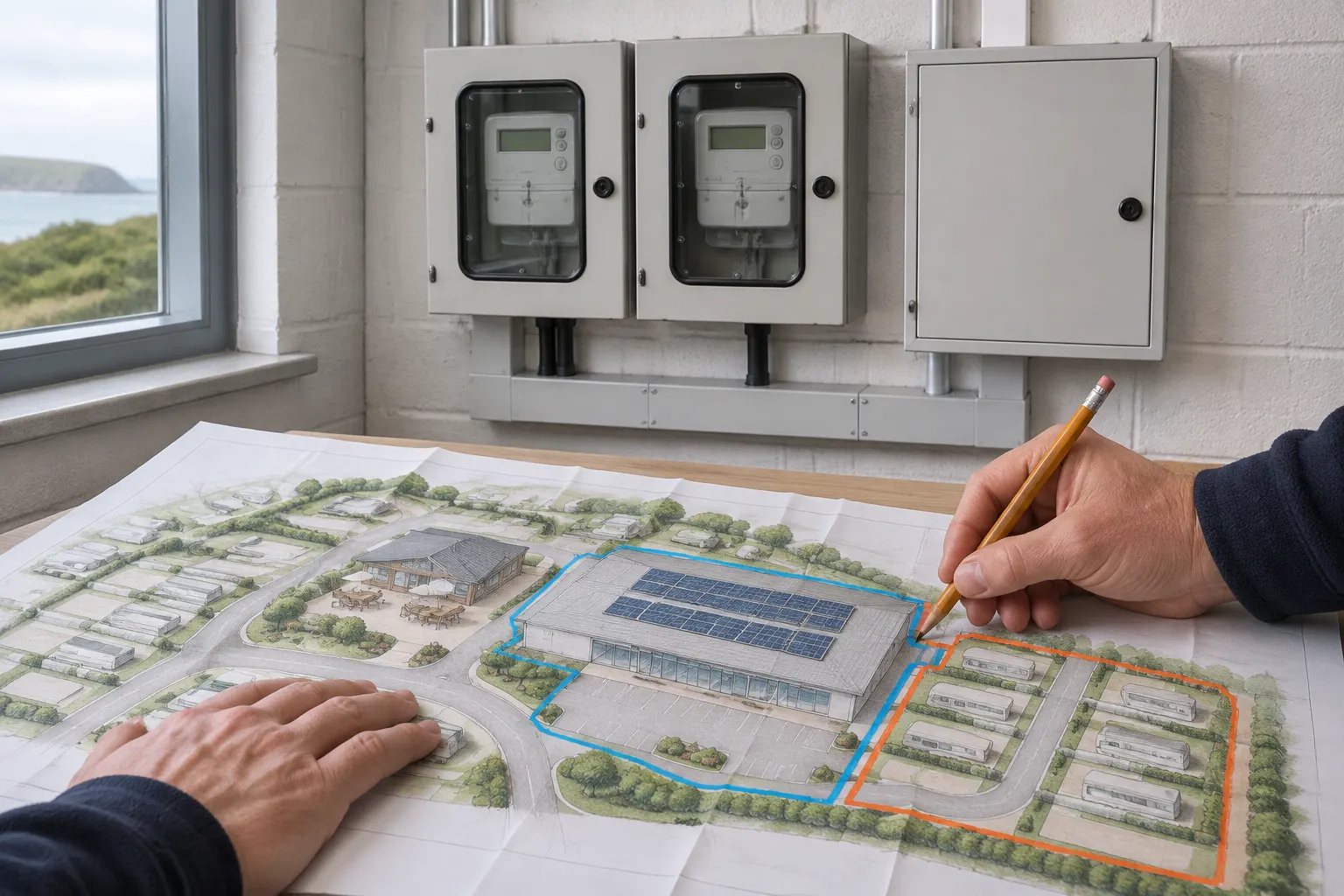
A park may have one main supply with downstream sub-meters, several separate incoming supplies, or a mixture. Establish the proposed connection point and the loads behind it. Do not assume an amenity-building array offsets a separately operated café, lodge or pitch area on a different incoming supply.
Pitch sub-metering is not the same as a separate incoming supply. Where the arrangement is unclear, our commercial electrical services can help establish which buildings and circuits share the proposed connection.
For separately operated facilities or recharged pitch electricity, also confirm who pays for the electricity and who benefits from reduced imports.
Keep solar thermal separate from PV in the demand review. Solar thermal heats water; PV generates electricity. Count only electrical loads that the proposed PV system can actually serve.
Model peak season, shoulder months and winter closure
Seasonal holiday park electricity demand needs more than one operating case. Use these three checks rather than an annual average.
Keep future expansion separate from the current-demand case. If a new pool heat pump or extra EV charging is only a possibility, show it as an additional scenario rather than using it to justify today's system size.
Peak season
Check daytime demand, not just maximum occupancy. Record which electrical facilities operate, on which days, and whether guest demand arrives mainly after useful PV output has fallen.
Shoulder months
Separate weekends and school holidays from quieter weekdays. Reduced opening hours for facilities can change direct use even while the array continues generating.
Winter closure
List the loads that remain, such as security or frost protection, where applicable. Lower winter output does not guarantee there is no surplus if nearly everything has closed.
Value direct use and exports separately
Ask for three separate outputs: PV electricity used directly on the relevant supply, electricity exported, and electricity still imported. Value direct use and exports using their respective tariff assumptions, rather than pricing every generated unit at the import rate.
When assessing solar self-consumption at seasonal sites, distinguish the share of PV used on site from the share of the park's electricity supplied by PV. A high figure for one does not guarantee a high figure for the other.
Solar export during the off-season may have value, but only on the export terms and connection arrangements actually available. Include any export restriction in the model before choosing the array size.
A battery may move some daytime surplus into later demand. Assess it against the site's daily operating pattern and show its costs separately; do not assume it resolves a seasonal mismatch.
Any payback estimate should show the seasonal energy flows, assumed tariffs and project costs. Ask what changes if occupancy falls or export income is lower than expected.
What to gather before choosing a system size
Before requesting a proposal, gather:
- A full recent year of interval electricity data for each relevant incoming supply, including closure periods and any gaps.
- Bills and tariff details, including any confirmed export terms.
- Opening dates, occupancy patterns and operating hours for major electrical facilities.
- Plans showing buildings, incoming supplies, pitch distribution and sub-metering.
- Available roof details and any existing PV, solar thermal or storage.
- Planned changes such as a heat pump, altered pool timetable or EV charging.
Ask for a smaller, demand-led option alongside any larger array, with seasonal imports, direct use and surplus shown. The right size is a comparison to test, not a conclusion drawn from available roof area.
If a larger array mainly adds off-season export, test that extra investment against the confirmed export income rather than the park's import price. If peak daytime loads absorb the extra output, the comparison will look different.
Planning holiday-park solar in Cornwall? Discuss your operating calendar and supply layout with Maenporth Electrical Ltd as part of our solar PV services. Call 01326 250297. We serve Falmouth, Penryn and wider Cornwall.