
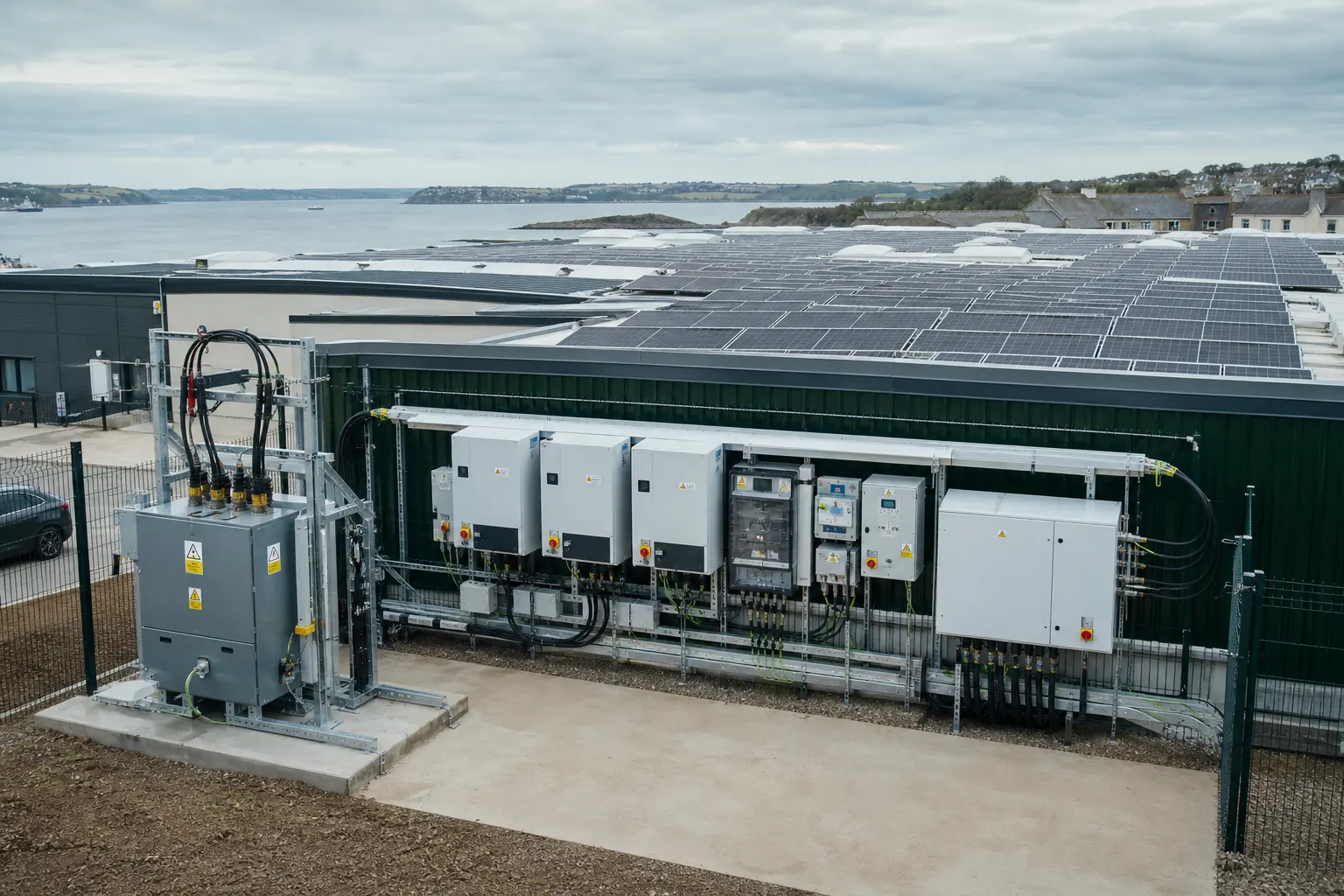
A commercial site may have enough roof or land for a substantial solar array but still face a limit on how much power it can export to the local distribution network. That does not necessarily rule out the project. It does mean that generation, daytime electricity demand, connection terms and control arrangements need to be assessed together.
For businesses investigating commercial solar export limitation in Cornwall, the important question is not simply how many panels will fit. It is how the proposed system will behave at the site’s grid connection during changing levels of generation and demand.
Can a Falmouth business install more solar than it can export?
Potentially, yes. A site can sometimes have more solar generation capacity than its agreed maximum export capacity, particularly where a meaningful proportion of the electricity will be consumed onsite. An approved export-limitation scheme may prevent net export from exceeding the agreed figure.
However, this is not automatic approval for an oversized array. The proposed PV system, inverter capacity, site load profile, existing equipment and connection agreement all affect the assessment. Network capacity and connection terms are site-specific, so a result elsewhere in Cornwall cannot predict the outcome for a Falmouth premises.
Four figures that should not be confused
A useful proposal should clearly distinguish between four different values:
- Panel capacity: the combined DC nameplate capacity of the installed solar modules.
- Inverter AC output: the continuous AC rating of the equipment converting solar generation for use by the site.
- Battery power: the rate at which battery equipment can charge or discharge, which is separate from its stored energy capacity.
- Maximum export capacity: the agreed limit on net power exported through the site’s connection point.
These figures are related, but they are not interchangeable. A large panel capacity does not by itself describe maximum AC output, while an export figure does not show how much solar electricity a business can use behind the meter.
Why G99 can become part of a commercial solar project
National Grid Electricity Distribution serves the South West and manages the relevant connection process for generation operating in parallel with its distribution network. Its guidance says G99 processes apply where generation or storage is above 16A per phase, equivalent to 3.68kW per phase, or where the installation does not qualify for the G98 route.
For inverter-connected solar, the relevant threshold assessment uses continuous steady-state AC output rather than panel DC capacity alone. NGED identifies a simplified G99 route for eligible type-tested schemes up to 50kW three-phase or 17kW single-phase; larger installations follow the standard process. The correct route still needs to be established for the actual design.
The current NGED guidance for G99 generation applications sets out the process and information requirements. Connection consideration should start early rather than after a final panel count has been accepted.
What a G100 export-limitation scheme actually does
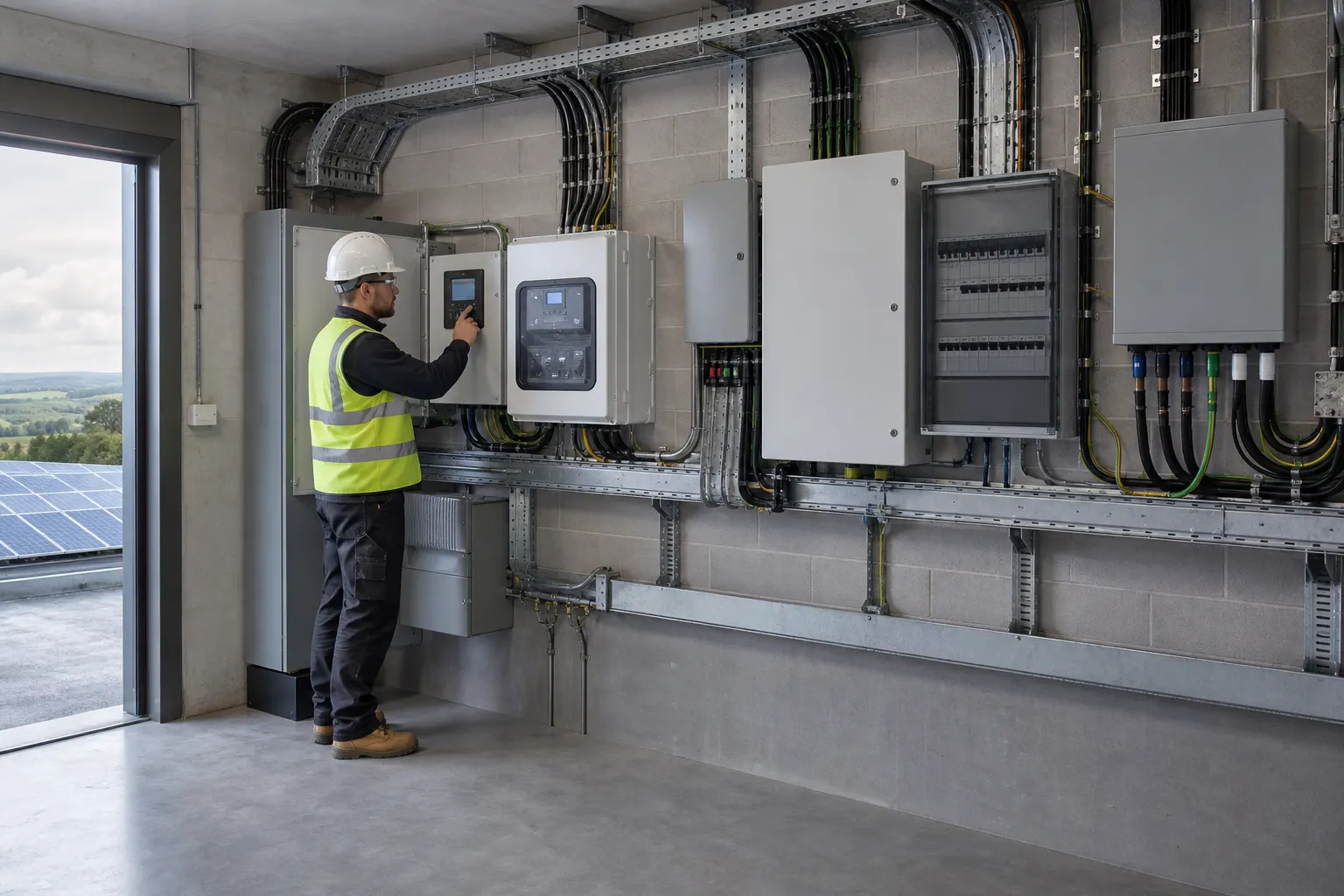
EREC G100 covers customer limitation schemes that control net flow into or from the distribution network at the connection point. In an export-limited solar design, the control system monitors that point and adjusts generation or other relevant equipment so export remains within the agreed limit.
This is more than a convenient inverter setting. NGED requires an export-limitation scheme to reduce exported active power to the agreed maximum export capacity within five seconds. It must also operate fail-safe if relevant components, signalling or power are lost.
Export limiting therefore does not remove the need for the appropriate DNO process or guarantee that every proposed array size will be acceptable. The limitation scheme, protection arrangements and generating equipment form part of a coordinated design.
When export limiting may be worth assessing
The case is generally stronger where a site can use a significant amount of solar generation while it is being produced. Commercial solar self-consumption may support offices, machinery, refrigeration, ventilation, pumps, heating equipment or other operational loads.
A designer should compare realistic consumption data with expected generation across the day and year. If demand regularly falls below solar output, generation may need to be curtailed once battery charging and permitted export have been accounted for. Excess panel capacity is not automatically valuable if much of its potential output cannot be used.
Battery storage can change the operating profile by absorbing and releasing energy, but it introduces its own power ratings, controls, losses and connection implications. It should be modelled as part of the system rather than presented as a universal answer.
What changes for holiday parks, workshops and larger sites?
Different premises create different export-limitation questions. A holiday park may have highly seasonal occupancy and a mixture of accommodation, leisure and infrastructure loads. A workshop or factory may have substantial three-phase demand during operating hours but much lower consumption at weekends or during shutdowns.
Larger rural sites can also include long cable routes, several distribution points, existing generation and buildings with different uses. The position of the grid connection and the point at which load and generation are measured matter to the overall design.
For these sites, the headline annual electricity total is rarely enough. Half-hourly data, operating schedules and planned changes provide a more useful picture of when electricity is actually required.
Why solar, batteries and EV charging need one assessment
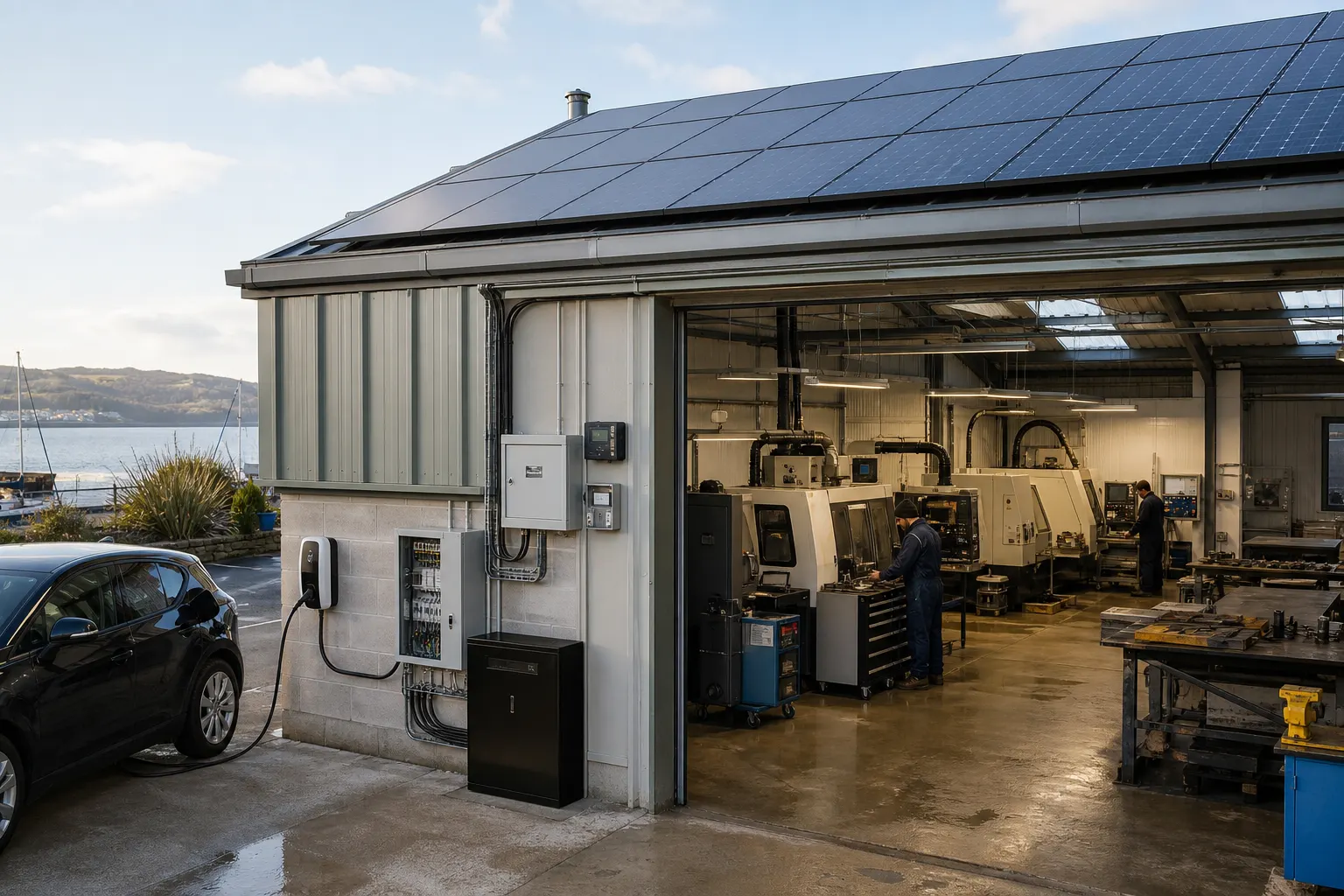
Solar PV and battery storage operating in parallel may need to be considered by their relevant aggregate AC output. MCS MIS 3002:2025 notes that aggregate generator output is used when considering the 16A-per-phase threshold, including an example where parallel solar and battery equipment moves a single-phase installation into G99.
Future EV charging matters too. Chargers can increase site demand and potentially improve use of solar generation, but they also affect electrical capacity, distribution and load-management decisions. Existing PV, battery controls, protection, isolation and metering should consequently be reviewed alongside any planned commercial EV charging installation.
What to assemble before requesting a solar proposal
Good information reduces the number of assumptions in an early design. Where available, assemble:
- recent electricity bills and half-hourly consumption data;
- MPAN and supply information;
- existing single-line diagrams and plant schedules;
- details of current solar PV, batteries or standby generation;
- roof, building and wider site plans;
- operating hours and significant seasonal changes;
- planned machinery, EV charging or building expansion; and
- previous connection correspondence or agreed export details.
Network mapping and capacity datasets can inform early investigation, but they are not a substitute for a formal application or agreed connection terms.
Questions to ask before approving the design
- What are the proposed panel capacity and inverter AC output?
- What consumption profile supports the assumed self-consumption figure?
- What export capacity is being requested or has already been agreed?
- Does the project require a G99 application and a G100 export-limitation scheme?
- How does the system respond if controls, communications or power fail?
- How are existing generation, battery storage and future additions included?
- When might solar generation be curtailed, and has that been reflected in the assessment?
Clear answers help decision-makers compare designs on their technical basis rather than relying on panel quantity or an unexplained claim of “zero export”.
Next step for a Falmouth commercial site
A quoted panel count should not be treated as the finished design until the site’s electrical infrastructure, demand profile and connection position have been reviewed. Early assessment can establish which figures are firm, which depend on DNO agreement and whether export limiting deserves further consideration.
Maenporth Electrical provides solar PV services for commercial and larger sites in Falmouth, Penryn and the wider Cornwall area. To discuss the electrical and site information needed before progressing a proposal, call 01326 250297.