

Does a shop, office, leisure venue, holiday park or larger rural business have to close whenever electrical alterations are carried out? Not necessarily. However, no responsible contractor can answer that question from the proposed scope alone.
Before commercial electrical work in Falmouth begins, the contractor needs to understand the installation, the affected circuits and the services on which the site depends. Only then is it possible to decide whether the work can be phased, contained within part of the premises or requires a planned partial or fuller shutdown.
The objective is to reduce avoidable disruption without allowing operational convenience to take priority over electrical safety. Maenporth Electrical provides commercial electrical services for premises in Falmouth and across Cornwall, including occupied and operational sites where careful coordination is essential.
Does commercial electrical work always mean closing the business?
The answer depends on what is being altered and how the existing installation is arranged. Work affecting one clearly identified final circuit may have a different operational impact from replacing distribution equipment, changing a main supply arrangement or carrying out work that affects several interconnected areas.
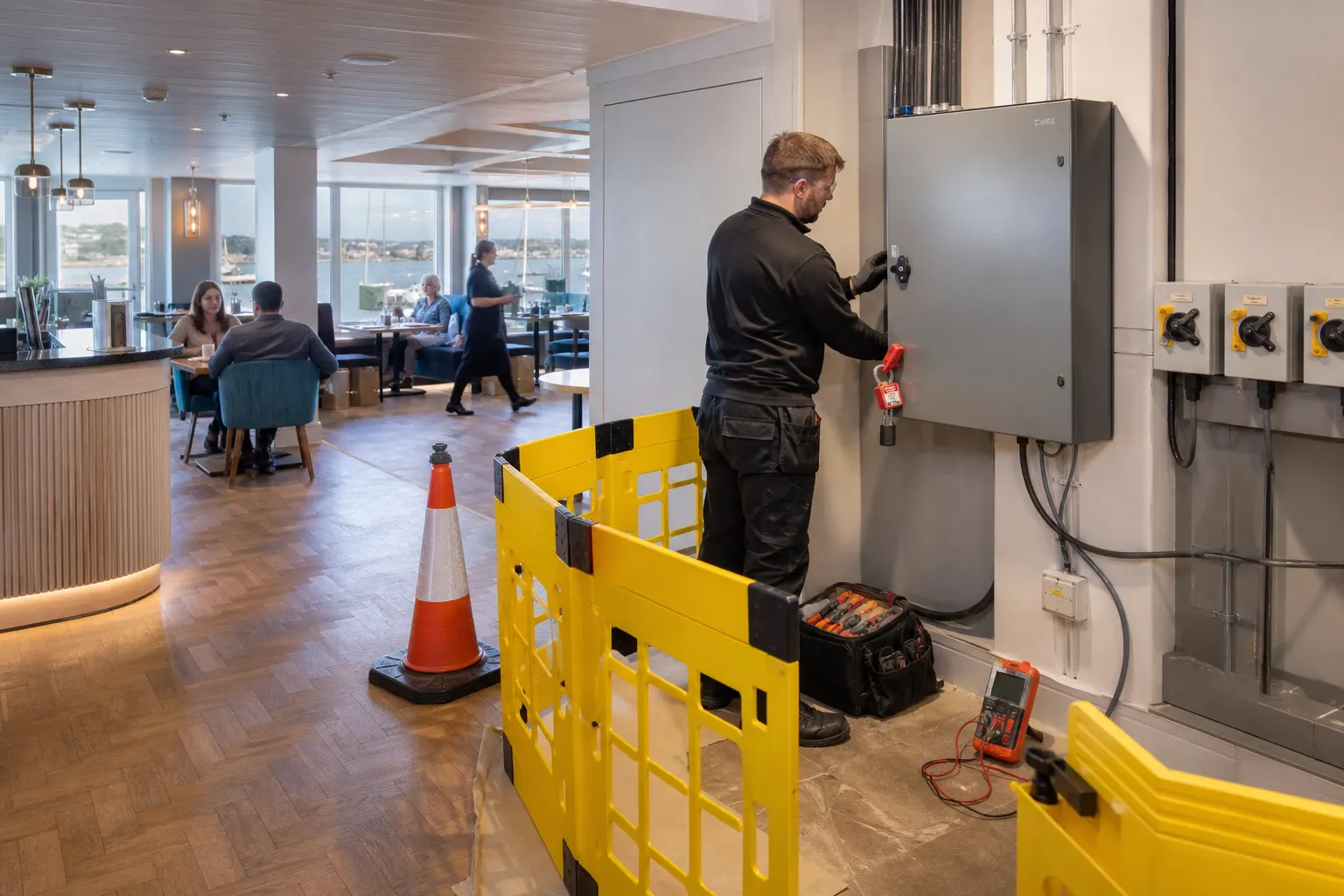
A site may be able to remain partly operational if affected sections can be safely isolated and separated from areas that remain in use. In other cases, a wider outage may be the safest and most practical approach. The condition of the installation, accuracy of circuit information, physical access and presence of shared supplies can all influence that decision.
Keeping the doors open is therefore not the same as maintaining every normal service. A business might remain occupied while losing access to selected rooms, equipment or facilities. These limitations must be understood before opening hours, bookings, deliveries or staff arrangements are confirmed.
Start by identifying the loads and services that cannot simply be switched off
The first planning question is not merely “when can the power go off?” It is “what would happen if this particular supply were unavailable?”
Critical or operationally sensitive services may include:
- refrigeration, freezers and temperature-controlled stock;
- IT systems, data equipment, communications and payment facilities;
- security alarms, CCTV, access control and automated gates;
- fire detection, emergency lighting and other life-safety provisions;
- pumps, ventilation, process equipment and building controls;
- guest accommodation, welfare facilities and accessible areas;
- landlord-controlled equipment or services shared with another occupier.
The list will differ between a town-centre commercial unit, a leisure venue and a larger rural site. Equipment should also be considered in terms of how it shuts down and restarts. Some systems require input from their maintainer, manufacturer or IT provider rather than simply being turned off and on.

What a site survey needs to establish before a shutdown date is agreed
A survey should establish which parts of the installation are involved, where they are supplied from and what else could be affected. Existing drawings, labels and reports are useful, but they cannot automatically be assumed to describe the installation exactly as it stands.
The contractor may need to assess distribution arrangements, circuit identification, access to electrical equipment, the condition of relevant components and the relationship between the planned work and occupied areas. Restrictions on plant-room access, delivery routes, customer areas and working space also matter.
Planning is a safety requirement rather than an administrative extra. The HSE guidance on safe electrical working practices explains that many electrical accidents result from a failure to plan ahead and highlights the need to consider hazards, risks, management, supervision, implementation and completion.
Isolation, phased work and temporary arrangements are different approaches
Planned isolation
Switching something off is not automatically the same as safely isolating it. Suitable isolation must ensure the relevant supply remains off, prevent inadvertent reconnection and allow the work to be controlled safely. The isolation boundary must relate to the actual installation and proposed task, not an unverified assumption.
Phased electrical work
Phasing divides a project into controlled sections. It may allow unaffected parts of a building or site to continue operating while work proceeds elsewhere. This depends on whether the electrical arrangement, access and project scope provide meaningful separation.
Phased work can also create repeated shutdowns, handovers or access restrictions. It is not automatically less disruptive than one well-planned outage, so the overall effect on the business should be compared rather than assumed.
Temporary arrangements
Temporary power may be considered for selected loads, but it is not a universal answer. The load, supply capacity, protective arrangements, cable routes, environmental conditions and interaction with site users all require assessment. Critical equipment may also have power-quality, connection or restart requirements that make a proposed temporary supply unsuitable.
Temporary arrangements should consequently be treated as an engineered part of the plan, not as an informal extension-lead solution or a promise that normal operation will continue unchanged.
Planning around staff, customers, guests and other site users
Electrical work in occupied business premises affects more than the electrical contractor. The plan may need input from managers, occupiers, landlords, facilities teams and specialist maintainers. Staff should know which rooms, entrances, equipment and facilities will be unavailable, as well as who has authority to confirm that an area can return to use.
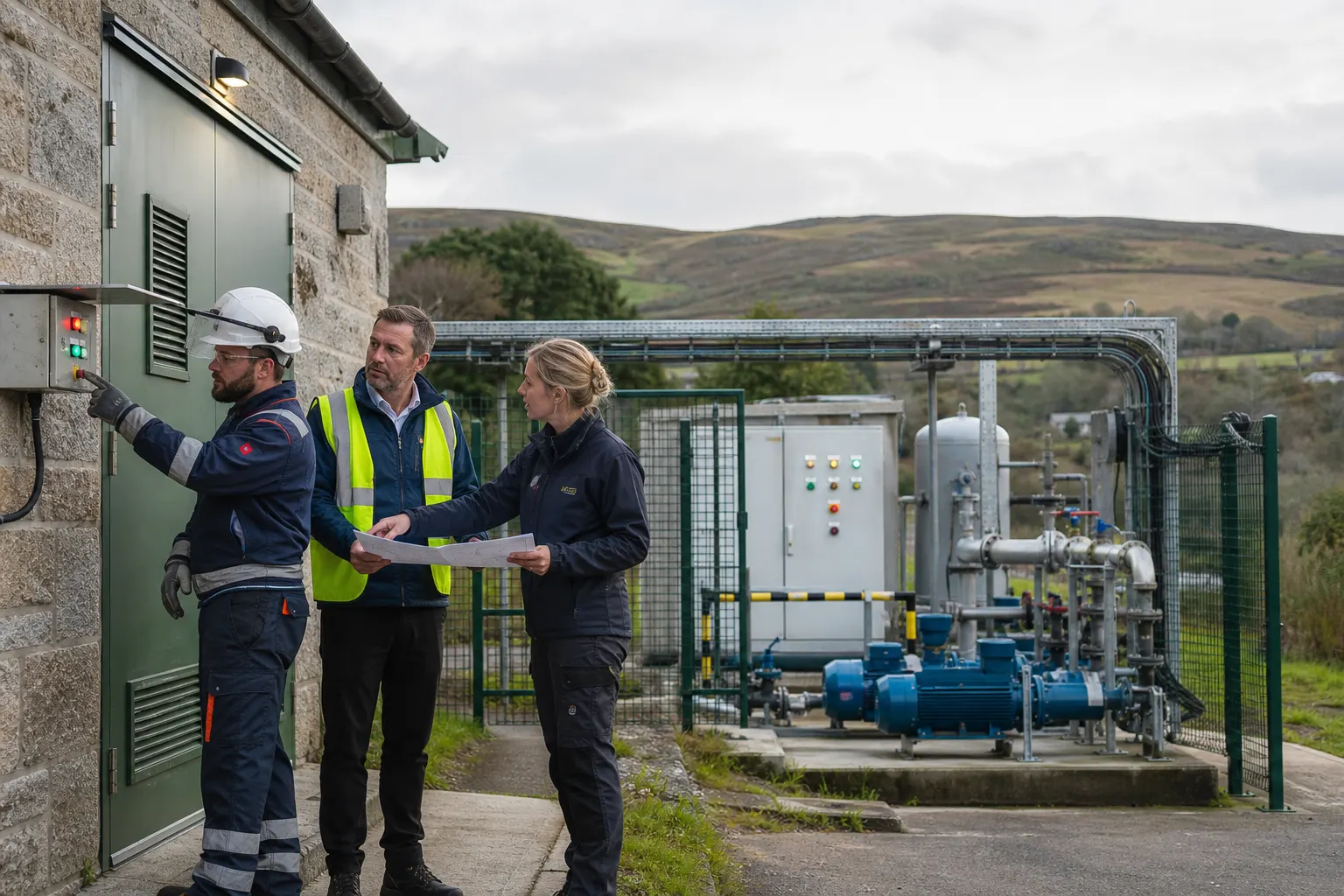
For customer-facing and leisure premises, consider bookings, deliveries, check-in periods, public access and quieter operating windows. Larger rural sites may also need to account for remote plant, long cable routes, gates, pumps or buildings supplied from a shared distribution point.
If the electrical work forms part of a broader alteration, the coordination principles in Maenporth Electrical’s guide to planning electrical work during a commercial refurbishment can help identify dependencies beyond the immediate electrical scope.
Fire safety, emergency systems and shared-building responsibilities
An outage or change to normal site operation may affect fire detection, emergency lighting, access routes, automatic doors, smoke-control equipment or communications. The responsible person for commercial premises must maintain appropriate fire precautions, complete a suitable fire-risk assessment and plan for emergencies. If alterations or temporary operating conditions change the risks, the assessment and arrangements may need review.
Shared buildings require particularly clear responsibilities. A tenant may not control the incoming supply, communal alarm, landlord’s distribution equipment or access to the electrical intake. The landlord or managing agent should be involved early enough to confirm permissions, responsibilities and the effect on other occupiers.
What should be agreed in the shutdown and handback plan?
The level of detail should be proportionate to the job, but the agreed plan should normally make the operational sequence clear. Relevant points include:
- the work scope, affected areas and intended isolation boundaries;
- who authorises the shutdown and who needs to be notified;
- equipment requiring controlled shutdown by others;
- access arrangements and restrictions for staff or customers;
- any temporary services and their stated limitations;
- the arrangements for fire precautions, security and emergencies;
- what inspection, testing or functional checks are required;
- who confirms that systems and areas are ready for use;
- what happens if the installation differs from the available information.
Handback should not be reduced to the moment when power is restored. Relevant systems may need to be restarted or checked by the people responsible for them, and any remaining limitations should be communicated before normal operations resume.
When a larger project needs wider CDM coordination
Where an electrical upgrade forms part of construction work, the commercial client may have duties under the Construction (Design and Management) Regulations 2015. These include making suitable project-management arrangements, allowing adequate time and resources, and providing relevant pre-construction information.
Not every small electrical task needs the same formal structure. Nevertheless, larger projects involving several contractors, building alterations or overlapping work require responsibilities and dependencies to be coordinated rather than left to individual trades on the day.
Information to prepare for a Falmouth commercial electrician
Useful information includes the proposed scope and layout, operating hours, critical equipment, access constraints and the contact details of landlords or managing agents. Provide current test records, single-line diagrams and distribution information where available, together with details of known shared supplies.
Also identify dates when an outage would create exceptional consequences, such as major bookings, production commitments or occupied guest periods. This does not establish that an outage can be avoided, but it helps the contractor assess realistic options before work is scheduled.
If you are planning a commercial electrical upgrade in Falmouth, Penryn or elsewhere in Cornwall, contact Maenporth Electrical on 01326 250297. A site-specific assessment can establish whether phased work, a partial shutdown or a fuller outage plan is the appropriate approach.