
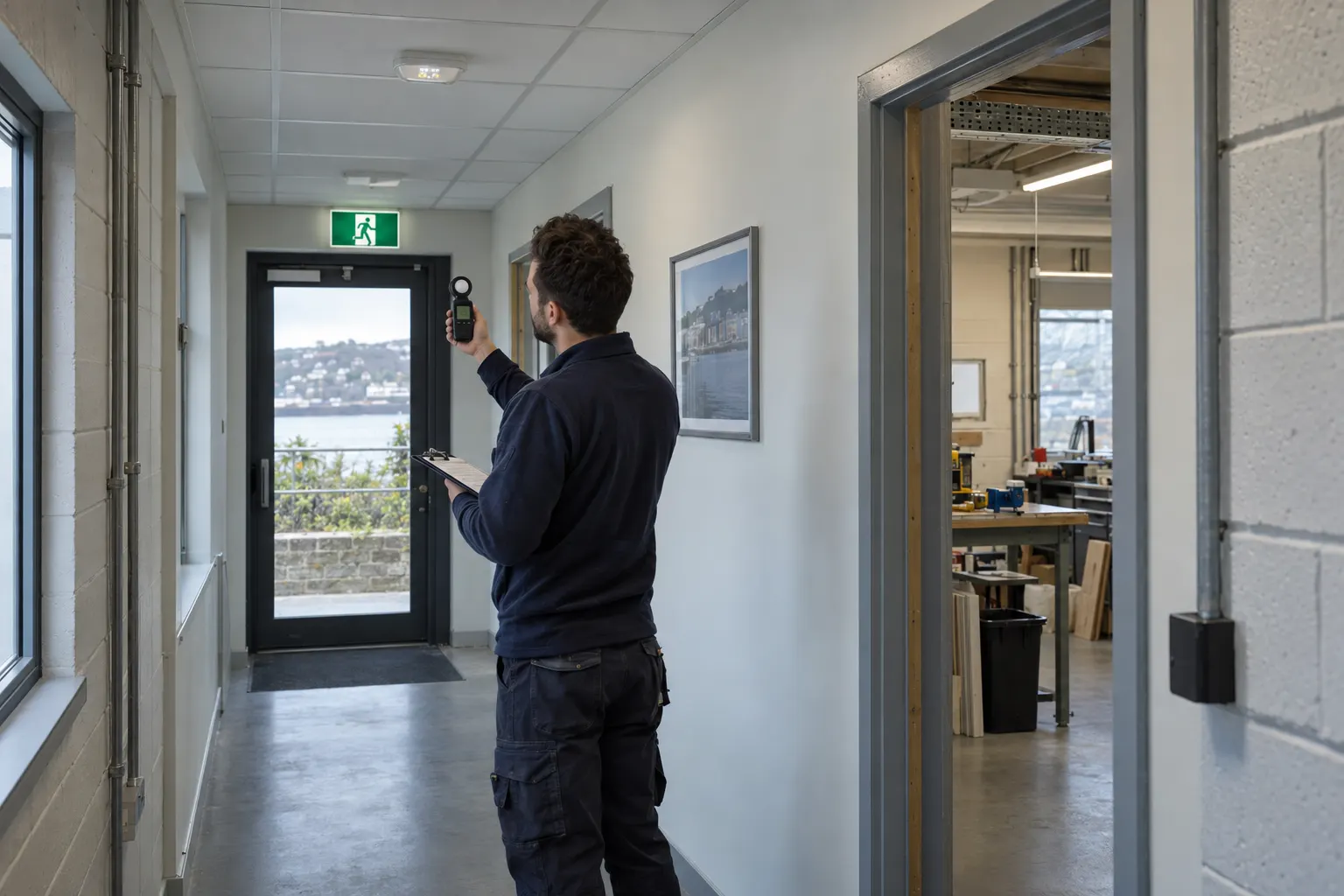
No, not automatically. BS 5266-1:2025 emergency lighting guidance does not, simply by being published, require every existing fitting to be replaced. For a Falmouth business, the better question is whether its current provision still meets the premises' assessed needs, and whether any lighting needed beyond escape has been properly considered.
That matters when a quotation or internal compliance review says the system needs updating “to the latest standard”. Before committing to replacement, ask what problem the proposed work would solve. A standards update is a reason to understand the changes, not proof that the whole installation is inadequate.
What changed in BS 5266-1:2025?
BSI lists the 2025 emergency lighting code of practice as current, with a publication date of 29 October 2025. It supersedes the 2016 edition. BSI describes the principal change as an expanded scope covering local-area and standby lighting alongside emergency escape lighting.
Standby lighting vs emergency escape lighting
Emergency escape lighting supports escape when normal lighting fails. Lighting intended to let people remain in an area or continue an activity during a power cut has a different purpose. Local-area emergency lighting and standby lighting should therefore be discussed in terms of what they are meant to achieve, rather than treated as interchangeable with escape provision.
A lit escape corridor at a factory does not demonstrate that production can safely continue. Equally, lighting intended to support an activity does not, by itself, demonstrate that the escape arrangements are adequately lit.
An expanded scope does not mean every business needs every form of lighting. The required provision still depends on the premises, its risks and what the lighting is intended to achieve.
Does the revised standard require existing lights to be replaced?
The edition date alone is not a replacement instruction. BS 5266-1 is a code of practice, not legislation. The government's offices-and-shops fire safety guide explains that cited standards are guidance, while the necessary safety level is determined through risk assessment.
For existing installations, that rules out two unhelpful assumptions: that everything must be replaced because the standard changed, or that everything is acceptable because it was installed under an older edition. Neither conclusion follows without considering the premises and the evidence.
If a proposal is justified by the new edition, ask the designer to identify the relevant recommendation and explain its significance for your installation. That separates a genuine design issue from a general statement that newer guidance exists.
A review may support targeted work, broader redesign or retaining existing provision. When commissioning commercial lighting work, the reason should be more specific than “the fittings are old” or “there is a new standard”.

Which legal duties still apply to your site?
The emergency lighting requirements for businesses start with their duties and risks, not a universal package of fittings. The Home Office says emergency escape lighting is needed where necessary to illuminate escape routes and exits; its adequacy should be considered through the premises' fire-risk assessment.
There is also a workplace lighting duty. HSE's guidance on suitable and sufficient lighting includes emergency lighting where workers would be specially exposed to danger if artificial lighting failed. For a workshop, the loss of light around machinery may therefore need consideration beyond the route to the exit.
Do not assume that anything beyond escape lighting is merely a convenience. Where loss of light creates a safety risk, that risk needs assessing; it is a different case from choosing extra illumination so a business can continue trading.
These are related but distinct considerations. An electrical contractor can assess the lighting installation and advise on electrical work. That review is not a substitute for the responsible person's fire-risk assessment or competent fire-safety advice.
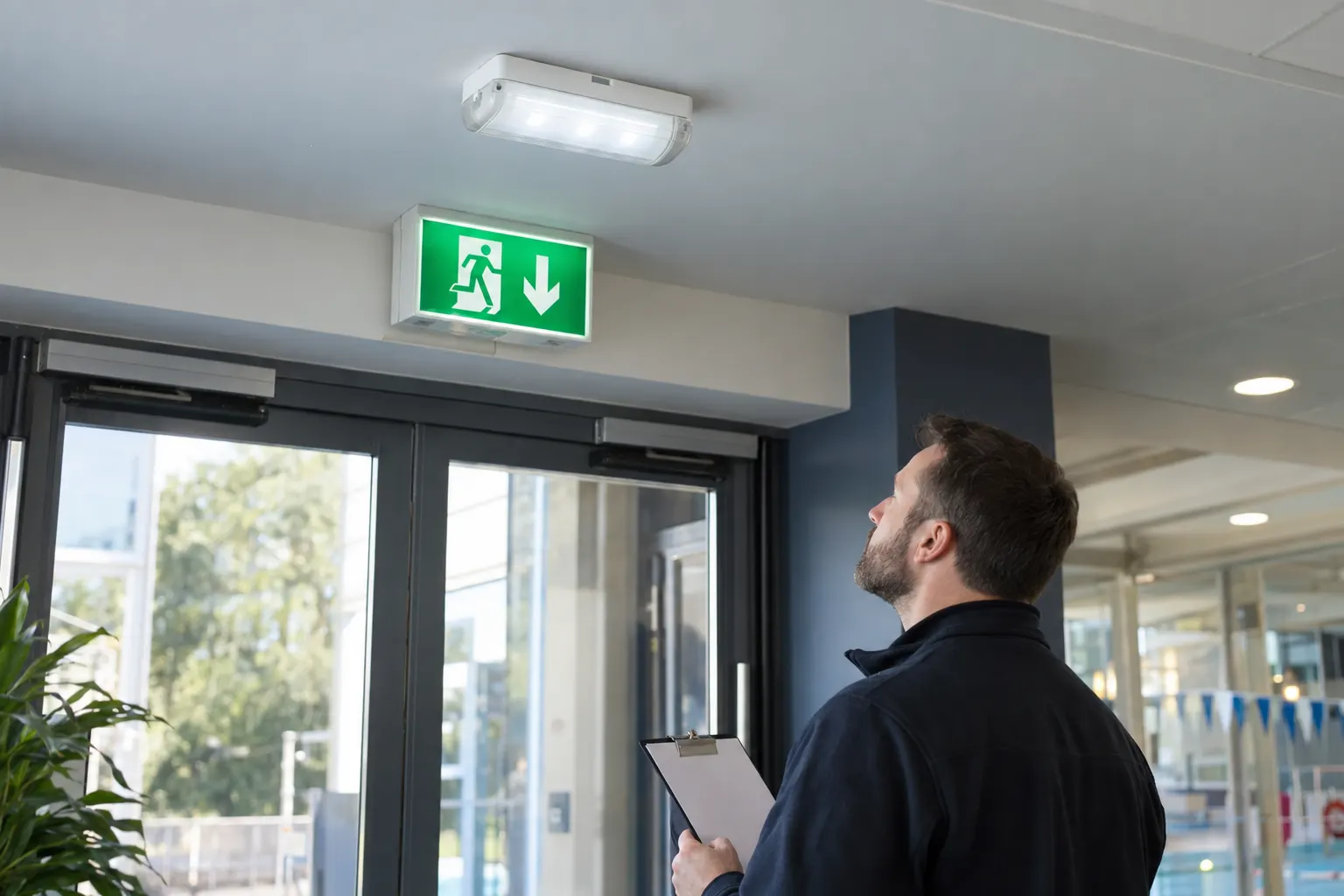
When should a Falmouth site review its existing provision?
A focused review is especially useful when the reason for replacement is unclear or the evidence does not match how the site expects to operate during a loss of normal lighting. Useful prompts include:
- An upgrade proposal cites BS 5266-1:2025 but does not identify a site-specific shortfall.
- The available records do not clearly describe what the existing lighting was intended to provide.
- Management expects people to remain on site or continue an activity during a power cut, but that lighting need has not been assessed separately from escape.
- The fire-risk assessment has raised a lighting concern that needs an electrical response.
For a holiday park reception or leisure building, explain the intended response to a power cut before asking for products. Is the plan to move visitors out, or are staff expected to manage an occupied area? That expectation belongs in the assessment, rather than being left for the contractor to infer.
What should a review establish before an upgrade is specified?
Start with the required outcome for each relevant area. Is the lighting there to support escape, address danger arising from loss of light, or enable a defined activity to continue? Those objectives should be agreed before selecting products.
Ask for evidence and a reasoned scope
The reviewer should compare the assessed need with available installation information, drawings and maintenance records. Gaps in documentation should be recorded as uncertainties to resolve, not automatically presented as proof that every luminaire must be replaced. Conversely, paperwork alone is not enough to dismiss an identified safety concern.
Ask for the recommendation to distinguish work needed to address assessed risks from any optional improvements for business continuity. It should explain what can remain, what needs changing, and why. Where the existing information is insufficient, the next step may be further competent assessment rather than an immediate whole-site replacement quote.
Compare quotations against that agreed scope. A proposal to renew worn fittings and one to provide lighting for an additional activity are not necessarily alternative prices for the same job. Differences should be explained before cost becomes the deciding factor.
Request that written reasoning alongside the proposed electrical scope. It gives the responsible person something meaningful to consider with their fire-safety adviser, rather than simply a choice between fittings.

Who should agree and document the next step?
The responsible person should retain oversight of the fire-safety decision, with competent fire-safety advice where needed and electrical design input for the installation. Site management should confirm operational expectations, while the proposed electrical work should be checked against the agreed assessment before it is authorised.
Where an occupier, landlord or site operator controls different parts of the premises, agree who will provide information and authorise work. A lighting specification cannot resolve unclear responsibilities by itself.
Record the assessed needs, evidence, actions and who will take them forward. If the decision is to retain the existing lighting, document the reasoning for that too.
If lighting changes also involve other fixed electrical work, bring those requirements into the same brief for commercial electrical services. Known safety concerns should be addressed rather than deferred while the edition number is debated.
Planning an emergency lighting upgrade in Falmouth? Call Maenporth Electrical Ltd on 01326 250297 to discuss a site-specific electrical review before committing to replacement. Based at Maenporth, we serve Falmouth, Penryn and the wider Cornwall area.