

No. The RCD test button is a useful routine check, not a complete assessment of electrical safety. Commercial RCD testing in Falmouth needs to distinguish a button check from instrument testing and a wider inspection of the installation.
For a site manager, there is another question: what will stop when the device trips? A check at the distribution board may affect equipment elsewhere. A sound plan covers both the protection being checked and the operations that depend on it.
What the RCD test button does and does not prove
An RCD, or residual current device, can reduce the risk from some electric shocks. The Health and Safety Executive (HSE) explains that it does not protect against every type of shock and cannot replace other electrical safety measures.
The built-in button provides a routine check that the device’s test mechanism can cause it to trip. A successful result does not measure its operating time, establish the condition of the wiring or confirm that the protection is suitable for everything now connected.
Routine checks should be carried out only by an authorised person following the manufacturer’s instructions and the site procedure. Removing protective covers or attempting fault-finding is not part of that routine task.
How instrument testing and an EICR differ
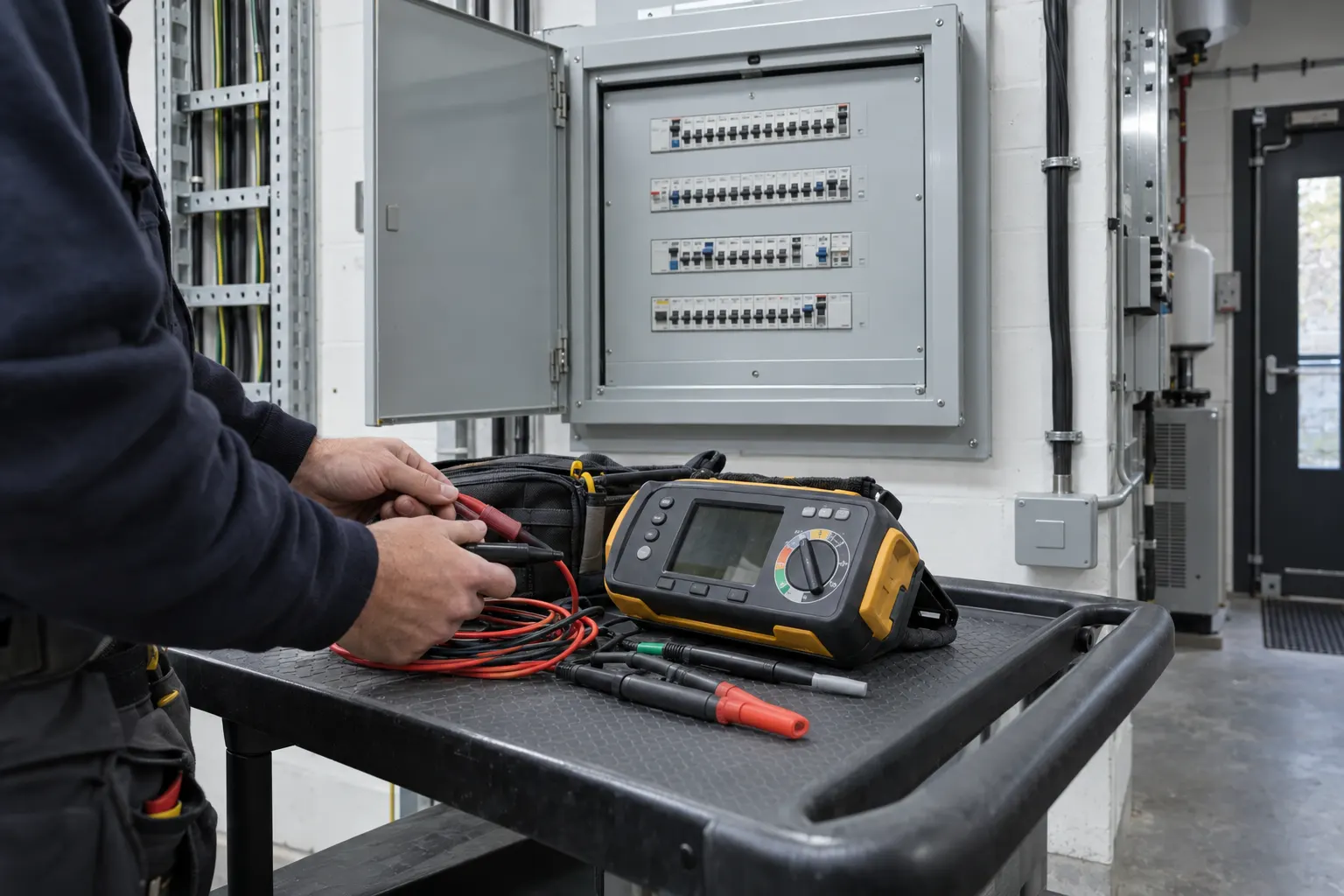
A competent electrician uses appropriate instruments to assess RCD operation, including operating time where required. The scope depends on the device and the purpose of the work; not every diagnostic test is necessary in every situation.
An Electrical Installation Condition Report (EICR) follows a wider inspection and testing of the installation. A button check does not replace appropriate instrument testing, and an RCD test alone does not replace an EICR.
When arranging electrical testing and compliance, agree whether the work is a specific RCD investigation, planned testing or a wider inspection. A previous satisfactory EICR does not remove the need for routine checks between inspections.
Give the electrician the previous EICR, relevant test results and details of repeated tripping or equipment changes. Those records help define the task; asking only for an RCD test can leave people expecting different levels of investigation.

How often should a commercial site check its RCDs?
The IET’s guidance on RCD test-button notices describes six-monthly operation and explains why older labels may say quarterly. This is BS 7671 guidance for routine button checks, not a separate statutory requirement for six-monthly instrument testing.
Where labels, manufacturer’s instructions and site records differ, ask a competent electrician to resolve the schedule. Do not assume that a longer interval is appropriate simply because it appears on a newer notice.
The Electricity at Work Regulations require electrical systems to be maintained where necessary to prevent danger. They do not prescribe one universal RCD instrument-test or commercial EICR interval. Use, operating conditions, maintenance history and external influences all inform the assessment.
For example, exposed outdoor equipment and a sheltered office should not be assigned identical maintenance needs without assessment. Previous faults or changes in use may also justify a review.
Specify RCD testing between EICRs in the maintenance plan, distinguishing routine button-check dates from any agreed instrument testing and wider inspection dates.
Plan for the circuits affected, not just the device
A successful test-button check interrupts the supply protected by that RCD. Depending on the arrangement, that may mean one circuit or several. Labels and old drawings may not reflect equipment added or moved since they were produced.
At a factory, an interruption could affect machinery controls; at a holiday park or leisure site, it could affect pumps, refrigeration or booking systems. Confirm which operations rely on those circuits, not just the equipment names on a label.
If records are uncertain, arrange competent help to establish the scope before scheduling the check. A quiet period is not automatically a safe window if equipment needs an attended shutdown or controlled restart.
On a shared site, the person arranging a check may not control every affected operation. Confirm the contacts and authority needed before interrupting equipment managed by another department, tenant or contractor. Access to the board is not the same as permission to stop the services it supplies.
Allow time for shutdown and restoration
For example, a leisure building may have equipment that must be shut down in an agreed order. Even if the check itself is brief, the site team needs time to make affected activities safe, manage the interruption and confirm that services have recovered. Schedule the whole task, not just the moment of testing.
If an interruption cannot be accommodated, agree a safe plan with a competent electrician rather than skipping checks indefinitely or improvising a workaround.
What site managers should plan and record
Treat the check as a controlled maintenance task, with a short record that someone else can understand. For each device, cover:
- Identification. Record the board and device reference, the circuits protected and any known linked operations. Flag unclear or conflicting circuit information before the check is arranged.
- Responsibility. Name the person authorised to carry out routine checks and the competent electrician responsible for instrument testing or investigating concerns.
- Timing. Record the agreed interval and operational window, including who needs notice and any arrangements for equipment or services that cannot simply stop.
- Restoration. Agree who will confirm that affected equipment is safely back in service. Restored power is not the same as a confirmed return to normal operation.
- Results. Log the date, observed outcome, unexpected interruptions and any follow-up action. Make the next check date clear rather than leaving it to memory.
- Escalation. Identify who must be told about a failed check or unexplained trip, and who can authorise safe arrangements for affected operations.
Distinguish button-check entries from instrument-test results and EICR findings, but keep them accessible together. Building this into planned electrical maintenance helps prevent a routine check being mistaken for a completed installation inspection.
If a check interrupts an unexpected service, record that too and have the circuit information reviewed. A successful trip can still expose a gap in your understanding of what the device protects, which matters when planning the next interruption.
A deferred check is not a pass. Record the restriction and have the responsible person agree the next safe action with a competent electrician, rather than allowing missed checks to disappear from the log.

When to arrange competent inspection or fault investigation
Arrange an assessment if an RCD fails its routine check, repeatedly trips, will not reset, or protects circuits that cannot be identified confidently. Missing records or significant changes to connected equipment are also reasons to review the plan rather than automatically waiting for the next EICR.
Repeated tripping needs investigation; it is not, by itself, a diagnosis that the RCD is faulty. HSE advises that faulty or inoperative RCDs should not remain in use. Follow the site’s safety procedure to have affected supplies or equipment made safe and kept out of use pending competent assessment. Do not bypass protection or keep resetting an unexplained trip.
To discuss RCD testing and commercial electrical maintenance for your Falmouth site, call Maenporth Electrical Ltd on 01326 250297. Based at Maenporth, we also serve Penryn and the wider Cornwall area.