

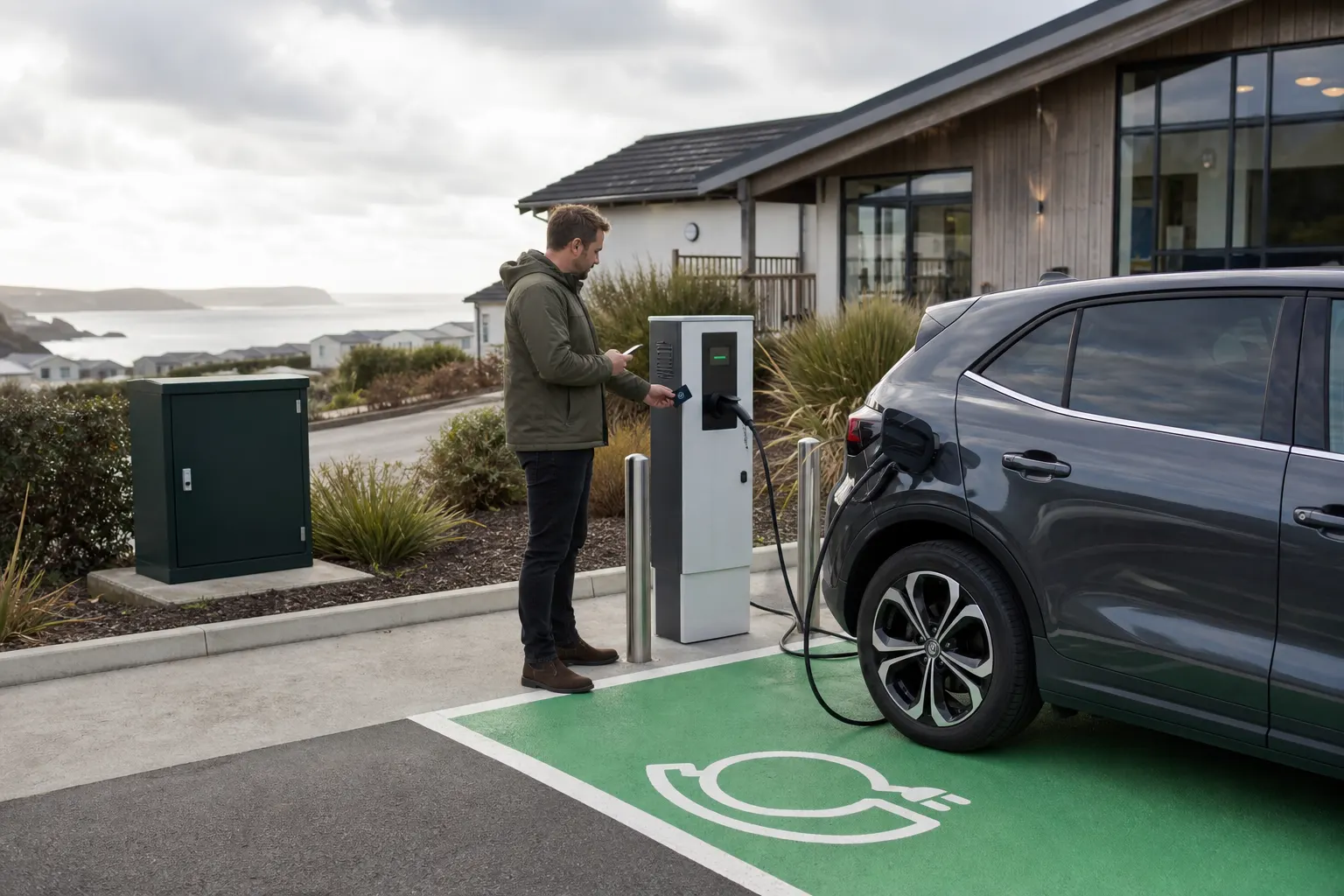
For many holiday parks and accommodation sites, the immediate EV question is no longer whether guests will arrive in electric cars. It is whether the site should continue prohibiting unmanaged charging from lodges, holiday lets or pitch supplies, or provide a dedicated service that can be controlled and monitored.
Planning EV charging for holiday parks in Falmouth therefore starts with a site policy, not a charger catalogue. Operators need to decide who may charge, where it will happen, how electrical demand will be managed and whether the installation should allow for additional bays later.
There is also a timely funding question. Qualifying small accommodation businesses may be able to use the Workplace Charging Scheme for guest chargepoints, but eligibility and the electrical design must be checked before an operator relies on that support.
Why holiday parks need a clear EV charging policy
Without designated charging, guests may ask to connect vehicles to supplies intended for accommodation, pitches or other site equipment. Whether a particular connection is suitable cannot be decided from its socket type alone. Existing demand, circuit design, protection, earthing, metering and the duration of the load all matter.
A clear policy gives guests and staff a consistent answer. It can prohibit charging from undesignated supplies while directing drivers to managed bays, if provided. This is more useful than relying on informal permission that may vary between shifts or bookings.
Decide who the chargers are for before choosing equipment
The access model affects the electrical design, software, payment arrangements and day-to-day management. A park should distinguish between:
- guest-only charging linked to a stay or booking;
- staff, maintenance vehicle or company fleet charging;
- mixed use by guests and site vehicles;
- chargers intentionally available to the general public.
Guest-only chargers might use an app, RFID card, reception-issued access or another controlled method. Public access may require a different commercial platform and additional operational checks. Settling this distinction early prevents the site from buying equipment that does not match its intended service.
Accommodation and pitch supplies are not automatically EV infrastructure
An electric vehicle can represent a substantial load over several hours. On a holiday park, that demand sits alongside accommodation heating, hot water, catering, leisure facilities, lighting and other seasonal loads.
The issue is not that every existing supply is inherently unsuitable. It is that an unmanaged connection may bypass the capacity planning, dedicated protection, metering and access controls expected from a designed charging installation. A competent assessment should establish what the site can support rather than relying on assumptions about spare capacity.
Maenporth Electrical’s commercial electrical services cover the wider site infrastructure that needs to be considered alongside any proposed charging bays.
What the electrical site assessment should establish
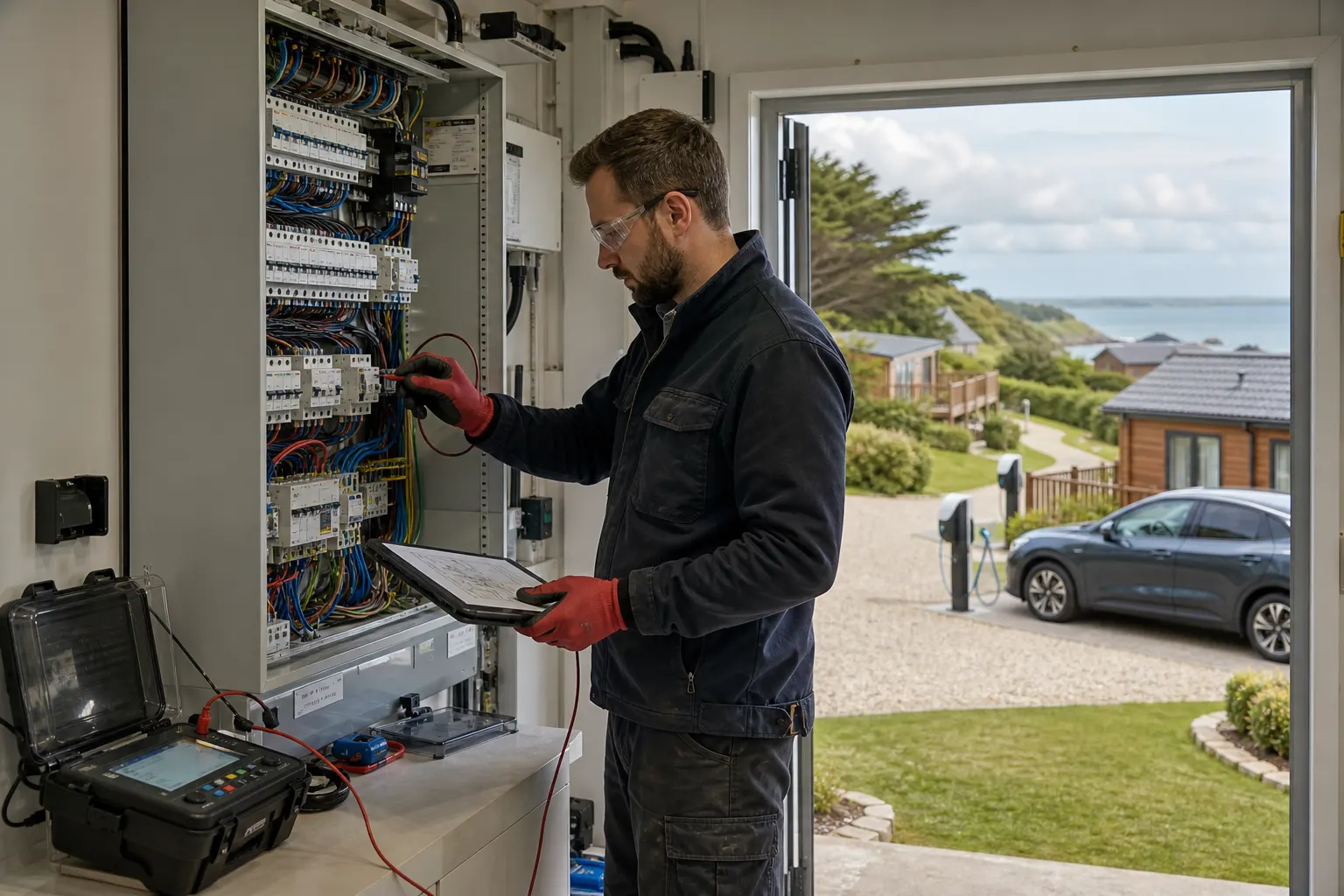
A survey should build a picture of the complete site, including present demand and credible future changes. Selecting a charger before this work can result in unnecessary limitations or an installation that is awkward to expand.
The assessment should consider:
- the incoming supply and how electricity is distributed around the park;
- recorded or calculated demand during realistic peak operating periods;
- the capacity and condition of relevant switchgear and distribution circuits;
- cable lengths, routes, containment and the practical impact of groundworks;
- the required protective measures and earthing arrangement;
- whether charger consumption needs separate monitoring or metering;
- load management options and any potential need for a supply upgrade;
- space and electrical provision for additional charging bays.
Chargepoint work must also follow the applicable current electrical, supply and Building Regulations requirements. This is specialist installation work rather than an extension of ordinary guest socket provision.
Choose locations around operations as well as parking
The closest parking spaces to a reception building are not always the best technical or operational location. Cable routes, excavation, accessibility, vehicle movement, drainage and maintenance access can significantly affect the installation.
Operators should also consider how bays will be identified and protected from general parking. A convenient charger provides little value if the space is routinely occupied by a vehicle that is not charging.
Future phases matter too. Installing suitable containment or allowing for later cabling during the first phase may reduce disruption when demand grows, even if only a small number of chargepoints are installed initially.
Use load management to plan beyond the first bays
Charger quantity and headline charging speed should not be considered separately from site capacity. Holiday park vehicles are often parked for extended periods, so the best arrangement may not require every socket to operate at its theoretical maximum simultaneously.
Dynamic or managed charging can distribute available capacity between connected vehicles and respond to other site demand. The appropriate approach depends on the selected equipment, electrical infrastructure and operating model. It should be designed around realistic arrival patterns rather than used as a substitute for understanding the supply.
For operators considering a managed rollout, Maenporth Electrical provides further information about its EV charging services.
Set payment, booking and access rules before launch
A controlled guest service needs operational decisions as well as electrical equipment. The park should establish whether charging is included, charged by energy used or handled through a third-party platform. Staff also need a process for faults, overstays and guests who need assistance.
A practical policy should address:
- who can activate a charger and how access is issued;
- whether bays can be reserved or are first come, first served;
- how prices and any additional conditions are communicated;
- what happens when charging is complete;
- where guests report damage or a failed session;
- how undesignated charging is explained and managed.
Signage and booking information should use the same rules. Guests are less likely to improvise when the designated option and its terms are clear before arrival.
Can a Falmouth holiday park use the Workplace Charging Scheme?
Potentially, if the operator qualifies as a small accommodation business and meets the scheme conditions. Eligibility should not be assumed for every holiday park, campsite or accommodation site.
As checked on 20 September 2026, the Workplace Charging Scheme for eligible organisations is scheduled to close at 11:59pm on 31 March 2027. For qualifying installations completed on or after 1 April 2026, it can cover up to 75% of eligible purchase and installation costs including VAT, capped at £500 per socket and 40 sockets across all sites per applicant.
A relevant feature is that a qualifying small accommodation business can allow customers, guests, visitors, staff or others to use funded chargepoints. That differs from the position for an ordinary business applicant and makes the scheme particularly worth checking for guest EV charging.
Conditions include dedicated off-road parking associated with the premises and owner or landlord consent where applicable. The site should be surveyed before application, and an OZEV-authorised installer is required for a claim. Grant support is not available for chargepoints or infrastructure already required by Part S Building Regulations or a planning condition.
Operators should verify the current terms, eligibility and application sequence before committing to equipment or budgeting on the basis of funding. Maenporth Electrical should not be assumed to be an OZEV-authorised installer or grant-claiming provider without separate confirmation.
Public access can bring additional responsibilities
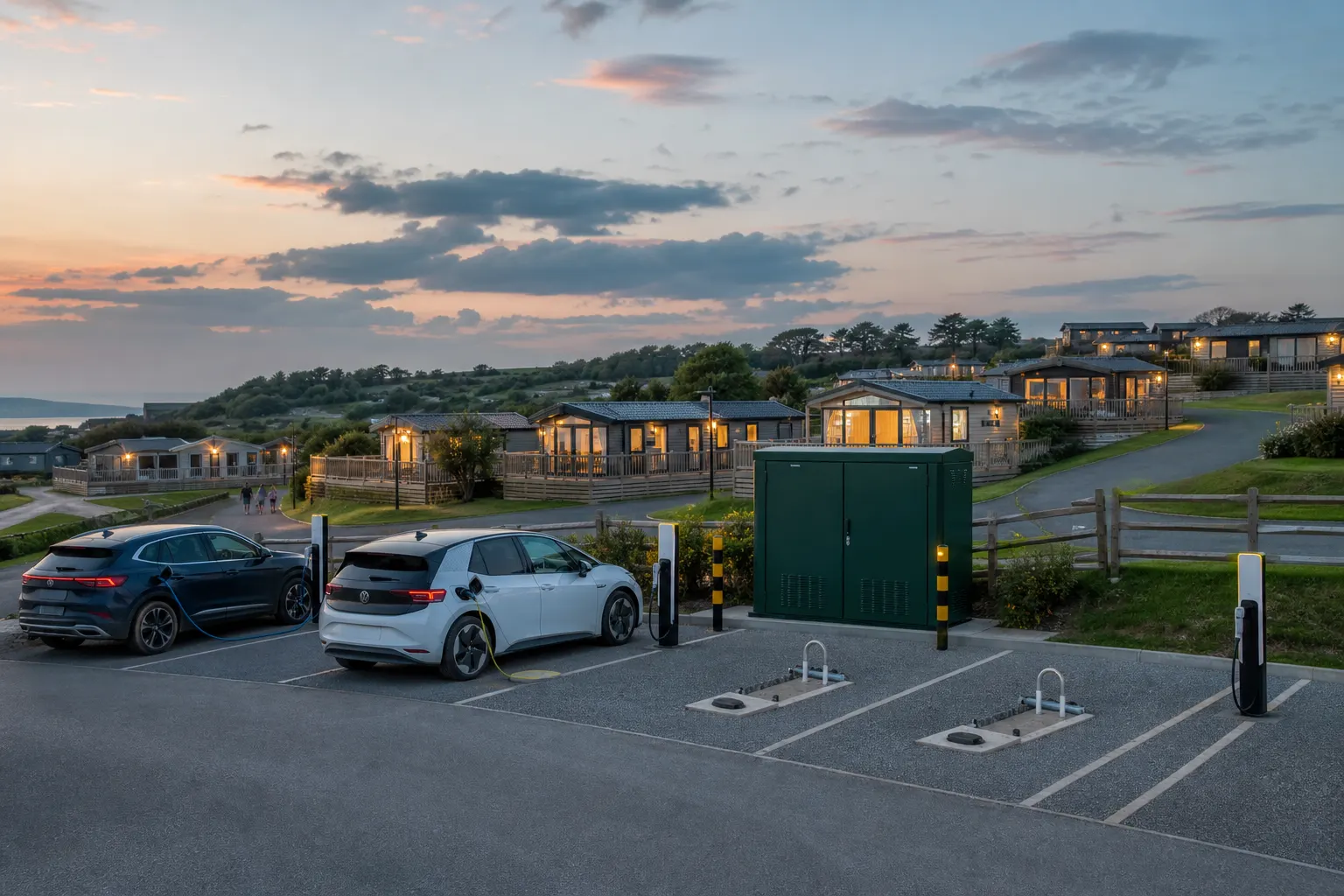
Making chargepoints genuinely available to the general public is different from restricting them to booked guests, staff or authorised visitors. Public Charge Point Regulations may apply to chargepoints in privately owned car parks that the public can access, including requirements involving pricing transparency and, in some circumstances, payment.
The intended access model should therefore be discussed with the chosen chargepoint operator or provider before the system is commissioned. A site should not accidentally create a public charging service simply because its access rules were left undefined.
Prepare a useful brief before requesting a site survey
A concise project brief helps an electrical contractor assess the right problem. Before the survey, gather any available electrical records and note:
- the proposed users and access model;
- initial and possible future bay numbers;
- likely parking duration and seasonal demand patterns;
- preferred locations and operational constraints;
- known plans for new accommodation, leisure facilities or other electrical loads;
- payment, reporting and reception-management requirements;
- land ownership, landlord consent and relevant planning conditions.
The objective is a controlled service that fits the wider site, not simply a row of chargers. For a practical discussion about guest EV charging in Falmouth, Penryn or elsewhere in Cornwall, contact Maenporth Electrical Ltd on 01326 250297.