
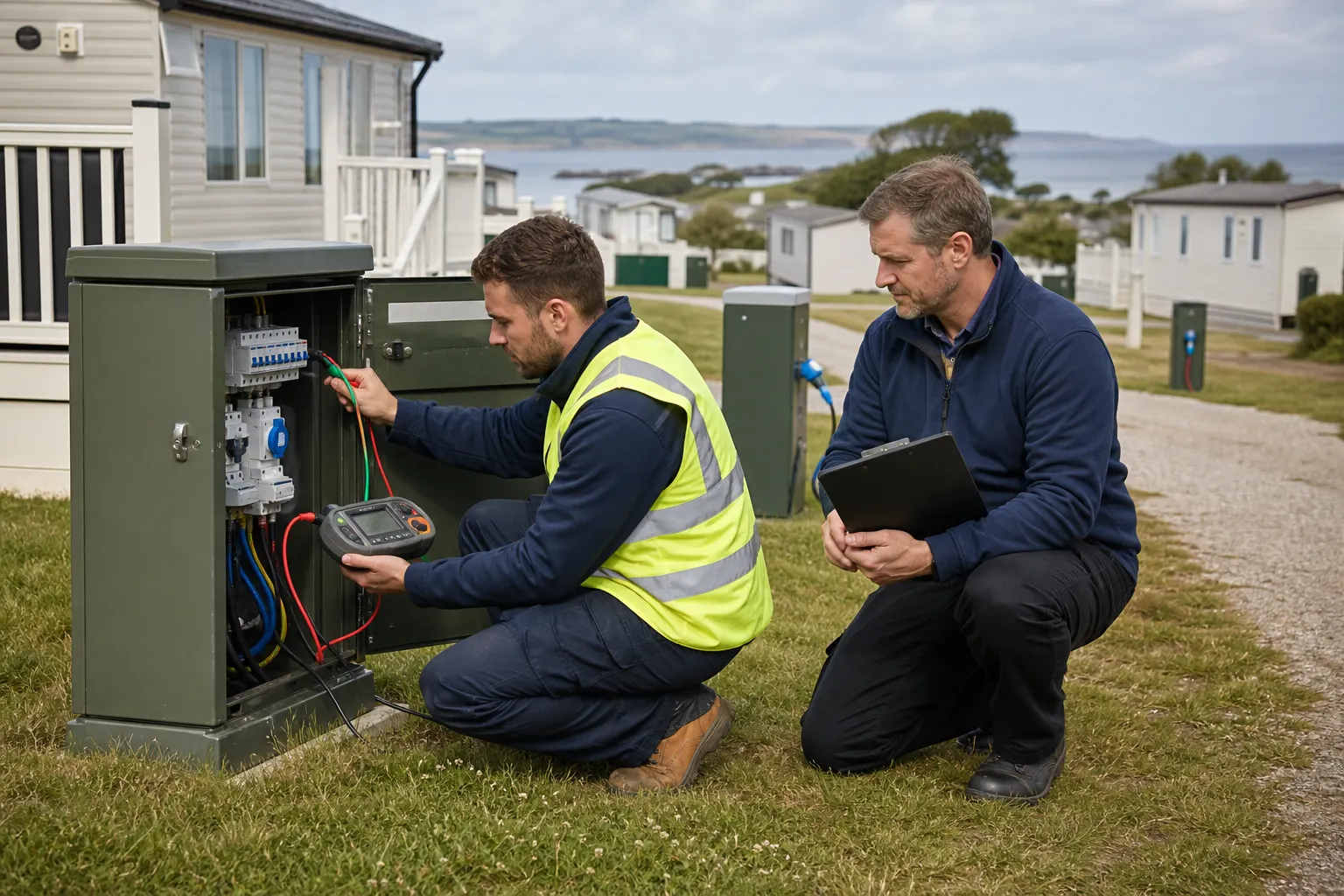
Electrical testing at a holiday park is rarely as simple as inspecting one building and issuing one certificate. A site may contain several distribution areas, pitch supplies, shower and laundry blocks, reception or retail spaces, workshops, external lighting and newer equipment added over many seasons.
Effective preparation starts by defining what is included, what records already exist and when parts of the site can safely be made available. For operators arranging holiday park electrical testing in Cornwall, doing this work before the busy season can reduce uncertainty and help the inspection reflect the site as it actually operates.
Why holiday parks need a site-wide electrical testing plan
Under the Electricity at Work Regulations 1989, electrical systems must be maintained so far as reasonably practicable to prevent danger. HSE guidance describes inspection and, where necessary, testing as essential parts of a preventive maintenance programme.
A periodic inspection provides evidence about the condition of the fixed electrical installation at the time of inspection. It should not be treated as a guarantee that faults will never occur or as a substitute for ongoing maintenance.
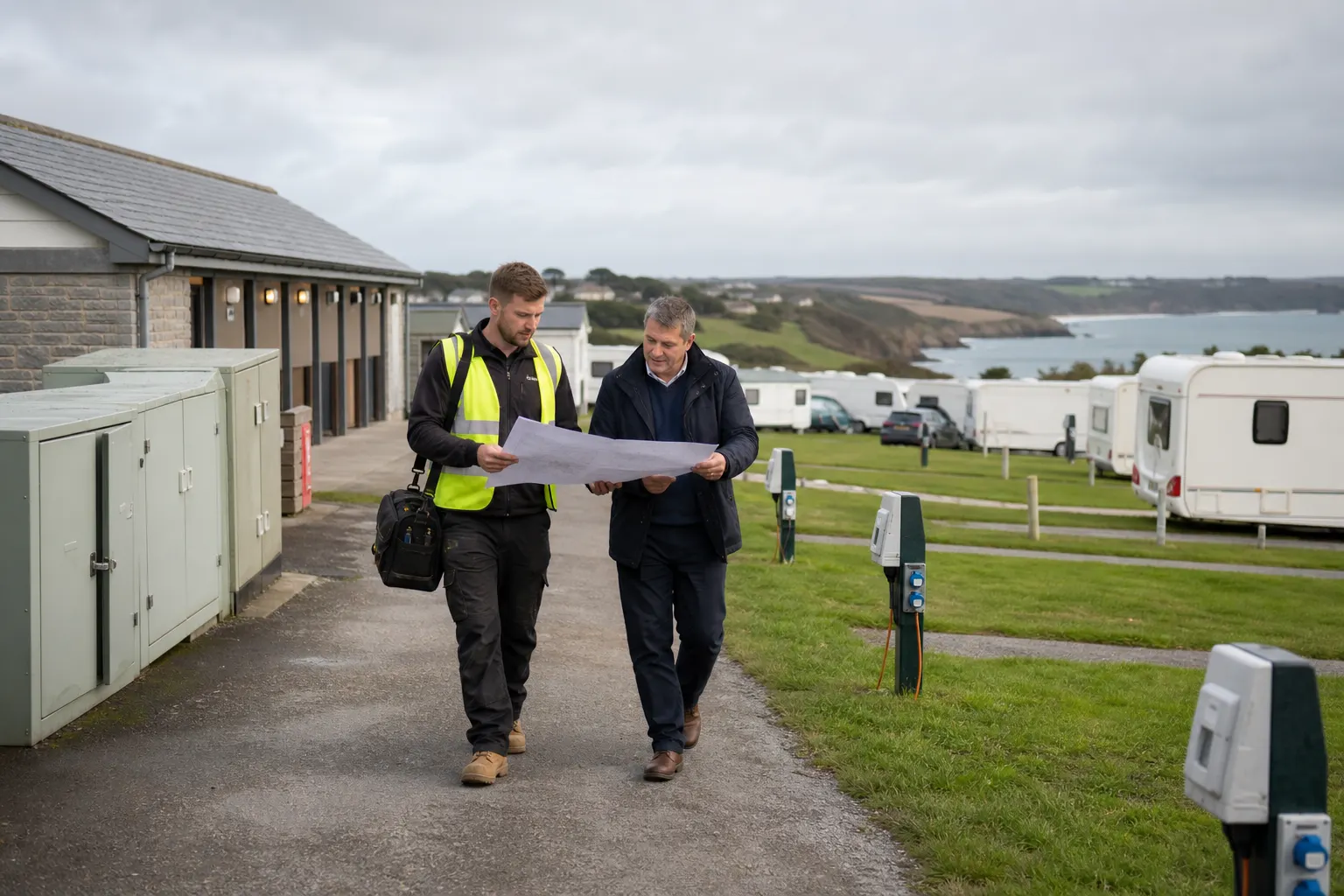
On a multi-building site, the first challenge is establishing the boundary of the inspection. If the scope is described only as “the campsite” or “the main buildings”, important areas may remain ambiguous. A clear plan should identify the fixed installations under the operator’s responsibility and highlight any exclusions or access restrictions before work begins.
Which parts of the electrical system should be in scope?
The exact scope will depend on the site layout, ownership boundaries and electrical design. A caravan park electrical inspection may need to consider:
- The site intake, main switchgear and principal distribution boards.
- Submains supplying separate areas, buildings or groups of pitches.
- Pitch hook-up supplies and associated distribution equipment.
- Reception, shops, offices and staff areas.
- Shower, toilet, laundry and washing-up facilities.
- Maintenance buildings, stores, workshops and plant rooms.
- External lighting and other fixed outdoor infrastructure.
- Solar PV, battery storage, generators or other alternate supplies where present.
This does not mean every item belongs on the same report. It means the operator and electrical contractor should agree what is owned, what is fixed, what is accessible and what requires a separate inspection regime.
Recent changes should be raised at the planning stage. Additional pitches, an altered amenity block, replacement distribution equipment or a new source of generation can affect circuit information and safe isolation arrangements. Where an Electrical Installation Condition Report is required, Maenporth Electrical’s information on EICR testing explains the purpose of this assessment of a fixed installation.
How should inspection frequency be decided?
There is no single statutory annual EICR rule that applies automatically to every holiday park. The IET states that the interval between periodic inspections should reflect the installation and equipment, how they are used and operated, the quality and frequency of maintenance, and relevant external influences. Recommended frequencies are guidance rather than standalone legal requirements.
For a holiday site, the decision may also need to account for its previous report, installation condition, operating season, exposure to outdoor conditions, alterations and evidence from ongoing maintenance. A competent person should recommend the next inspection date based on the actual installation.
Operators should also check their insurance requirements, risk assessments and individual licence conditions. Cornwall Council explains that caravan and camping sites may require a licence, subject to exemptions, and that conditions can be attached or varied. Its guidance on caravan and campsite licensing in Cornwall is a useful starting point, but the conditions applying to the specific site remain important.
What records should be gathered before testing?
Useful records allow the electrician to understand the installation’s history and identify where documents no longer match the physical site. Operators should assemble what is available rather than delaying because the file is incomplete.
- Previous condition reports and their schedules of circuits and test results.
- Electrical installation certificates or minor works certificates for alterations.
- Up-to-date distribution-board schedules and site plans.
- Records of remedial work completed after earlier inspections.
- Details of known faults, recurring trips or damaged equipment.
- A list of new pitches, buildings, supplies or distribution equipment.
- Information about solar PV, batteries, generators and changeover arrangements.
- Relevant maintenance records and any site-specific access procedures.
HSE guidance notes that maintenance records and test results can help demonstrate compliance and monitor both equipment condition and the effectiveness of the maintenance policy. Although the guidance does not present record-keeping as a separate legal requirement, organised records make it easier to compare findings and plan future work.
Planning access and safe outages around guests
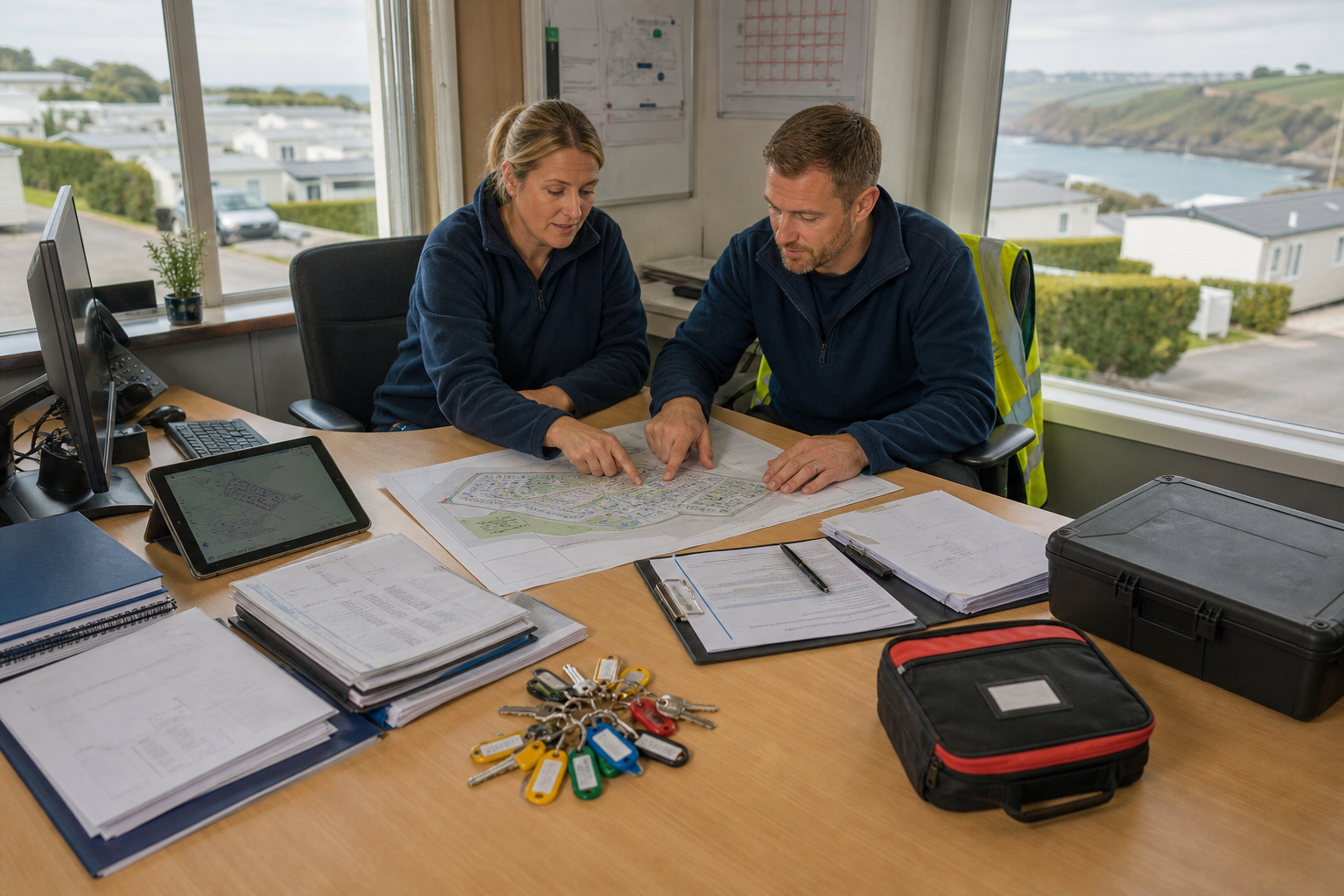
Campsite fixed-wire testing may require access to distribution equipment and final circuits, together with periods of isolation. Operators should not attempt electrical isolations or open equipment themselves. Their role is to provide accurate operational information and agree safe working windows with the contractor.
Map occupancy and critical operations
Identify occupied accommodation, turnover periods and buildings that cannot lose power without advance preparation. Reception systems, laundry operations, water or drainage equipment, refrigeration and other site services may affect the sequence, depending on the installation.
Choose workable testing windows
Pre-opening periods are often useful because more areas may be accessible, but the programme still needs to account for contractors, cleaning teams and maintenance work. On an operating site, testing may need to be divided by area or arranged around quieter periods.
Confirm access responsibilities
Before the visit, establish who holds keys, who can authorise access and whether privately occupied or third-party areas fall outside the operator’s control. Guests and staff should receive suitable notice of planned interruptions through the site’s own communication process.
Where one visit cannot provide safe access to the full agreed scope, phased testing may be more realistic than leaving exclusions unclear. Each phase should be recorded so the operator knows what has and has not been inspected.
Fixed-wire testing and other electrical checks are different
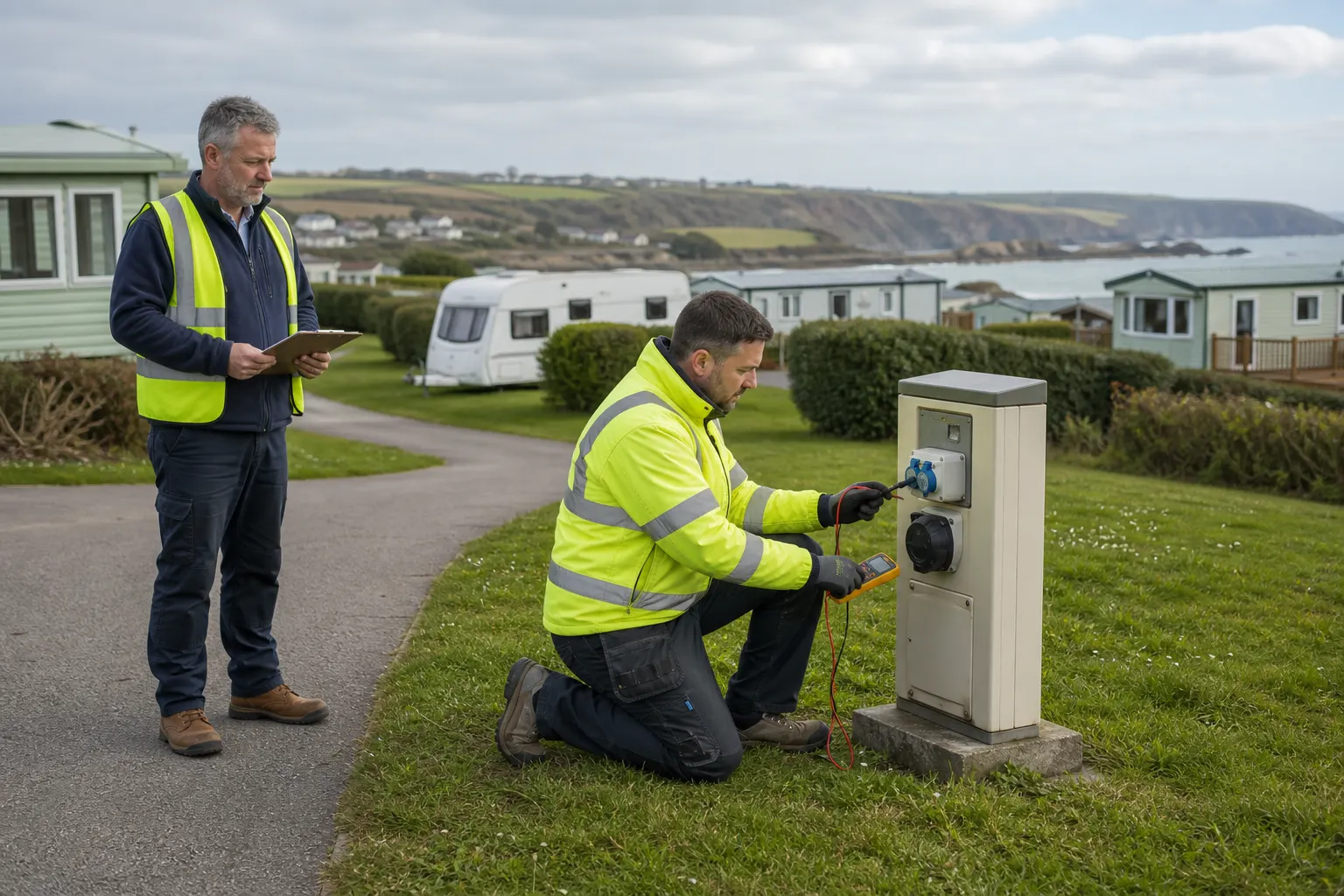
A holiday park EICR concerns the condition of the fixed electrical installation within its agreed scope. It should not be confused with every other electrical safety activity on the site.
Portable-equipment maintenance can include user checks, formal visual inspections and combined inspection and testing where appropriate. HSE guidance supports a risk-based maintenance regime rather than treating one blanket PAT interval as the whole electrical safety programme.
Emergency-lighting tests, fire-alarm tests and checks of privately owned caravans or guest equipment also have different scopes and evidence trails. They should be coordinated where useful, but not recorded as though one process automatically covers another.
Using the report to plan remedial work
Once the report is received, review the observations, classifications, limitations and recommended next-inspection date. Confirm which areas were inaccessible or outside scope, and retain the schedules with the site’s electrical records.
Remedial work should be prioritised according to the report and competent advice rather than simply by convenience. It may be practical to coordinate suitable work with closed periods, refurbishment plans or known infrastructure changes, provided urgent safety matters are addressed appropriately.
The findings can then feed into planned electrical maintenance. Repeated damage, water exposure, frequent operational faults or recurring issues in one area may indicate that the maintenance programme needs adjustment before the next periodic inspection.
Questions to ask before booking testing
- Has the site-wide boundary of the inspection been agreed?
- Are pitch supplies, amenity buildings and external infrastructure clearly identified?
- Which records, plans and previous reports are available?
- What alterations or additional supplies have been installed?
- Which areas will be occupied or inaccessible?
- What planned outages may be required, and how will they be communicated?
- Are any parts of the site covered by separate ownership or maintenance arrangements?
- How will limitations, findings and follow-on work be recorded?
Maenporth Electrical Ltd supports electrical testing and maintenance for commercial and larger sites in Falmouth, Penryn and across Cornwall. To discuss the scope and practical timing of testing for a holiday park, caravan park or campsite, call 01326 250297.