
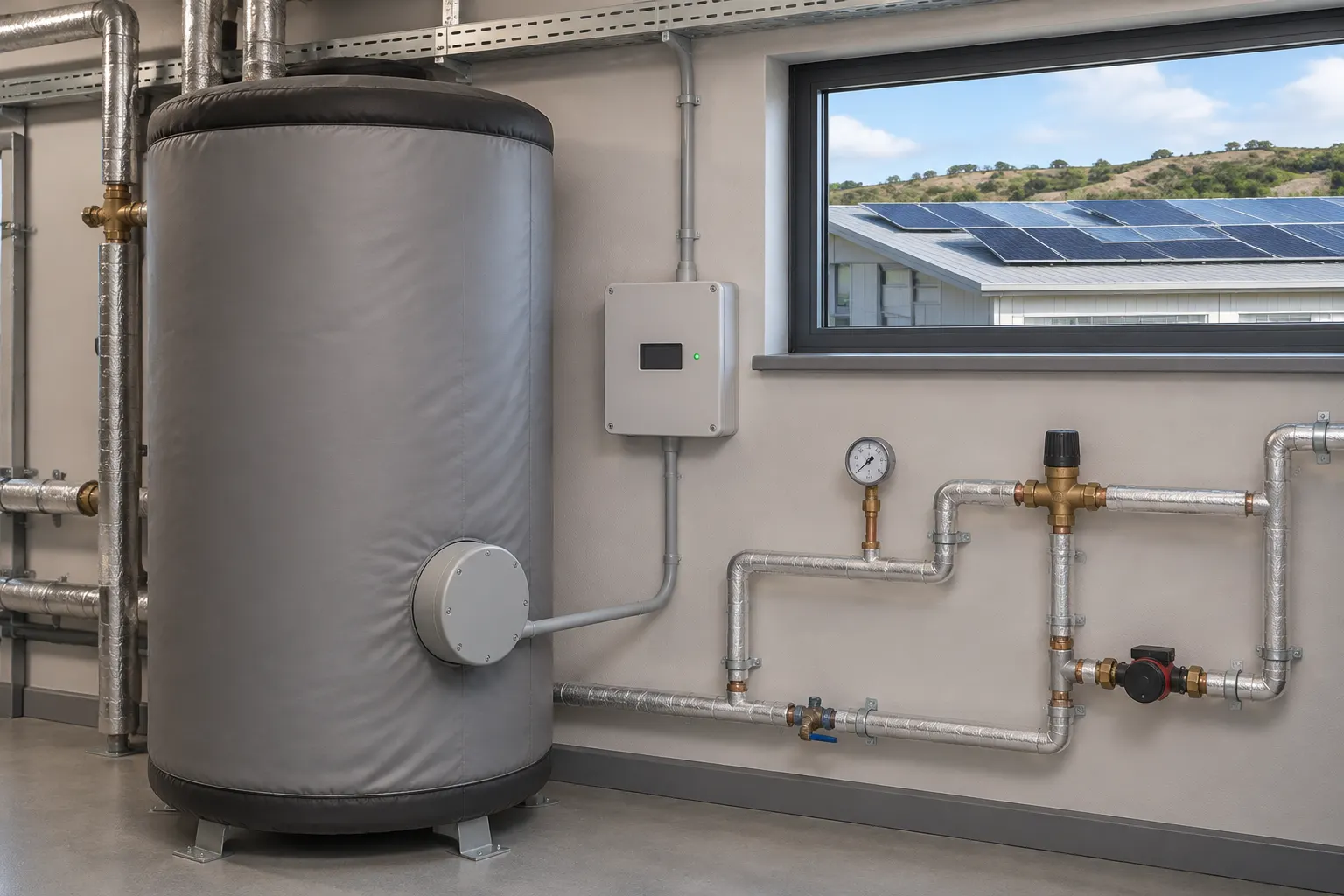
A commercial solar PV hot water diverter can turn surplus generation into stored heat instead of exporting the electricity. For premises with shower blocks, changing rooms or regular hot-water demand, it may be worth assessing. But an energy-saving control must not weaken the site’s water-hygiene arrangements.
The starting point is not the diverter brand. It is whether the calorifier, immersion heater, other heat sources and existing controls can work together. That matters on Cornwall’s visitor, leisure and commercial sites throughout the year, not just on sunny afternoons.
PV immersion diversion is not solar thermal
A commercial PV immersion diverter directs available surplus electricity to a compatible immersion heater in a cylinder or thermal store. The immersion converts electricity into heat; the PV panels do not heat the water directly.
Solar thermal is different: collectors gather heat rather than generate electricity, and transfer that heat through a separate circuit. PV diversion is an electrical load-control proposal, not a solar-thermal retrofit.
The diverter does not create extra generation or guarantee hot water. Its usefulness depends on actual surplus, suitable storage and when that stored heat is needed. If an array is also being planned, assess both together through the site’s solar PV design.
Start with the calorifier, immersion and real hot-water demand
Before specifying a solar immersion heater for commercial premises, establish what is already installed. A large vessel alone does not prove that it can accept the proposed heater or store useful surplus.
- Record the calorifier or cylinder details, existing heat sources and current heating programme.
- Identify immersion ratings and positions, the electrical supply and any existing controller.
- Compare measured surplus, or realistic generation and demand estimates for a proposed array, with hot-water use and seasonal occupancy.
- Confirm how much of the stored water the immersion can heat, rather than assuming it heats the whole vessel.
- Check how normal heating meets peak demand when solar surplus is unavailable.
The survey needs to establish whether a compatible immersion is already fitted, whether replacement or additional equipment would be needed, and whether the vessel manufacturer permits the proposed arrangement. Do not assume a domestic diverter is suitable simply because the heater uses electricity.
At a holiday park or leisure facility, peak shower use may not coincide with surplus generation. Use operating information, not just the array’s rated output.
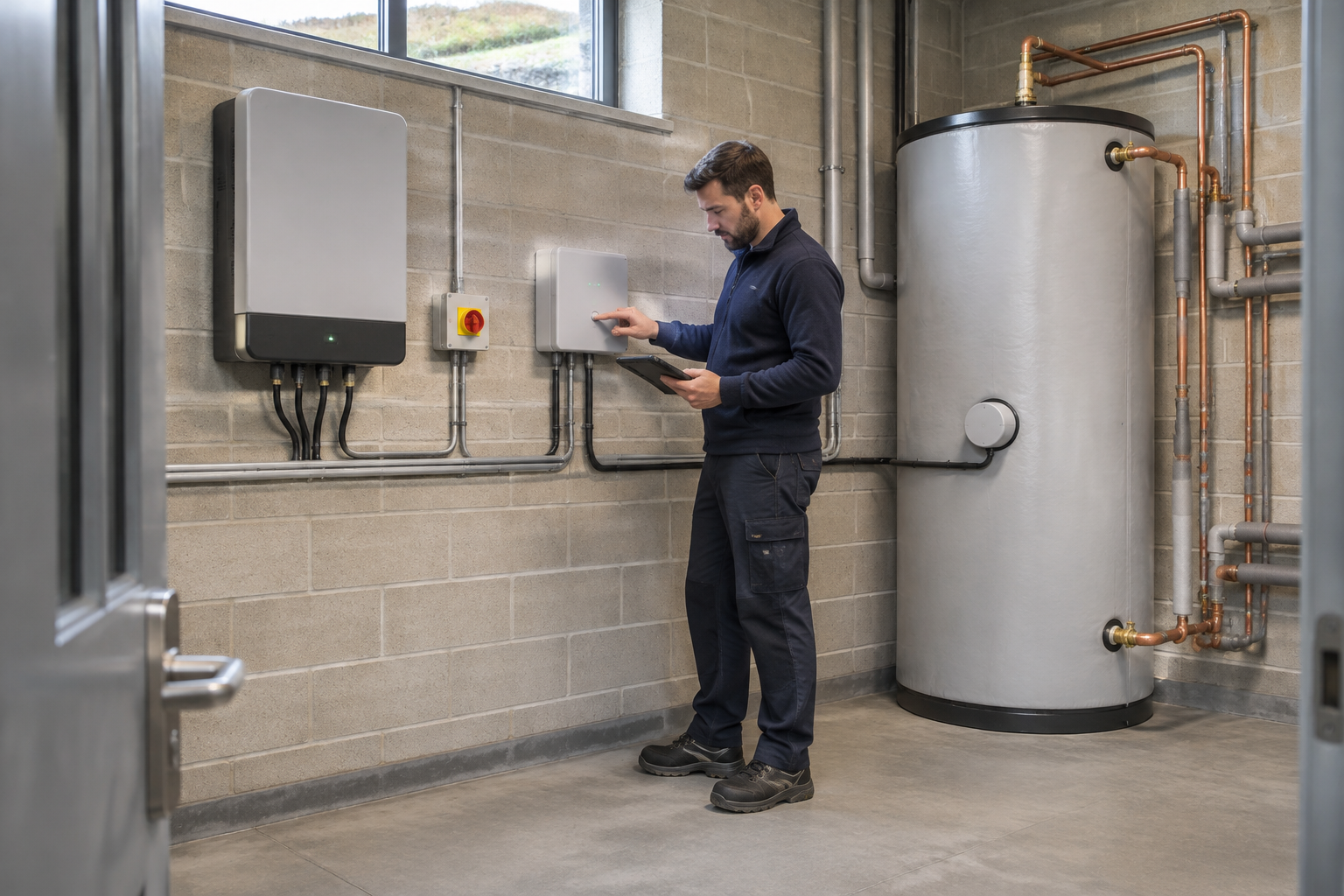
Keep water-hygiene controls effective when solar gain is low
Solar PV and Legionella controls need to be considered together. A diverter is not a Legionella-control system and does not replace the site’s risk assessment, monitoring or established heating arrangements.
HSE’s guidance on managing legionella in hot and cold water systems explains that, where temperature is used to control risk, hot water should be stored at 60°C or higher, distributed at 50°C or higher, and cold water kept below 20°C. These are not universal diverter settings or instructions to change outlet temperatures. The site-specific risk assessment and control scheme govern the arrangements.
HSG274 Part 2 also addresses calorifiers linked to solar heating or other microgeneration. Its relevant principle is year-round management, monitoring and maintenance so low solar gain does not compromise hot-water temperatures. Its solar-coil examples are not PV-diverter designs.
Plan for low generation and control faults
Agree with the water-system responsible person how the required heating will remain available through dull weather, winter operation and a diverter fault. Refer any proposed change to heating or control arrangements for water-hygiene review before commissioning.
The review should consider the volume being heated and what the existing monitoring demonstrates, rather than treating a new diverter’s display as evidence of effective water-hygiene control.
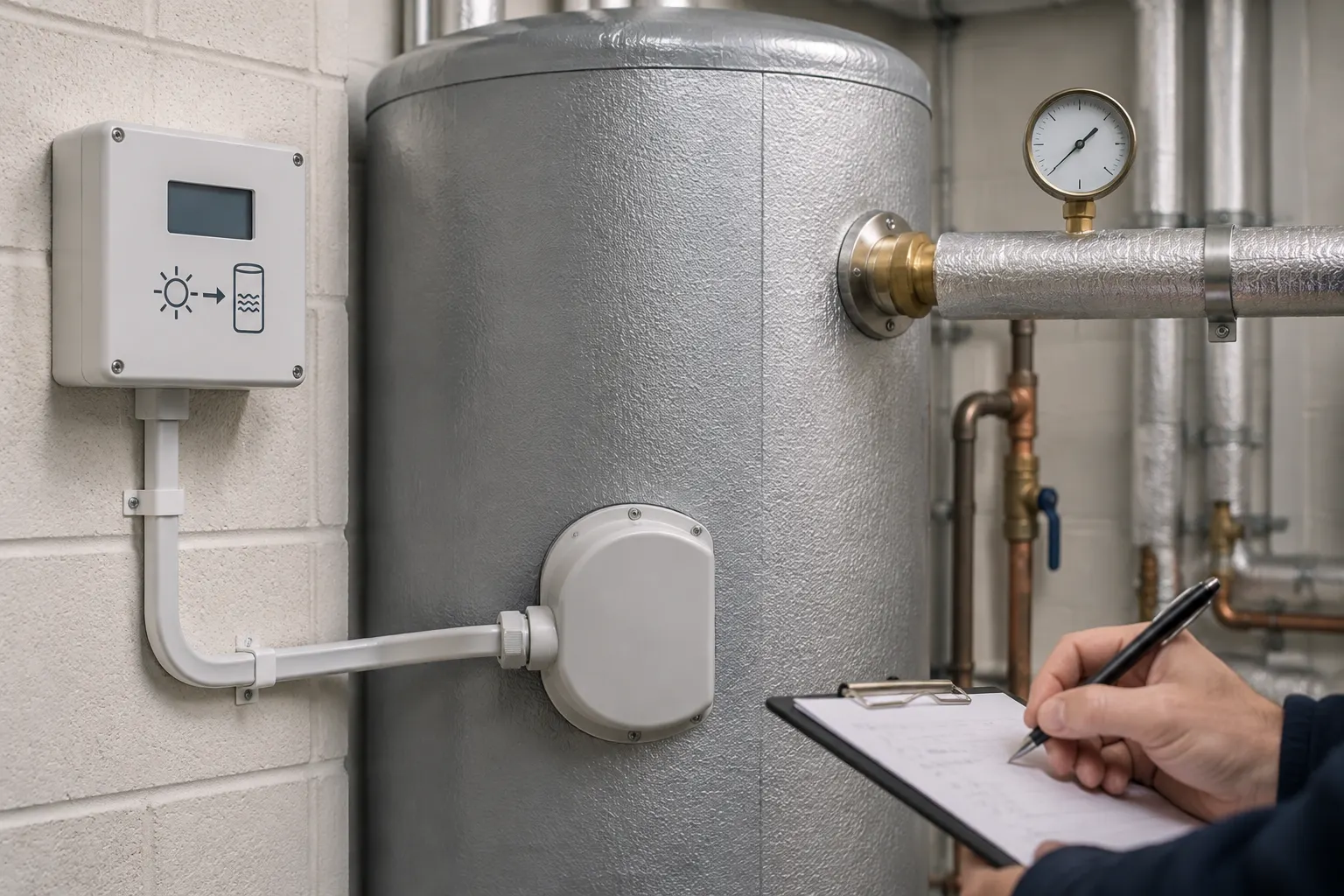
Check the electrical and control interface before choosing equipment
Commercial calorifier solar controls need to suit the installation, not merely the PV array’s size. Ask the electrical contractor to confirm load and phase compatibility, circuit suitability and protection, and how surplus will be measured alongside existing site loads.
Where there are batteries, a building management system or several heat sources, agree which controls have priority. The design should preserve thermostat and over-temperature protection functions and the agreed water-hygiene heating programme. An energy-saving command must not defeat a safety function.
Before equipment is ordered, ask for a simple description of the normal sequence: when diversion is enabled, when it stops, what retains priority and how the normal heat source remains available. This is particularly important where one control can inhibit another heat source.
Integration with existing industrial controls needs an agreed operating sequence, including what happens if the diverter or its measurement signal fails. Do not assume that independently supplied products will work together correctly without checking.
Compare diversion with other uses of surplus electricity
Using solar surplus for commercial hot water is a commercial choice, not automatically the best destination for every exported unit. Compare the value of displacing existing water-heating energy with export income forgone and competing uses, such as battery charging or daytime electrical loads.
The calculation needs realistic surplus data, hot-water demand, usable storage, export arrangements, tariffs and the cost of the existing heat source. Include equipment, installation, control integration and ongoing checks. Electricity diverted into water is not automatically free.
The displaced cost is the energy the normal hot-water plant would otherwise use, not necessarily the price of imported electricity. Ask the comparison to show which fuel or electricity use is actually avoided, and when.
Household diverter advice can explain the principle, but it is not evidence of a commercial site’s savings. Avoid payback claims that ignore the existing heating system or assume all PV output is available for hot water.
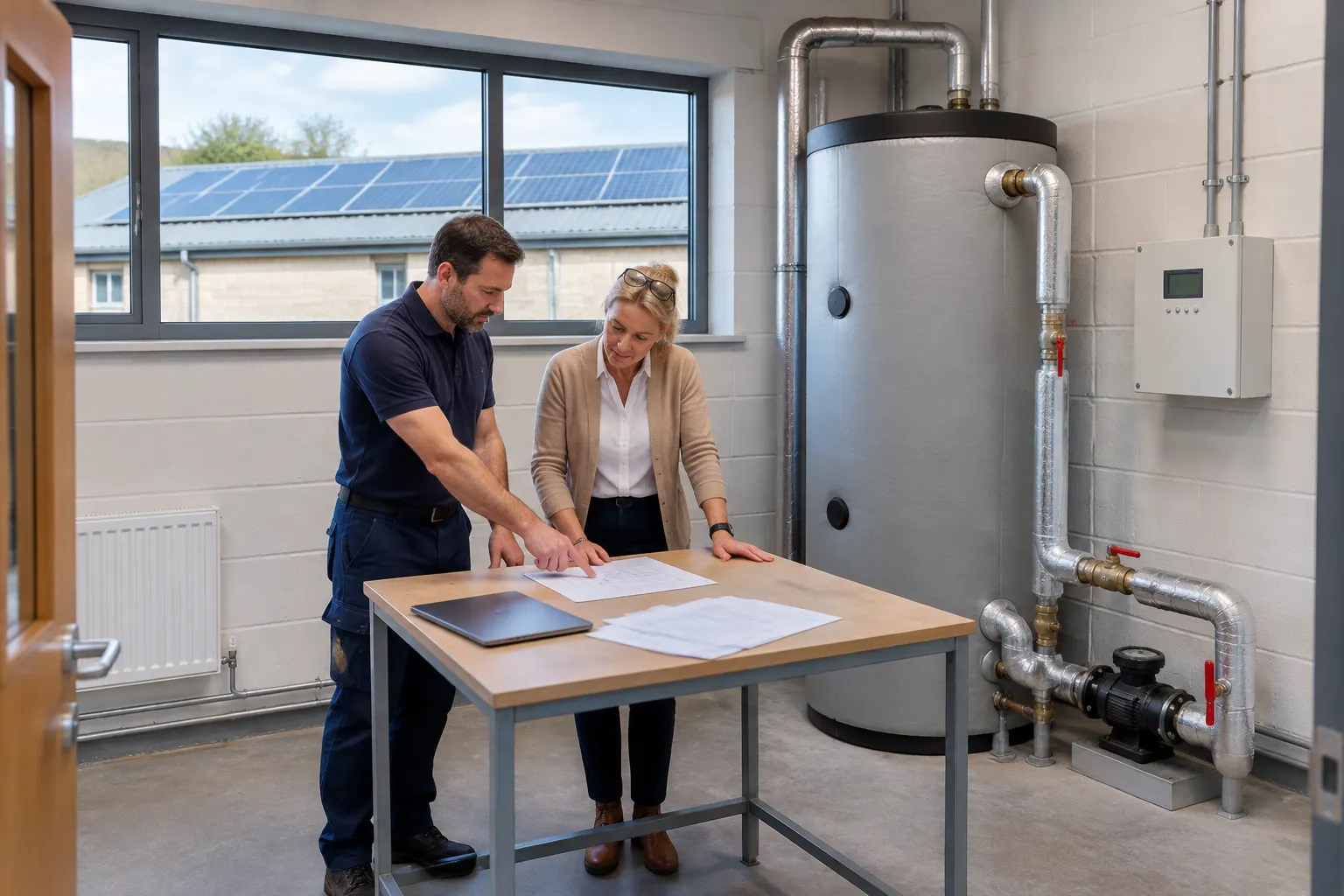
Agree responsibilities, commissioning evidence and monitoring
Agree responsibilities before ordering equipment. The water-system dutyholder retains responsibility for risk assessment and water-hygiene arrangements, supported by a competent responsible person. They should review the proposed heating change. The electrical contractor establishes electrical compatibility and the control interface; an electrical test is not approval of the water-hygiene scheme.
Handover should set out the operating priorities, relevant settings, normal heating arrangements and the response to faults. Ask for electrical test information and evidence that the agreed control sequence has been checked, including loss of solar surplus or the diverter’s measurement signal.
Agree who will monitor performance, temperatures and faults, using the site’s established control scheme. Keep relevant operating and maintenance records accessible, and review the arrangement if occupancy, hot-water demand, heating plant or PV controls change.
To discuss the electrical side of a PV hot-water proposal in Falmouth, Penryn or elsewhere in Cornwall, call Maenporth Electrical Ltd on 01326 250297. Have the cylinder details, existing controls and available generation or export information ready.