
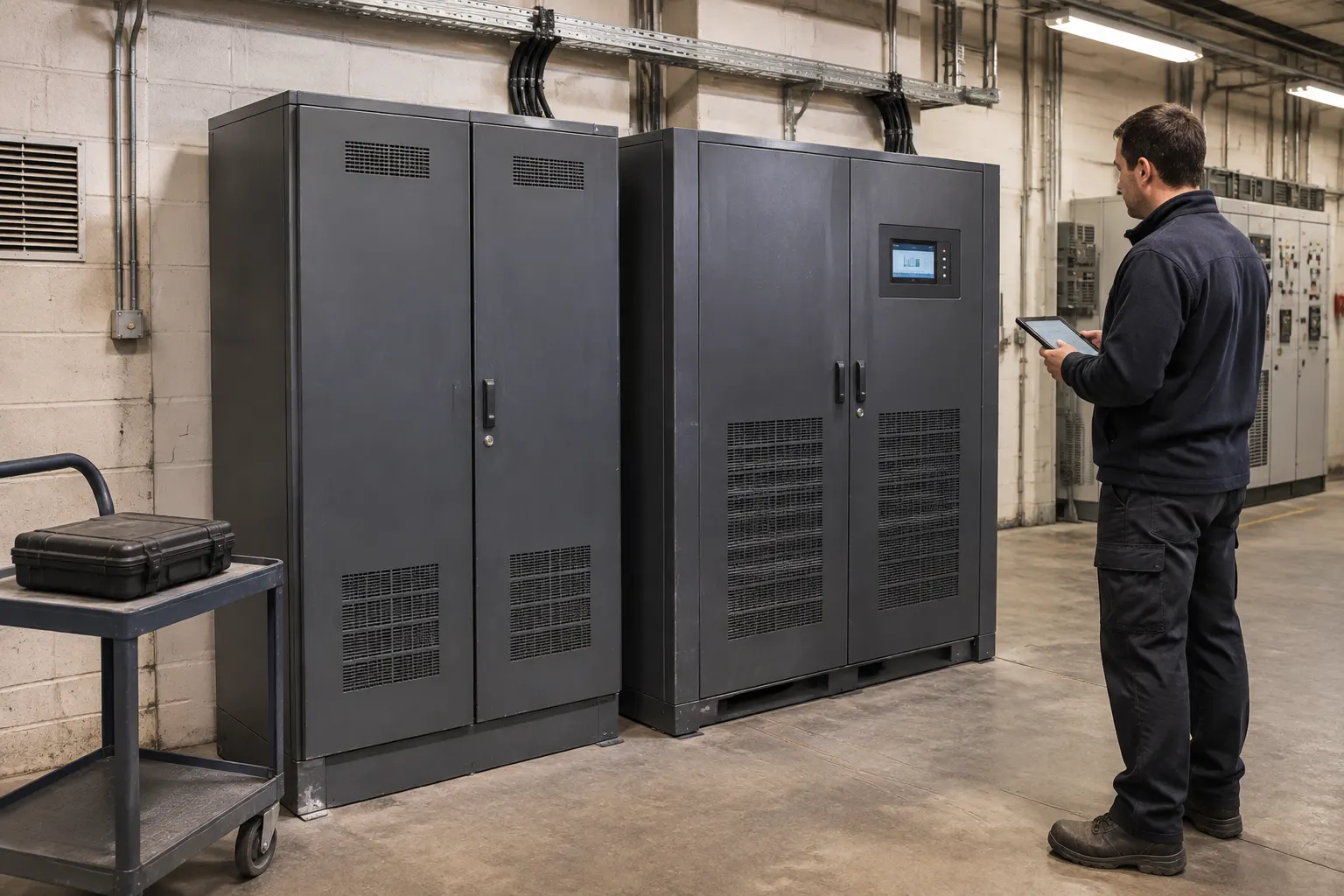
An uninterruptible power supply (UPS) showing healthy battery status can still leave important maintenance questions unanswered. Industrial UPS maintenance needs to consider the complete unit, its life-limited components and the equipment depending on it, not just the latest battery result.
For a factory or larger commercial site in Cornwall, the practical decision may be whether to service, repair or replace an ageing system. Start with what it must do and what the records demonstrate, rather than relying on a quoted design life.
Define what the UPS must keep running
Record which equipment the UPS must keep running, the required backup time and what should happen when normal power returns. It may support control and instrumentation rather than an entire production process.
Check that today’s connected loads and shutdown arrangements still match the original assumptions. Added equipment or process changes can alter what successful testing needs to demonstrate. Identify who owns the maintenance plan and who can authorise an interruption.
Separate keeping production running from allowing a controlled stop. Where the UPS supports a shutdown function, define the required outcome with the people responsible for that process. A maintenance visit cannot establish that outcome unless everyone is working to the same description of the protected load and operating duty.
Separate system design life from component life
HSE’s February 2022 industrial UPS maintenance safety notice warns that some original operating and maintenance instructions may not be enough to ensure safe, reliable operation over the intended design life. Obtain the latest information from the original equipment manufacturer (OEM), rather than relying solely on the handover manual.
HSE notes that sales literature may quote a 15–20-year design life. This is neither a maintenance-free guarantee nor an automatic replacement date. HSE identifies batteries, filter capacitors, cooling fans, internal RAM batteries, power cards and control cards as components that can have shorter lives.
The reported incidents involved onshore major-hazard establishments, with failures affecting control, emergency-shutdown and mitigation systems. They included problems involving batteries, capacitors, static switches and outdated firmware. Those consequences should not be assumed for every commercial UPS. The notice excludes non-maintainable UPSs and diesel rotary UPS systems.
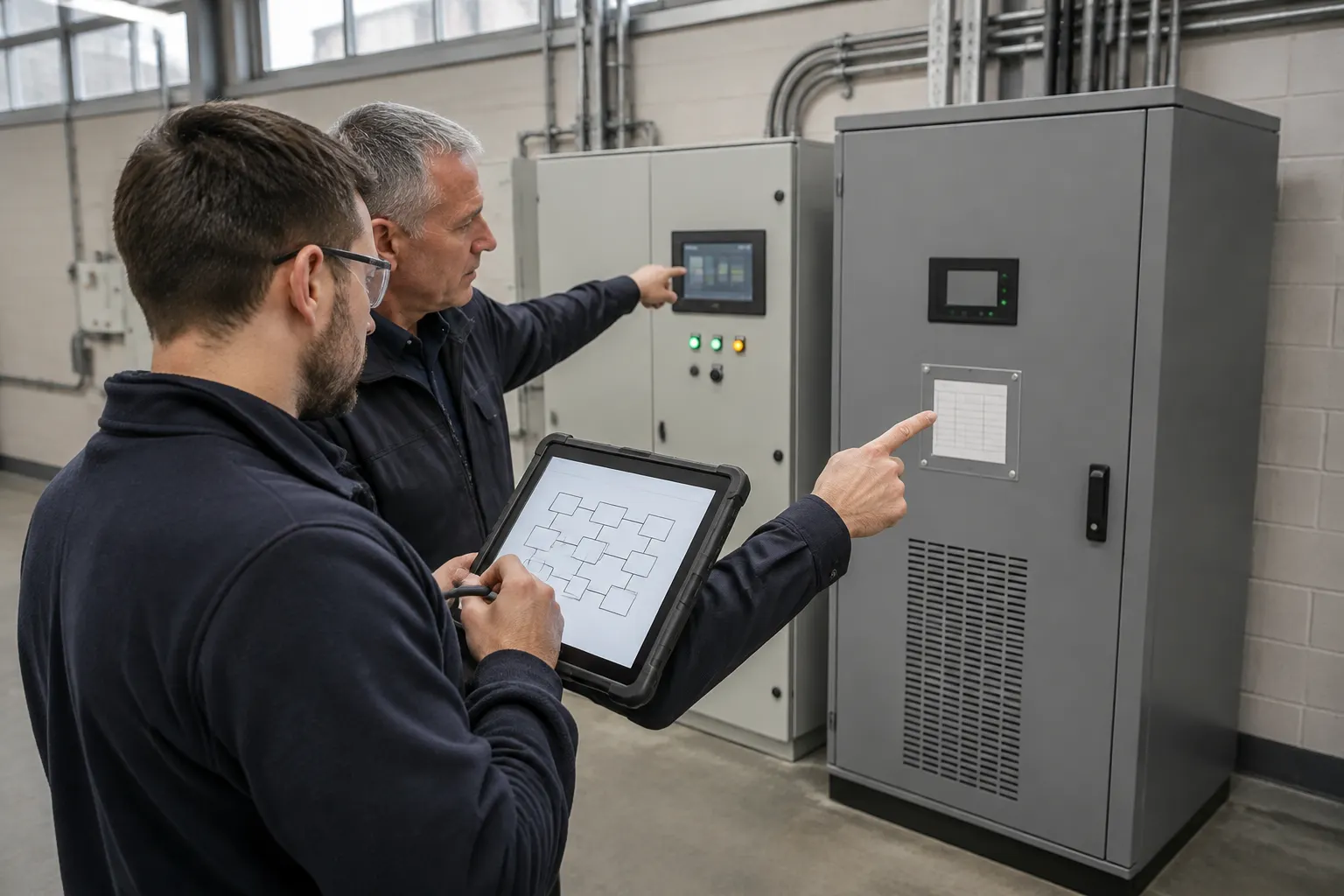
Review more than battery condition
UPS battery testing is valuable, but a result only answers the questions covered by that test. It cannot establish whole-system condition by itself. Built-in tests also vary by model, so ask what a reported pass covers and what remains untested.
Ask whether the battery report records the method used, the conditions of the check and the result against the manufacturer’s criteria. Keep any limitations visible. This helps distinguish a condition indication from evidence supporting the runtime your particular load requires, without assuming that all battery tests measure the same thing.
Depending on the installed model, the service scope should address:
- Environment and cooling, including temperature, airflow and signs of contamination.
- Connected load, alarm history and trends since previous visits.
- Rectifier, inverter and static-switch checks specified by the manufacturer.
- Life-limited components, previous replacement dates and outstanding recommendations.
- Applicable UPS firmware updates and how these will be assessed and managed by the specialist.
An industrial UPS can contain potentially lethal AC and DC voltages. Internal servicing and testing must be left to appropriately trained personnel; a site review is not permission to open the cabinet.
Set a model-specific UPS maintenance schedule
Regulation 4 of the Electricity at Work Regulations 1989 requires electrical systems to be maintained as necessary to prevent danger, so far as is reasonably practicable. It does not prescribe one universal UPS service interval or battery replacement age.
Base the schedule on current OEM advice, operating conditions, criticality, service history and previous results. HSE’s general maintenance guidance likewise makes equipment, environment and previous findings relevant to check frequency.
When current advice differs from the original manual or existing service contract, ask the maintainer to identify the change and update the written plan. Budget for planned component renewal alongside routine visits, so a service booking is not mistaken for an agreement to replace every life-limited part.
Coordinate specialist visits with planned electrical maintenance so access, possible interruptions and work outside the UPS cabinet are agreed. Record who is responsible for outstanding actions and when they must be reviewed, not just the next visit date.
Plan testing around the complete backup path
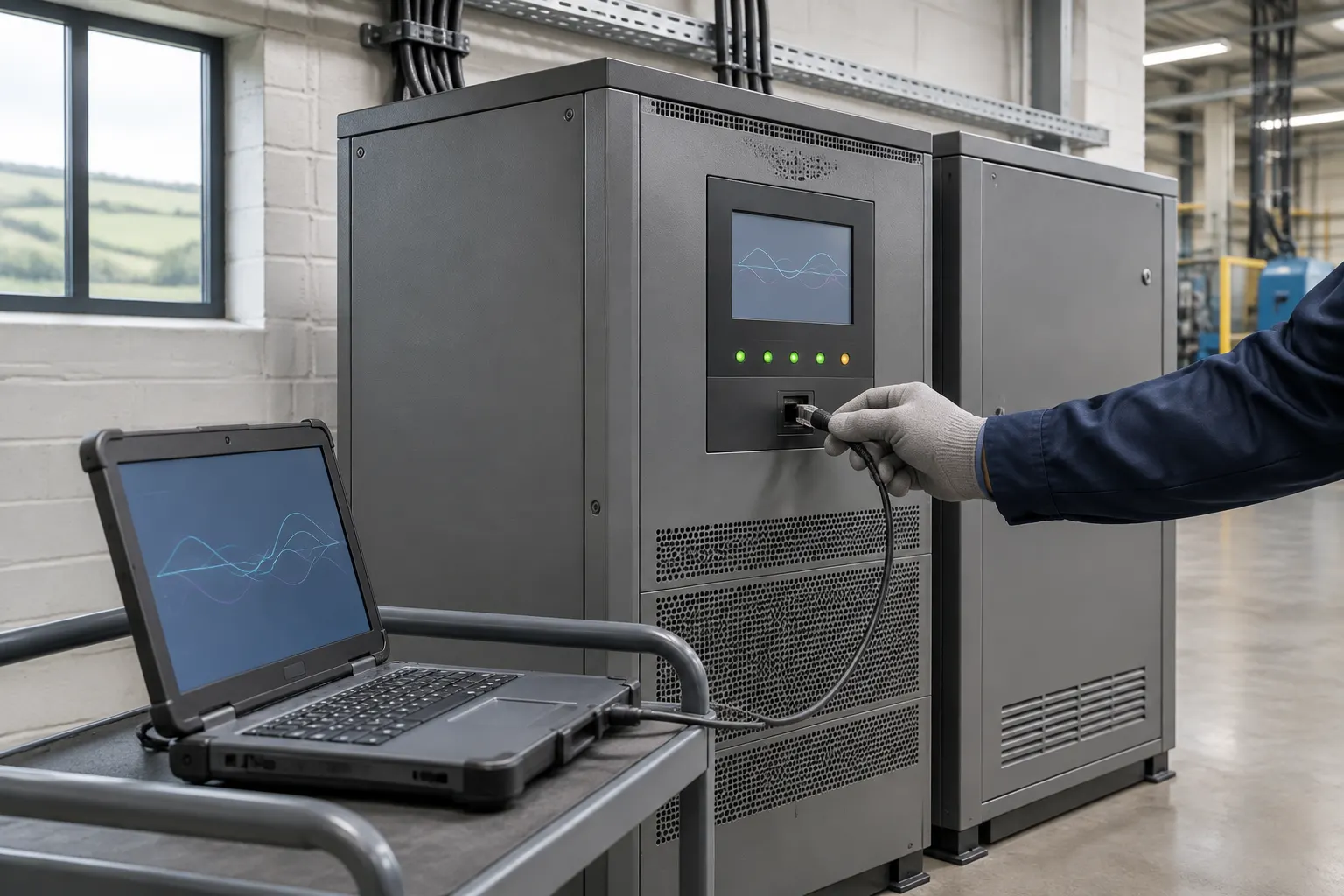
Industrial UPS testing should answer a defined question. A component check and a test of the complete backup path are different exercises: agree the scope, limitations and acceptance criteria before commissioning the work.
HSE’s COMAH guidance for major-hazard sites discusses written maintenance and end-to-end backup testing for critical control and instrumentation. This is not a universal testing rule for every workplace.
Where a system-level test is justified, competent specialists should plan it around the protected process, with authorisation, disruption controls, contingency arrangements and an agreed return to normal service. Significant changes to loads or backup arrangements should prompt a review of what needs demonstrating, not an improvised power interruption.
Also agree who needs to be involved from site operations, controls and UPS support. Establish what happens if the equipment does not perform as expected, and who can stop or postpone the work. This planning matters especially where testing could affect an occupied site or a live industrial process.
Choose repair or renewal from evidence
Base industrial UPS replacement planning on evidence. Ask for a recommendation that brings together component condition, test trends, OEM support, parts availability and the load and backup time the site requires.
Battery replacement may address a battery defect without renewing the rest of the UPS. Equally, cabinet age alone does not prove replacement is necessary. Compare repair, planned component replacement and renewal against the required duty, remaining support and disruption involved.
For a fair comparison, ask whether each quotation includes the same attendance, access arrangements, testing after the work and handover records. Separate work inside the UPS from any changes to its supply or downstream distribution. Different boundaries can make two apparently similar prices cover quite different work.
For each option, ask what will remain unchanged and what evidence will confirm satisfactory operation afterwards. If current OEM support or maintenance information cannot be established, record that uncertainty in the recommendation rather than assuming the old plan remains adequate.
Keep records that support the next decision
Keep the UPS model and serial number, current OEM instructions, firmware version, service and test reports, component replacement history, unresolved defects and agreed next actions together. Reports should state the test scope and limitations, rather than simply recording a pass.
For handover, retain an up-to-date record of protected loads, operating arrangements, responsibilities and the next review date. This gives the next maintainer a usable baseline, not just a cabinet label and a stack of battery readings.
After work is completed, close out each recommendation against evidence of what was actually done. Where an action is deferred, retain the reason, the responsible person and the review date. An unresolved recommendation should not disappear when a new service report is filed.
Plan the surrounding electrical work
Maenporth Electrical serves Falmouth, Penryn and wider Cornwall. Call 01326 250297 to discuss site electrical testing and compliance and planned electrical work around your UPS. Agree any specialist internal UPS servicing separately with an appropriate maintainer.