
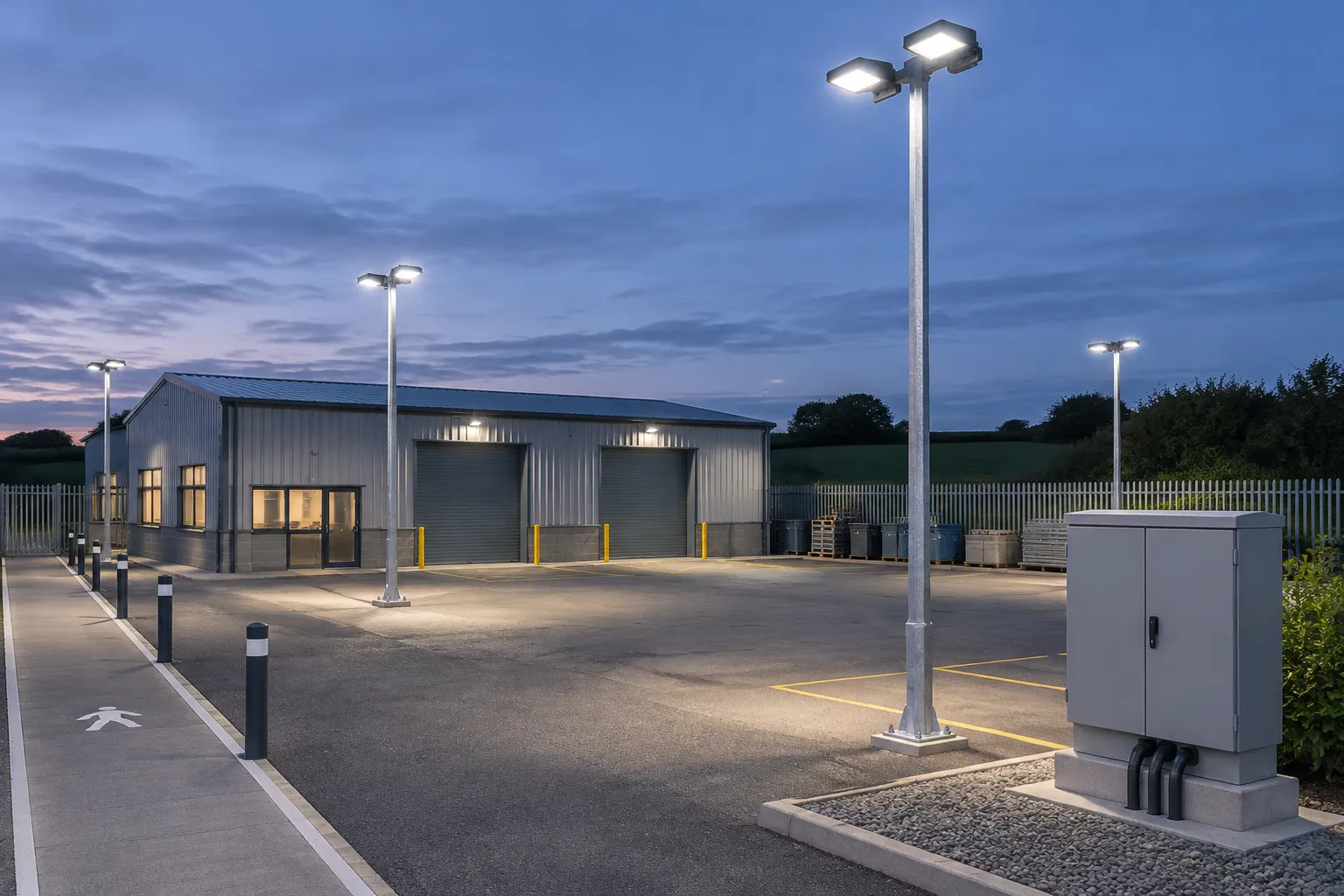
Not necessarily. A floodlight’s built-in surge protection may help protect that fitting, but it does not establish that the whole lighting installation is adequately protected. Equally, it does not follow that every site needs extra surge protective devices (SPDs).
Surge protection for commercial outdoor lighting means assessing the installation, not just the product label. For a quarry yard, factory car park or holiday-park route, the practical questions are what could cause damage, which equipment might be affected and what losing the lighting would mean for the site.
What can cause surges in outdoor lighting?
A surge is a brief transient overvoltage. Atmospheric events are one source, but storms are not the only concern. Supply-network events and electrical switching can also be involved; switching large industrial motors is one example identified by the Institution of Lighting Professionals (ILP).
The ILP’s guidance on surge protection for exterior lighting says protection should be considered for every exterior-lighting installation. That means considering the risk, not automatically fitting extra SPDs everywhere. Complete immunity is unattainable, and a direct lightning strike can still damage a protected system.
On industrial premises, the relationship between lighting and other site equipment is therefore relevant. Tell the contractor about major plant switching or supply changes, but do not treat coinciding events as proof of the cause.
What does a luminaire’s built-in SPD cover?
An SPD is intended to limit transient overvoltages. Built-in SPDs in LED luminaires form part of those products’ protection arrangements, subject to their specifications and installation instructions.
An integral device does not demonstrate that other fittings, external controls or the distribution equipment supplying them are adequately protected. A product feature and an assessment of the whole installation answer different questions.
When comparing replacement fittings, ask what protection is included, what equipment it covers and what installation conditions the manufacturer specifies. A sales description saying surge protected is not enough to settle those points. Include this review in the scope of commercial lighting work before selecting products.
Ask whether the documentation describes the complete luminaire or a particular component, and retain the relevant information with the asset record. That gives future replacement decisions a clearer starting point.

When a wider site assessment is worth arranging
Outdoor LED lighting surge protection deserves particular attention where failure would create significant disruption or difficult replacement work. Discuss these factors with your contractor:
- Lighting continuity. Does the system serve vehicle movements, pedestrian routes or a working yard where darkness would affect safe use?
- Access and downtime. Would repairs require access equipment, traffic management or interruption to normal operations?
- Fault history. Have several lights failed together, or have replacement drivers repeatedly failed?
- Site changes. Are you upgrading to LEDs, extending the network or changing how the lighting is supplied?
HSE calls for suitable and sufficient workplace lighting, including roads, yards and pedestrian areas. That explains why the consequences of failure matter; it is not an HSE instruction to install an SPD at every outdoor light.
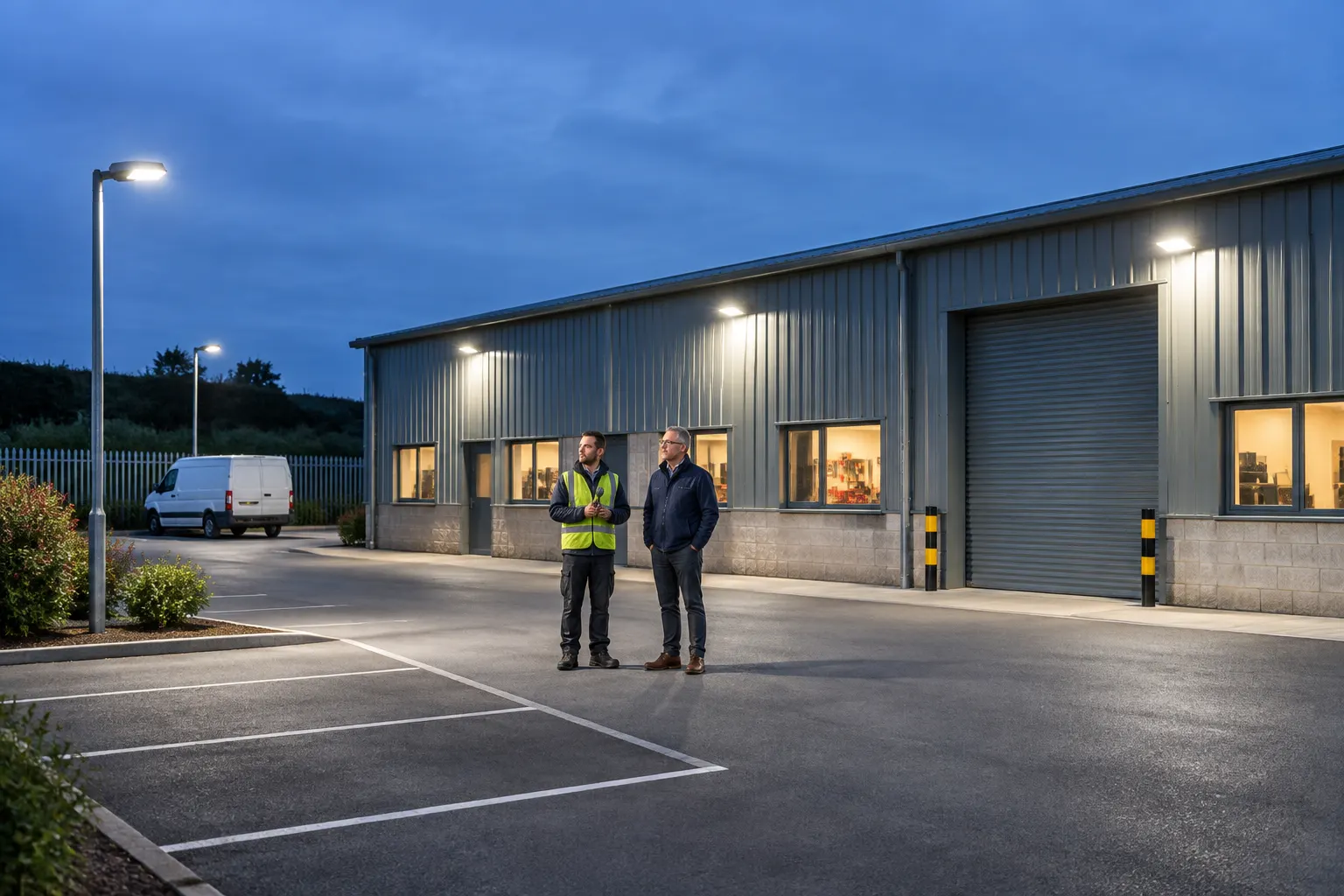
For a holiday park, include the routes guests use after dark; for a factory or quarry, identify where pedestrians and vehicles interact. The assessment should reflect actual operating hours and site use, rather than treating every outdoor circuit as equally critical.
Review columns, feeder pillars and private cables
Start with a clear picture of what supplies each lighting circuit. Existing drawings, equipment details and the locations of any SPDs help a designer assess the network rather than treating each failed fitting in isolation.
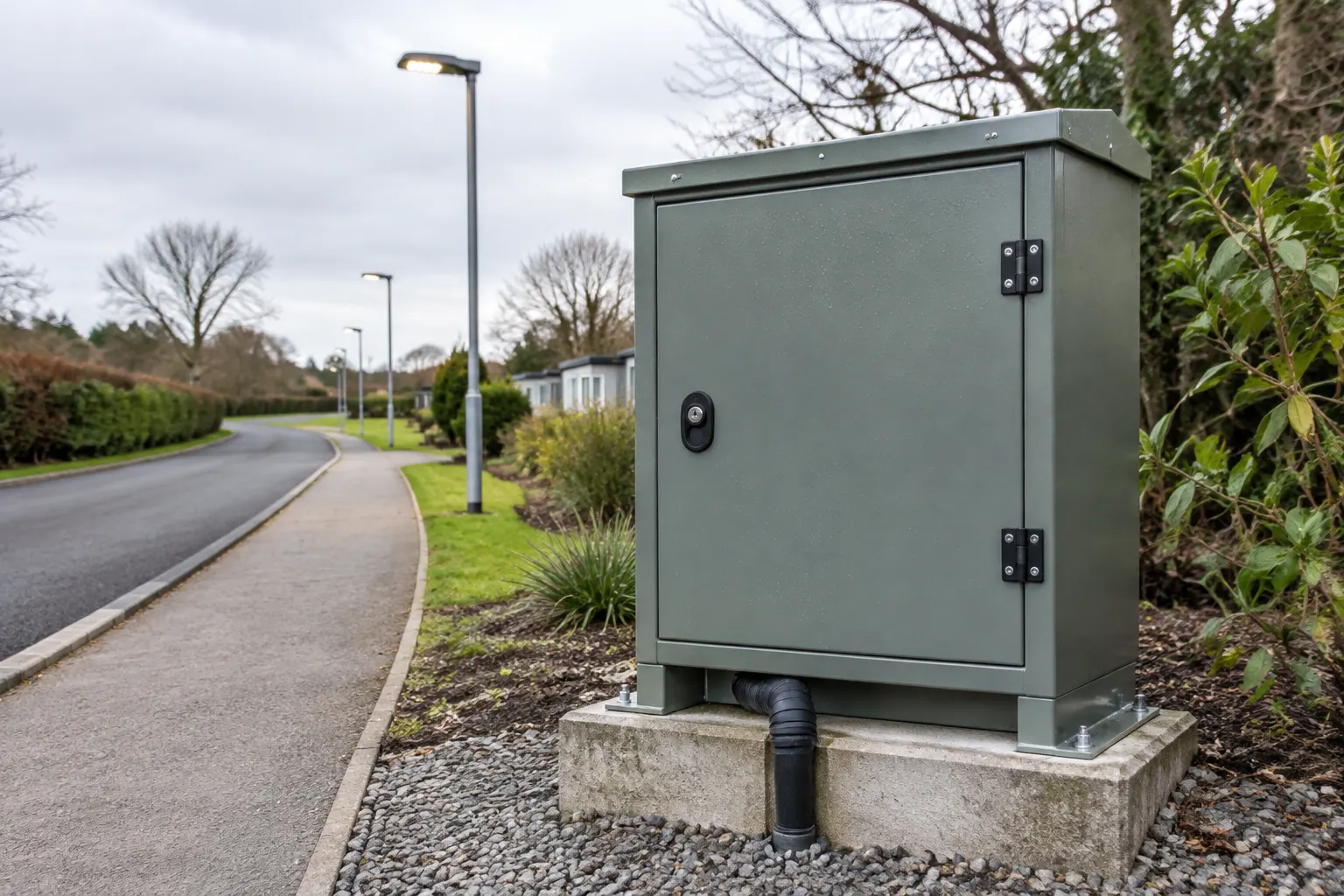
The ILP identifies the luminaire, column cut-out and feeder pillar as possible protection points, depending on the assessment. Lighting column surge protection therefore needs consideration alongside the upstream supply and any protection already inside the luminaire.
For feeder pillar surge protection, ask which circuits and control equipment the pillar serves and how any proposed device would coordinate with protection elsewhere. Include private cable routes between buildings, pillars and columns, not just the visible lights.
Supply source, location, environment, replacement cost and the importance of continued lighting inform the decision. A coastal address alone does not determine whether extra protection is needed.
If records are incomplete, ask the contractor to establish the relevant circuit arrangement as part of the survey. Managers should provide access and available documentation, not open columns or pillars to identify equipment themselves.
Specify coordinated protection and a maintenance plan
Ask the designer to explain what each proposed device protects, why its location is appropriate and how it coordinates with the rest of the installation. A quotation that simply lists surge protection does not explain that strategy.
Selection, installation and testing belong with competent electrical professionals. The contractor should also check the SPD’s overcurrent protection requirements against the manufacturer’s instructions and the existing protective arrangement.
If a review concludes that extra devices are not needed, ask for the reasoning to be recorded too. That distinguishes a considered design decision from protection simply being omitted.
Check the standard used for the design
The ILP note references BS 7671:2018+A2:2022. Design work should be checked against BS 7671:2018+A4:2026, the current edition, rather than simply repeating the older reference. As the IET explains, a standards update does not automatically make an existing installation unsafe or require it to be upgraded.
Agree how protection will be maintained
Record the installed devices, retain manufacturer information and agree how their condition or status will be checked. The handover should make clear who follows up defects and how replacement is arranged. Inspection and maintenance arrangements should suit the products, site and access needs rather than rely on a generic interval.
Include protection components when reviewing future driver or luminaire replacements. A substitute product should be checked against the protection strategy, rather than assumed equivalent because it fits the same bracket or has the same light output.
Investigate recurring lighting failures without guessing
Recurring commercial LED floodlight failures justify investigation, not an immediate diagnosis of surge damage. Similar symptoms can have other causes, including driver defects, water ingress, connection problems, control faults or other supply issues.
Record which lights failed, when they failed, whether they share a circuit and any relevant weather or operating events. Keep previous repair notes and product details. This helps the electrician look for patterns without assuming that a storm or switching event caused the damage.
Have those possibilities investigated before choosing extra SPDs as the remedy. Address any immediate risk from poorly lit routes separately from the longer-term protection decision. The outcome should be a repair and protection plan based on evidence, not another round of unexplained replacements.
Discuss your outdoor lighting installation
Maenporth Electrical Ltd serves Falmouth, Penryn and wider Cornwall. For an outdoor lighting upgrade or recurring faults that may involve the wider supply, explore our commercial electrical services or call 01326 250297 to discuss the site and the information needed for an assessment.