
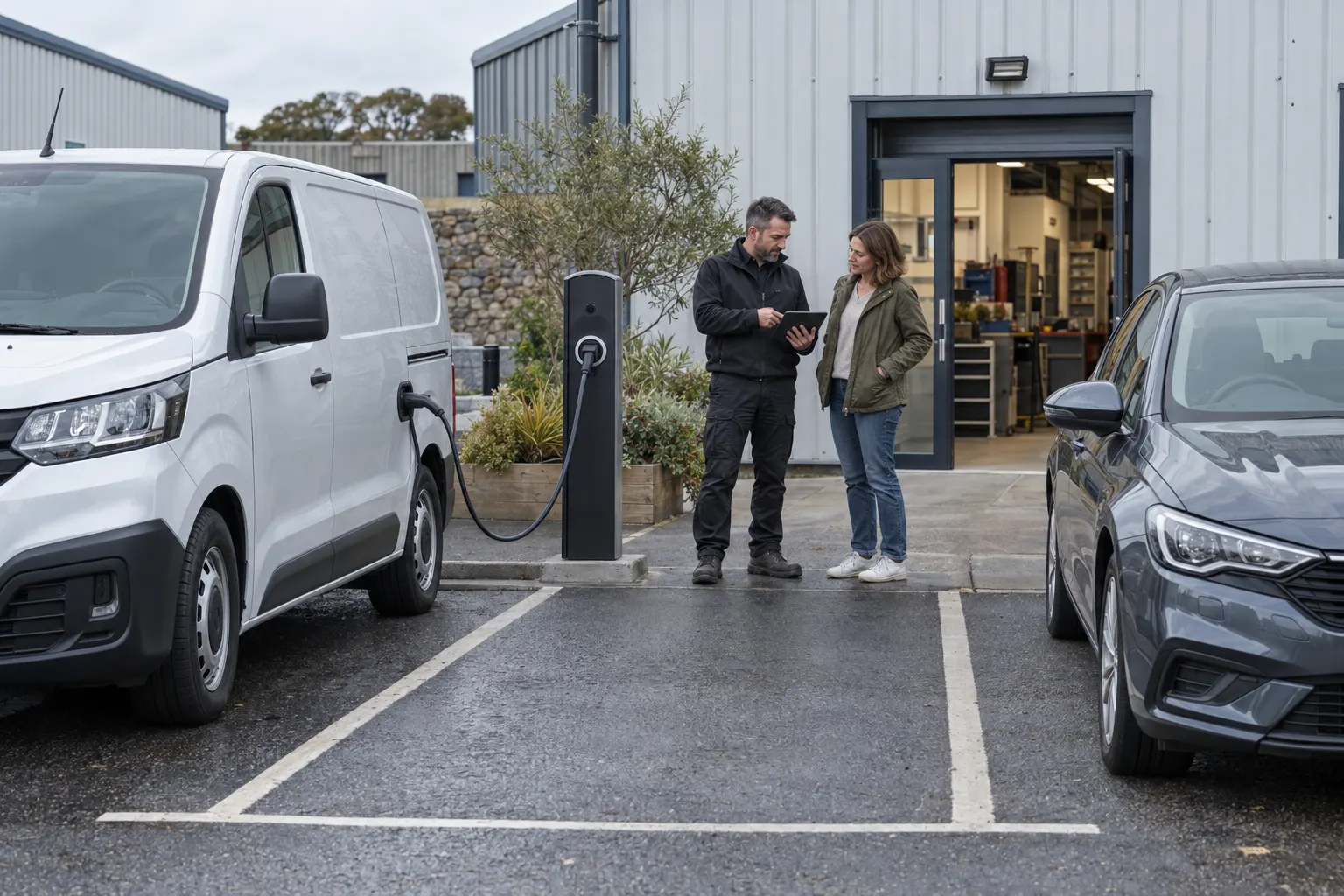
Opening a staff or fleet charger to customers can change its regulatory status without changing the hardware. But the answer is not simply that any non-employee makes it public.
The workplace EV charger public access rules focus on who the point is intended to serve. For a Falmouth employer, the practical step is to review its classification and operator arrangements before widening access, rather than assume it remains private because it sits on business premises.
When is an EV charger public in the UK?
The Public Charge Point Regulations 2023 apply across the UK. The government guidance for charge point operators explains that a public point is one intended primarily for use by the general public. Staff-only workplace EV charging and fleet-only workplace provision are excluded from this public category.
This is an intended-use test, not a rule based simply on who owns the land. When reviewing public and private EV charging points, start with the proposed access policy: who may use each point, and why?
A change can be easy to miss if it starts informally: reception begins offering the charger to customers, or a staff access code is shared more widely. Those are reasons to review the operating plan even if nobody is ordering new equipment.

Where workplace visitors and customers differ
The statutory workplace definition covers points intended solely for employees and contractors at work, or visitors to that workplace. However, it excludes visitors who intend to purchase goods or services.
Consider a hypothetical Falmouth workshop with a trade counter. Employees and a maintenance contractor charging while working fit the workplace pattern. A business visitor attending a meeting without intending to buy anything may also fit it.
Customers charging while buying from the workshop’s trade counter are different: they do not fall within that workplace-visitor category. Their access is a reason to reassess the point’s intended primary use and access arrangements, not to assume that ‘customers only’ means private.
Offering charging to anyone who wants to stop at the site is more clearly directed at general-public use. Do not group that proposal with a meeting visitor simply because both drivers use the same entrance. ‘Visitor’ is too broad a label to settle the classification.
For mixed-use proposals, assess both intended primary use and access arrangements. Do not jump straight from a visitor’s employment status to a public/private label.
Include that access plan in the brief for any associated commercial electrical work, rather than simply requesting a ‘workplace charger’.
Can free charging or restricted hours still be public?
Yes. A public point can be free to use, available only during certain hours or situated in a car park limited to customers of particular goods or services. A gate is not, by itself, a reliable public/private test.
Separate classification from the duties that follow. Free public points remain within the regulations’ general scope, while contactless payment and roaming requirements have specific free-use exceptions. Free charging is not a blanket exemption.
If you later introduce a charge for sessions that were previously free, ask the operator to review the relevant payment and roaming obligations again. The point may already have been public before any money changed hands.
What changes when a charger becomes public?
Public status brings operating responsibilities, but they do not apply identically to every point or operator.
Pricing and payment
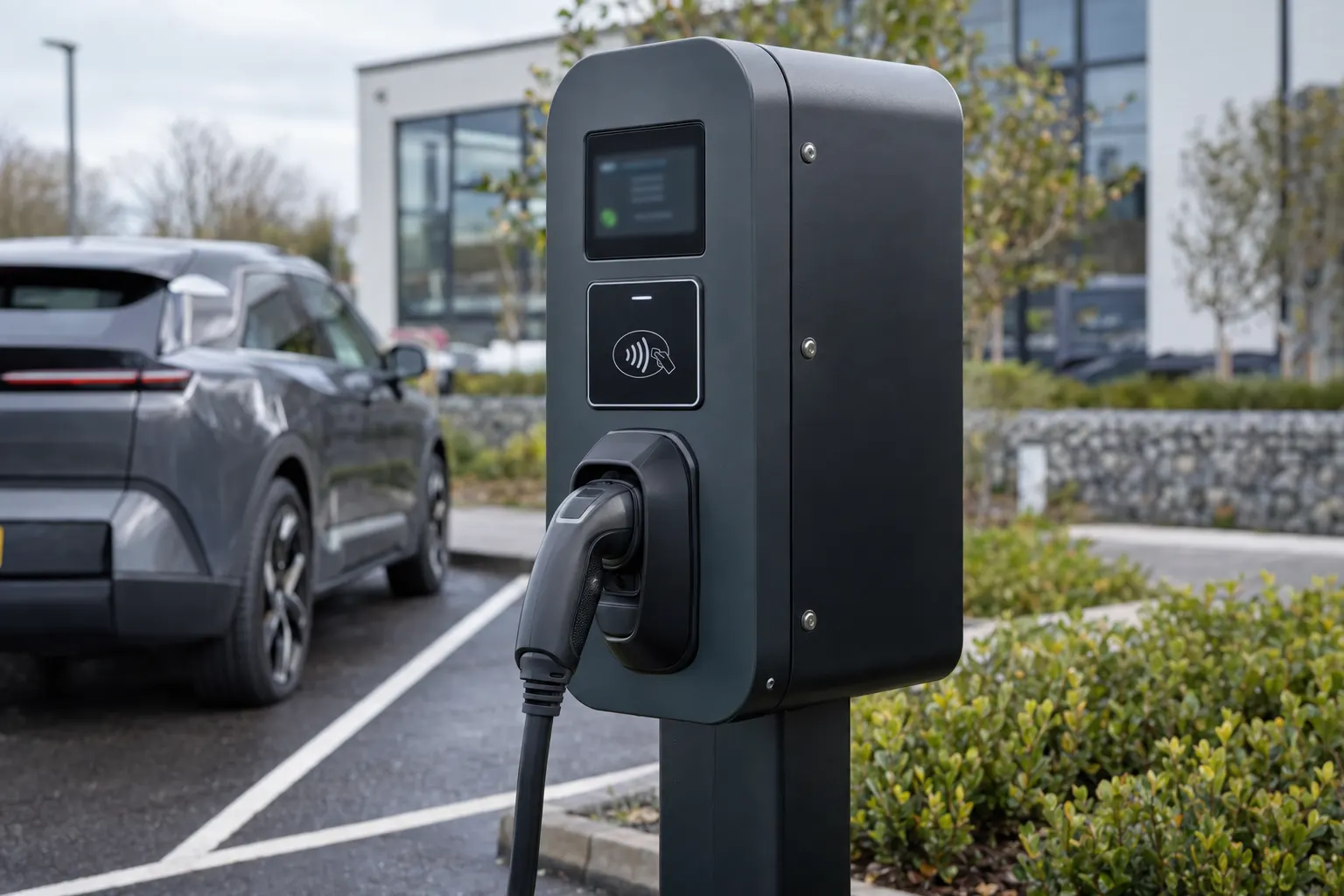
Price transparency is a public-point requirement. Contactless requirements depend on the point’s power and the relevant deployment or public-opening date. For an existing workplace unit, include the proposed opening date in the assessment instead of relying only on when it was installed.
Where customers pay, agree how they will see the price before charging starts, who sets and updates the tariff, and who manages the payment service. These are operating arrangements to settle with the proposed operator, not assumptions to leave in an equipment specification.
Help, data, roaming and reliability
Other duties include a staffed helpline, open data and roaming, subject to applicable exceptions. Ask the proposed operator how these will be provided; an installation contract alone does not establish ongoing driver support.
The 99% reliability requirement is averaged across an operator’s rapid public-charge-point network, covering points rated 50kW and above. It is not a separate 99% target for every individual point.
For your own site, still agree how faults will be reported and repairs arranged. A network-level reliability measure is not a maintenance plan for an individual charger.
Micro-business operators
An operator qualifying as a micro-business is exempt from regulations 5–10, but not the pricing requirement. Assess the actual operator, not simply the size of the business hosting its charger.

Who controls the charger, and what should be agreed?
The charge point operator is the entity controlling the point’s functioning. It is not necessarily the landowner: a third party may be contracted to manage and operate it. An installer without day-to-day operational responsibility is not automatically the operator.
If a third party is involved, hosting the equipment, maintaining the electrical installation and running the charging service are different tasks to allocate. Check the agreement against who will actually control operation, rather than relying on the names printed on the charger or the original installation paperwork.
Before widening access, put the following in writing:
- Users and access. Who may use each point, why they are visiting and how workplace visitors will be distinguished from purchasing customers.
- Charging terms. Opening hours, access controls, paid or free use, and who has authority to change these arrangements.
- Point details. Rated power, deployment history and the proposed date for opening it to customers or the public.
- Operating responsibilities. Which organisation controls operation, and who will deliver each applicable pricing, payment, helpline, data, roaming or reliability duty.
- Exceptions. Whether the actual operator qualifies for an exemption, and which duties remain applicable.
- Faults and changes. How maintenance and repairs will be handled, and who will review any future change in users or payment arrangements.
Use this brief before changing signage, sharing access credentials or promising customer charging. It gives the operator and electrical contractor the same starting point, while keeping the legal classification decision separate from the scope of installation work.
Keep equipment compliance separate
Public-point operating duties and the separate smart-charge-point rules have different scopes. A point remaining private still needs its applicable equipment and electrical requirements checked.
An access change therefore needs its operating arrangements reviewed separately from any electrical work it may require. This article scopes the first question; it is not legal advice or a full electrical-compliance assessment.
Planning to open workplace charging to customers? Discuss the electrical side with Maenporth Electrical Ltd on 01326 250297, or explore our EV charging services. Based at Maenporth, we serve Falmouth, Penryn and the wider Cornwall area.