
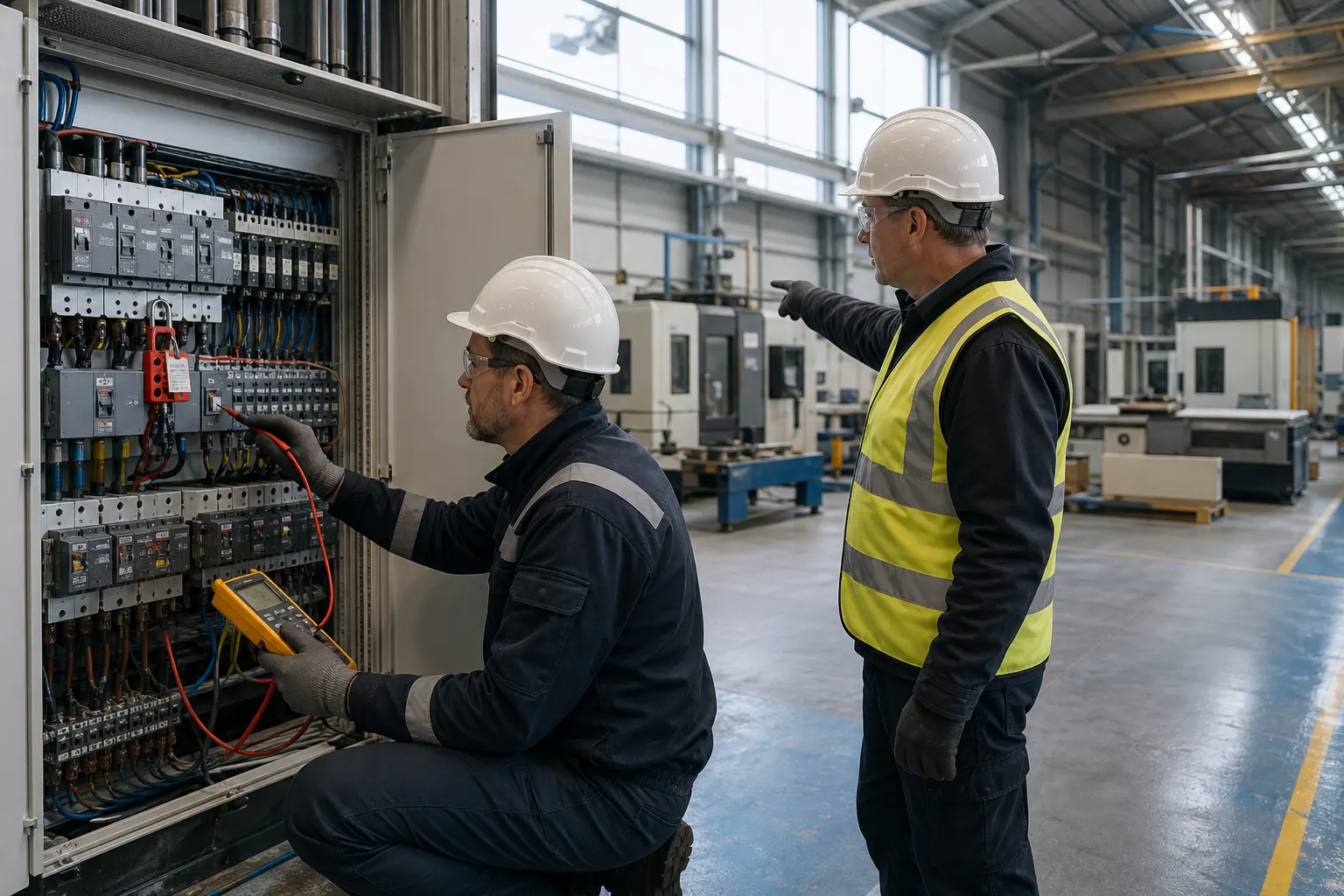
A fault on one machine or final circuit might be expected to disconnect only that part of an installation. When it instead stops a production area, workshop or much of the site, the operational consequences can be significant.
The immediate cause still needs to be identified. A trip could result from a genuine downstream fault, overload, damaged cable, earth leakage, motor problem or control-system defect. However, repeated incidents in which more of the installation disconnects than expected may also justify a review of protective-device coordination and the wider distribution system.
Effective industrial electrical fault finding in Falmouth is therefore about more than finding the device that operated. It means establishing what happened, why the protection responded and whether the installation contained the event appropriately.
Why can one fault switch off far more of an industrial site than expected?
An industrial distribution system usually has several levels of protection between the incoming supply and individual loads. A local circuit may be supplied through a distribution board, which is itself supplied through an upstream board or main switchboard.
Ideally, a fault is cleared by the appropriate protective device nearest to it, while unaffected sections remain available. This is not always what happens. An upstream device may operate as well as, or instead of, the expected downstream device. Where several RCDs are connected in series, their arrangement and suitability for the connected loads also matter.
That does not mean every wide-area shutdown proves poor discrimination. The actual fault conditions, device characteristics, cable details and installation arrangement must be investigated before reaching that conclusion.
What electrical selectivity and protection coordination mean
Selectivity, also called discrimination, describes the ability of protective devices to isolate the relevant part of an installation without unnecessarily disconnecting healthy circuits. Protection coordination is the broader process of considering how those devices work together throughout the distribution hierarchy.
This is both a safety and continuity issue. The priority is to prevent danger and clear faults correctly. Within those safety requirements, a well-considered arrangement can also reduce the chance of a local defect stopping unrelated machinery, lighting, controls or essential site services.
HSE guidance on the Electricity at Work Regulations explains the importance of proper equipment selection, maintenance and considering relationships between items in an electrical system. BS 7671 is also an important industry standard for electrical installation work, but it should not be described as legislation itself.

Site symptoms that justify a competent review
A single protective-device operation may simply indicate that it performed its intended function. Repeatedly resetting it without establishing the cause is not an appropriate response. A competent review becomes particularly useful when a pattern begins to emerge.
- A fault on one machine disconnects several unrelated circuits or an upstream section of the site.
- The main or sub-main device operates while the expected downstream device remains set.
- Trips began after machinery, controls, a variable-speed drive or other equipment was added.
- Different shifts or operating conditions produce an intermittent pattern.
- More than one RCD appears to operate during the same event.
- Records show recurring outages but do not identify the affected load or sequence of events.
- Obsolete devices, undocumented alterations or mixed generations of distribution equipment make the arrangement difficult to assess.
These symptoms are evidence to investigate, not proof of a particular defect. Maenporth Electrical’s electrical fault-finding service is relevant where a Falmouth site needs structured diagnosis rather than repeated trial-and-error resets.
What an industrial electrical assessment needs to examine
A protection-coordination review cannot be completed from breaker ratings alone. The electrician needs to understand the installation as a system and verify the information on site.
The assessment may need to consider:
- the incoming supply and earthing arrangement;
- the hierarchy from the main switchboard to sub-distribution and final circuits;
- protective-device ratings, characteristics and manufacturer data;
- prospective fault current at relevant points;
- cable sizes, types, routes, lengths and installation conditions;
- the position and arrangement of RCD protection;
- machinery starting currents and other load characteristics;
- previous trip reports, test results and alteration records;
- which circuits are critical to safe shutdown or continued operation.
Accurate single-line information is valuable, but older sites may not have complete or current drawings. Part of the work may therefore involve tracing and documenting the actual arrangement before corrective options can be evaluated.
The answer is not automatically a complete board replacement. Depending on verified findings, the work could involve repairing a downstream defect, improving circuit segregation, changing part of the distribution arrangement, replacing unsuitable or obsolete equipment, or producing a staged upgrade plan. The site’s wider industrial distribution system provides the context for those decisions.
Why site changes can alter fault behaviour
Industrial installations rarely remain static. Machinery is moved, production equipment is added and former spare ways are brought into use. Solar PV, battery storage, EV charging, UPS equipment and variable-speed drives can also change load characteristics or introduce considerations that were not part of the original design.
Some electronic equipment can affect residual-current behaviour, which is why RCD selection must reflect the actual connected loads. It is not appropriate to prescribe an RCD type without inspecting the installation and equipment data.
A change may also expose an existing weakness rather than create a new one. For example, an additional load might reveal limited capacity, a deteriorated connection or an undocumented relationship between upstream and downstream protection. Reviewing the complete arrangement is more useful than assuming the newest equipment is automatically at fault.
Information to gather before an industrial electrician visits
Site managers should not open equipment or alter protective settings. They can, however, collect operational evidence that makes diagnosis more efficient.
- Record the date and time of each incident.
- Note which areas, machines and services stopped.
- Identify what equipment was starting, stopping or running at the time.
- Preserve event logs from machinery or control systems where available.
- Locate existing drawings, test records and equipment manuals.
- List recent electrical, machinery or operational changes.
- Explain which circuits are safety-critical or costly to interrupt.
Photographs taken from a safe position may help identify which device operated, but covers should remain closed and site access rules must be followed.
Planning corrective work around production and isolation
Once the cause and distribution arrangement are understood, remedial work should be planned around safe isolation, access and operational priorities. Some verification or alterations may require a controlled shutdown. Others may be divided into stages, but that depends on the installation and the ability to isolate each section safely.
The plan should identify affected equipment, responsible site contacts, shutdown boundaries and the checks required before re-energisation. Where records are incomplete, updating drawings and device schedules can also make future maintenance and fault response more effective.

When an electrical incident needs immediate escalation
Stop using the affected equipment and escalate the issue promptly if there is heat damage, smoke, burning smells, arcing, unusual noise, a damaged enclosure, exposed parts or evidence of water ingress. The area should be managed under the site’s safety procedures and assessed by a competent person.
Repeated trips should not be treated as an inconvenience to overcome. A protective device may be responding to a dangerous condition, and resetting or changing settings without diagnosis can increase risk.
Arrange industrial electrical fault finding in Falmouth
If a local electrical fault is disconnecting a much larger part of your factory, workshop, quarry or operational site, Maenporth Electrical can discuss the symptoms, available records and access requirements. Call 01326 250297 to arrange an initial conversation about industrial electrical fault finding in Falmouth or elsewhere in Cornwall.