
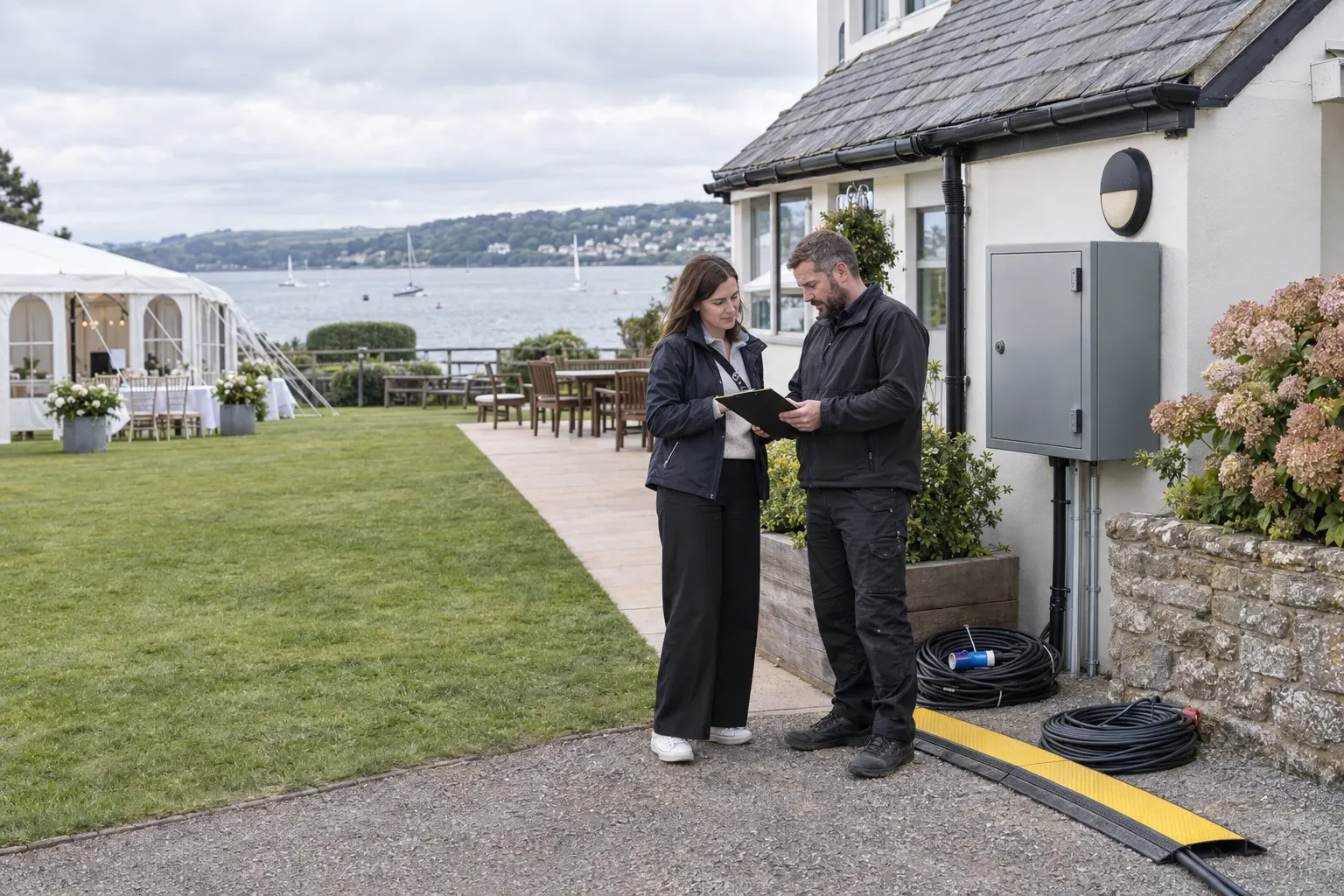
A spare socket is not a power plan. A marquee, catering stalls and a sound system may share the venue’s supply with kitchens, accommodation or other normal site services. The question is not just whether equipment can be plugged in, but whether the fixed installation and temporary system have been assessed together.
Planning temporary event power in Cornwall starts with a clear boundary between those two systems. For a Falmouth holiday park, golf club or rural venue, agree what each side must provide, who checks it and what information is needed before equipment arrives.
Start with the event layout, timetable and equipment schedule
Event power planning for venues needs to cover set-up, rehearsals or sound checks, public opening and dismantling, not just the advertised event times. Show where power is needed throughout that timetable.
The HSE guidance on electrical safety at events highlights layout, power requirements, access to mains supplies, environmental conditions and the timetable of demand as planning considerations.
Ask suppliers for a written equipment list, stated electrical requirements and operating periods, not just a request for ‘a socket’. Keep manufacturers’ information available; estimates based on the size of a stall or marquee are not a reliable brief.
Record which loads will run together and whether refrigeration or security equipment needs power overnight, when venue staff may have left.
Can the venue supply support the event alongside normal operations?
The assessment must include the venue’s continuing loads. A holiday park may still have accommodation and site services running; a clubhouse may need its kitchen while an outdoor function is under way.
Give the electrical professional the equipment schedule and proposed supply points. They can assess the relevant fixed circuits and supply arrangements against the combined demand. An outlet’s appearance, or the fact that it worked for last year’s event, is not enough.
The assessment concerns the proposed connection point as well as the incoming supply. Capacity elsewhere on the site does not automatically mean it is available at the outlet closest to the event. Resolve uncertainties before confirming the layout or accepting extra equipment.

Separate the fixed installation from temporary event distribution
The venue side
Mark the proposed connection point on the site plan. A review of the venue’s fixed commercial electrical installation should establish what can be made available and any limitations or work needed before the event. Existing fixed-installation records are background information, not approval of the proposed temporary system.
The temporary event side
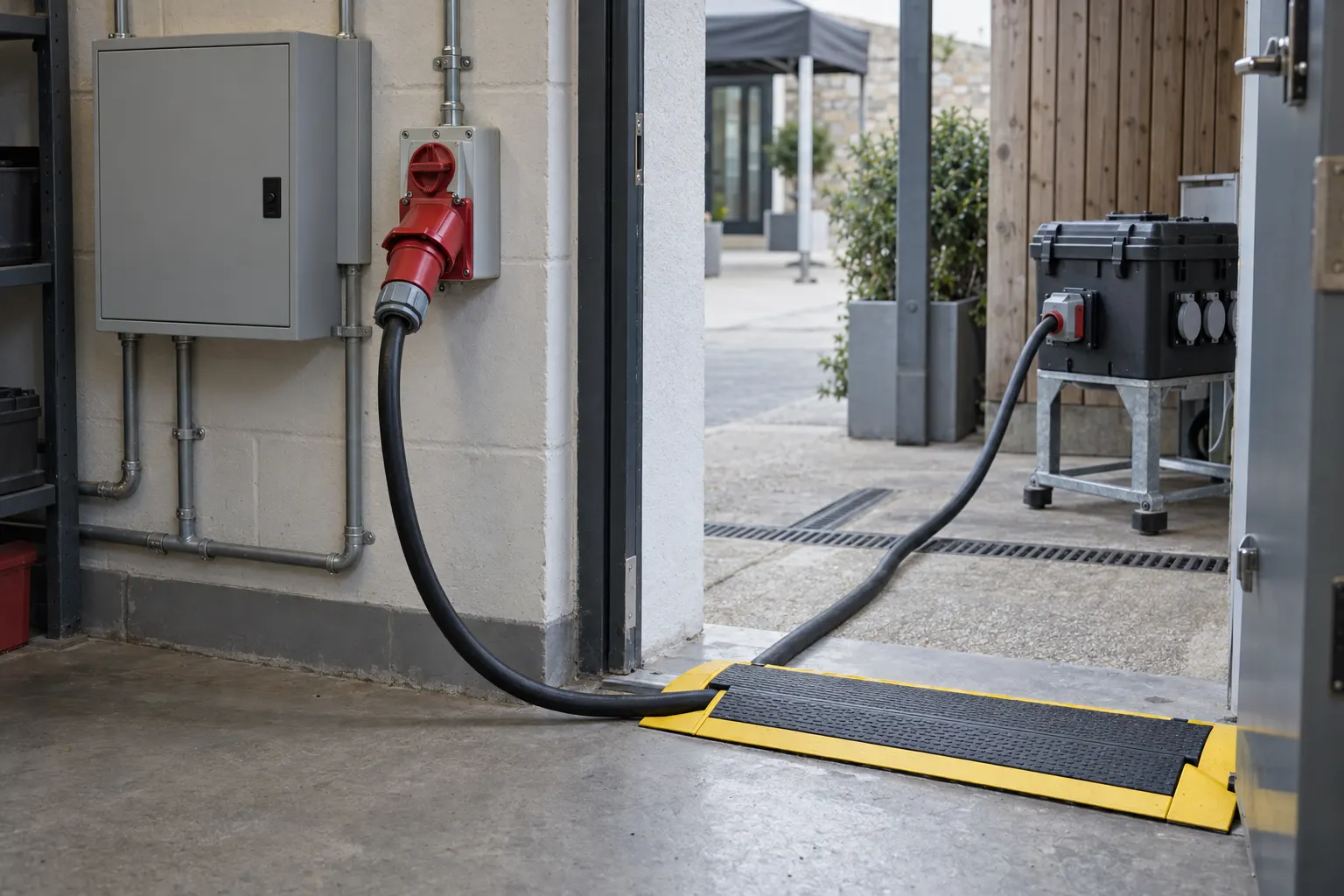
Temporary electrical installations for events need appropriately competent professionals to design, install and verify the distribution beyond that agreed point. Confirm who coordinates the connection, who checks compatibility between the systems and who records readiness for use.
Do not assume the venue contractor also covers the event equipment. A clear boundary helps prevent both contractors assuming the other has assessed the connection point.
The agreed scope should also include temporary equipment supplied by the venue itself. A venue-owned lighting unit should not be left out of the event assessment simply because it is not hired.
Plan around people, weather, vehicles and site services
Outdoor event electrical safety depends on the actual layout, not simply on equipment being described as suitable for outdoor use. Identify rain exposure, public access, service areas and vehicle movements early.
- Show pedestrian routes, accessible routes and crossings where cabling could create trip or damage risks.
- Plan positions that keep electrical equipment inaccessible to the public where practicable.
- Identify overhead lines and buried cables that could affect temporary structures or site activity.
- Agree how deliveries, grounds maintenance and emergency access will work around the electrical layout.
The electrical contractors should decide the equipment, protection and cable arrangements. Agree who can revise the plan if weather or ground conditions deteriorate, and how those changes reach the contractors before equipment is moved.
Identify emergency and other essential power needs
Identify which services need to remain available during an incident or supply interruption, rather than treating every event load alike. Discuss first-aid facilities, emergency lighting, communications and security requirements with the event team.
For example, a first-aid team’s requirements still matter if their equipment uses much less power than the catering stalls. Electrical demand and operational importance are different questions.
Do not assume the building’s normal emergency arrangements cover a marquee or temporary outdoor route. Any alternative supply arrangements need competent assessment and coordination with the event plan. Agree a response to power loss, including who makes decisions and how staff contact the responsible person.
Include lighting needed for safe set-up or removal outside public opening hours in the timetable.
Agree responsibilities before contractors arrive
Name the venue representative, event organiser, fixed-installation contractor and temporary-system contractor. The written brief should identify who supplies equipment information, assesses the fixed supply, verifies the temporary installation and accepts the handover before use.
Also agree who is available during the event, who receives reports of damaged equipment or unexpected interruptions, and who controls changes. A late request for an extra heater needs review, not an informal addition.
For temporary electrical systems for entertainment and related purposes, BSI lists BS 7909:2023+A1:2024 as the current code of practice. It is not legislation. Ask the event electrical contractor which requirements and records apply to the proposed system.
The Electricity at Work Regulations 1989 are relevant to work activities generally. A written division of tasks helps coordination but is not, by itself, a definitive allocation of legal responsibilities.
What site information and handover records should be ready?
Prepare one shared event file, with the agreed layout and a named contact for updates. Keep revised equipment schedules and any agreed limits together so contractors are not working from different versions.
Before assessment, provide:
- Available fixed-installation records and details of the proposed supply points, including known faults or restrictions.
- The equipment schedule, operating timetable and expected overlap with normal site use.
- Plans showing temporary structures, public routes, site services and restricted areas.
- The proposed division of work and contact details for both electrical contractors.
Before opening, obtain the inspection, test and handover information appropriate to the temporary system, together with operating limits and emergency contacts. Make clear who confirms outstanding issues are resolved, and keep a record of approved changes.
Keep the operational information accessible to whoever is supervising the event; the person who booked the contractors may not be there when a problem occurs.
Agree the removal stage too: who coordinates electrical shutdown, what must stay powered until people leave and how the venue supply is handed back.
When should a Falmouth venue seek electrical advice?
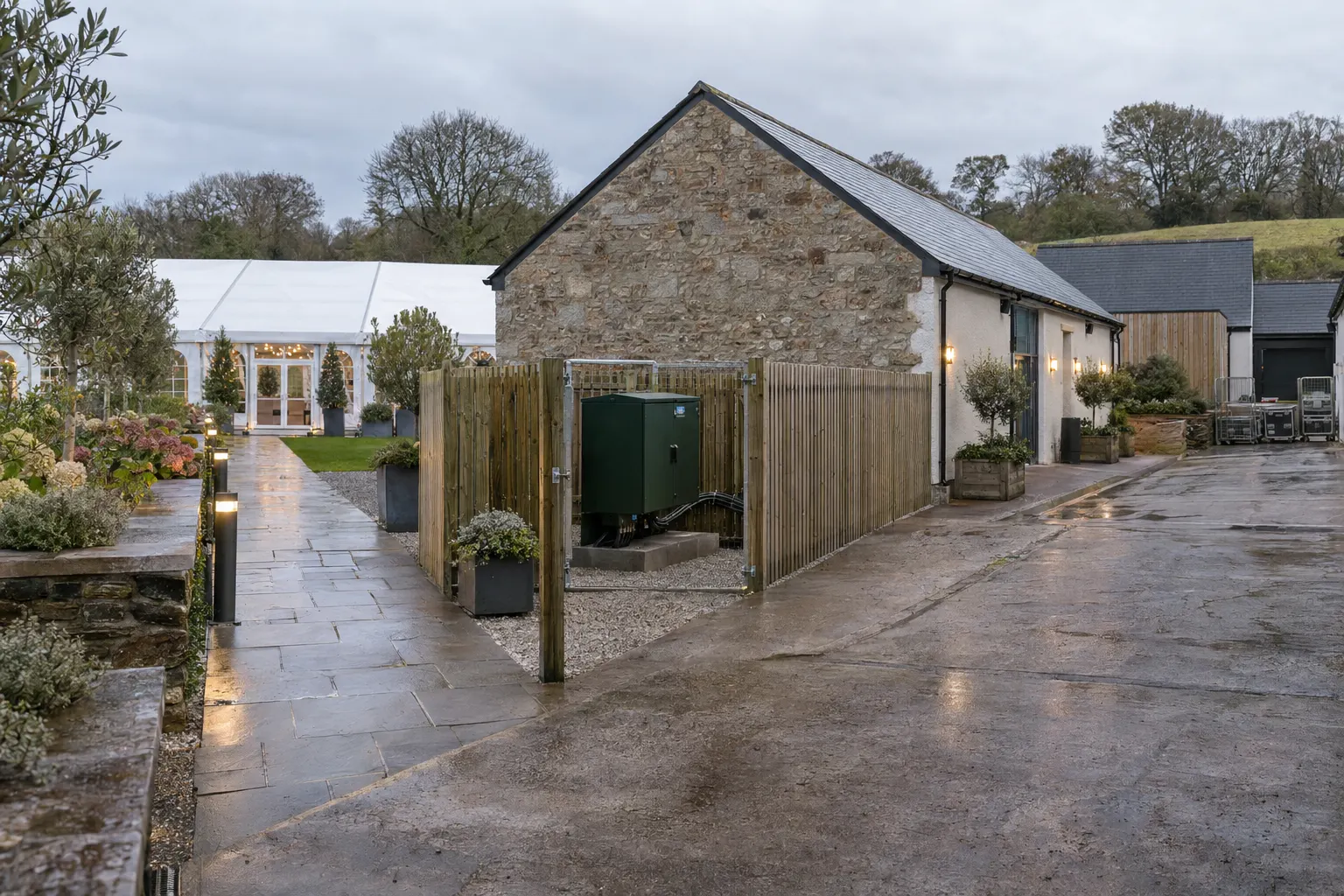
Ask before the layout is fixed, equipment is booked or suppliers are promised a particular supply. Early advice is especially useful where records are incomplete, outdoor power has not previously been assessed, or the event will overlap with normal trading.
Bring the temporary event contractor into that conversation so both sides work from the same plan.
For commercial electrical advice on your venue’s fixed installation, contact Maenporth Electrical Ltd on 01326 250297. Based at Maenporth, we serve Falmouth, Penryn and wider Cornwall. Bring the site plan and equipment schedule; arrange the temporary event system with an appropriately competent event electrical contractor.