
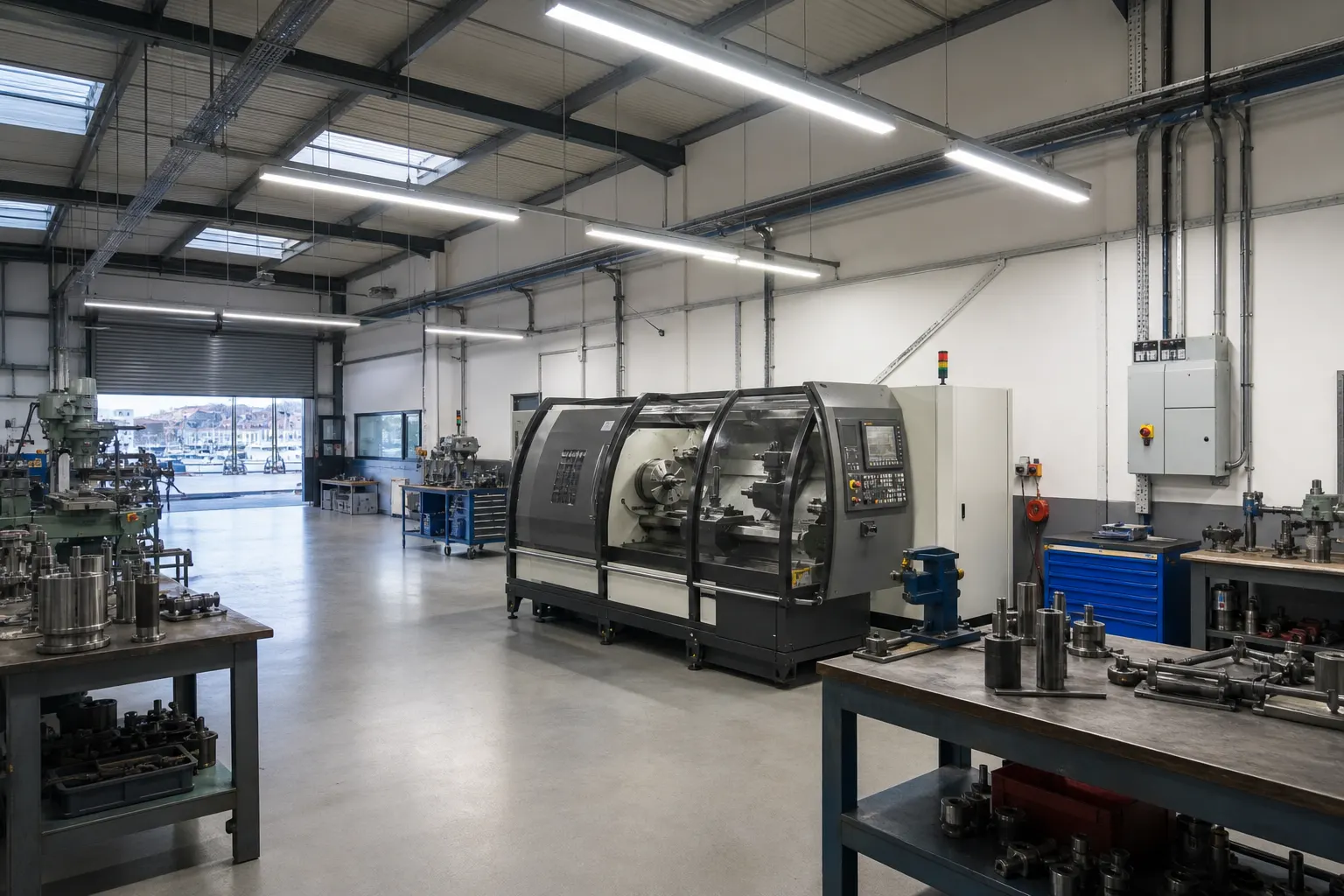
Lighting problems in a factory or workshop are not always as obvious as a failed fitting or a dark corner. Under certain lighting conditions, rotating or reciprocating machinery can appear stationary, move unevenly or seem to be turning at a different speed. That visual effect can create a serious misunderstanding around equipment that is still moving.
For businesses reviewing industrial lighting in Falmouth, this is an important reason to look beyond brightness and energy use. The suitability of a lighting system depends on the machinery, visual tasks, controls, layout and working environment—not simply the number of fittings installed.
This guide explains the stroboscopic effect, the warning signs that justify a closer review and the questions to address before changing workshop or factory lighting.
Could your factory or workshop lighting make rotating machinery look stationary?
Yes, it is possible. The Health and Safety Executive specifically warns that flickering fluorescent tubes can make rotating machinery appear stationary. The concern is especially relevant where people work around rotating shafts, chucks, wheels, pulleys, cutting equipment or other cyclically moving components.
This does not mean that every visibly flickering lamp creates the same hazard. The effect depends on the light source, its control gear or driver, the machinery speed and the amount of affected light reaching the task. Daylight and light from other fittings may also change what an operator sees.
Reports that machinery looks still, jerky or unusually slow under artificial light should therefore be treated as a reason for investigation rather than dismissed as an irritating lighting fault.
What the stroboscopic effect is and why it matters on industrial sites
Artificial light output can fluctuate over time. If those fluctuations interact with repeated machine movement, they may produce a stroboscopic effect. Rotating or reciprocating equipment can then appear stationary or seem to move differently from its actual motion.
CIBSE describes flicker, stroboscopic effects and phantom arrays as temporal lighting artefacts. They are related effects, but they are not necessarily experienced in the same way. A person may notice an obvious fluctuating light, while a hazardous interaction with machinery may be less immediately recognisable.
The practical issue is visual judgement. Someone approaching a machine, inspecting a process or assessing whether movement has stopped must not rely on misleading lighting. Normal guarding, isolation procedures and safe systems of work remain essential; suitable lighting supports those controls rather than replacing them.
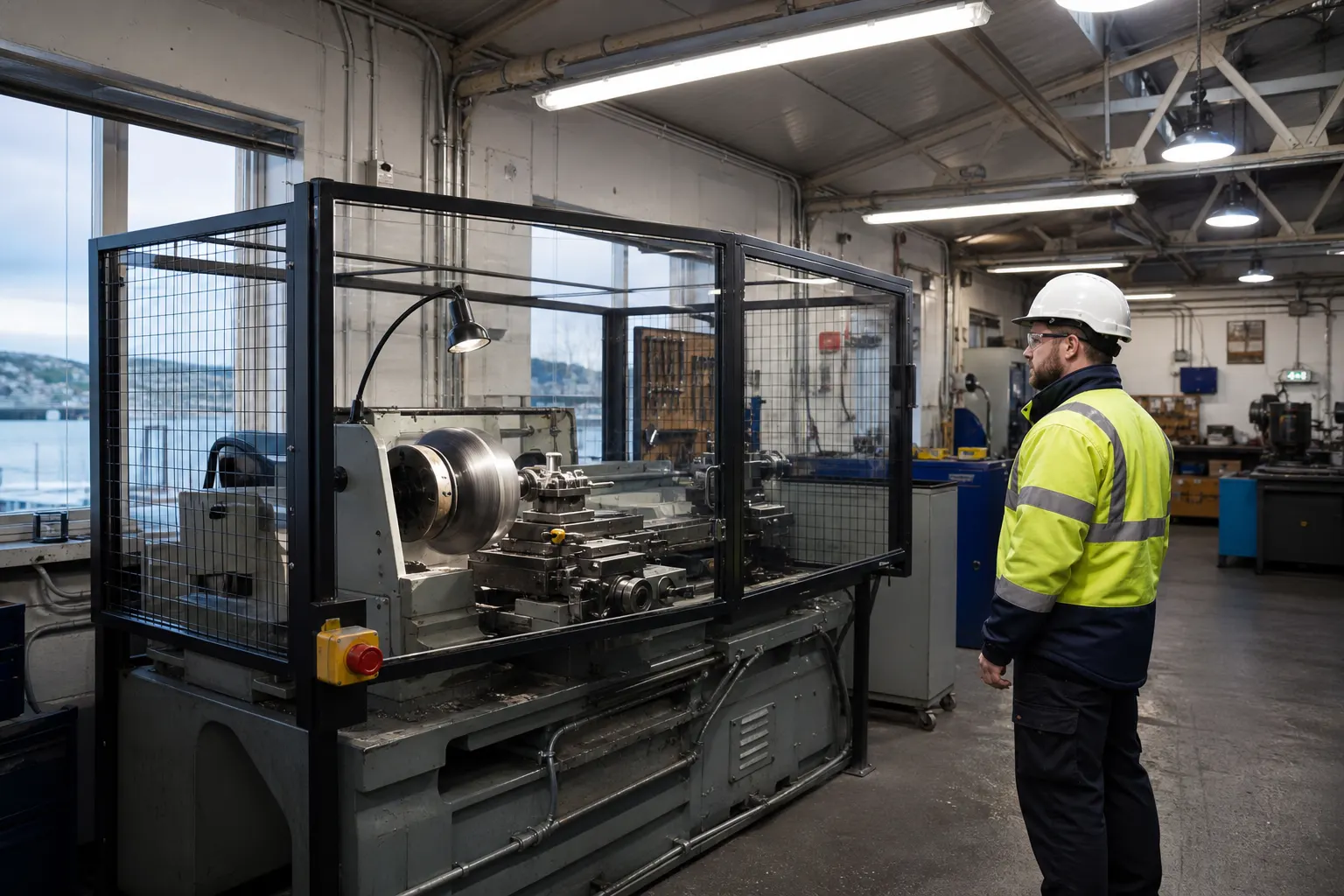
When a Falmouth or Cornwall site should review its lighting urgently
A lighting review should be prioritised when operators or maintenance personnel report unusual visual effects around moving equipment. Other triggers include repeated lamp or control-gear faults, inconsistent light between work areas, or a proposed retrofit that will alter luminaires, drivers, dimming or sensors.
Warning signs can include:
- rotating parts appearing still, slow or intermittently moving;
- visible flicker from fluorescent or LED fittings;
- different visual effects after switching, dimming or changing operating modes;
- machinery being clearly visible in daylight but harder to judge under artificial light;
- dark bands, strong shadows or glare around the working area;
- lighting complaints concentrated around a particular machine or production task;
- temporary or local lights becoming the routine solution for essential work.
These signs do not diagnose the cause. They identify where the lighting, electrical system, machinery and operating conditions need to be considered together.
Why replacing old fittings with LED is not automatically the whole answer
Modern industrial LED lighting can provide a practical replacement for ageing equipment, but the word “LED” does not by itself confirm that a fitting is suitable for every machine area. Performance can depend on the luminaire, driver, controls, dimming arrangement and installation conditions.
A like-for-like replacement may also preserve weaknesses in the existing layout. A new fitting can be efficient and reliable while still being poorly positioned for the task, producing glare on a machine surface or leaving important components in shadow.
The right question is therefore not simply whether fluorescent fittings should be replaced. It is whether the proposed system provides suitable light for the actual work and behaves appropriately under all normal operating and control conditions. Maenporth Electrical’s commercial lighting services can support a site-led assessment rather than treating an upgrade as a basic fitting swap.
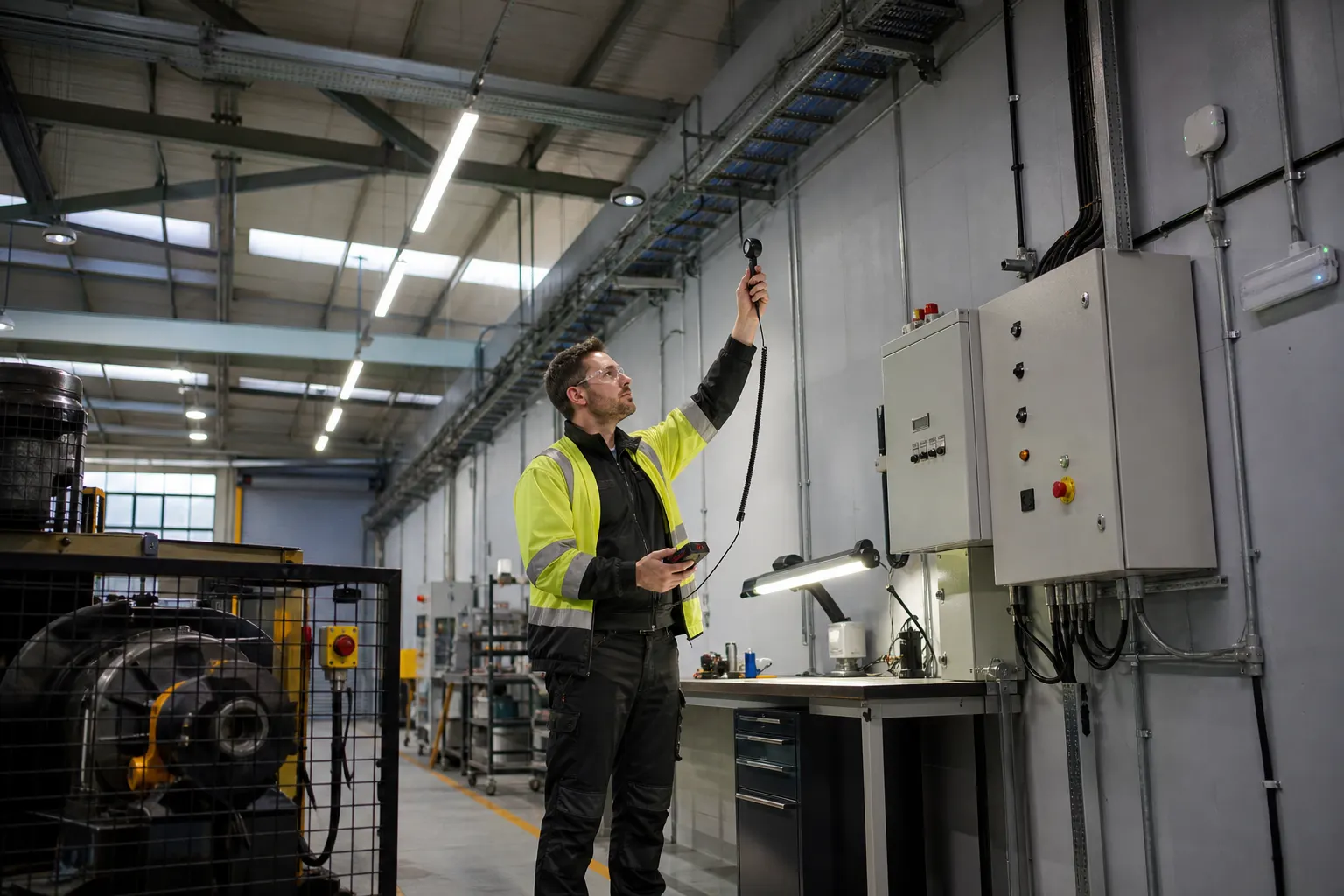
What a competent industrial lighting review should consider
Under Regulation 8 of the Workplace (Health, Safety and Welfare) Regulations 1992, every workplace must have suitable and sufficient lighting. Emergency lighting is also required where people would be especially exposed to danger if the artificial lighting failed.
That legal duty establishes the outcome required, but it does not create one universal lighting design for every factory, quarry workshop or larger rural site. A useful assessment needs to examine how each area is used.
The task and machinery
The review should identify what people need to see, including tools, workpieces, controls, markings, guards, indicators and moving components. The speed and type of machinery matter where temporal lighting effects could alter how motion appears.
The complete lighting arrangement
Luminaires should be considered with their drivers, switching, sensors and dimming controls. The assessment should also account for daylight, supplementary task lighting and light arriving from adjacent areas.
The working environment
Dust, moisture, temperature, vibration and the likelihood of physical impact can all influence fitting selection and positioning. Quarry workshop lighting may face different conditions from lighting in a clean assembly area or commercial storeroom.
Maintenance and access
Future inspection, cleaning and replacement should be planned from the start. A difficult-to-reach fitting above active plant can create disruption and access challenges long after the original installation.
Lighting details beyond flicker
Temporal effects are only one part of industrial lighting design. A system can avoid noticeable flicker and still be unsuitable for the work.
Glare can make it difficult to see displays, tools or reflective surfaces. Poor positioning can cast a worker’s shadow directly across the task. Rapid changes between bright and dark areas can affect comfortable movement through the site, while inadequate local lighting may make fine inspection difficult.
Colour quality can also matter where people need to distinguish materials, cables, warning indicators, surface finishes or process conditions accurately. The importance of each issue depends on the work being performed, so an assessment should be based on actual tasks rather than lamp wattage alone.
Routes, steps, changes in level and access around plant also need appropriate illumination. Lighting for production should not leave movement and maintenance areas overlooked.
Planning an upgrade around production and maintenance access
Industrial lighting work often has to be coordinated with live operations, machinery availability and safe access. Before installation begins, the site should establish which areas can be taken out of use, how electrical isolation will be managed and whether access equipment can be positioned without obstructing production or escape routes.
If lighting alterations involve circuits serving machinery areas, the work should be considered alongside the wider installation. The requirements for power supplies and controls may extend beyond the luminaires themselves, particularly where equipment is being moved or a production area is being rearranged. Relevant plant and machinery electrical supplies should form part of that coordinated review.
Emergency arrangements also need attention where alterations could affect escape-route illumination or expose people to danger following a lighting failure. This is a related project check, not a substitute for a separate assessment of the site’s emergency-lighting needs.
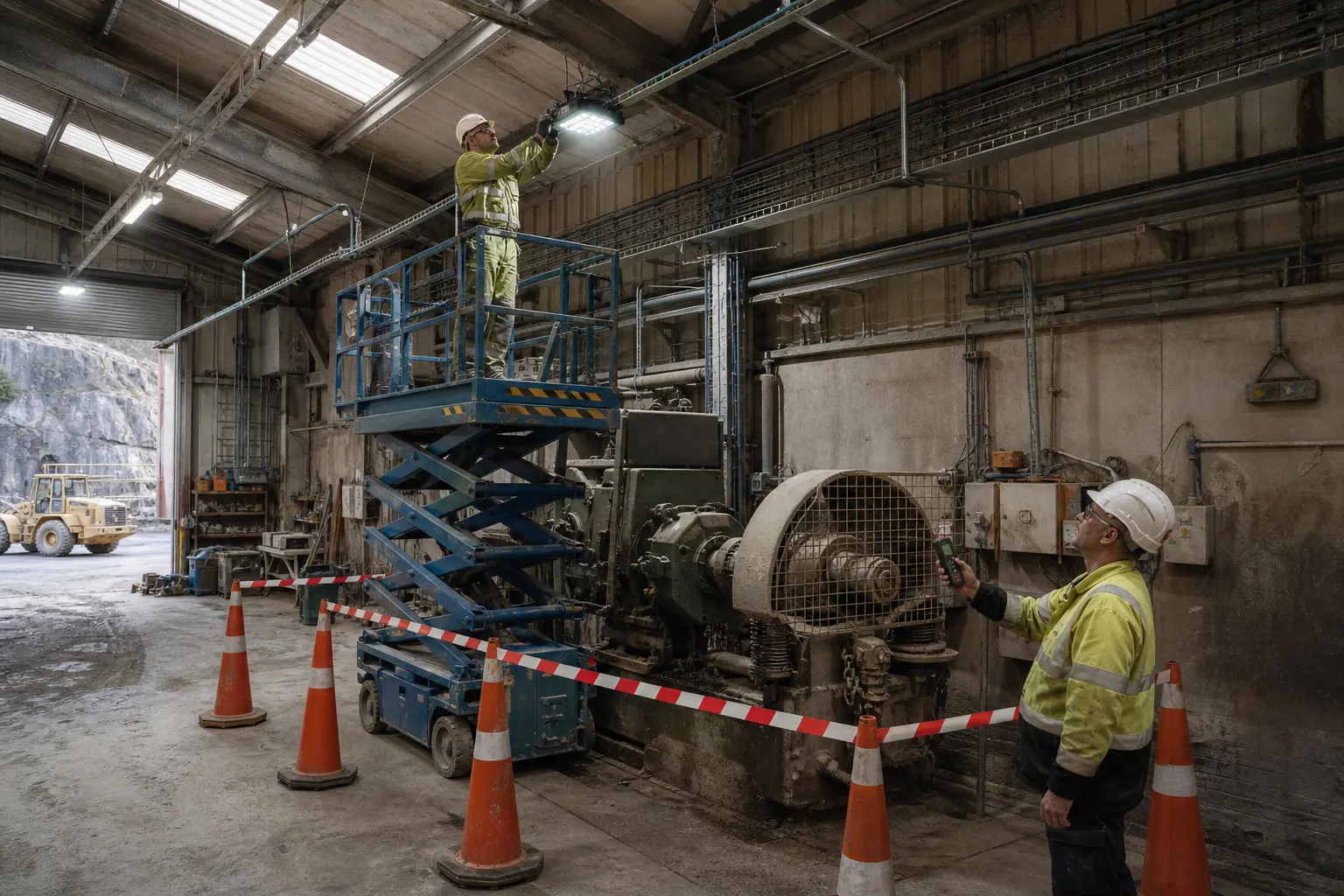
When to involve an electrical contractor before a lighting change
Early involvement is sensible where lighting serves rotating machinery, controls are being altered, repeated faults remain unexplained or production changes will affect the layout. It is also valuable when access is difficult or installation work must be phased around operations.
A contractor can assess the existing electrical arrangement, discuss the tasks performed and help develop a lighting proposal suited to the site. No responsible assessment should promise a particular safety, compliance or energy outcome without examining the installation and operating conditions.
Maenporth Electrical supports industrial and commercial sites in Falmouth, Penryn and across Cornwall. To discuss industrial lighting, machinery-area concerns or a planned upgrade, call 01326 250297.