
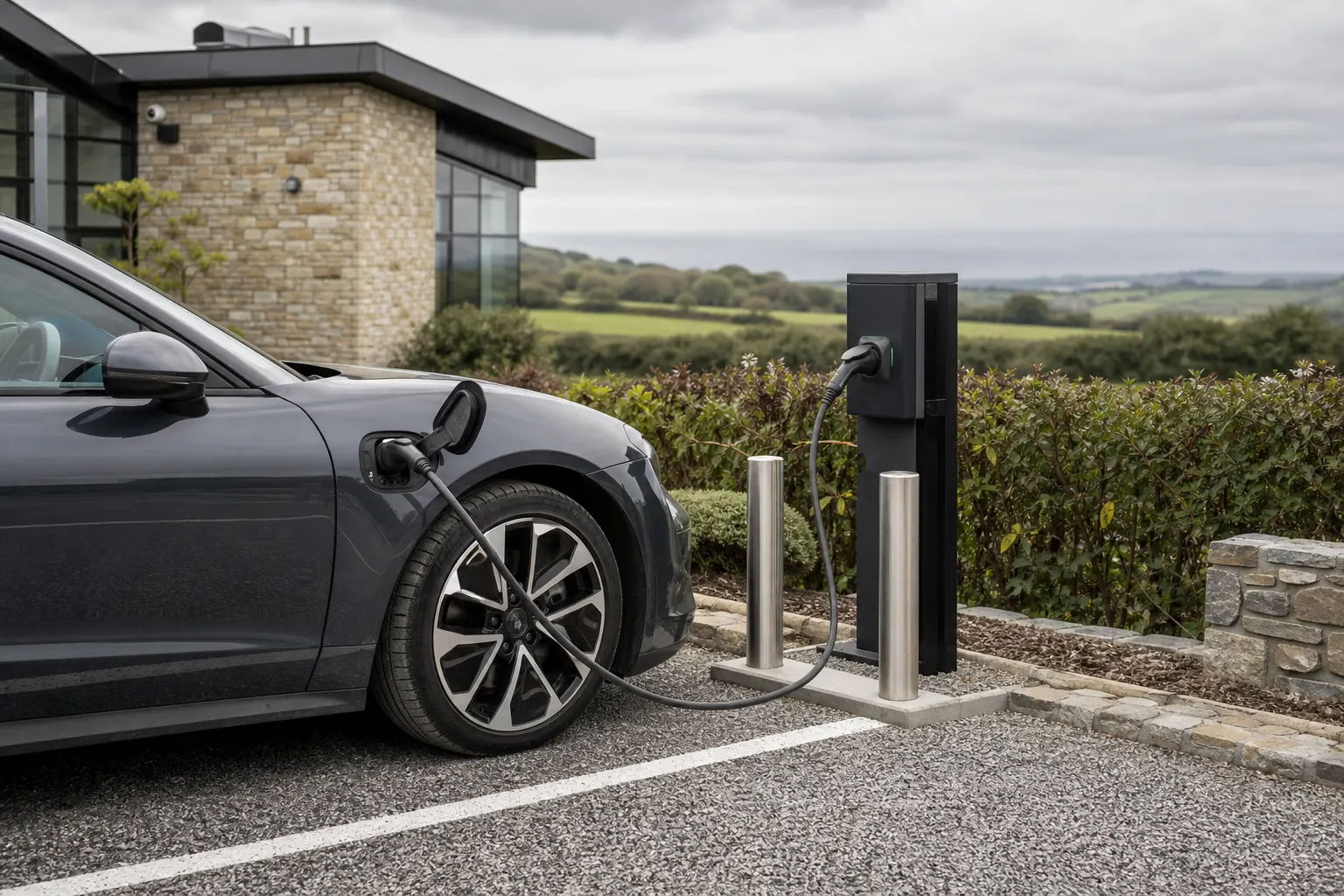
Choosing car chargers is not simply a matter of finding the unit with the highest power rating. The right arrangement depends on how long vehicles remain parked, what the electrical supply can support, who will use the chargers and how the site is expected to develop.
These questions are especially important across Cornwall, where a charging location might be a private driveway, factory yard, holiday park, golf club, rural business or customer car park. Cable distances, exposed locations and constrained supplies can all influence the final design. A useful first step is therefore to assess the site rather than selecting the hardware in isolation.
Match charging speed to the time vehicles spend on site
A charger only needs to be fast enough for the vehicle’s likely parking period. Installing more power than the site requires can increase connection and infrastructure costs without giving drivers a meaningful benefit.
7kW AC chargers
A 7kW unit is a common choice where a vehicle will remain parked for several hours or overnight. That can make it suitable for homes, employee parking, fleet vehicles returning to a depot and holiday accommodation where guests normally stay overnight.
Most 7kW chargers use a single-phase supply. Actual charging time depends on the vehicle, battery size, state of charge and conditions, so the number on the charger should not be treated as a guaranteed charging rate throughout every session.
11kW and 22kW AC chargers
Higher-powered AC charging may suit sites where vehicles need a useful charge during a shorter stay. A 22kW unit generally requires a three-phase supply, while the vehicle must also be capable of accepting the available AC rate.
This last point is easily overlooked. The car’s onboard charger converts AC electricity for storage in the battery and limits how much AC power the vehicle can take. A car that accepts 11kW AC will not draw 22kW simply because it is connected to a 22kW unit.
Rapid DC charging
DC charging supplies the vehicle battery without relying on the car’s onboard AC charger in the same way. It is useful where drivers need to continue their journey quickly, but it places substantially greater demands on the site connection, distribution equipment and project budget.
For many workplaces, leisure sites and accommodation businesses, several sensibly managed AC chargers may provide a better operational fit than one high-powered charger. The decision should follow parking behaviour, not assumptions about what looks most future-proof.
The existing electrical supply sets the starting point
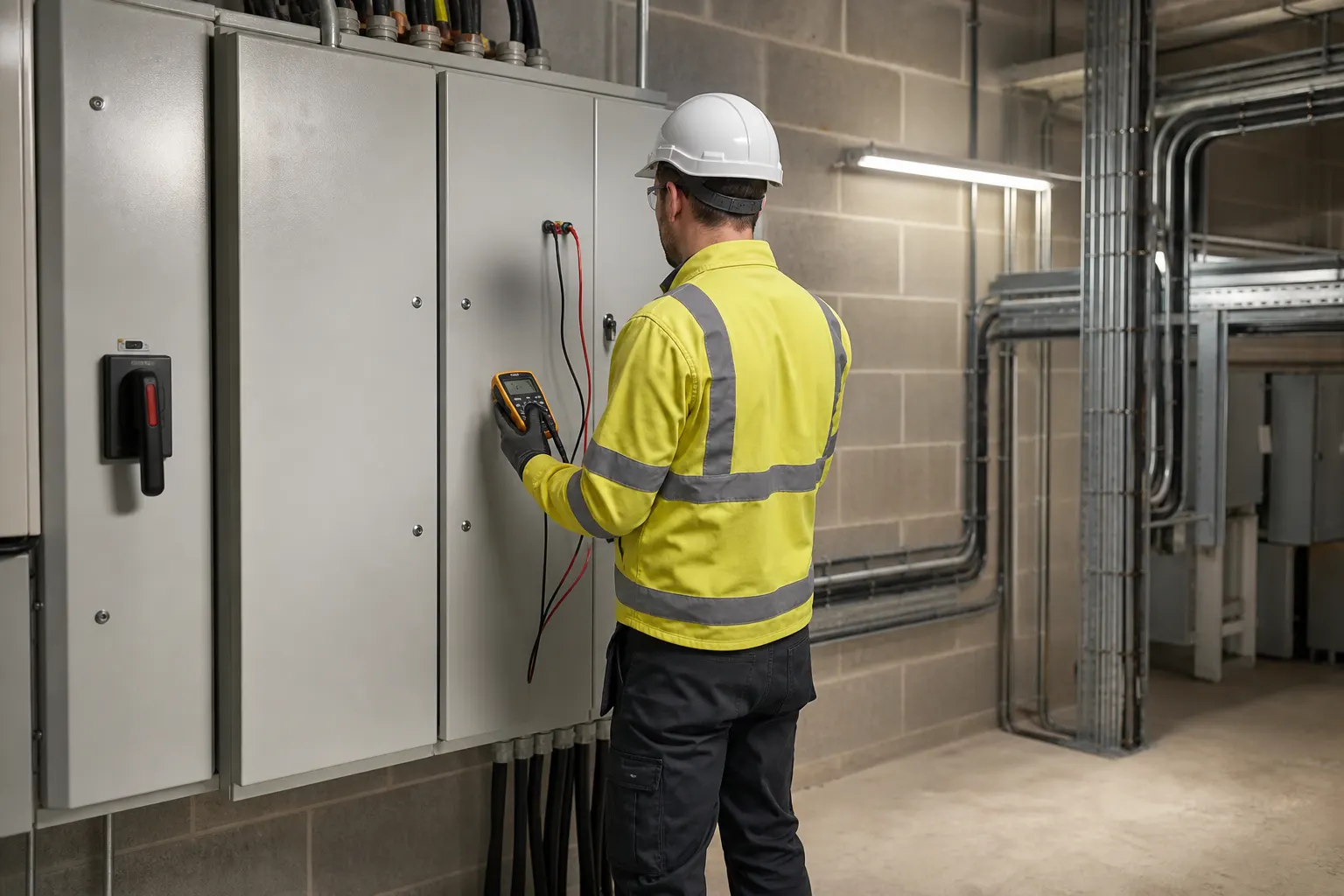
Before an EV charger installation in Cornwall is specified, the incoming supply and existing demand should be assessed. This is part of the wider commercial electrical infrastructure, not a separate accessory that can always be added without consequence.
The assessment may need to consider:
- Whether the property has a single-phase or three-phase supply.
- The rating and condition of the incoming equipment and distribution boards.
- Existing peak demand from heating, machinery, catering equipment or other large loads.
- The number of vehicles likely to charge simultaneously.
- Cable length, installation method and the route between the supply and parking area.
- Whether the local distribution network operator must be notified or consulted before installation.
A charger’s headline rating does not show the combined demand created by multiple units. Four 7kW chargers, for example, represent a very different design question from one 7kW home charger. On industrial or leisure sites, charging may also coincide with production loads, electric heating, laundry equipment or busy changeover periods.
Load management can avoid unnecessary peaks
EV load management controls how much power a charger or group of chargers can use. A dynamic system can monitor demand elsewhere on the premises and reduce charging power when the site approaches a defined limit.
This can allow several vehicles to share available capacity rather than every charger drawing its maximum output at once. Where vehicles remain parked for long periods, distributing energy over time may meet operational needs without requiring all bays to charge at full power continuously.
However, load management needs a clear design. The installer should understand which loads have priority, the minimum useful charging rate, how the system behaves if communications are lost and whether drivers need guaranteed departure times. A fleet depot has different priorities from a visitor car park where charging is an optional amenity.
Private, workplace and public charging are not the same
A charger reserved for a householder, employees or a private fleet has different operational requirements from one offered to members of the public. Access method, billing, user support and data connectivity should therefore be agreed before equipment is ordered.
Private domestic and workplace chargers sold in Great Britain are subject to smart charging requirements. These include functions intended to support scheduled charging and management of electricity demand. For a business, useful features may also include user authentication, session reporting, energy allocation and remote fault monitoring.
If charging will be offered to the general public, the operator also needs to consider consumer-facing obligations. Government guidance on the Public Charge Point Regulations 2023 covers matters including price transparency, payment, helplines, data and reliability requirements. The precise obligations vary with factors such as charger rating, deployment date, whether charging is free and the status of the operator.
This distinction matters for hotels, holiday parks, golf clubs and other destinations. A unit intended only for registered guests or authorised users should not automatically be specified in the same way as a charger advertised for unrestricted public use.
The parking area is part of the electrical design
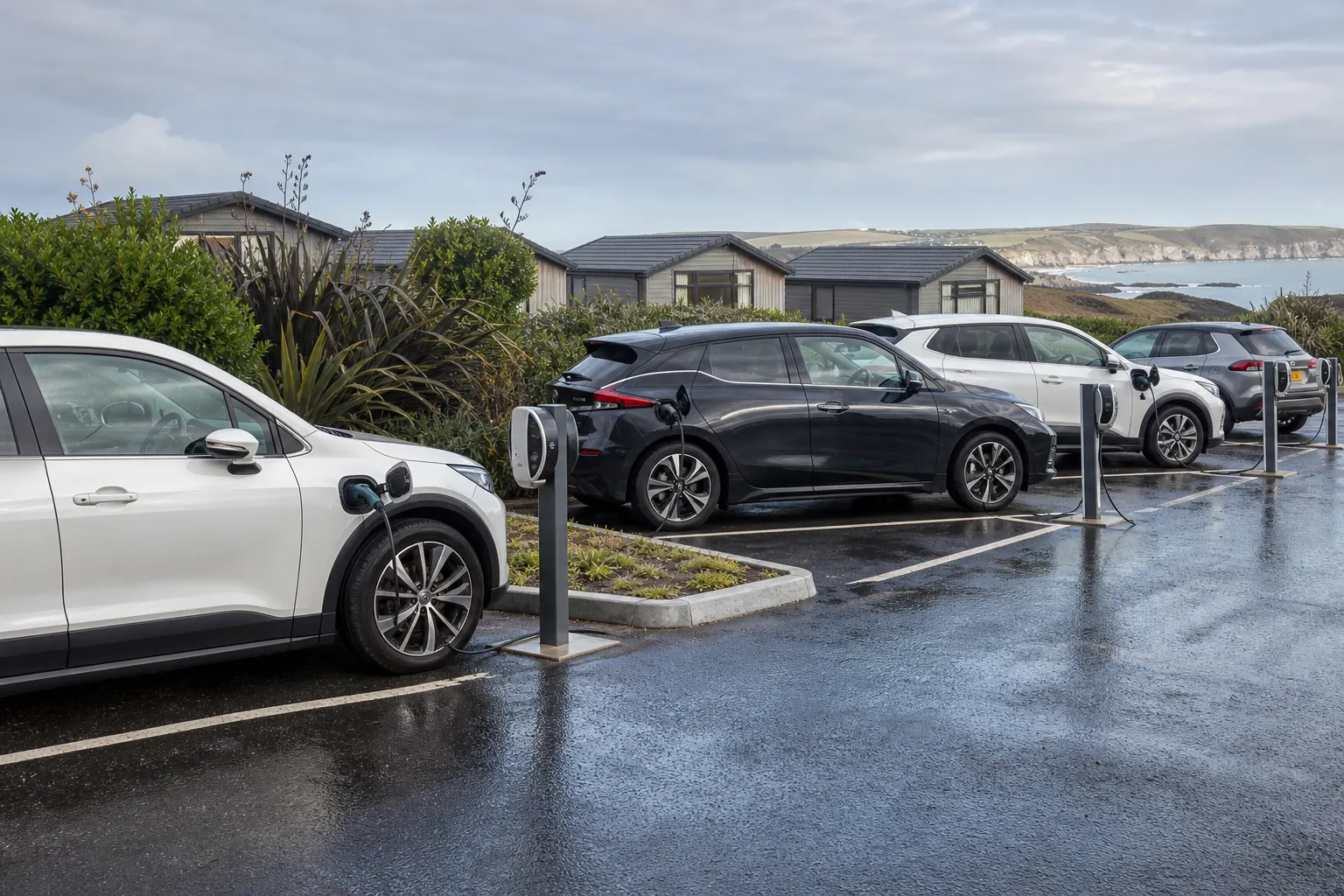
The safest electrical position is not always the most convenient parking position. Charger placement should account for different vehicle inlet locations, cable reach, pedestrian routes and the risk of vehicles striking the equipment.
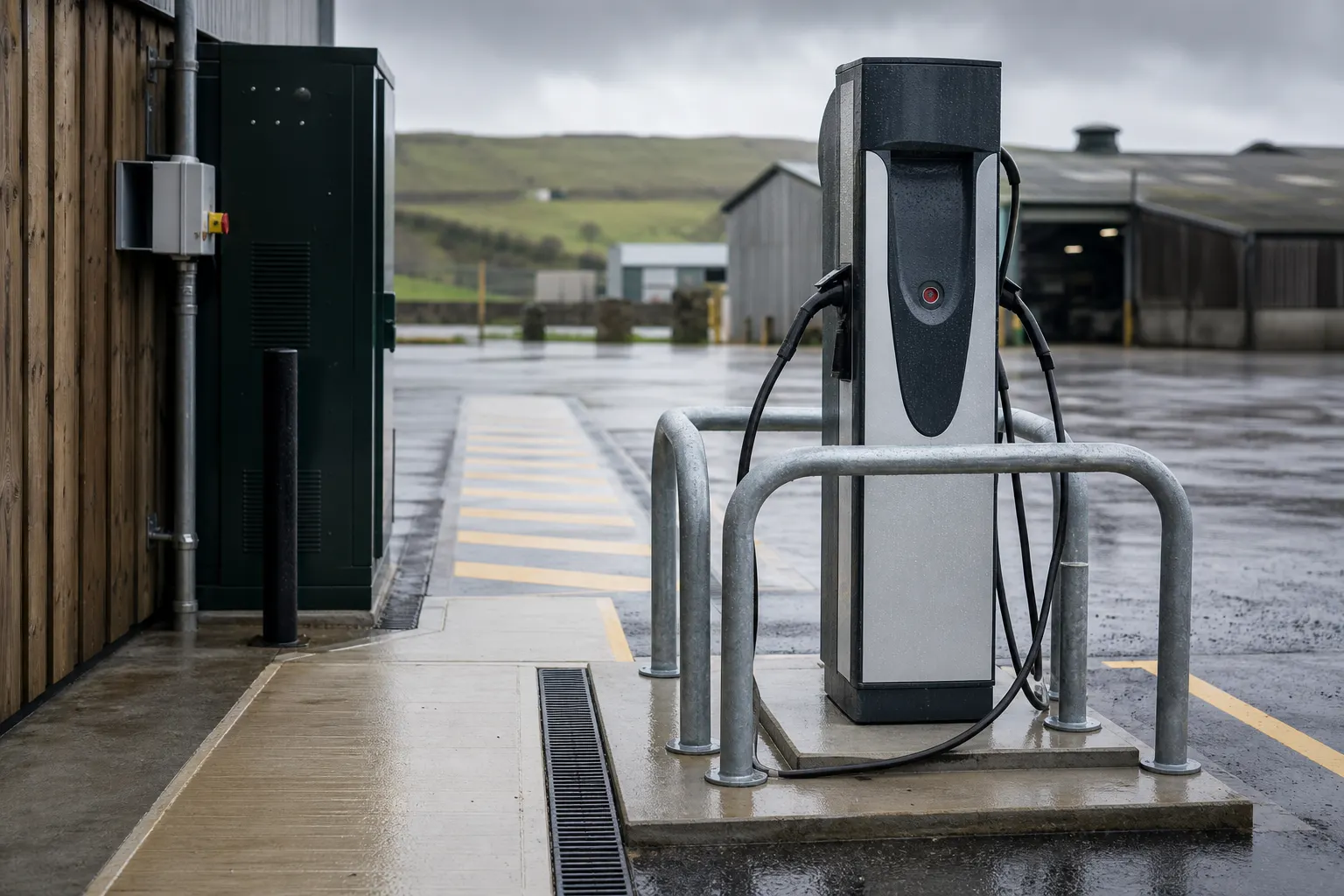
On exposed Cornish sites, the enclosure, fixings and support arrangement also need to suit the environment. Coastal air, wind-driven rain and open car parks can be harder on equipment than a sheltered domestic driveway. Quarries, factories and working yards introduce further considerations such as dust, heavy vehicle movements and accidental impact.
Practical design points include:
- Keeping charging leads away from walkways and vehicle routes.
- Providing suitable physical protection without obstructing charging access.
- Avoiding low points where water regularly collects.
- Ensuring controls, sockets and displays can be reached and used safely.
- Planning lighting, bay markings and signage where unfamiliar drivers will use the equipment.
- Checking that mobile or data connectivity is reliable enough for the chosen system.
- Leaving sensible access for inspection, isolation, repair and replacement.
Plan for expansion without oversizing everything now
Future preparation does not necessarily mean installing the largest possible charger on day one. It may be more valuable to design cable routes, distribution capacity, ducts, foundations and communications so that additional bays can be added with less disruption.
A staged plan might begin with chargers for current fleet vehicles or a small number of visitor bays, while reserving routes and distribution space for later phases. This is particularly useful for holiday parks, larger rural sites and commercial premises where demand may grow gradually.
EV charging can also be considered alongside solar and renewable electrical systems. Daytime solar generation may contribute to vehicle charging when production and parking patterns align, while suitable controls can coordinate site demand. Solar does not remove the need to assess the grid connection, however, because vehicles may charge when generation is low or unavailable.
Ask these questions before requesting a quotation
- Who will charge? Residents, employees, fleet drivers, guests, customers or the public?
- How long will they park? Overnight, a working day, a few hours or a short journey break?
- How many vehicles may connect together? Consider likely use rather than only the initial number of electric vehicles.
- Does payment or user identification matter? Free access, allocated energy, staff reimbursement and public billing require different systems.
- What else uses significant electricity? Include machinery, heating, kitchens, laundries, pumps and planned equipment.
- Could more bays be needed? Early provision for cable routes can be easier than excavating a finished car park later.
- Who will manage the chargers? Decide who handles user access, software accounts, faults and ongoing inspections.
A good car charger installation starts with the site
The right charging system balances vehicle requirements, parking time, electrical capacity and practical operation. For some locations that will mean a straightforward 7kW charger. For others, it may involve three-phase AC units, managed groups of chargers or a connection assessment for higher-powered equipment.
Maenporth Electrical provides EV charging services for domestic, commercial and larger working sites across Cornwall. To discuss car chargers for a property, workplace, holiday park or rural site, call 01326 250297.