
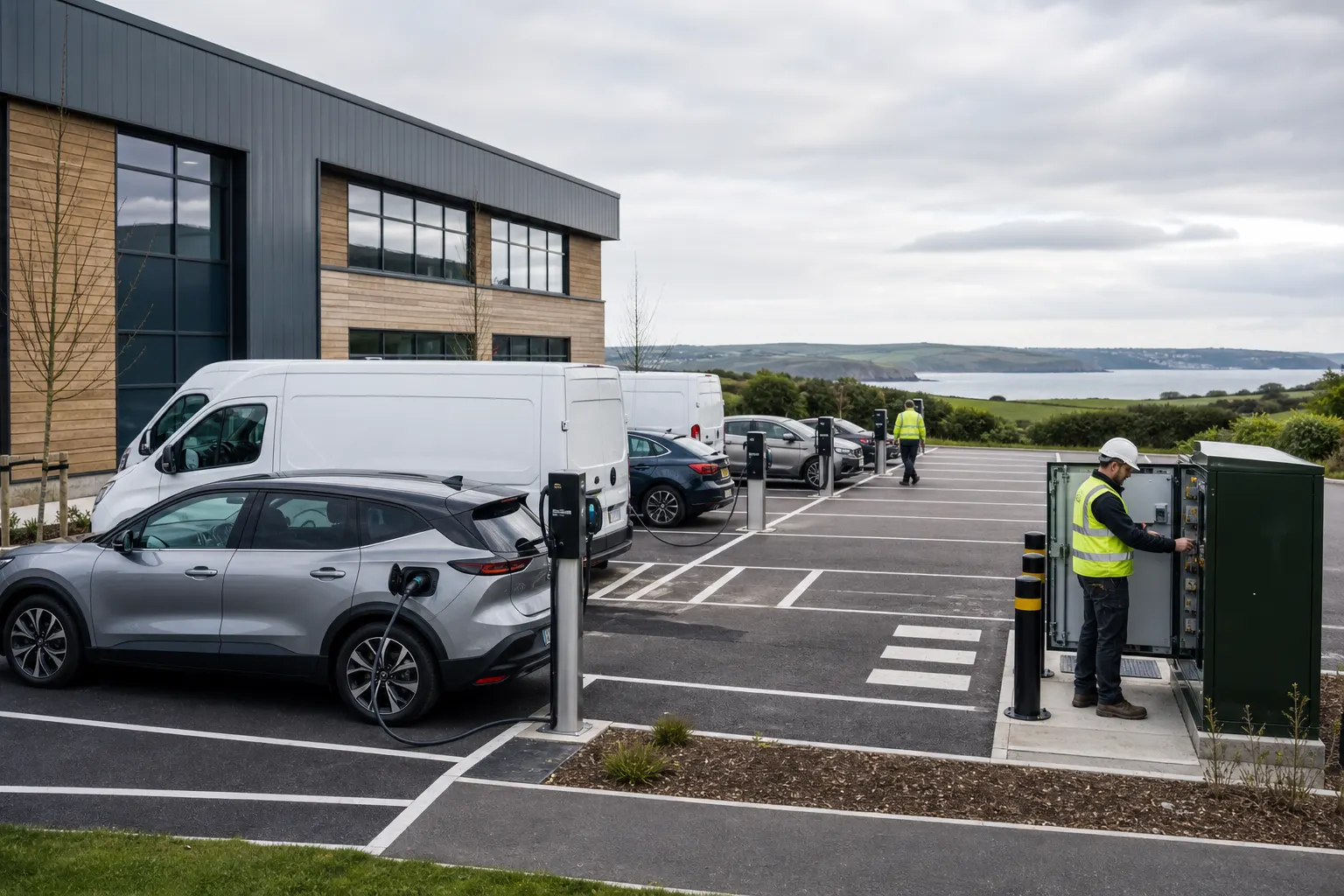
Asking how many EV chargers a commercial site can support sounds like a simple question. In practice, the answer is rarely found by looking at the main fuse or choosing a charger rating in isolation.
A useful assessment has to consider the building’s existing electrical demand, when vehicles will be parked, how much energy they need and what other equipment must remain available. A factory operating several shifts has a different charging profile from an office, golf club, rural depot or holiday park, even if their incoming supplies appear similar on paper.
For businesses considering commercial EV charging installation in Falmouth or the surrounding area, the strongest starting point is therefore a site and operational review rather than a charger catalogue.
Why the charger rating does not tell you the whole story
A chargepoint’s stated power is its maximum potential output. It does not mean that every connected vehicle will draw that amount continuously, nor does it prove that the electrical installation can safely make that power available alongside the rest of the site.
The practical question is how much capacity is available during the hours when charging will take place. Existing loads may include machinery, heating, catering equipment, refrigeration, lighting, pumps, ventilation, process equipment or renewable generation and battery systems.
Some loads are steady. Others start intermittently or vary sharply through the working day. Relying on a single snapshot can therefore create a misleading picture. Where the existing demand is not adequately understood, monitored load data may be needed before a charging design is settled.
Five questions that shape commercial EV charging capacity
1. What is the site already using?
The incoming supply is only one part of the assessment. Distribution equipment, switchgear, protective devices, submains and final cable routes must also be suitable for the proposed load.
An older commercial or industrial site may have undergone several alterations. Drawings and circuit schedules can be incomplete, while spare ways in a distribution board do not necessarily indicate spare electrical capacity. Existing equipment may also be approaching its practical limit before EV charging is added.
2. How long will vehicles remain parked?
Vehicle dwell time can be more important than headline charging speed. A fleet van returning in the evening and remaining on site overnight may have a long charging window. A visitor staying for 45 minutes has a very different requirement.
Longer dwell times can allow energy to be delivered at a lower rate or staggered across several vehicles. Where vehicles must return to service quickly, higher power may be justified, but it can have a much greater effect on the site supply and project scope.
3. How much energy does each vehicle need?
Planning should be based on realistic daily use rather than battery size alone. A vehicle does not normally return completely empty every day. Mileage, payload, route conditions, seasonal use and the required departure state of charge all affect the energy that must be replaced.
For fleet charging, it helps to record:
- the number and type of vehicles;
- typical daily mileage and operating pattern;
- arrival and departure times;
- which vehicles are operationally critical;
- whether vehicles return together or in stages;
- expected fleet changes over the next few years.
This information allows the electrical design to support the actual transport operation instead of assuming every socket must deliver full output simultaneously.
4. What happens during the site’s busiest electrical period?
EV demand should be considered alongside the site’s normal peak. At a leisure or hospitality property, charging may overlap with busy guest periods, catering demand and hot-water use. At an industrial site, vehicles might return while production is still running. On a rural site, pumps, workshops or processing equipment may create short but significant peaks.
The design should protect essential operations. Installing chargers without understanding these overlaps can lead to nuisance interruptions, restricted charging or the discovery that further electrical work is needed later.
5. Is expansion likely?
Installing only for today’s vehicle count can make the next phase unnecessarily disruptive. Even where a business begins with one or two chargers, it may be sensible to consider distribution capacity, containment, ducting, data connectivity and parking layout for additional units.
Future-ready planning does not always mean buying every charger immediately. It means avoiding obvious constraints where proportionate enabling work can be incorporated into the first phase.
How load management can make better use of the supply
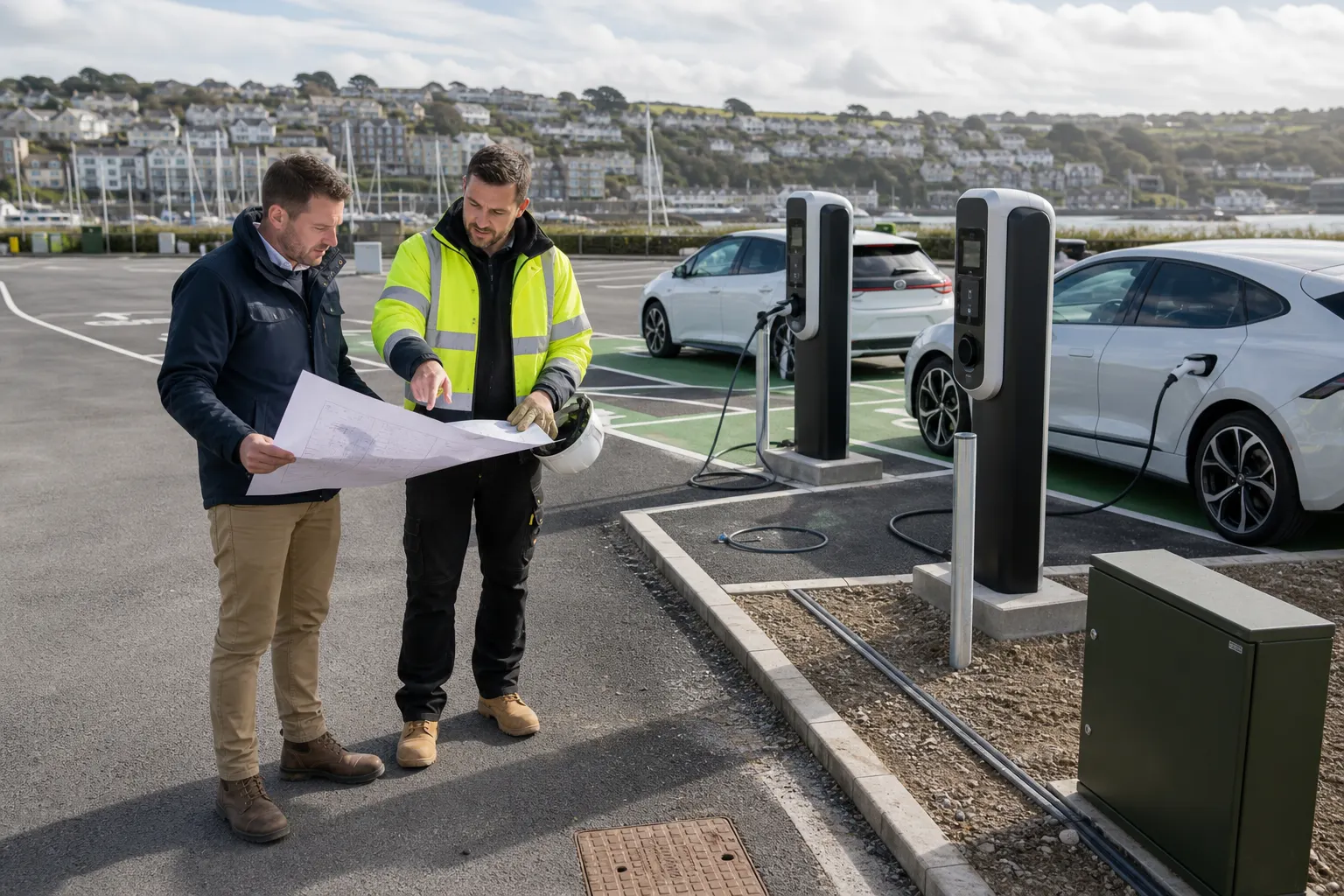
Load management controls how available power is shared between chargepoints or adjusted in response to demand elsewhere on the site. Rather than allowing every charger to operate at maximum output regardless of conditions, the system can keep total charging demand within an agreed limit.
For example, vehicles with long overnight dwell times may share the available power and still receive the energy they need before departure. Charging output can also be reduced while a building is heavily loaded and increased when other demand falls.
This can help avoid an unnecessary supply upgrade, but it is not a substitute for proper design. The system still needs a defined operating strategy, compatible equipment, appropriate communications and a clear response if connectivity or control components fail.
Businesses should also decide whether charging priority is required. Fleet vehicles due to leave first may need precedence over staff cars, while essential operational vehicles may need a guaranteed minimum allocation.
When a supply upgrade may still be necessary
Load management cannot create energy or shorten an unrealistic charging window. A supply upgrade may need to be investigated where vehicle energy requirements are high, turnaround times are short or the existing site is already close to its usable capacity.
Depending on the project, this can involve discussion with the local distribution network operator. Connection requirements and timescales should be considered early, particularly for a larger fleet, several higher-powered chargers or a phased installation expected to grow substantially.
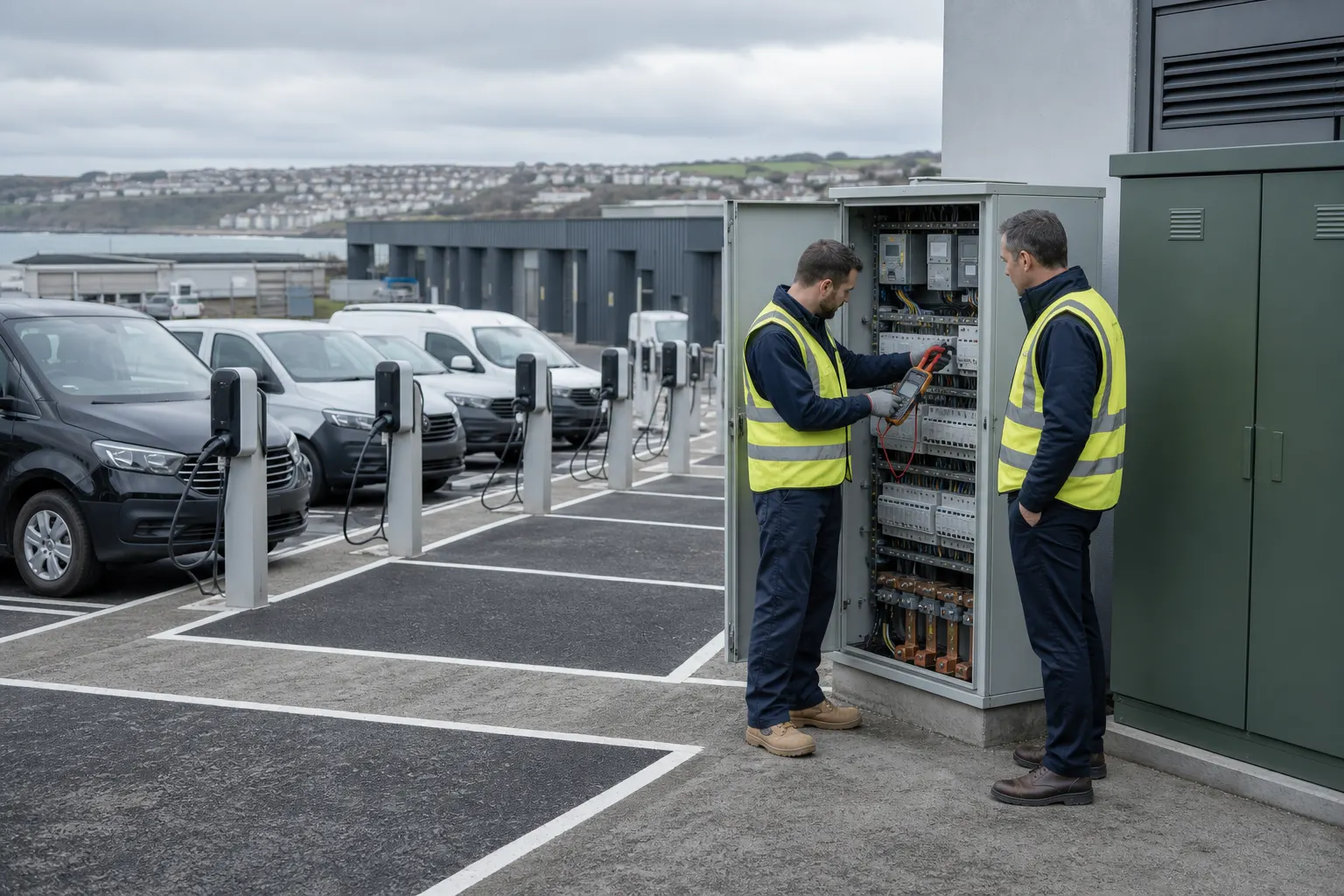
Early capacity planning can also reveal whether wider commercial electrical improvements should be coordinated with the charging project. That might include distribution upgrades, replacement switchgear, new submains or changes to the route between the intake position and car park.
Parking, cabling and communications affect the answer too
An electrically possible design is not automatically a practical one. Chargepoint positions need to work with the movement of vehicles, pedestrians and site equipment. Cable routes may cross landscaped ground, surfaced parking areas or sections of an operating yard where disruption must be controlled.
A commercial EV charging survey should therefore consider:
- parking bay dimensions and vehicle access;
- protection from accidental impact;
- accessible charging provision where applicable;
- safe cable use without creating trip hazards;
- distance from suitable electrical distribution;
- ground conditions and civil works;
- mobile signal, network or hard-wired data requirements;
- user access, billing and chargepoint administration;
- drainage, exposure and the local environment.
These details can affect both cost and reliability. A charger placed where it is vulnerable to reversing vehicles, poor connectivity or persistent misuse may become an operational problem even if the electrical installation itself is adequate.
Current workplace charging grant support
As of September 2026, eligible organisations can use the Workplace Charging Scheme for support towards qualifying installations. The scheme can cover up to 75% of eligible purchase and installation costs, capped at £500 per socket and 40 sockets across an applicant’s sites. It is scheduled to remain available until 31 March 2027, subject to its terms and any government changes.
Businesses should check the current government guidance on workplace chargepoint grants before ordering equipment or beginning work. Eligibility, approved equipment, installer requirements and application timing matter, and a grant should not be treated as confirmation that the site is electrically ready.
A practical brief for an EV charging site survey
Before arranging a survey, gather information that connects the vehicles to the site’s electrical operation. Useful records include recent electricity bills, available electrical drawings, equipment schedules and details of planned building or fleet changes.
Prepare a simple vehicle plan showing:
- how many vehicles need to charge now;
- how many may need charging in three to five years;
- their daily mileage and likely arrival times;
- the latest time each vehicle must be ready;
- whether staff, visitors and fleet vehicles need separate access;
- whether users will pay, authenticate or simply plug in;
- which parking areas could remain available during installation.
This gives the electrical contractor a stronger basis for comparing charger numbers, charging rates and load-management options.
Plan the charging outcome before choosing the hardware
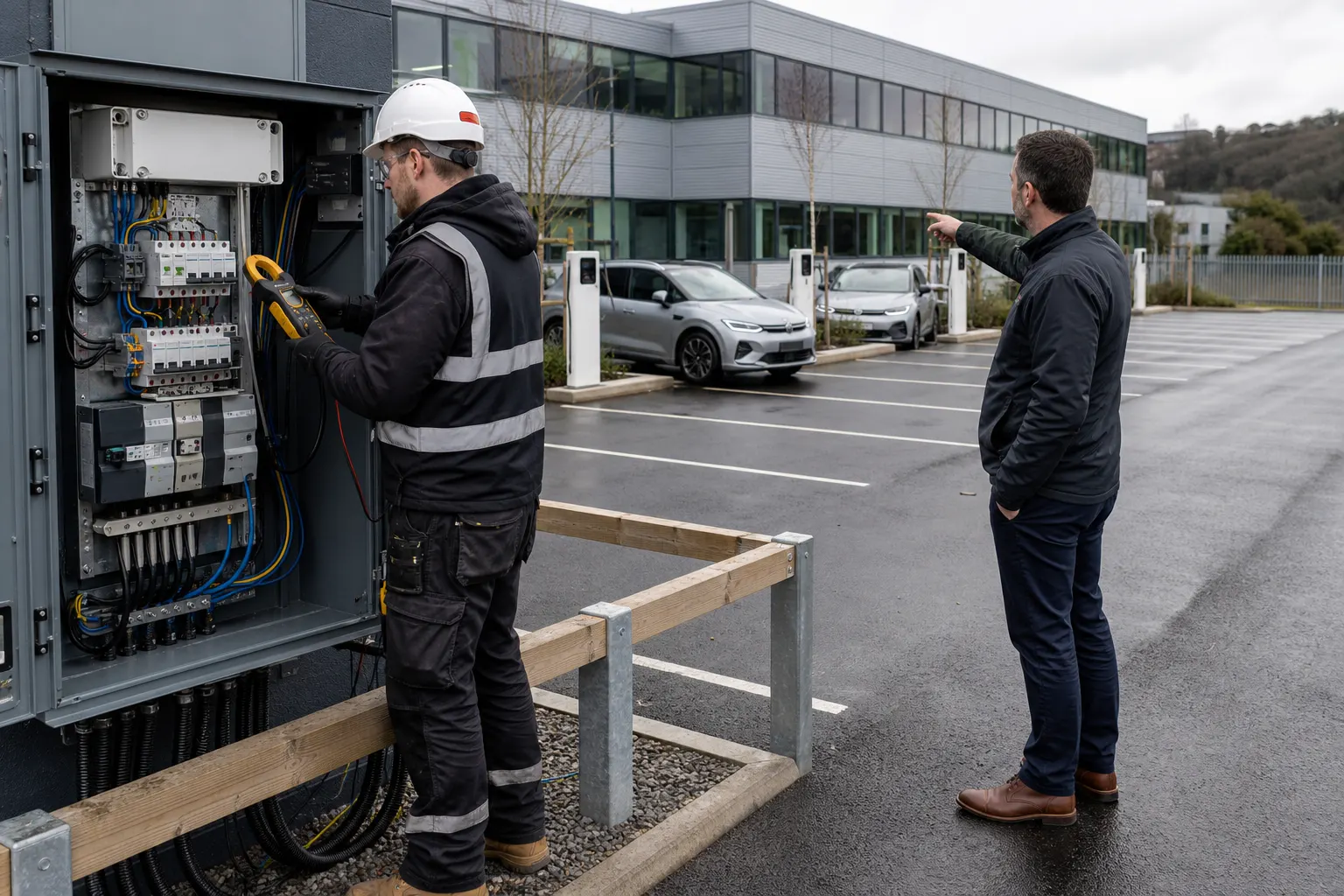
The right number of chargers is not necessarily the largest number that can be connected or the smallest number that keeps initial costs down. It is the number that can deliver the required vehicle energy reliably, fit the site’s operating pattern and allow sensible future development.
Maenporth Electrical Ltd supports businesses and larger sites in Falmouth, Penryn and across Cornwall with practical EV charging and associated electrical planning. To discuss the capacity, layout and operating requirements of your site, call 01326 250297.