
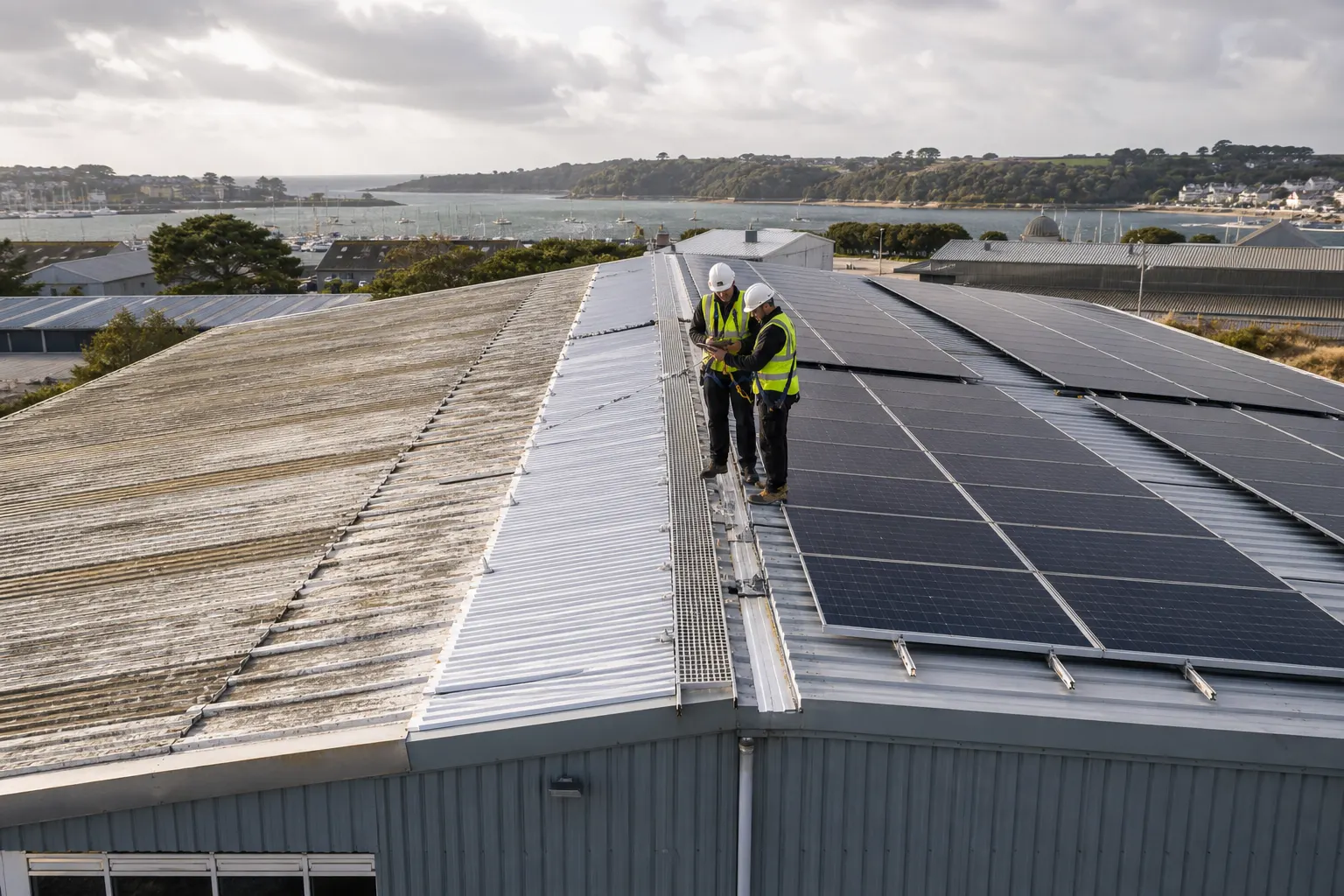
Installing solar panels on a commercial roof is not simply a question of finding enough unshaded space. The roof may need to support the array and its mounting system for many years while remaining weather-tight, accessible and maintainable.
For owners and operators of factories, holiday parks, leisure venues, rural buildings and commercial premises around Falmouth, that raises an important question: should the roof be repaired or replaced before the solar project begins?
There is no universal answer. A sound roof with a suitable remaining service life may need no more than targeted preparation. An ageing, leaking or altered roof may justify repair, strengthening or replacement first. The aim is to establish the correct sequence before the array is designed and priced.
The short answer is to plan solar around the roof’s remaining life
Available roof area is only the starting point. The decision should consider the condition and expected life of the roof covering, the supporting structure, safe access, warranties, fire considerations and how maintenance will be carried out after installation.
If substantial roof work is likely within the foreseeable life of the solar installation, proceeding immediately could create avoidable disruption. Modules, mounting equipment and cables may later need to be removed so that contractors can reach the covering beneath them.
That does not mean every older roof must be replaced. It means roof condition and future maintenance should be considered alongside the proposed commercial solar PV system, rather than treated as a separate problem after installation.
Start with leaks, corrosion and previous roof alterations
A commercial solar roof survey should establish what is already known about the building. Useful information may include its approximate age, roof specifications, repair records, leak history and details of previous alterations.
Visible defects such as corrosion, damaged sheets, degraded coverings or persistent water ingress warrant attention, but a visual check alone may not reveal the complete condition. Previous penetrations, replacement rooflights, added plant and undocumented alterations can also affect how a new array should be approached.
Persistent leaks should not simply be concealed beneath panels. The underlying cause and repair strategy need to be understood so that the solar installation does not obstruct remedial work or create uncertainty over responsibility for future water ingress.
Structure and wind loading require more than a panel-weight estimate
A simple calculation based on module weight cannot determine whether a roof is suitable. The assessment needs to consider the particular structure, mounting arrangement and relevant loading factors. Wind exposure, roof geometry, local condition and the way loads are transferred into the building can all be material.
Cornwall Council states that rooftop solar requires building-regulations consideration, including assessment of whether the existing roof can carry the panels, with strengthening potentially required. Its guidance on solar panels and planning permission in Cornwall also highlights circumstances in which planning constraints need attention.
The current MCS solar PV standard requires MCS contractors to have the roof structure checked by a suitably competent person. It says a qualified structural engineer should be consulted where a roof is unusual or there is doubt, including cases involving visible distress or post-construction alterations. These are MCS requirements rather than a substitute for project-specific professional judgement.
Fragile rooflights and asbestos must shape the safe approach
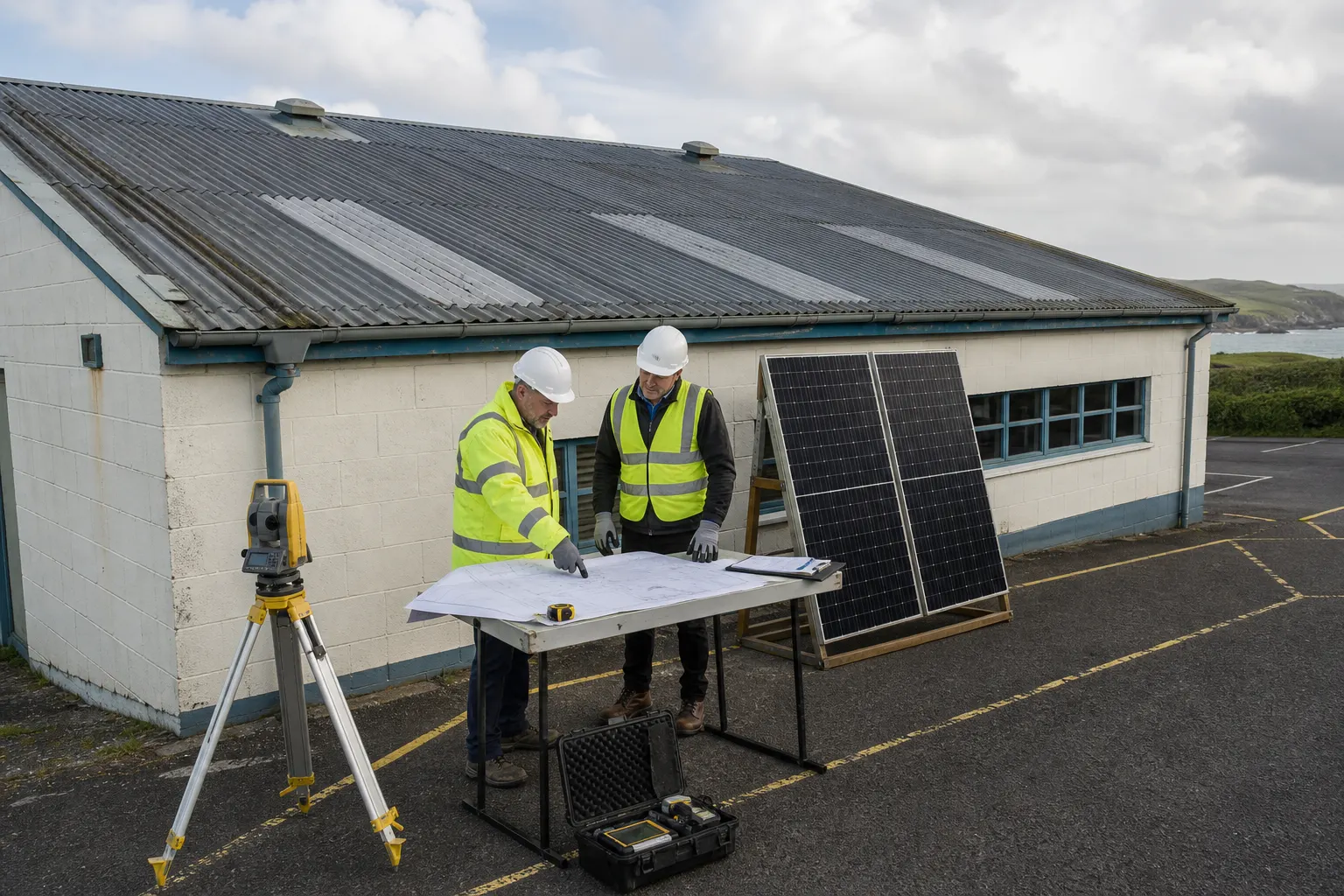
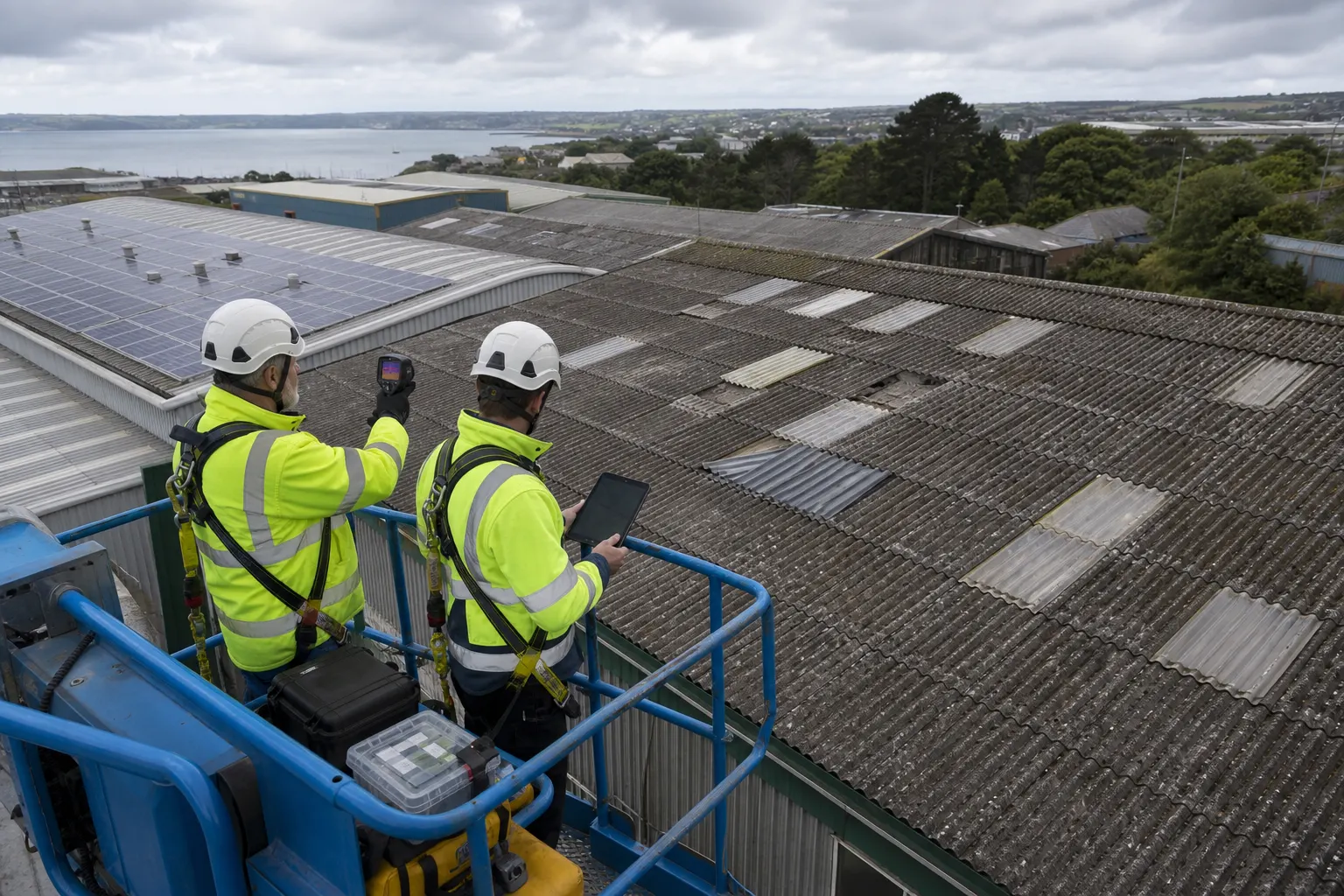
Older commercial, industrial and rural roofs may contain fragile sheets or rooflights. HSE guidance identifies falls through fragile materials, including rooflights and asbestos cement sheets, as a major roof-work hazard. No one should assume that a sheeted roof or rooflight can safely bear a person’s weight.
Before survey or installation work begins, the project needs a suitable access and safety plan. This may influence array spacing, access routes and the practical area available for modules.
Asbestos-containing materials cannot be identified reliably from a photograph or the roof’s age. At non-domestic premises, the responsible dutyholder must manage the asbestos risk and provide relevant information to those who may disturb the material. Existing asbestos records should therefore be reviewed before intrusive surveying, drilling or fixing work is planned. Where the available information is insufficient, competent asbestos survey input may be required.
Roof warranties and weather tightness need early attention
If the roof has an active warranty, the provider’s requirements should be checked before the design is fixed. Mounting methods, penetrations or work by an unapproved party could affect warranty terms.
The current MCS standard says MCS contractors should ensure that PV work does not adversely affect structural integrity or weather tightness and should check an existing roof warranty with its provider. Even where MCS does not govern a particular project, those are sensible coordination questions for the building owner, roofing contractor and solar designer.
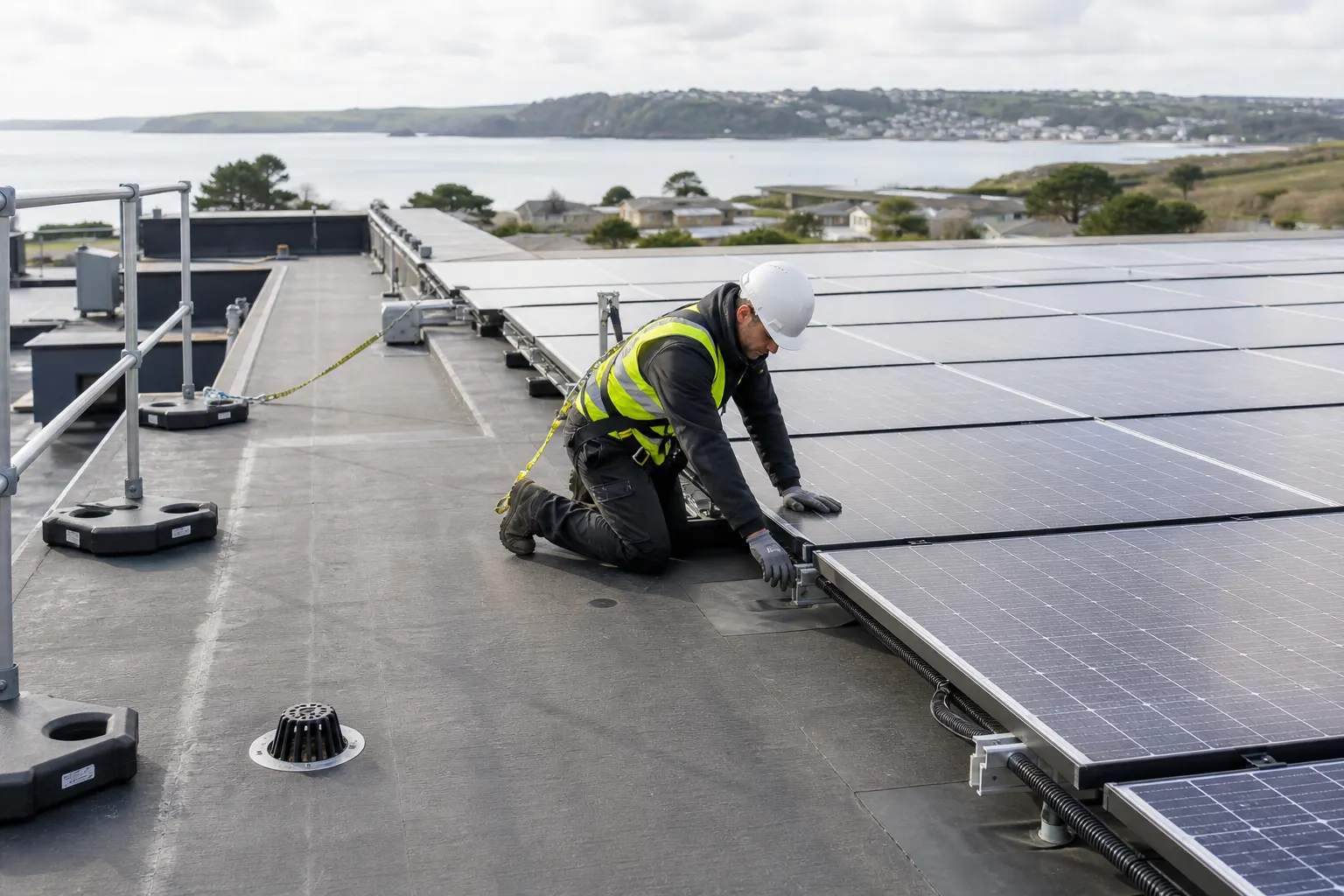
Future access also matters. Leaving practical routes to gutters, outlets, roof plant and likely repair areas can reduce the risk that routine roof maintenance becomes unnecessarily complicated.
Fire, cable routes and access are part of the roof design
The modules are only one part of a roof-mounted system. Cable routes, connectors, isolating equipment and penetrations through the building fabric need to be coordinated with the roof construction and the site’s electrical arrangements.
The design should consider fire performance, emergency access and how equipment can be inspected safely. It should also avoid placing modules or cables where they obstruct drainage, roof-mounted plant or maintenance routes. These decisions are easier to make before array capacity has been treated as fixed.
A sound roof alone does not make a viable solar project
Repairing or replacing a roof does not automatically establish that solar is technically or commercially suitable. The proposed generation should still be assessed against the site’s electricity use, operating pattern, available electrical capacity and distribution arrangements.
A factory with steady daytime demand presents a different load profile from a seasonal visitor site or a building with limited daytime occupation. Array orientation, shading, inverter selection and any proposed battery storage need to be considered as one system.
This electrical assessment helps prevent the roof layout from being developed in isolation from the equipment and site demand it is intended to serve.
Grid connection and inverter rating should be checked early
Roof capacity is not the same as grid connection capacity. National Grid Electricity Distribution identifies G98 as the simplified notification route for fully type-tested generation or storage below 16A per phase. Installations above that threshold, or outside the G98 criteria, may need to follow G99 procedures.
For solar PV, the relevant generation figure for this purpose is the inverter’s continuous steady-state AC rating, not simply the total panel capacity expressed in kWp. Export constraints and the applicable connection process should therefore be investigated before the final array and inverter specification is committed. A particular DNO outcome should not be assumed in advance.
When repair, re-roofing or another location may be better
The correct sequence depends on evidence from the site. Possible outcomes include:
- Proceeding with solar: where the roof condition, structure, access and remaining life are suitable.
- Completing targeted repairs first: where local defects can be resolved without wider roof replacement.
- Strengthening the structure: where competent assessment identifies a need and a practical solution.
- Combining re-roofing and solar: where the covering is nearing replacement and coordinated work would avoid removing the array later.
- Reducing or rearranging the array: where rooflights, plant, access routes or weaker areas limit usable space.
- Considering another location: where the existing roof is unsuitable and another roof, carport or ground-mounted option can be properly assessed.
Where an array proceeds, planned inspections and solar maintenance services should be considered from the design stage. Safe access and sensible equipment placement support both electrical maintenance and the upkeep of the roof beneath and around the system.
What to assemble before requesting a Falmouth roof assessment
Providing accurate site information can make an initial commercial solar assessment more productive. Where available, assemble:
- roof drawings, specifications and approximate installation dates;
- records of leaks, repairs, coatings and structural alterations;
- roof and product warranty information;
- the asbestos register and relevant management information;
- details of rooflights, drainage, plant and existing access arrangements;
- recent electricity consumption data and normal operating hours;
- information about the site supply, main distribution and existing generation;
- planning, lease or landlord constraints already known to the organisation.
Do not walk on, drill into, clean or alter a potentially fragile roof to gather this information. Existing documents and observations from safe locations are the appropriate starting point; specialist inspections should be planned and carried out by competent people.
Plan the roof and solar installation as one project
The strongest approach is to settle the roof sequence before committing to a final solar layout. That means understanding condition, structure, fragile materials, warranties and future maintenance before matching the available area to site demand and connection requirements.
Maenporth Electrical supports commercial, industrial and larger rural sites in Falmouth, Penryn and across Cornwall. To discuss the electrical and solar considerations for an existing commercial roof, call 01326 250297.