
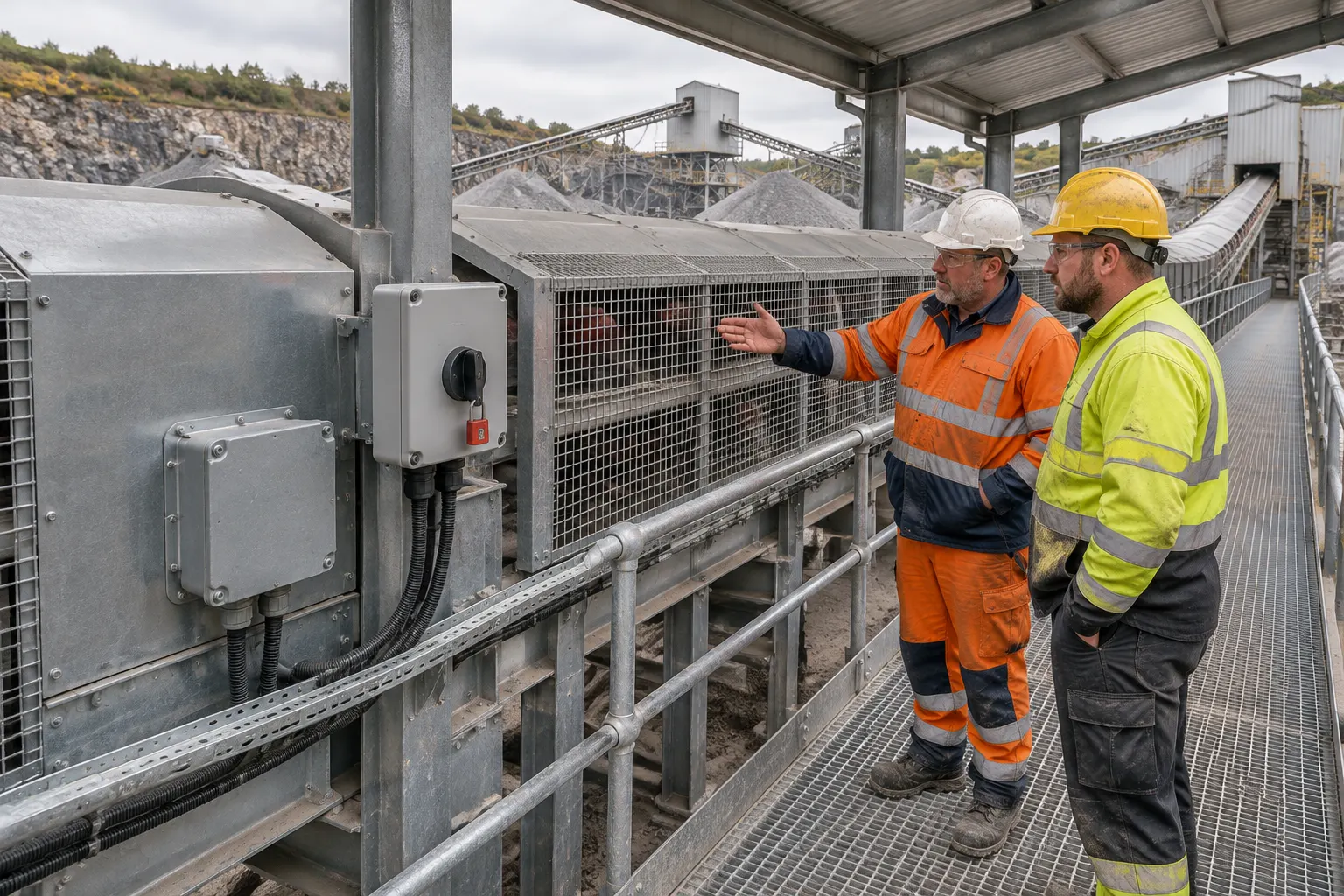
A stopped belt can look ready for repair while the maintenance boundary remains unclear. A separate feed, linked plant or stored energy may still put someone in danger.
Planning conveyor isolation for maintenance means agreeing which equipment and energy sources the job involves, who controls the isolation and who can authorise restart. For quarry and factory managers, those decisions belong before the shutdown.
This is a planning guide, not an isolation procedure. Work must follow the site-specific risk assessment, manufacturer’s instructions and authorised procedure, using competent, authorised people.
Is the conveyor stopped or isolated for maintenance?
A pull-cord, emergency stop or open interlocked guard may stop movement, but stopping is not secure isolation. HSE’s work-equipment guidance states that emergency-stop controls and interlocked guards are not suitable means of isolation.
PUWER Regulation 19 requires suitable means to isolate work equipment from all energy sources where appropriate. Those means must be clearly identifiable and readily accessible, and reconnection must not expose people to risk. Regulation 12 of the Electricity at Work Regulations defines electrical isolation as secure disconnection and separation from every source of electrical energy.
The regulations do not prescribe one identical lockout method for every machine; the suitable arrangement depends on the equipment and work.
Define the quarry conveyor isolation boundary
The work boundary should describe the actual task and equipment capable of affecting it. It is not automatically the whole quarry, nor necessarily one motor.
Before booking the work, ask the site-authorised person and contractor to settle:
- The exact asset, work area and extent of any guard removal or access.
- Which connected feeders, screens or downstream conveyors could create danger at that location.
- Relevant electrical feeds and any remote or automatic control functions that need assessment.
- Where isolation points are, whether their identification matches the plant, and who resolves discrepancies.
Discuss any missing labels or difficulty reaching the intended isolation points at the planning meeting, rather than leaving access problems for the maintenance crew.
For example, cleaning a transfer point may involve a different boundary from work on the drive alone. The site assessment must decide; convenience must not set it.
Record any equipment that will remain available to production and how its operation is kept from affecting the maintenance area. Simply agreeing a line shutdown is too vague if the two parties mean different sections.
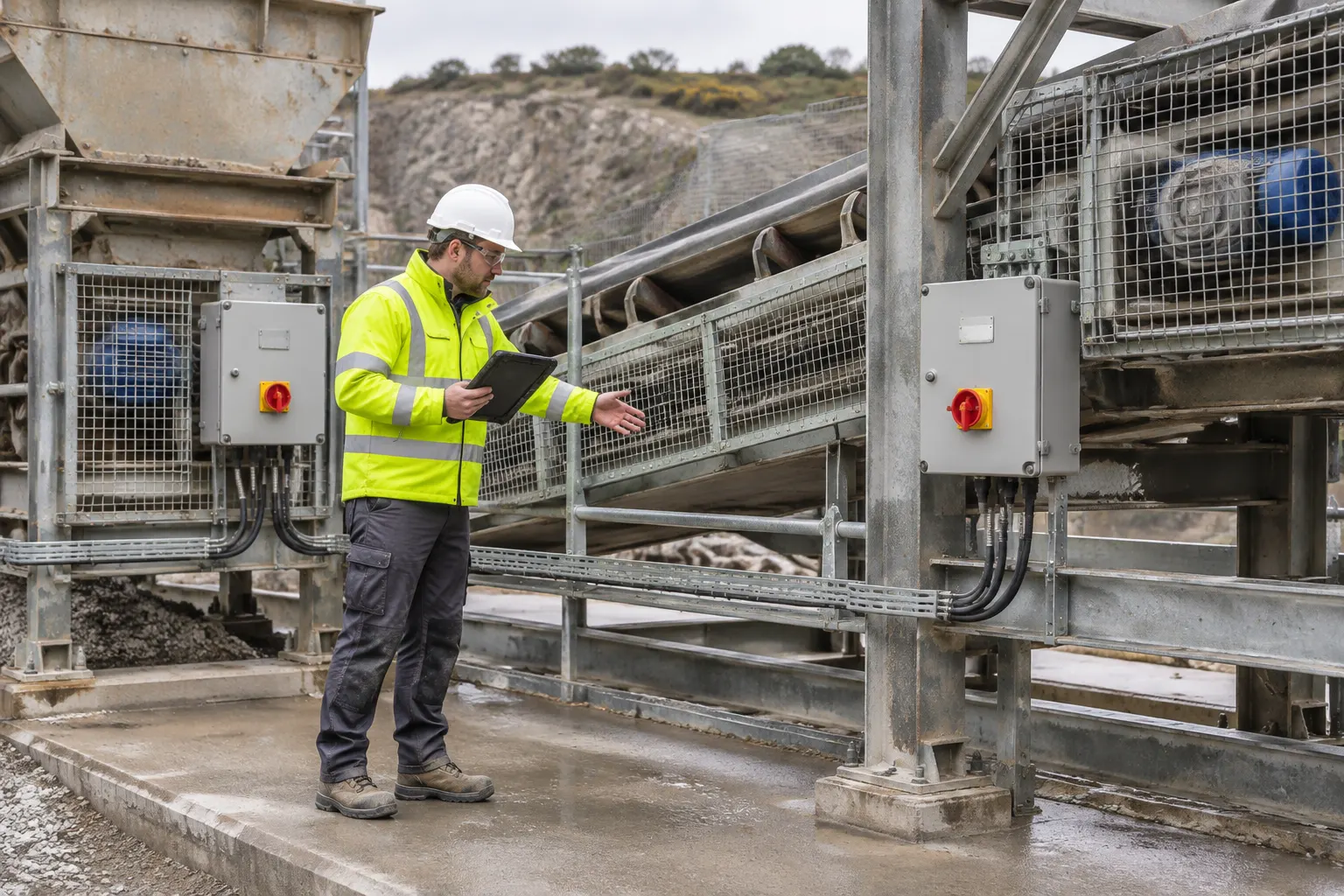
Why a locked control panel may not cover every relevant feed
HSE’s quarry guarding guidance describes a conveyor that started because its feed bypassed the control panel believed to be locked off. The lesson is about scope: a locked panel does not establish that every relevant supply has been isolated.
Where drawings, labels or modifications leave doubt, competent people need to establish the actual plant and machinery electrical supplies before the job is authorised. Do not assume an old drawing includes later alterations.
Labels on industrial machinery isolation points should be checked against the plant, the asset names operators use and the information issued to contractors. Unexplained discrepancies need resolving before work is authorised.
Consider stored and non-electrical energy where it applies
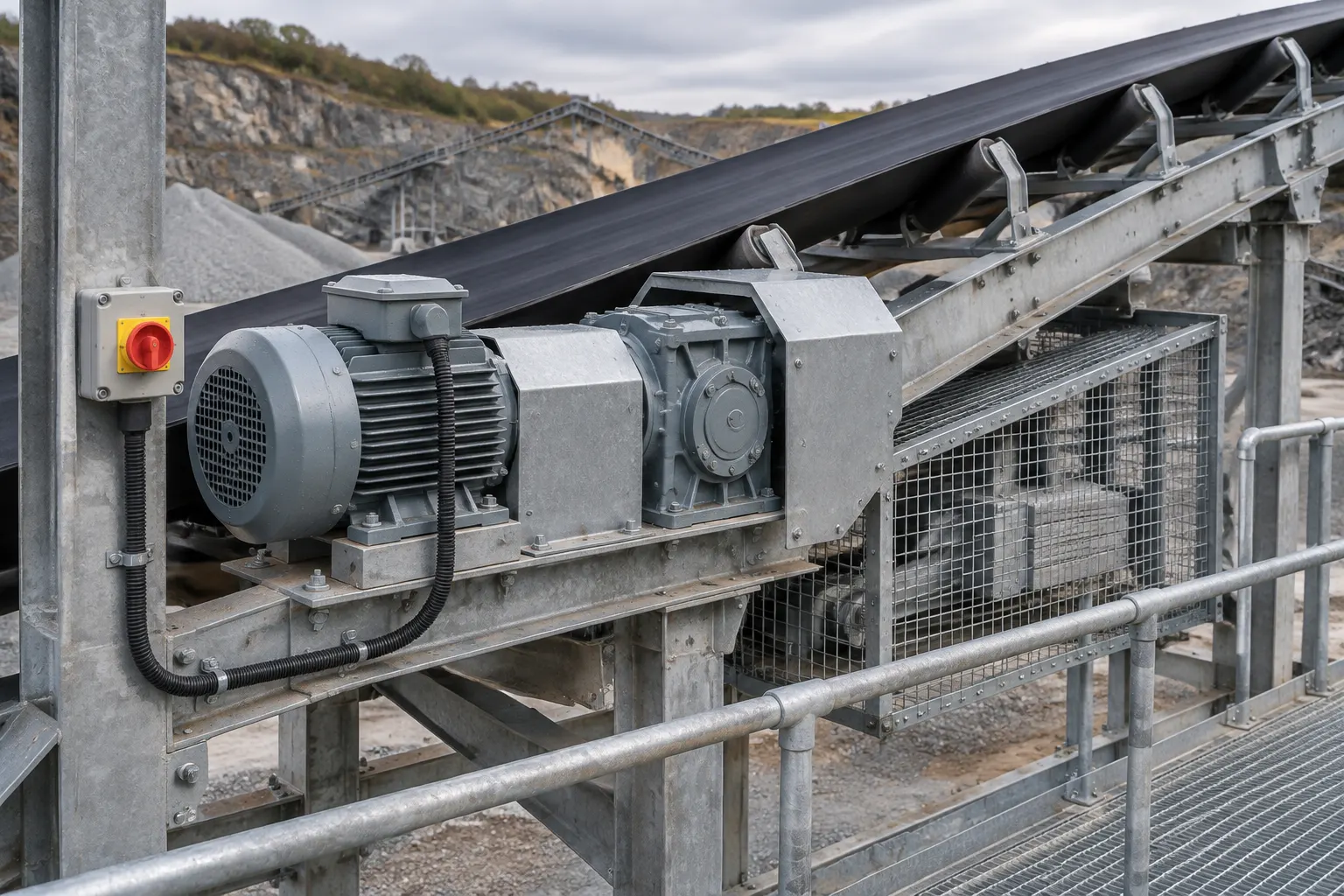
Safe isolation of conveyor systems is not solely an electrical question. Depending on the plant and task, the assessment may need to address belt tension, gravity, material that could move or fall, hydraulic or pneumatic energy, and belt rollback.
The Mineral Products Association’s energy-isolation guidance notes the potential for conveyors without a backstop to roll back. That is not a description of every installation; the relevant hazards must be assessed for this equipment.
Electrical isolation alone cannot remove mechanical or gravitational hazards. Their controls belong in the maintenance plan, with suitable competent input.
Clarify isolation ownership and contractor briefing
Contractor coordination for conveyor maintenance needs more than an induction and a key. Agree who is authorised to define and control the isolation, who is responsible for electrical work, and who manages any mechanical or other energy hazards.
Where several people or employers are involved, arrangements must protect everyone affected. HSE guidance addresses personal locks and multiple-worker isolation; the site procedure must cover how each person is accounted for, including at shift changes.
Ask how the arrangements cover an electrical contractor working alongside fitters, cleaners or a belt specialist. The briefing must make the limits of the authorised work clear, not just name the conveyor.
A useful pre-job record identifies the agreed work boundary, any exclusions and unresolved questions with a named person responsible for each. Attendance at a briefing should not be mistaken for agreement about technical limits.
Confirm how permit-to-work arrangements apply, who briefs operators and other contractors, and how changes to the task are authorised. A permit records the agreed controls; it does not itself isolate equipment.
Plan verification, reinstatement and restart authority
Agree the required verification and its responsibilities before work starts. It must follow the equipment-specific procedure and address the relevant hazards, rather than relying on a stopped belt or control-room indication.
The plan should also identify who accepts the completed work, how people and tools are accounted for, how guards and other safety measures are restored, and who authorises return to service. Keep the maintenance handover distinct from permission to restart.
Set out who communicates with the control room or operators and how ongoing work elsewhere on the line will be taken into account. A completed electrical repair is not, by itself, permission to restart linked plant.
If the scope changes or another feed is discovered, the work and isolation arrangements need reassessment before proceeding.
When a site-specific electrical review is worthwhile
An electrical review is worth arranging before the shutdown if relevant supplies cannot be confidently identified, isolation points are poorly labelled, drawings conflict with the installation, or previous modifications are uncertain.
Ask for a defined scope: the equipment and feeds being examined, any limits on the review, the record to be provided and who will address findings. Resolve uncertainty before fixing the maintenance scope and shutdown duration.
Useful material to provide includes the task description, asset identifiers, available drawings, known alterations and the proposed outage window. This helps separate the scope of the investigation from the repair itself.
If an investigation is needed, allow for that separately from the repair. Confirm whether updated labels or drawings are included, rather than assuming every finding will be corrected during the same visit.
An electrical review is only part of the picture. It does not replace the machinery risk assessment, non-electrical controls or the site’s authorisation arrangements.

Common questions about conveyor maintenance isolation
Does a pull-cord count as isolation?
No. It is a protective stop, not a substitute for secure energy isolation or fixed guarding.
Is locking the control-panel door enough?
A locked door does not establish isolation. Relevant energy sources and suitable isolation means must be identified, secured and verified under the authorised procedure.
Can a contractor rely on the site’s isolation?
The site and contractor must agree how isolation is established and verified, whose work it protects and who controls restart. Do not leave those decisions until the job starts.
To discuss the electrical scope of a conveyor shutdown, call Maenporth Electrical Ltd on 01326 250297. Based at Maenporth, we provide quarry electrical services for sites in Falmouth, Penryn and wider Cornwall.