
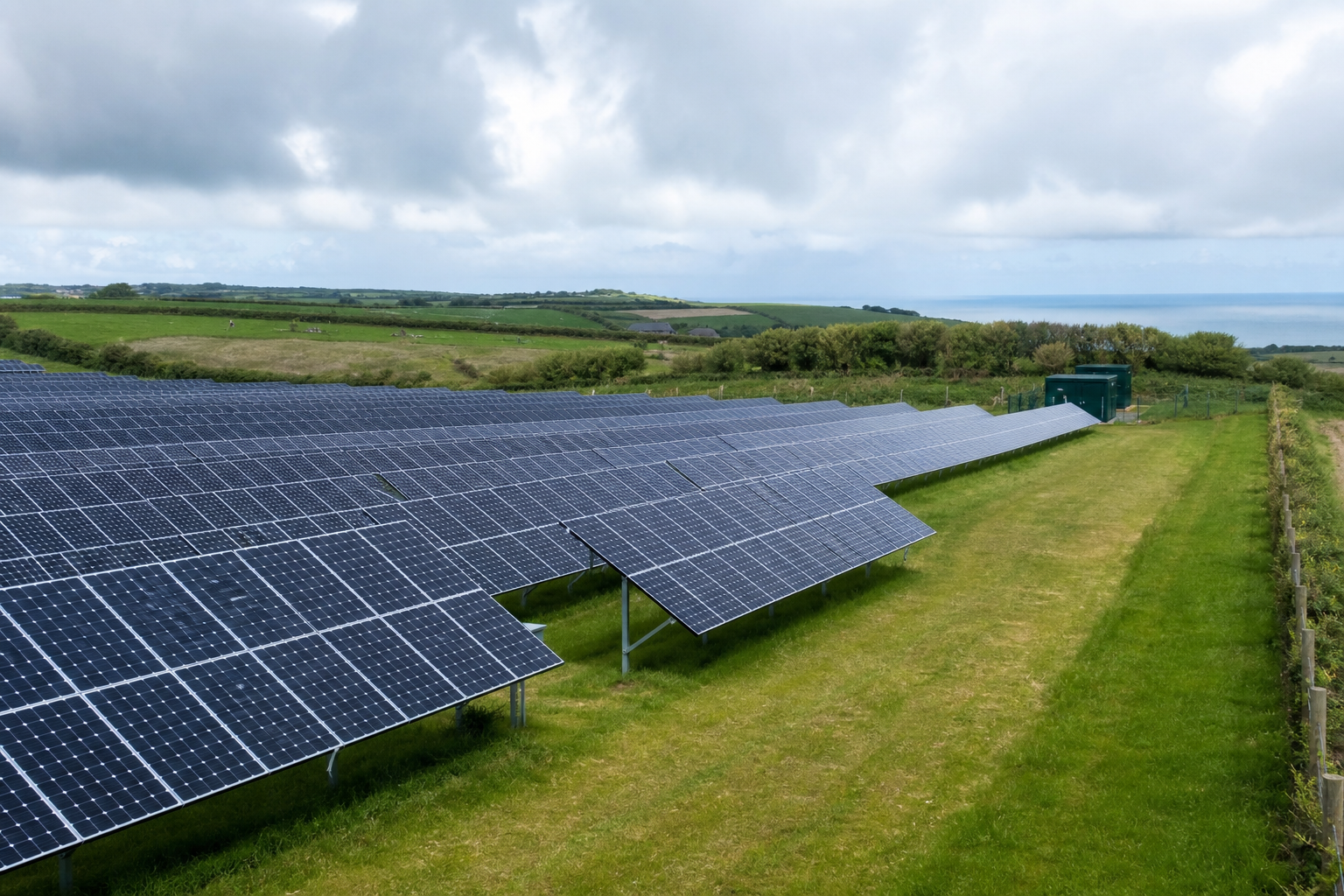
When a business has enough suitable land, ground mount solar can look like the obvious alternative to putting panels on a roof. One of its frequently cited advantages is easier maintenance: the modules are closer to ground level, technicians do not usually need to cross a roof, and key components can potentially be positioned where they are readily accessible.
That advantage is real, but it needs qualifying. Ground mounting can make access simpler while creating a different maintenance workload involving grass, weeds, drainage, mud, animals, security and longer cable routes. A badly arranged ground array may be awkward to service even though none of its panels is on a building.
The practical answer is therefore that ground mount solar can be better for maintenance, provided long-term access is treated as a design requirement rather than something to resolve after installation.
Why ground-level access can make solar maintenance easier
Maintenance on a rooftop system may involve work at height, controlled roof access and precautions around fragile surfaces. HSE guidance says roof work must be organised and planned so that it can be completed safely, with roofs treated as fragile until a competent person confirms otherwise. Work-at-height risks must also be assessed and suitable equipment selected.
A ground-mounted array can reduce or remove many of those access complications. Subject to the mounting height, terrain and layout, technicians may be able to inspect module faces, frames, visible cabling and connectors from ground level. Replacing a module or investigating physical damage may also be less disruptive than arranging access to a busy commercial roof.
This can be particularly useful where a roof is difficult to reach or where access would affect normal site operations. On a factory, holiday park, quarry, golf facility or larger rural property, avoiding repeated roof access can simplify the planning of inspections and reactive visits.
However, ground level does not automatically mean unrestricted access. Steep land, narrow row spacing, waterlogged areas and poorly located fencing can all make a site difficult to work on.
Maintenance access should shape the array layout
The space between panel rows is not simply unused land. It may need to accommodate inspections, vegetation control, cleaning equipment and the safe movement of technicians carrying tools or replacement components.
For major solar infrastructure, current government policy expects access routes for operation and maintenance to be considered as part of the site design. It notes that on-site footpaths, tracks, earthworks or landscaping may be required and that applications should identify the full extent of the necessary access. Although individual commercial projects can be much smaller, the underlying design principle remains useful: decide how the equipment will be reached throughout its service life.
Questions to settle before fixing the layout
Can technicians reach both ends of every row without climbing over equipment?
Is there enough working room around inverters, isolators and distribution equipment?
Can a damaged module be removed and carried out safely?
Will gates, fences or livestock controls delay access during a fault?
Can maintenance vehicles reach the relevant equipment without crossing soft ground?
Are underground cable routes recorded and protected from later excavation?
Will hedges or new planting eventually obstruct access or shade the array?
Can drainage features be inspected and maintained without disturbing electrical infrastructure?
These details may appear minor on a drawing, but they have a direct effect on the time, equipment and planning needed for future work.
The trade-off: vegetation becomes part of the system
A roof does not need mowing. A field does.
Vegetation beneath and between ground-mounted panels must be managed so that technicians retain access and plants do not interfere with equipment. The appropriate approach depends on the land, ecological objectives, array height and continuing use of the site. Options may include mowing, controlled grazing or a planned habitat-management regime.
Clearance around cables, connectors and equipment enclosures is especially important. Strimmers and mowing machinery can damage inadequately protected equipment, while unmanaged growth can make visual inspection more difficult. Ground works must also account for buried services.
The design should consequently bring together the electrical layout and the land-management plan. Row spacing, mounting height, cable protection and the position of equipment should reflect how the vegetation will actually be controlled, not an assumption that the land will somehow remain accessible.
Land beneath arrays can support vegetation, but shading, rain shadow, mounting structures and restricted access can affect what can realistically be established and maintained. This is one reason habitat and maintenance proposals need to be specific to the site.
Wet ground can cancel out the access advantage
A technician may not need a scaffold or roof-access system for ground mount solar, but they still need a safe route across the site. Drainage and ground conditions are therefore maintenance issues as well as planning and civil-engineering considerations.
Persistent mud can restrict vehicle access, increase the risk of slips and allow maintenance activity to damage the ground. Concentrated runoff or repeated vehicle movements may also create rutting around panel rows and access routes. Current national policy describes water management as a critical part of ground mount solar design.
On rural sites in Cornwall, the design should be based on what access will be like during poor weather, not only on how the field looks during a dry survey. Existing ditches, changes in level, field gateways and areas prone to standing water all deserve attention.
A practical design may require defined access routes, suitable surfacing around frequently visited equipment and enough clearance to inspect drainage features. The objective is not to turn the entire site into hardstanding, but to ensure that foreseeable maintenance can take place without unnecessary ground damage or delay.
Electrical maintenance still requires a planned regime
Solar PV should not be treated as fit-and-forget equipment. Ground mounting improves visibility and physical access, but it does not remove the need to assess performance, inspect components and investigate faults.
Depending on the installation and manufacturer requirements, planned solar maintenance may consider:
system monitoring and unexplained changes in generation;
visible module damage, contamination or shading;
mounting structures, fixings and signs of movement or corrosion;
accessible DC cabling, connectors and mechanical protection;
isolators, inverters and associated distribution equipment;
warning labels, site information and emergency arrangements;
vegetation, drainage, fencing and safe access routes;
electrical inspection and testing where appropriate.
The HSE states that electrical equipment must be maintained to prevent danger and that the type and frequency of checks, inspections and testing should reflect the equipment, its environment and previous findings. Its guidance also identifies inspection and, where necessary, testing as essential parts of preventive maintenance.
The MCS solar PV installation standard includes an advisory maintenance schedule and notes that system size can influence an appropriate frequency. The IET's solar PV guidance likewise covers operation, monitoring and maintenance over an installation's lifetime. A maintenance plan should therefore be tailored to the actual array rather than based on an arbitrary assumption that every system needs identical visits.
Component positioning matters as much as panel access
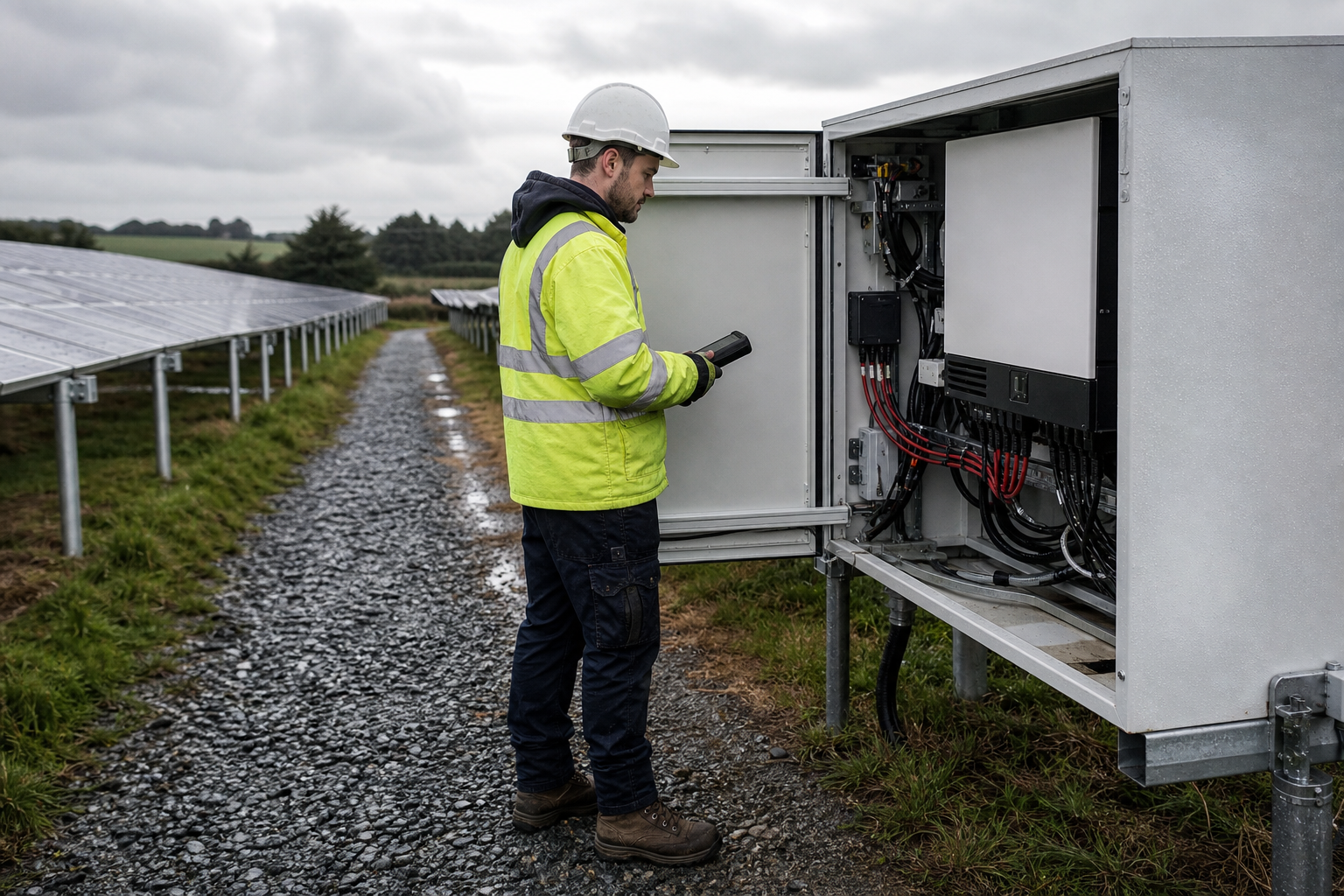
Easy access to the modules is only part of the picture. Inverters, switchgear, isolators, meters and communications equipment may require more regular attention than the panel surfaces themselves.
If those components are positioned in a cramped enclosure, behind stored materials or at the far end of an unreliable track, the system will not be especially maintenance-friendly. Equipment also needs appropriate protection for the conditions in which it is installed, while allowing safe inspection and operation.
For commercial solar, designers should consider how a fault visit would work during normal business activity. Technicians may need access without entering an active production area, crossing a visitor route or interrupting operations unnecessarily. Clear labelling and accurate system information also make future investigation more efficient.
Ground mounting is not automatically the best overall choice
Maintenance is important, but it is only one factor in deciding between roof and ground mount solar.
A usable roof may avoid taking up land and could place generation close to the building's electrical demand. Ground mounting requires suitable space and may introduce planning, landscape, agricultural, ecological and drainage considerations. Cornwall Council advises that standalone solar equipment is subject to specific permitted-development limits and restrictions, meaning larger or more sensitive proposals may require planning input.
The right comparison is not simply "roof versus field". It is between realistic designs for the particular premises, including the available electrical connection, energy-use profile, roof condition, land constraints, cable route and future operational plans.
The practical verdict
Ground mount solar is often easier to access, but not always easier to maintain as a complete site. It can avoid much of the complexity associated with roof work and give technicians more direct access to modules and supporting equipment. In return, the owner takes on vegetation control, ground access, drainage and site-management requirements that rooftop systems may not have.
The best results come from designing for maintenance at the outset: usable row spacing, protected cable routes, sensibly positioned electrical equipment and an honest plan for looking after the land.
Maenporth Electrical Ltd provides solar and renewable electrical services for commercial, industrial and larger rural sites in Cornwall. To discuss ground mount solar and the practical electrical requirements for your premises, call 01326 250297.