

When machinery trips without an obvious fault, controls reset unexpectedly or lighting flickers as equipment starts, it is tempting to blame the affected device. Sometimes that diagnosis is correct. In other cases, the equipment is reacting to a wider electrical power quality problem elsewhere on the site.
This distinction matters in factories, quarries, holiday parks, leisure facilities and larger rural premises. Replacing a drive, contactor or protective device will not provide a lasting solution if voltage dips, phase imbalance or harmonic distortion are the underlying cause.
Proper investigation starts by looking at the electrical installation as a connected system. Targeted commercial electrical testing, event records and temporary power quality monitoring can help establish what is happening, when it occurs and which loads are involved.
What does electrical power quality mean?
Power quality describes how closely the electrical supply delivered to equipment behaves as expected. It covers more than whether electricity is present or absent. Voltage level, waveform, frequency and the balance between phases can all affect how plant and electronic controls operate.
A site can therefore have a continuous supply but still experience disturbances that interrupt production or create repeated equipment faults. Some events last long enough to be noticed by people. Others happen in fractions of a second but are sufficient to drop out a contactor, reset a programmable controller or trigger a variable speed drive fault.
The cause may be within the premises, on the incoming supply or a combination of the two. Evidence is needed before responsibility or a remedy can be identified.
Common signs of a power quality problem
No single symptom proves that poor power quality is responsible. The same fault code or trip can have several possible causes. However, certain patterns justify a broader investigation, particularly when different items of equipment are affected at approximately the same time.
- Contactors, relays or motor controls dropping out during large load starts.
- Programmable controllers, computers or electronic tills resetting unexpectedly.
- Variable speed drives recording overvoltage, undervoltage or supply-related alarms.
- Lighting dimming or flickering when pumps, compressors or extraction equipment operate.
- Repeated protective-device operation without a clear downstream equipment fault.
- UPS systems transferring to battery more frequently than expected.
- Uneven loading or heating across a three-phase distribution system.
- Faults that appear during particular shifts, occupancy periods or operating sequences.
The timing is often as valuable as the symptom. If a problem appears when refrigeration equipment cycles, a borehole pump starts or several EV chargers increase output, that operating pattern gives the investigation a useful starting point.

The disturbances that may be behind the symptoms
Voltage dips and short interruptions
A voltage dip is a temporary reduction in supply voltage. It may originate upstream, but it can also be created within a site when a large motor or transformer is energised. Long cable runs, high starting currents and heavily loaded distribution equipment can make the effect more noticeable at the point where sensitive controls are connected.
A multimeter reading taken after the event will rarely explain a brief dip. The disturbance may be over by the time anyone reaches the distribution board, which is why time-based monitoring is often required.
Harmonic distortion
Modern premises contain many non-linear electrical loads. Variable speed drives, switched-mode power supplies, UPS equipment, LED drivers, EV charging equipment and power electronic inverters can all influence the current waveform.
Harmonics do not automatically mean that equipment is defective. Their significance depends on their level, where they originate and how the installation is designed. In some circumstances they can contribute to additional heating, neutral conductor loading, control problems or resonance involving power factor correction equipment.
The correct response is not to install a filter automatically. Measurements should first identify the type and source of distortion, after which equipment manufacturers’ requirements and the wider system design can be considered.
Three-phase voltage or current imbalance
Three-phase systems work best when loading is appropriately distributed. A growing site may gradually become unbalanced as single-phase buildings, catering equipment, pitches, offices or workshop circuits are added at different times.
Current imbalance does not necessarily mean that the incoming voltage is unbalanced, but it can expose weaknesses in internal distribution and leave one phase with less available capacity. Motors and other three-phase equipment may also be sensitive to voltage imbalance, making accurate measurement important.
Transients and switching events
Rapid changes caused by switching inductive loads, contactors, capacitors or other equipment can produce short-duration disturbances. Their origin can be difficult to locate because ordinary logging intervals may miss them. The monitoring equipment and setup must be suitable for the event being investigated.
Why a fault should be monitored in context
A power quality analyser can record parameters such as voltage, current, dips, swells, interruptions, harmonics, imbalance, demand and power factor. Collecting figures is only part of the process, however. The readings need to be connected to what the site was doing at the time.
A useful investigation may include:
- Reviewing fault codes, alarm histories and staff observations.
- Checking distribution equipment, connections, circuit condition and protective devices.
- Identifying large, sensitive or electronically controlled loads.
- Installing monitoring equipment at carefully selected points.
- Recording operating times for machinery, chargers, pumps and generation equipment.
- Comparing measurements upstream and downstream where appropriate.
- Using the evidence to separate equipment faults from installation or supply issues.
Monitoring should cover a representative operating period. A quiet midweek test may not reveal a problem that only appears during a production run, a weekend changeover or a period of high seasonal occupancy.

Possible remedies depend on the evidence
There is no universal power quality product that fixes every site. Once the cause has been established, the appropriate work might be relatively focused or form part of a larger distribution upgrade.
Potential measures include repairing poor connections, redistributing single-phase loads, changing motor starting arrangements, reviewing equipment settings, modifying operating sequences or providing dedicated supplies for sensitive controls. Other sites may require cable or transformer changes, manufacturer-specified reactors or filters, protection coordination work, selected UPS support or discussion with the distribution network operator.
Power factor correction also needs care. Capacitor equipment should not be added or altered without considering the existing harmonic environment and the actual site measurements.
The findings can be incorporated into a wider planned electrical maintenance programme. Keeping monitoring results, fault histories and previous test information together makes it easier to spot changes rather than treating every interruption as an isolated incident.
Power quality should be considered before a site expands
Monitoring is not only a response to faults. It can be useful before installing additional machinery, commercial EV charging, solar generation, battery storage, electric heating or larger refrigeration and pumping systems.
Existing demand data may show that the headline supply capacity is not the only issue. Phase loading, short-duration peaks, starting currents and the behaviour of existing power electronic equipment can influence how an expansion should be designed.
This is particularly relevant to Cornish sites that have developed in stages. A distribution system serving several buildings may include long cable routes and equipment from different periods, with seasonal loads that vary significantly through the year.
Power quality and electrical safety responsibilities
Power quality investigation does not replace fixed-installation inspection, fault protection checks or routine maintenance. These activities answer different questions and may need to be carried out together.
The HSE guidance on the Electricity at Work Regulations 1989 explains the duty to maintain electrical systems where necessary to prevent danger. It also identifies inspection and, where necessary, testing as an essential part of preventive maintenance. Electrical monitoring and any work inside distribution equipment should be planned and completed by competent people using appropriate procedures.
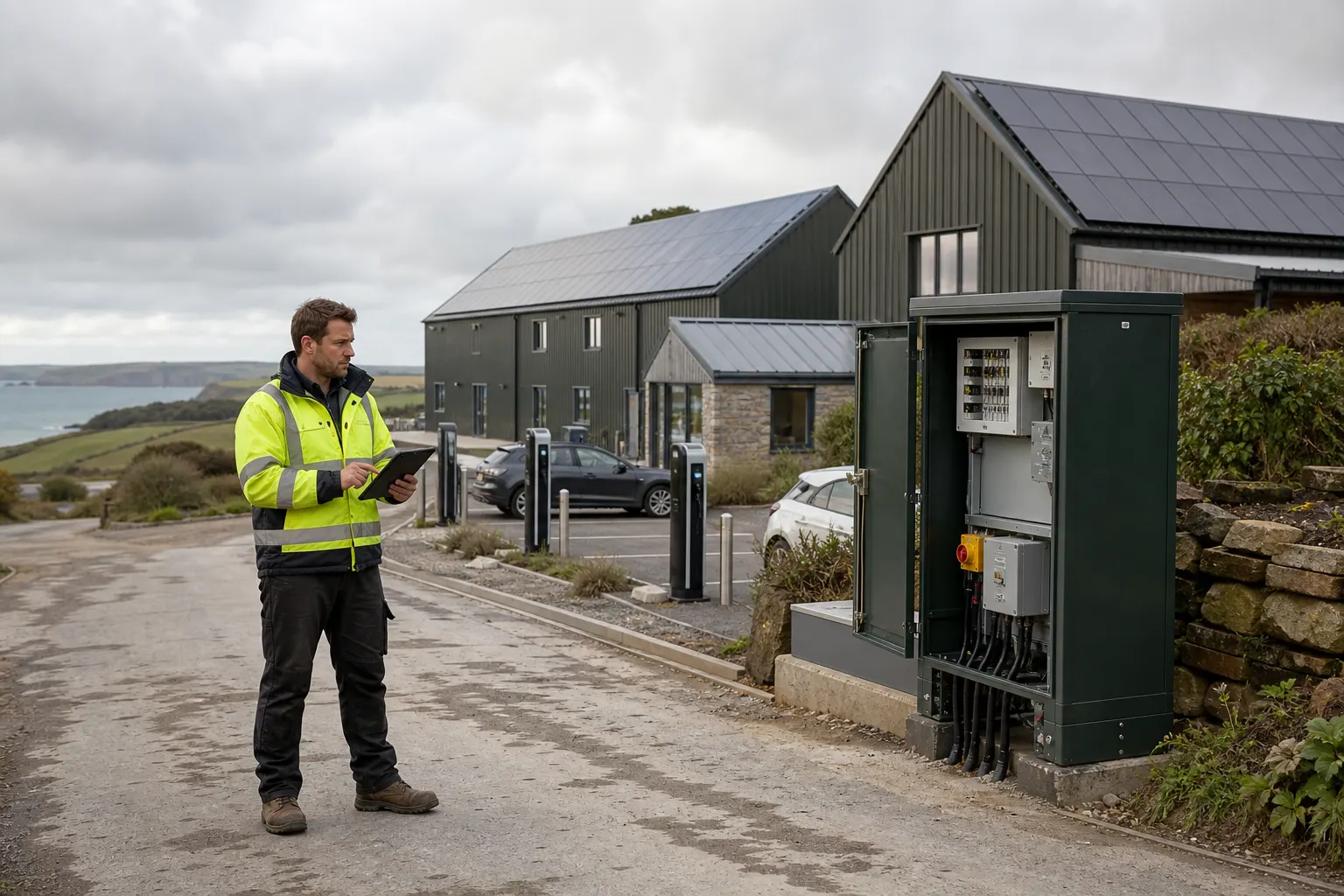
Turn unexplained faults into usable evidence
Repeated resets and nuisance trips should not be accepted as an unavoidable feature of a busy site. Nor should expensive components be replaced repeatedly without confirming why they are failing or shutting down.
Maenporth Electrical Ltd supports industrial, commercial and larger rural electrical sites across Cornwall. To discuss recurring electrical faults, site monitoring or maintenance planning in Falmouth, Penryn, Newquay, Carnon Downs or surrounding areas, call 01326 250297.