
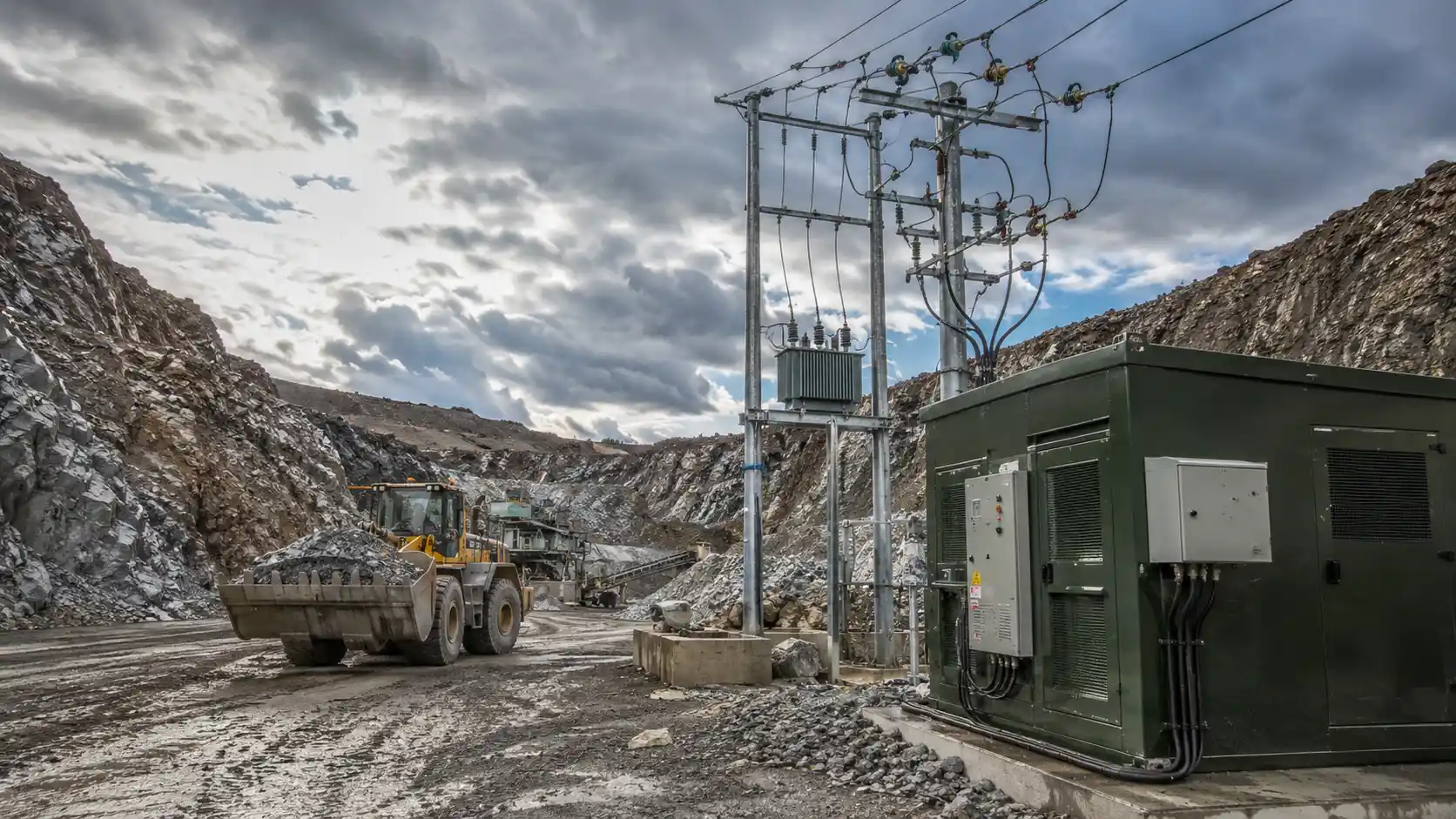
A quarry mains power upgrade is very different from adding a single new circuit. Heavy plant, motors, conveyors, crushers, pumps, workshops and processing equipment can place substantial and changing demands on the electrical system. The site may also need to remain operational while the work is carried out. That makes the project as much about planning and coordination as it is about cables and switchgear.
Understand the existing supply before designing the upgrade
The first stage is to establish what the site already has. Incoming supply arrangements, transformers where applicable, main switchgear, distribution routes, earthing, protective devices and existing maximum demand all influence what can be changed. Historical additions can make older industrial sites difficult to read, so a proper survey and accurate identification of circuits is important before new capacity is planned.
The new requirement also needs to be understood in operational terms. A motor has different characteristics from a steady resistive load. Several large items starting together can create a different demand profile from the same equipment operating at normal running current. Future plant additions matter too. A mains upgrade should ideally create useful headroom rather than solve today’s problem and immediately become the next bottleneck.
Plant loads are not all the same
Quarry equipment can include high-powered motors, variable-speed drives, control systems and machinery that starts and stops according to production. The design therefore needs to look at load characteristics as well as headline ratings. Cable sizing, protective devices, voltage drop, discrimination and equipment ratings must be considered in the context of the complete system.
- Confirm the existing incoming supply and main distribution arrangement.
- Review measured or recorded demand where useful information is available.
- Identify large motors, drives and other significant plant loads.
- Allow for likely future machinery or process changes.
- Check isolation, earthing, protection and maintenance access as part of the design.
Main switchgear has to be practical in a quarry environment
The environment influences equipment choice and layout. Dust, moisture, temperature, vibration and physical activity around plant can all affect electrical equipment. Switchgear and enclosures need to be suitable for their location, but maintainability is just as important. Engineers must be able to identify, isolate and work on equipment safely. Clear labelling and sensible separation of systems reduce confusion during maintenance or fault finding.
Where a new main panel or distribution section is introduced, its position should consider cable routes, access, future extensions and the practical process of getting equipment into place. A technically suitable board in an inaccessible location can create unnecessary problems for every later inspection, alteration or repair.
Cable routes and mechanical protection matter
Industrial cable routes may pass through exposed, dirty or mechanically demanding areas. Containment, supports and protection therefore need to match the environment. Routes should avoid creating obstacles for plant movement and should remain accessible enough for inspection where practical. Where long distances are involved, the design also has to manage voltage drop and the cost and practicality of larger conductors.
The changeover plan can be the hardest part
A quarry may not be able to lose power whenever it suits the electrical programme. Production, maintenance windows, safety systems and other services can dictate when isolation is possible. A mains upgrade therefore needs a clear changeover sequence. Some work can often be completed in advance, leaving only final connections and testing for the shutdown period. The more that can be prepared safely beforehand, the less pressure there is during the critical outage.
The sequence should identify what will be isolated, what must remain available, who is responsible for plant shutdown and when testing can begin. Where temporary arrangements are required, they need the same level of thought as the permanent installation. Rushing a temporary supply simply moves risk from one part of the programme to another.
Testing and commissioning are part of the programme
Commissioning should not be treated as the final few minutes after the last termination. New and altered circuits need appropriate inspection and testing, protective devices need to be correctly set or selected, phase rotation may matter for machinery, and control interfaces have to behave as expected. The site team also needs confidence that equipment can be returned to service in a controlled order.
- Pre-plan inspection and test requirements before the shutdown.
- Record protective-device information and relevant settings.
- Verify identification and phase relationships where plant is sensitive to rotation.
- Commission sections in an agreed sequence rather than energising everything at once.
- Update labels and handover information so future maintenance starts with accurate records.
Design for the next maintenance visit
One of the best tests of an industrial upgrade is whether it remains understandable after the installation team has left. Clear circuit identification, accessible isolation, logical board schedules and useful drawings or records make future work safer and quicker. On a quarry, where production pressures can make fault finding time-critical, that clarity has real operational value.
Maenporth Electrical approaches this kind of work as a complete site-power project: understand the existing installation, establish the demand, coordinate the upgrade, plan the outage, install robustly and commission carefully. The result should not only provide more capacity. It should leave the quarry with a distribution system that is easier to operate, maintain and expand as plant requirements change.
Future capacity should be deliberate
Industrial sites rarely stand still. A quarry may add a new conveyor, processing line, workshop load, pump or charging requirement after the main upgrade has been completed. It is not always economical to build for every possible future scenario, but it is useful to identify realistic growth and make sensible provision where the cost is modest during the main works. Spare ways, appropriate board capacity, planned cable routes and space around equipment can all make later expansion less disruptive.
That does not mean simply oversizing everything. The better approach is to understand which parts of the process are most likely to change and where future electrical demand may appear. Investment can then be focused on the infrastructure that is hardest to replace later, while keeping the installation proportionate to the site’s current needs.
Coordination with the quarry team
The people operating and maintaining the quarry hold information that drawings cannot show. They know which plant is critical, which shutdown windows are realistic, which access routes become busy and where faults have occurred in the past. Bringing that operational knowledge into the electrical planning can improve equipment positions, isolation strategy and the changeover sequence.
A mains power upgrade works best when the electrical contractor and site team treat the outage as a shared operation. Responsibilities are agreed, plant is shut down in a controlled order, testing is given enough time and re-energisation is staged. That collaborative approach reduces surprises and helps the upgraded system return to production with confidence.