
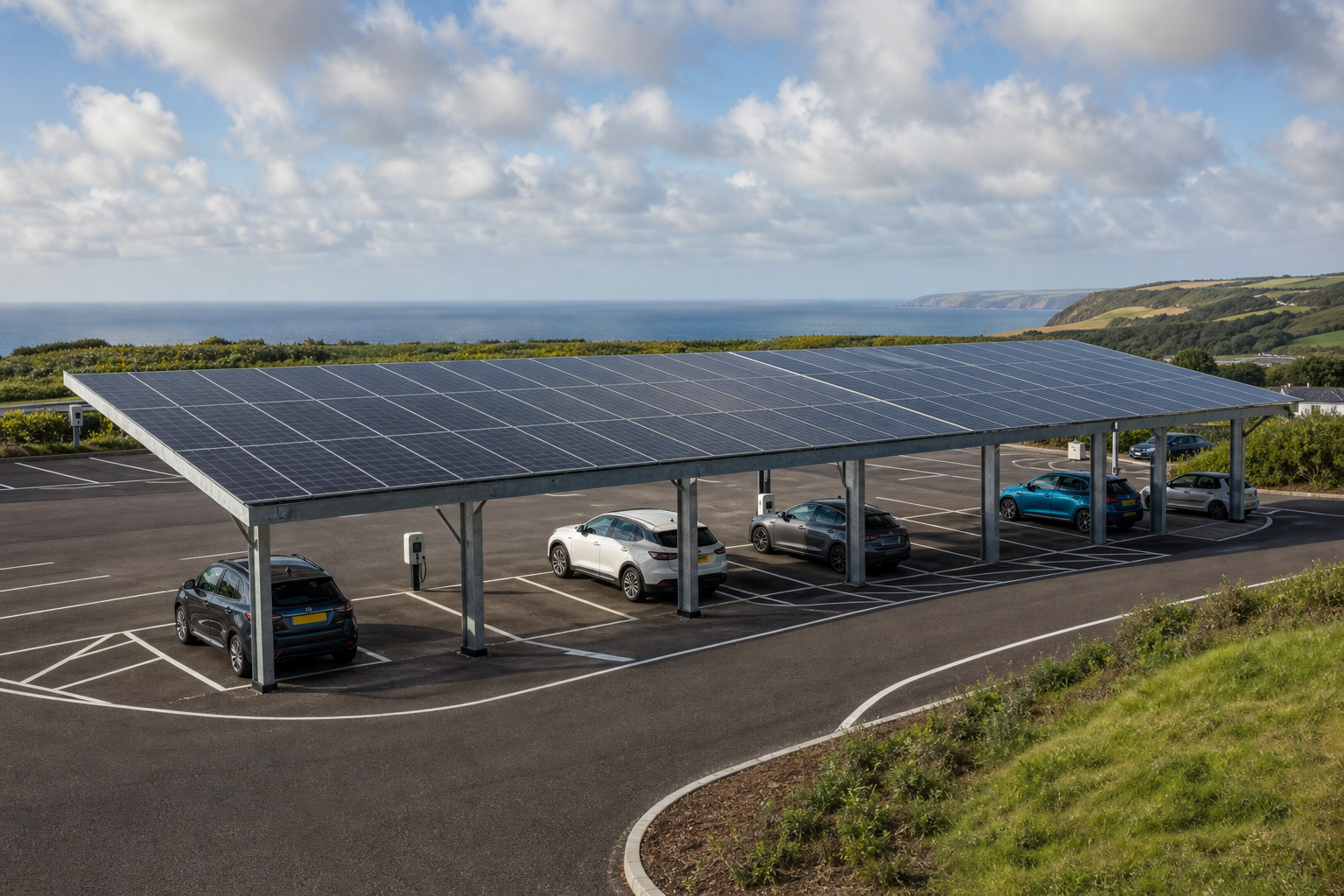
For many businesses considering solar in Cornwall, the roof is the obvious starting point. But it is not always the only option, or even the best one.
Holiday parks, golf clubs, leisure venues, factories and larger commercial premises often have substantial parking areas alongside daytime or seasonal electricity demand. A solar carport can turn that existing space into a generating asset while retaining its main purpose: parking vehicles.
The idea is straightforward, but a workable scheme requires more than placing photovoltaic panels over a row of spaces. The canopy structure, electrical infrastructure, drainage, vehicle movements, planning position and grid connection all need to work together.
Solar carports are particularly relevant following changes to permitted development rights for non-domestic parking areas in England. The government considered going further by requiring canopies on some new car parks, but confirmed in May 2026 that it would not pursue that proposal at this point. Solar carports therefore remain a site-led investment rather than a general national requirement.
What is a solar carport?
A solar carport is a canopy fitted with solar photovoltaic panels above an established parking area. The panels generate electricity in the same basic way as a roof-mounted solar array, but the supporting structure is designed around parking bays, vehicle clearances and movement through the site.
The electricity can be used within the premises, supplied to EV chargepoints, stored in a battery or exported where the connection and commercial arrangements allow. Most sites use a combination of these routes rather than relying on one alone.
A carport may be considered where roof space is limited by condition, orientation, shading, plant, vents or structural constraints. It can also form part of a wider system combining rooftop panels, canopies, battery storage and managed EV charging.
Why Cornwall’s seasonal sites may be well suited
One of the first questions in any solar assessment should be when the site consumes electricity. This is especially important for Cornwall’s visitor economy.
Holiday parks, campsites, golf facilities and leisure venues can experience higher demand during the brighter part of the year. Occupied accommodation, kitchens, laundries, pools, clubhouses, refrigeration and guest facilities may all contribute to a strong daytime or summer load.
That does not automatically make every site suitable. It does, however, create the potential for solar generation to coincide with real activity on the premises. Electricity used directly as it is generated can reduce imported power without depending entirely on export payments.
The same principle can apply to factories, workshops and commercial premises with steady daytime machinery, ventilation, cooling or process loads. The strongest design starts with the site’s actual consumption profile, not simply the maximum number of panels that can fit above the parking spaces.
Use evidence rather than an annual bill
An annual electricity total does not show whether power is being used at midday, overnight, during the working week or in a short peak season. Half-hourly consumption data, where available, gives a much clearer picture.
A feasibility review should consider:
- the site’s base electrical load throughout the day;
- weekday, weekend and seasonal variations;
- planned EV charging and likely vehicle dwell times;
- future electrical loads, equipment or building expansion;
- periods when the premises are closed or lightly occupied;
- existing rooftop solar or other generation; and
- how much surplus electricity may be exported or stored.
Combining a solar canopy with EV charging
Solar carports and EV charging are a natural visual pairing, but the electrical relationship needs careful design.
A charger beneath a canopy is not necessarily powered directly and exclusively by the panel above it. Generation, building demand, battery storage, grid imports and charging loads operate as one connected system. When solar output is lower than demand, the grid can provide the balance. When generation exceeds immediate demand, the surplus may be directed elsewhere or exported.
For a holiday park, the charging pattern may be concentrated around guest arrivals and overnight stays. At a golf club or visitor attraction, vehicles may remain parked for several daylight hours. A factory or office may have predictable employee and fleet parking. Each pattern points towards a different charger mix and control strategy.
Load management matters
Installing several chargepoints does not mean every unit must draw its maximum output simultaneously. Dynamic load management can allocate available capacity between chargers while protecting the agreed limit for the site.
Where solar, batteries and chargers are being combined, the control strategy should be planned at the outset. Separate systems added without an overall design can be harder to monitor and may not make the best use of available generation or connection capacity.
Planning permission and prior approval in Cornwall
Solar canopies over non-domestic, ground-level off-street parking can benefit from permitted development rights in England under Class OA of Part 14. However, permitted development does not mean that a business can proceed without checking the planning requirements.
The right is subject to limitations and a prior approval process covering matters including siting, design, external appearance and glare. Among the national conditions, a qualifying canopy cannot exceed four metres in height and cannot be within ten metres of the curtilage of a house or block of flats.
There are additional considerations for listed buildings, scheduled monuments and protected locations. Parts of Cornwall are subject to landscape, heritage and conservation constraints, so the specific site context matters. Drainage also needs attention, particularly where a canopy is constructed above a permeable parking surface.
Businesses should confirm the current position with Cornwall Council or an appropriate planning adviser before treating a proposal as permitted development. Leases, restrictive covenants and landlord consent may also affect what can be installed, even where the planning route appears straightforward.
The car park still has to work as a car park
A solar canopy must be designed around the operational site. A layout that looks efficient on a drawing can create problems if columns obstruct doors, delivery vehicles cannot turn, or maintenance access conflicts with busy visitor periods.
Practical considerations include:
- vehicle height and clearance requirements;
- accessible bays and pedestrian routes;
- impact protection around structural columns;
- delivery, refuse and emergency vehicle movements;
- existing drainage and surface water routes;
- underground services and foundation positions;
- lighting levels beneath the canopy;
- safe access for panel inspection and cleaning;
- exposure to wind and coastal conditions; and
- how construction will affect customers, guests or production.
Coastal and exposed rural sites also require appropriate consideration of corrosion, fixings and structural loading. These are design issues, not details to leave until installation has started.
Electrical capacity and the grid connection
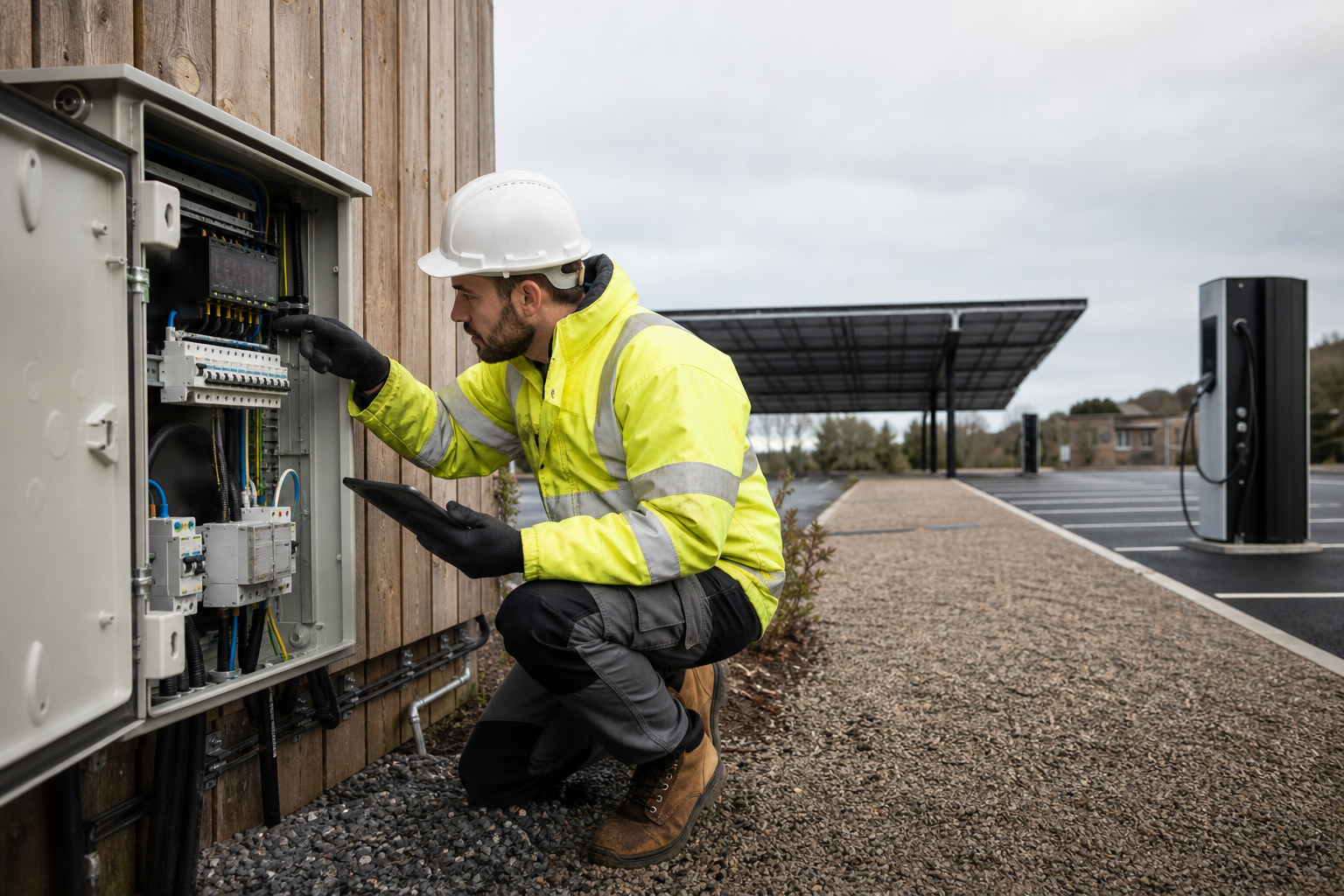
A solar carport connects into the site’s electrical installation, so the existing infrastructure needs to be assessed. The main switchgear, distribution equipment, cable routes, protection and metering may determine how easily the project can be integrated.
The local distribution network operator must also be involved through the appropriate generation connection process. Depending on the system, approval may be required before installation rather than notification afterwards.
If unrestricted export is not available without network reinforcement, an export limitation scheme may be an option. A compliant scheme monitors power at the connection point and controls generation or storage so that the agreed export capacity is not exceeded. This does not remove the need for network approval, and the equipment and commissioning process must meet the applicable requirements.
Early connection enquiries are valuable because they can influence array size, inverter selection, battery strategy and project timing. Designing the complete scheme before checking the network position risks expensive revisions later.
Does a solar carport need battery storage?
Not necessarily. A site with dependable daytime demand may be able to use a substantial proportion of its solar generation as it is produced.
A battery becomes more relevant where useful generation and electricity demand occur at different times. It may store daytime surplus for evening use, support managed EV charging or charge during an off-peak tariff period where the commercial arrangements make that worthwhile.
However, storage should not be added simply because it is available. Battery capacity, power rating, control settings, operating temperatures, installation position and replacement expectations all affect the case for investment. There are also conversion losses when electricity is stored and released, so direct consumption remains important.
The right question is not whether batteries are good or bad. It is whether storage solves a defined issue in the site’s energy profile.
What a useful feasibility assessment should establish
Before requesting final prices, a Cornwall business should aim to establish five things:
- How much usable space is available? This includes bay layouts, shading, boundaries, access routes and structural constraints.
- When is electricity consumed? The design should reflect interval data and expected future demand.
- Can the existing electrical installation accept the system? Switchgear, cable capacity, protection and metering need to be reviewed.
- What is the likely planning and grid connection route? Both can affect design, cost and programme.
- How will the installation operate over its life? Monitoring, maintenance access, cleaning, fault response and eventual equipment replacement should be considered.
This work helps distinguish an attractive concept from a technically deliverable project.
Planning solar around the whole site
A solar carport can be a practical option for Cornwall sites with significant parking, daytime demand or plans for commercial EV charging. Its value is not limited to producing electricity: it can make productive use of an existing hard-surfaced area and support a broader electrical strategy.
The best results come from treating generation, consumption, charging, storage and network capacity as one system. That requires an early understanding of how the premises operate now and how their electrical requirements may change.
Maenporth Electrical Ltd provides solar and renewable electrical services alongside industrial, commercial, testing, maintenance and EV charging work across Cornwall. To discuss the electrical requirements of a proposed solar carport or wider site energy project, call 01326 250297.