
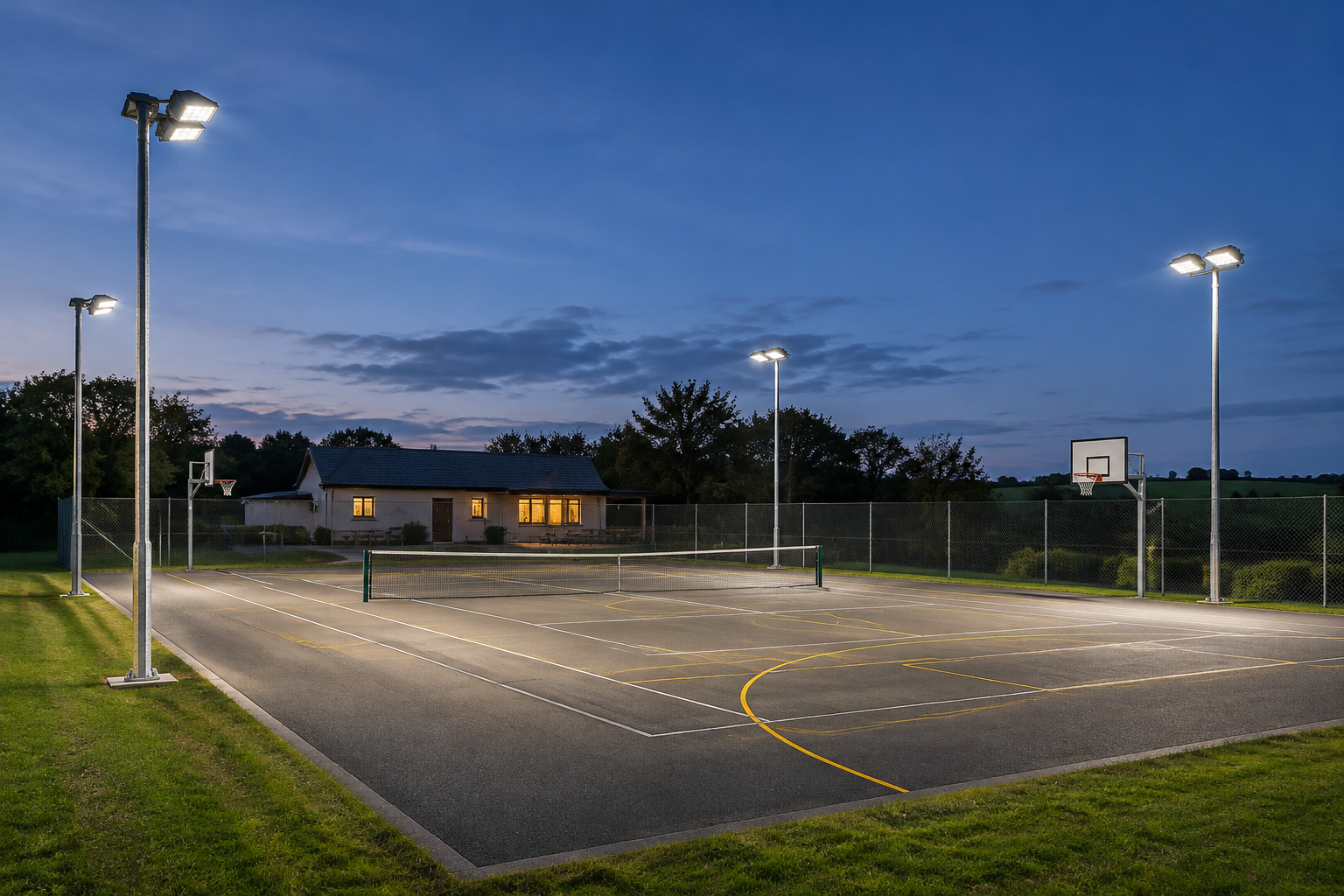
A sports floodlighting upgrade starts with the venue brief, not the floodlight catalogue. Before a club or leisure operator orders new fittings, establish what players need, what the existing installation can support and what constraints apply around the site.
Whether the proposal is replacement pitch lighting, a new court or an addition to a holiday park, agree the design and electrical scope first. That gives suppliers a common basis for quoting and helps avoid equipment choices that are difficult to justify, install or maintain.
Define how the venue will use the lighting
Start with the sport and level of play. Training, recreational bookings and competition can have different requirements; a multi-use space needs a brief covering its intended activities rather than an assumed ‘standard sports light’.
Give each designer and contractor the same short information pack:
- The sport or sports, relevant governing body and intended standard of play.
- Pitch or court layout, dimensions and any proposed changes.
- Playing seasons, evening bookings and latest intended finish times.
- Whether separate courts or training areas must operate independently.
- Existing drawings, lighting details, maintenance records and known faults.
- Neighbouring homes, roads, paths, boundaries and potentially sensitive habitats.
Include those who manage bookings and maintenance in that discussion. A design based on occasional training may not suit a venue expecting regular competitive fixtures or independently bookable courts.
Decide whether this is a complete replacement or a phased upgrade. If only part of the installation will change, ask how retained and new fittings will work together.
Nominate who will approve the brief and record any changes, especially where a landlord, club committee and site operator share decisions.
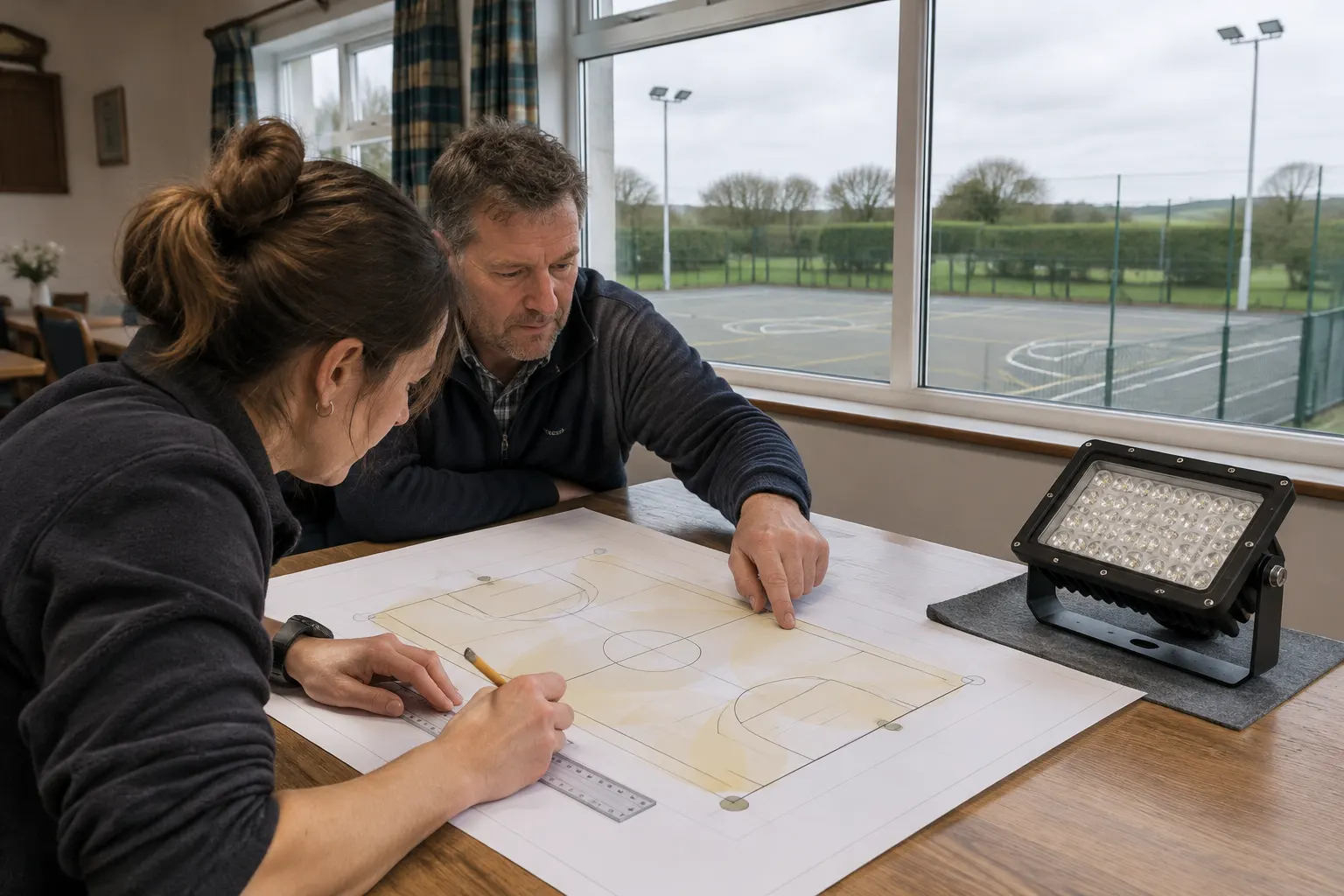
Agree performance criteria for sports floodlighting
Lighting quality is not defined by wattage or the number of LED sports floodlights. Useful sports court lighting design considers the full playing area, how evenly it is lit and how glare affects participants.
Use Sport England’s sports lighting guidance alongside the relevant governing body’s requirements to establish the brief. BS EN 12193 and CIBSE’s LG4 Sports lighting are relevant technical references. A competent lighting designer should confirm the applicable criteria for the sport and level of play, rather than using a generic lux table.
Ask for a design, not just a product list
Request a layout and lighting calculations showing the proposed mounting positions, aiming and performance across the area being assessed. Agree how performance will be checked after installation and how neighbouring properties and sensitive boundaries will be considered.
A sports pitch lighting scheme should not simply be copied onto a smaller court. Equally, padel court lighting needs a design reflecting that court’s use and surroundings. Compare quotations against the same agreed criteria, with exclusions made clear.
Ask what maintenance assumptions sit behind the predicted performance, including cleaning and replacement arrangements. The venue needs to understand the upkeep on which the design relies, not just how bright the installation looks when new.
Where the designer, equipment supplier and electrical installer are separate, agree who approves substitutions and resolves discrepancies on site. A late change of fitting or mounting position should go back through the design review.
Check planning and ecology before committing to equipment
Cornwall Council’s Validation Guide includes lighting-statement requirements for specified application contexts, including floodlighting in National Landscapes, the Bodmin Moor and West Penwith dark-sky areas or open countryside. That concerns application information, not a blanket answer about whether planning permission is needed.
Check current local requirements, existing approvals and any conditions on lighting or operating hours before committing to a layout. Do not assume that describing a replacement as ‘like for like’ settles those questions.
National planning guidance and Cornwall’s Design Guide emphasise limiting unnecessary light and considering neighbours, roads, dark landscapes and wildlife. Ask how the design controls spill beyond the playing area, rather than relying only on a claim that the fittings are efficient.
If proposed lighting is near habitats bats may use, such as hedgerows, trees or watercourses, seek advice from a suitably qualified ecologist early. Natural England notes that a survey may be needed; an absence of recorded bats is not proof that bats are absent.
If advice changes column positions or operating hours, revisit the lighting and electrical designs together before procurement.
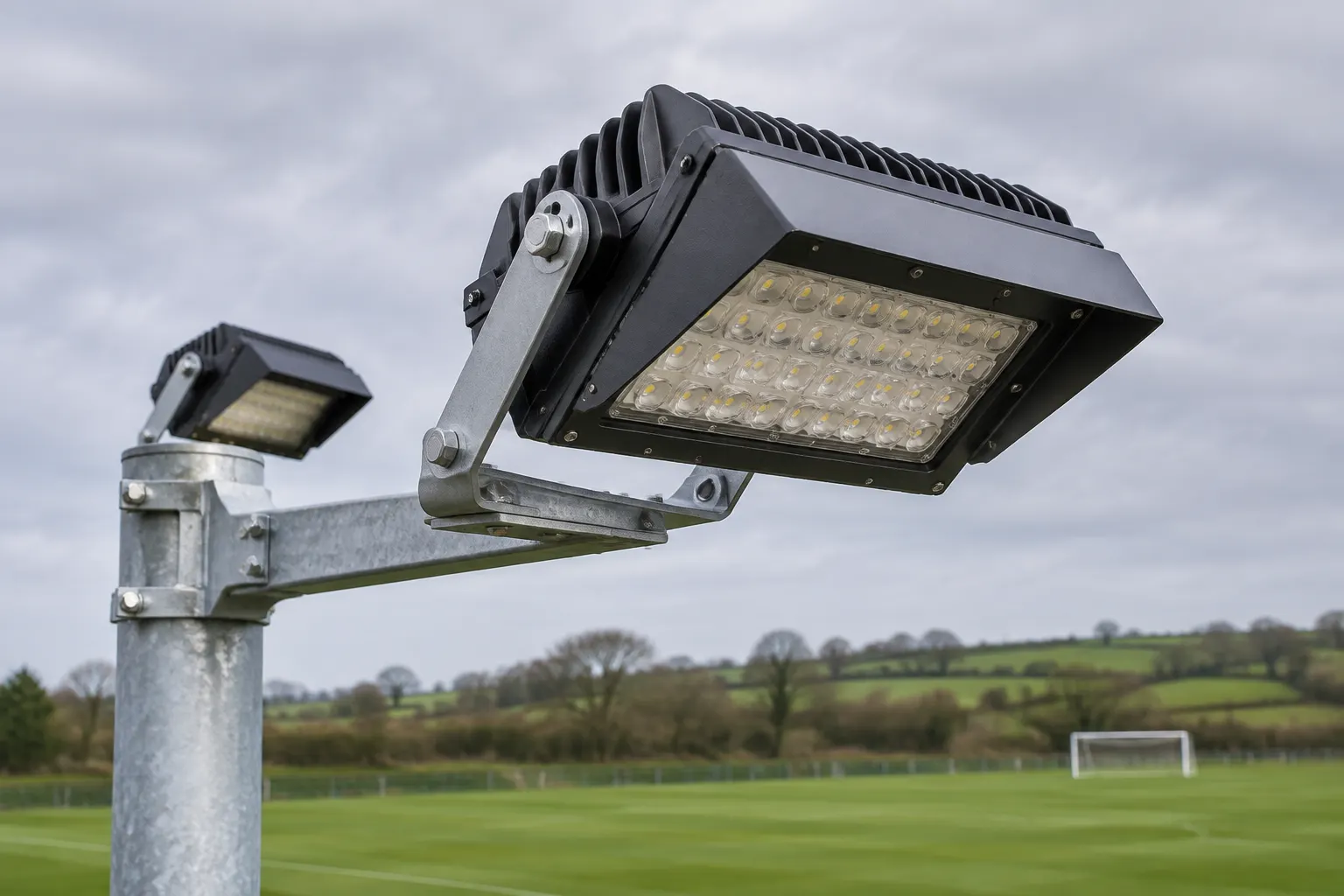
Review electrical infrastructure and mounting separately
Replacement fittings do not establish that the existing supply, circuits, cabling or controls are suitable. Ask the electrical contractor to assess their condition, capacity and compatibility with the proposed equipment, identifying remedial work before the quotation is finalised.
Columns and brackets need a separate suitability decision. New fittings may differ in weight and wind-loading characteristics; electrical testing does not establish structural adequacy. Have supports and foundations assessed by the appropriate professional, particularly where records are missing or corrosion is visible.
For exposed or coastal sites, confirm that equipment and fixings suit the environment. Define the commercial lighting installation scope alongside any specialist lighting design or structural assessment, so responsibilities are clear. Check whether cabling, groundworks, access equipment and reinstatement are included.
Where cable routes or underground service records are uncertain, allow for investigation and coordination with whoever manages the grounds. Do not assume a quotation for new fittings covers everything needed to connect them electrically.
Agree how work will fit around pitch use, guest access or other site activities. Confirm supply interruptions and safe access arrangements before fixing an installation date; equipment delivery is only one part of the programme.
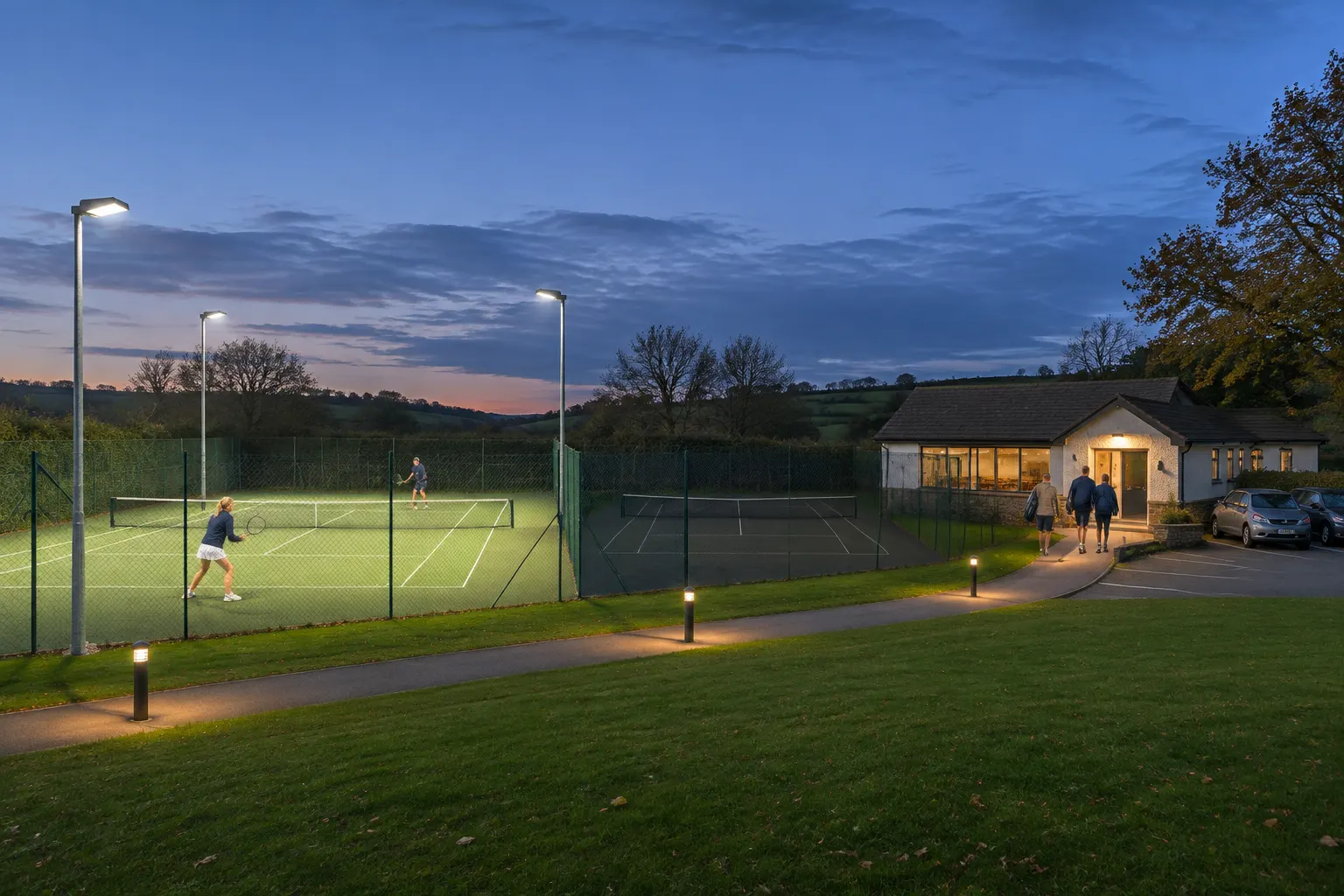
Plan operation, verification and maintenance together
Agree who can switch the system on, which areas can run separately and when it must turn off. Any reduced-output training mode should still meet the agreed criteria for that use, rather than being a percentage setting selected after installation.
Consider how users will reach paths, parking and exits after the playing lights switch off. Any separate access lighting needs its own assessment; leaving pitch lights on indefinitely is not a substitute for a clear closing-up plan.
Nominate who receives fault reports and who decides whether play should stop if part of the lighting fails. Controls and instructions should be understandable to the people running evening sessions, not only the installer.
Plan outdoor sports lighting maintenance around safe access, cleaning, inspection responsibilities and the booking calendar. Include planned electrical maintenance in the operating plan, with structural inspections allocated separately where needed.
Keep the handover useful to the operator
Before ordering, state the records expected at completion: design and as-installed information, commissioning and agreed performance-check results, electrical certification appropriate to the work, control settings, equipment details and maintenance instructions. Confirm who provides each item.
Arrange the handover demonstration for the people who manage bookings, not just the person who placed the order.
Keep those records with the venue’s operating information. If fittings are later replaced or re-aimed, review the effect on the agreed lighting design rather than treating the change as a routine product substitution.
Maenporth Electrical Ltd serves Falmouth, Penryn and wider Cornwall from Maenporth. Call 01326 250297 to discuss the electrical scope of your sports floodlighting project and the specialist input that may be needed alongside it.