
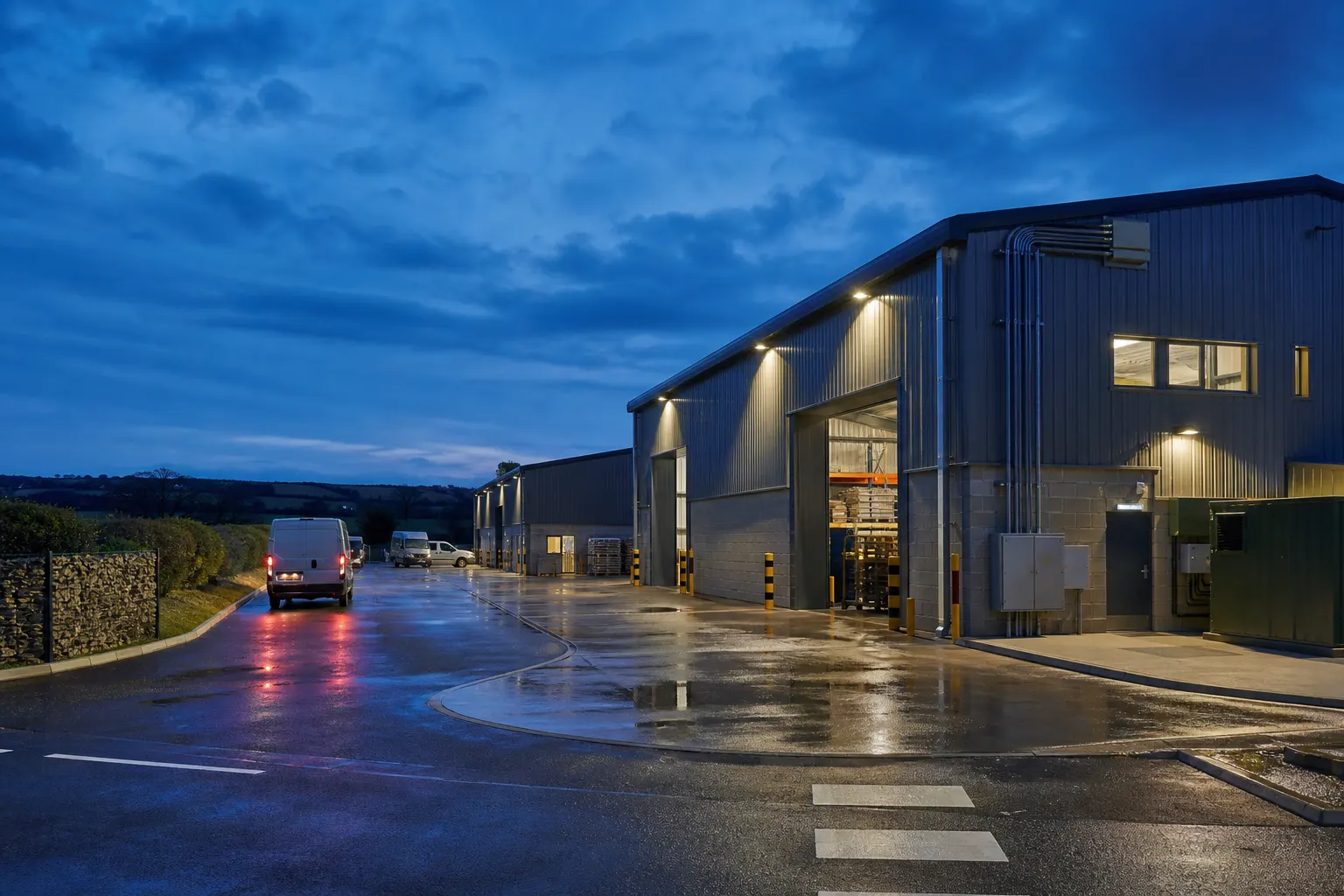
Outdoor lighting on a commercial or industrial site has several jobs to do. It may need to support vehicle movements, loading, pedestrian access, security, maintenance work and customer wayfinding, often across the same space.
The temptation is to solve every problem with more light. In practice, indiscriminate brightness can create glare, deep shadows, light spill and unnecessary energy use. On exposed and rural sites in Cornwall, the scheme may also need to account for nearby homes, dark landscapes, hedgerows and coastal conditions.
Good commercial outdoor lighting starts with the site and its activities, not with a catalogue of floodlights. It should form part of the wider approach to commercial electrical work, power distribution and ongoing maintenance.
Why brighter does not always mean safer
A powerful fitting can produce impressive output without putting useful light where people need it. If it faces drivers, reflects from wet surfaces or leaves machinery silhouetted against a bright background, visibility may become worse rather than better.
Contrast is as important as brightness. Someone walking from a brightly lit reception area into a dark car park needs time to adjust. A camera may also struggle when its view contains both an intense light source and poorly illuminated ground.
The objective should be controlled, reasonably even lighting across the relevant task area. That may require several carefully positioned fittings rather than one high-output floodlight trying to cover the whole site.
Survey the site after dark
A daytime plan will show buildings, roads and boundaries, but it will not reveal every lighting problem. An after-dark assessment can identify glare from existing fittings, shadowed corners, reflections and places where vegetation, parked vehicles or stored materials obstruct the light.
Map the tasks and movements
The first step is to identify what happens in each area and when. A quarry access road, factory loading bay, campsite path and golf club car park do not have identical requirements.
A useful survey should consider:
- vehicle entrances, junctions, reversing areas and loading points
- pedestrian routes, steps, ramps and changes in level
- plant, gates, compounds and equipment requiring inspection
- public entrances, reception points and accessible routes
- areas covered by CCTV or other security measures
- neighbouring properties, roads, hedgerows and watercourses
- seasonal changes to operating hours and site layout
Separate the site into operating states
Not every area needs full output throughout the night. A site may have a normal working state, a reduced level after closing, local lighting activated by movement and an emergency or security override.
Defining these states early helps determine how circuits, controls and zones should be arranged. It can also prevent a later situation in which every fitting has to be switched together because the original installation lacked suitable separation.
Put light where the activity happens
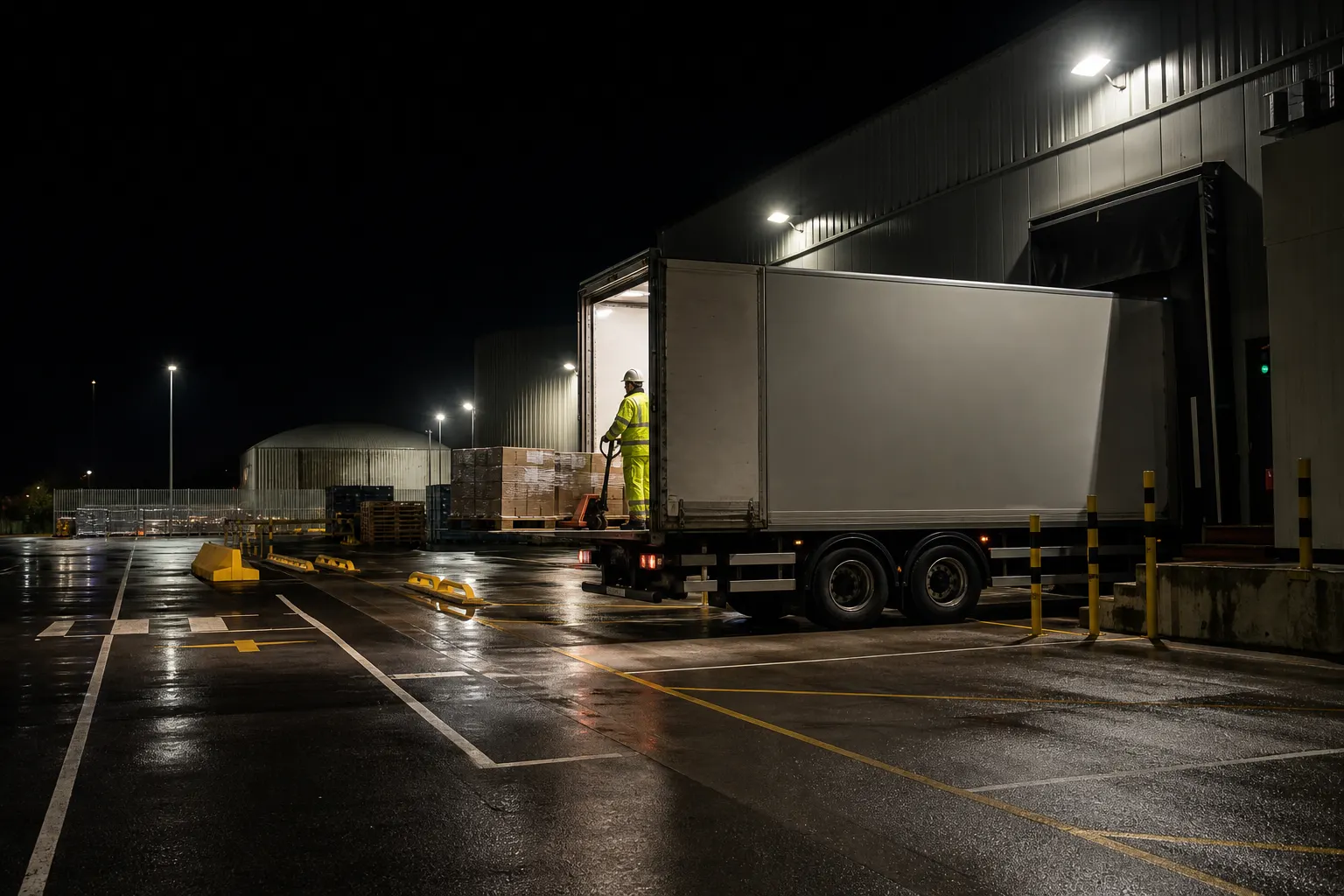
The HSE guidance on workplace transport lighting highlights the need for suitable lighting on roads, yards, manoeuvring areas and pedestrian areas. It also draws attention to dazzling drivers and to tall vehicles blocking poorly positioned lights.
Loading and parking bays illustrate the issue. A luminaire directly above the centre of a bay may be obscured by a high-sided vehicle. Positioning light to cover the working space between bays can be more useful, provided glare and spill are controlled.
Mounting height, beam angle and nearby structures must be considered together. A fitting should illuminate the intended surface without sending a significant proportion of its output above the site, through a neighbour’s window or towards an approaching driver.
Use controls that match real site activity
Controls are most effective when they reflect how the premises operates. A timer alone may not accommodate seasonal opening hours, late deliveries or staff working in an isolated area. Movement sensors can also be frustrating if they repeatedly trigger because of passing traffic, vegetation or wildlife.
Depending on the site, a practical control strategy could combine:
- time schedules for predictable operating periods
- photocells to respond to available daylight
- presence detection in intermittently occupied areas
- dimming during quieter periods
- separate zones for roads, yards, paths and entrances
- a clearly managed manual override for exceptional work
The position and settings of sensors matter. Detection coverage, delay periods and switching behaviour should be commissioned on site rather than left at unsuitable factory defaults.
Respect Cornwall’s rural settings and dark skies
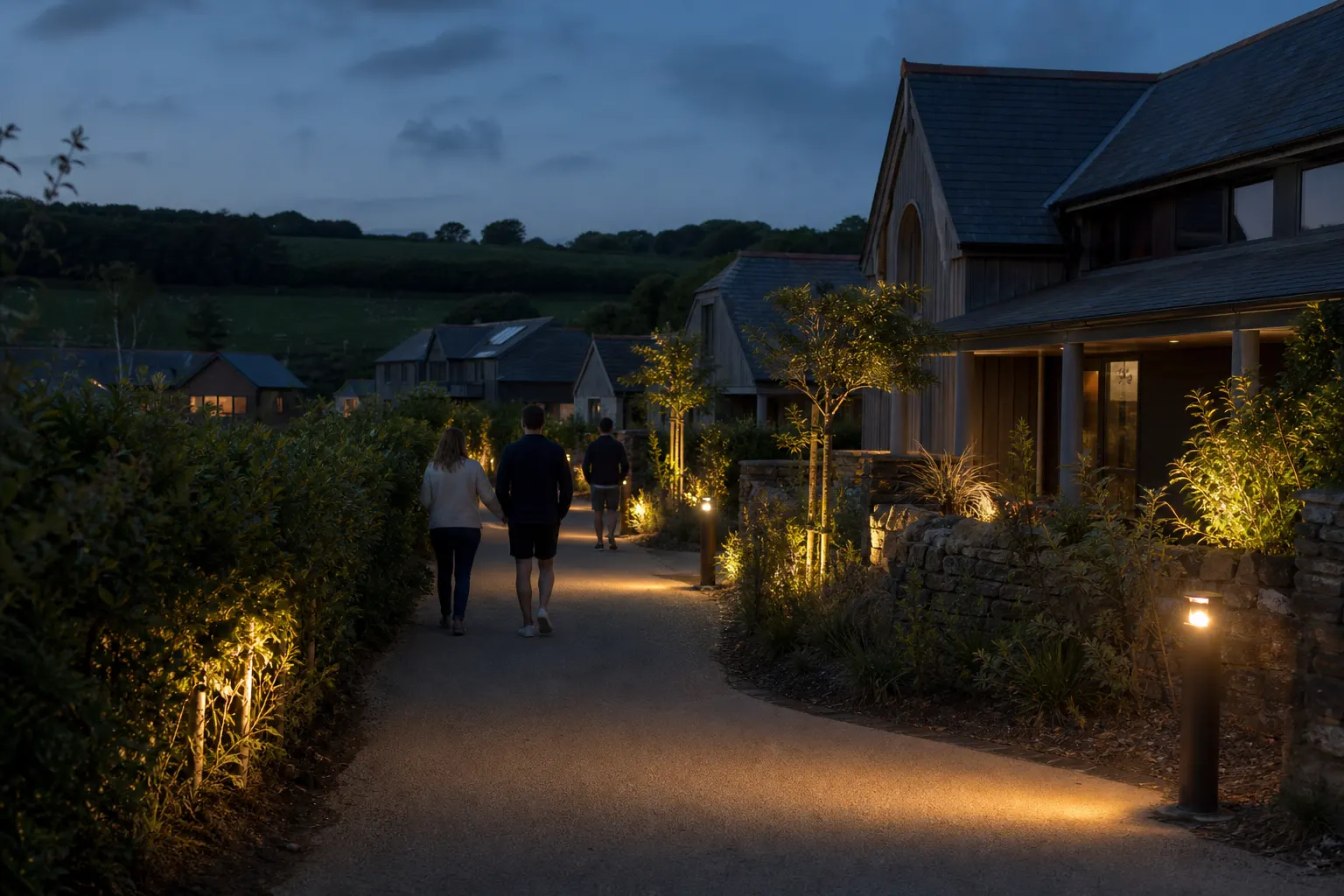
Cornwall contains many commercial premises close to homes, farmland, woodland edges and open countryside. Bodmin Moor and West Penwith also have internationally recognised dark-sky areas, but responsible external lighting is relevant throughout the county.
Planning guidance treats light spill, glare and sky glow as issues that may affect people, wildlife and intrinsically dark landscapes. Artificial light from premises can also be investigated as a statutory nuisance where it unreasonably and substantially interferes with the use or enjoyment of another property or is prejudicial to health.
Where bats or sensitive habitats may be affected, ecological considerations should be addressed early. Natural England advises that lighting proposals near features used for roosting, foraging or commuting may require ecological assessment. On larger rural sites, retaining genuinely dark hedgerows or corridors can be as important as selecting the luminaires.
This does not mean operational areas must be left unsafe. It means defining where light is genuinely required, directing it accurately and limiting operation outside working hours.
Specify fittings for the actual environment
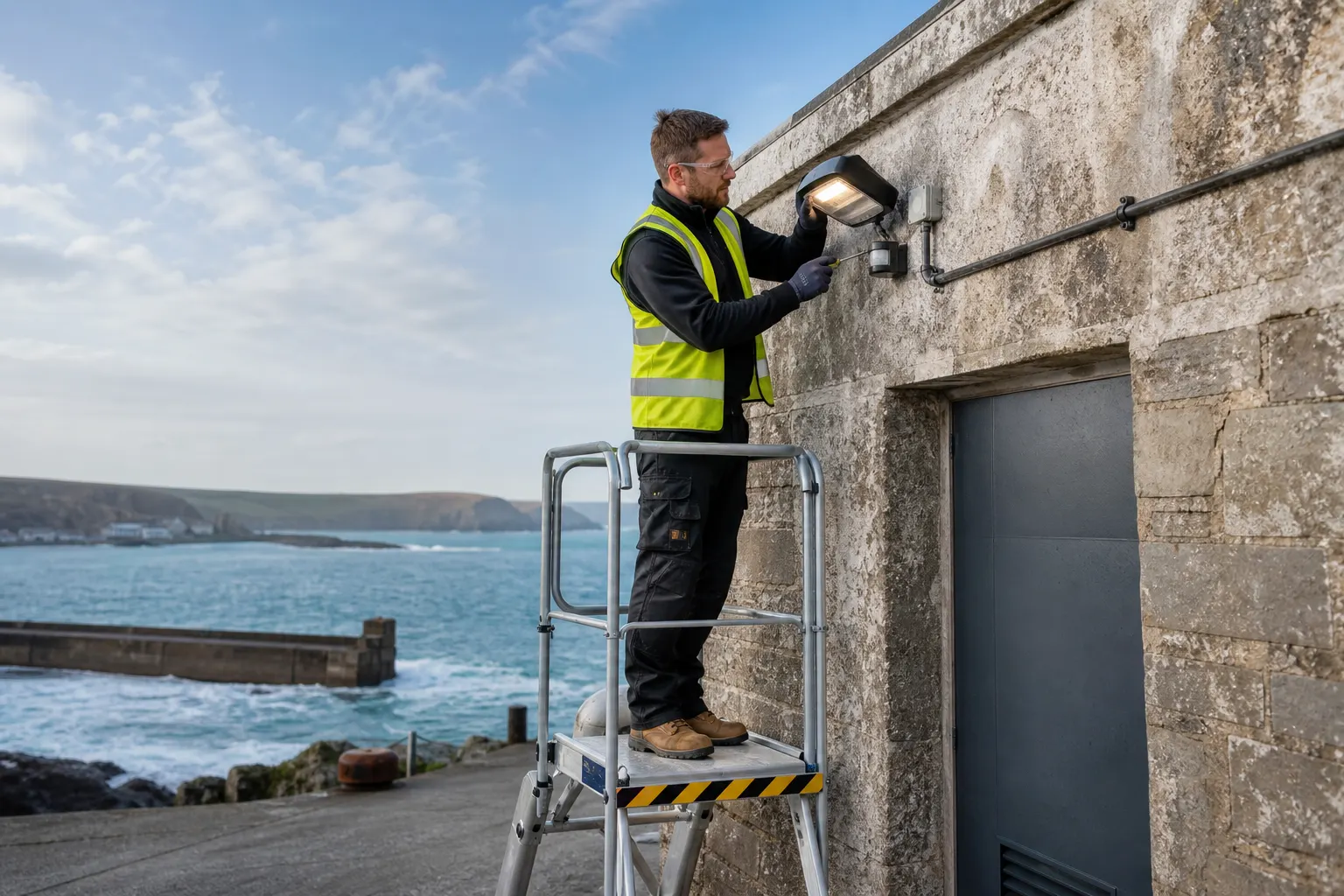
Exterior equipment in Cornwall may face wind-driven rain, salt-laden air, dust, vibration or accidental contact from site activity. Product selection should therefore go beyond wattage and headline light output.
The design should consider the fitting enclosure, corrosion resistance, mounting arrangement, cable entry, impact risk and access for maintenance. Quarries and industrial yards may present different conditions from holiday parks or customer-facing commercial premises, even when the areas appear similar on a plan.
Colour appearance and visual comfort also matter. Entrances and public paths may benefit from different optical characteristics than a loading yard, while security cameras should be coordinated with the lighting layout rather than treated as a separate system.
Plan for maintenance before installation
An external lighting scheme will change over time. Lenses become dirty, vegetation grows, brackets move, sensors drift out of adjustment and alterations create new shadows. A well-designed installation should make inspection and cleaning practical without requiring disruptive access arrangements for routine tasks.
Lighting can be incorporated into planned electrical maintenance so that damaged enclosures, deteriorating supports, failed controls and incorrectly aimed fittings are found before they compromise the site.
Commissioning should include an after-dark check with the site in a realistic operating condition. Fittings can then be aimed correctly, control zones confirmed and obvious spill or glare addressed. It is much easier to correct these points during commissioning than after complaints or incidents.
A practical outdoor lighting checklist
- Define the task before choosing the fitting.
- Inspect the site in darkness as well as daylight.
- Separate vehicles, pedestrians and public areas where possible.
- Check sightlines from driving positions and neighbouring land.
- Keep light away from unnecessary surfaces and sensitive boundaries.
- Use controls that reflect actual opening and working hours.
- Allow safe access for inspection, cleaning and replacement.
- Verify the completed scheme after dark.
Plan the whole site rather than isolated lights
Effective commercial outdoor lighting is not simply a question of replacing old floodlights with brighter LEDs. It requires an understanding of movement, working tasks, controls, surrounding land and long-term maintenance.
Maenporth Electrical Ltd supports commercial, industrial and larger rural electrical work across Cornwall. To discuss external lighting for a factory, quarry, holiday park, leisure facility or commercial premises, call 01326 250297.