
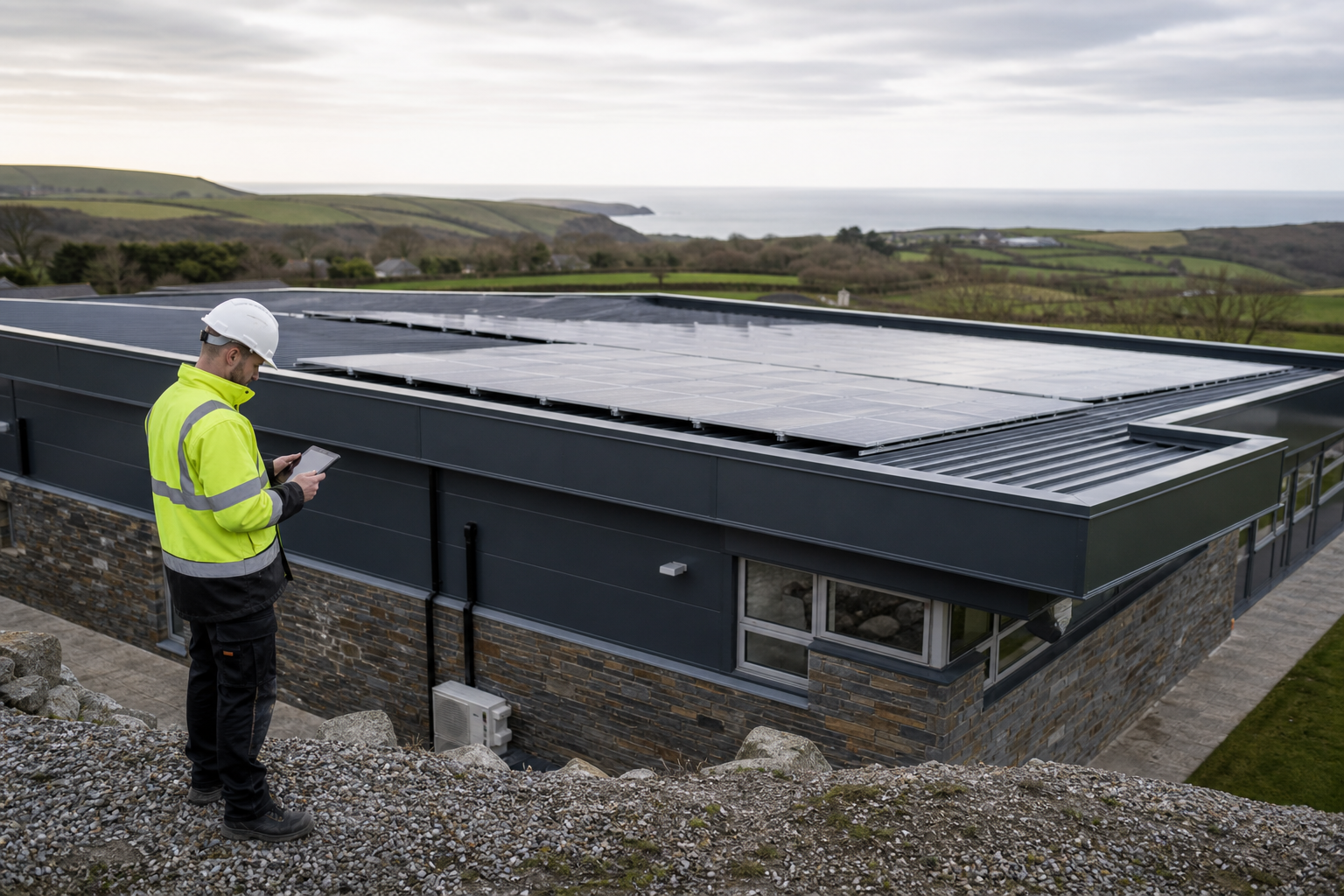
For businesses considering solar in Cornwall, the first question is often: How many panels can we fit? A more useful question is: What solar system will work best with this site?
The distinction matters. Two buildings with similar roof areas can require very different systems because of their operating hours, electricity demand, incoming supply, roof structure and plans for future expansion.
For related work and planning, see our solar PV services page.
This is particularly relevant to Cornwall’s mix of factories, workshops, holiday parks, leisure facilities, quarries and larger rural premises. Some have steady daytime consumption, while others experience sharp seasonal peaks or operate energy-intensive equipment intermittently.
A well-planned commercial solar project therefore starts with the building and its electrical use, not a standard panel package. Here are eight areas worth examining before committing to an installation.
1. Match the solar system to the site’s electricity demand
Solar PV is generally most valuable when the electricity it produces can be used directly on site. The starting point should be an accurate picture of when and how the premises consumes power.
Annual electricity bills provide useful background, but they do not always reveal the site’s daily load profile. Half-hourly meter data, where available, can show when demand rises, how low the base load falls and whether seasonal changes are significant.
Different commercial sites may have very different opportunities:
- A factory or workshop may have consistent weekday demand that aligns with daytime solar generation.
- A holiday park may use considerably more electricity during the brighter months, potentially creating a useful seasonal match.
- A quarry or processing site may have large loads that start and stop according to production requirements.
- A golf or leisure facility may have several separate loads, including kitchens, irrigation, workshops, changing facilities and EV chargers.
- A rural business may have a large roof but relatively low demand during parts of the day.
The aim is not necessarily to cover every available square metre. It is to specify a system that supports genuine site demand and provides a sensible balance between self-consumption, export and future requirements.
2. Establish whether the roof is genuinely suitable
A large roof can look ideal from ground level while still presenting structural, access or maintenance problems. Its condition and remaining service life should be considered before panels, mounting equipment and cabling are added.
Important questions include:
- What is the roof construction and covering?
- Can the structure support the proposed system and associated wind loading?
- Are there signs of corrosion, water ingress or damaged fixings?
- Will the roof need replacement during the expected operating life of the solar installation?
- Are rooflights, vents, gutters or smoke-control systems present?
- Can safe access be maintained for inspection and repair?
Older agricultural, industrial and leisure buildings may also have fibre-cement sheets or fragile rooflights. The Health and Safety Executive advises that roofs should be treated as fragile until a competent person confirms otherwise. Safe access and working methods must be planned into the project rather than considered after the array layout has been agreed.
Exposed and coastal premises also need mounting systems, fixings and external equipment selected with their environment in mind. The cheapest arrangement on paper may not be the most appropriate for a site exposed to strong winds, salt-laden air or difficult maintenance access.
3. Check the electrical infrastructure, not just the roof
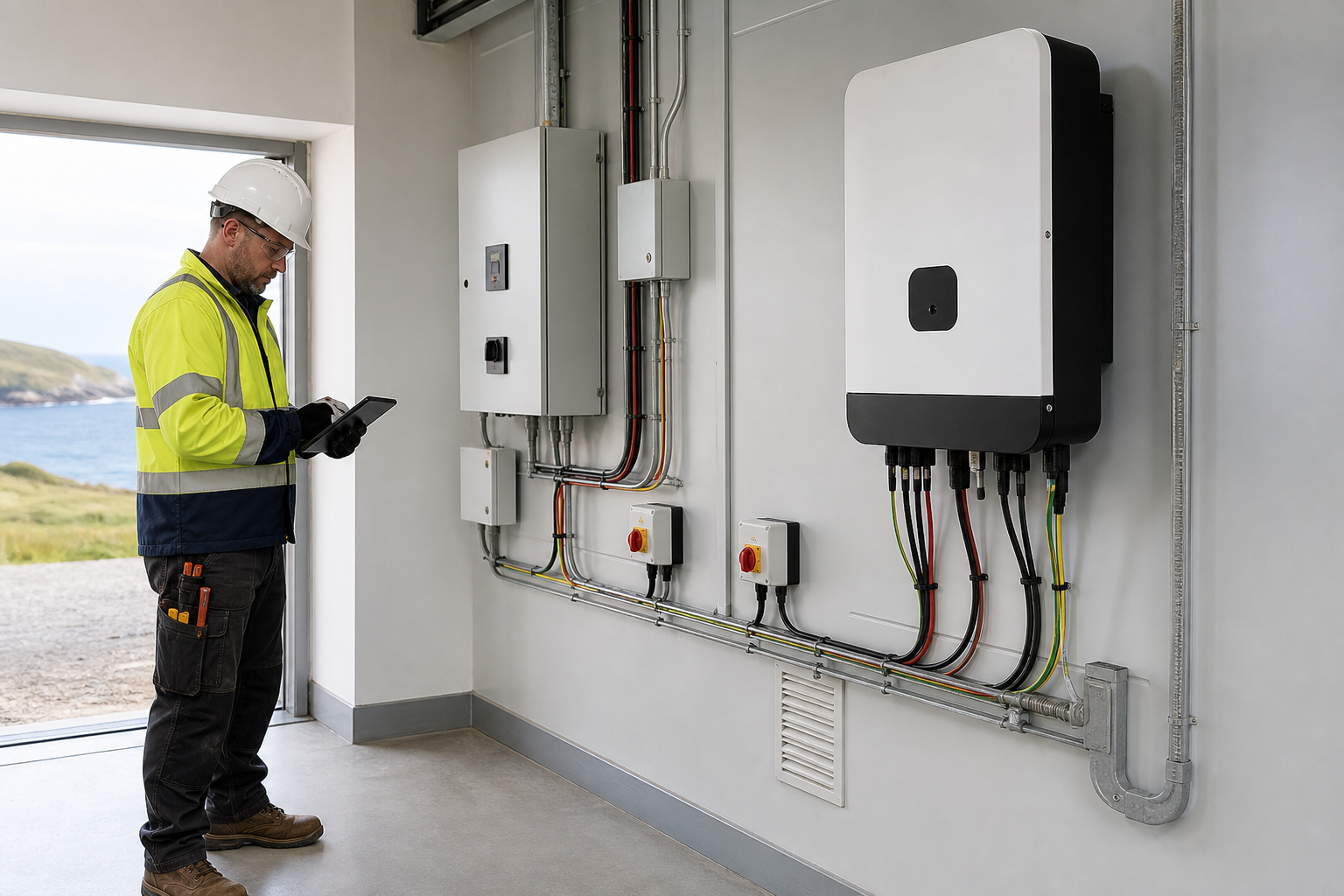
Commercial solar becomes part of the premises’ wider electrical installation. A site survey should therefore examine the incoming supply, metering, distribution equipment, earthing arrangements, protective devices and suitable connection points.
On older or heavily modified premises, the existing electrical layout may not be fully reflected in the available drawings. There may also be several buildings, sub-distribution boards or privately owned cables between different parts of the site.
This can affect where an inverter is installed, how generated electricity is distributed and whether additional equipment or alterations are needed. Long or impractical cable routes can add cost and create voltage, containment or fire-safety considerations.
It is better to identify these constraints during the design stage than after panels and inverters have been ordered.
4. Address the grid connection at an early stage
A solar installation operating in parallel with the public electricity network must follow the relevant distribution network operator connection process. The route depends on factors including the system’s capacity, phase configuration and any existing generation or battery storage.
For larger commercial systems, approval may be required before installation. Available export capacity can also influence the design. Where unrestricted export is not practical, an export limitation scheme may sometimes allow more generation to be installed while controlling how much electricity flows onto the network.
National Grid’s connection guidance explains that compliant export limitation can be considered where additional export capacity would otherwise involve reinforcement, cost or delay. It is not, however, a substitute for the required application and approval process.
Grid connection should not be left until the end of procurement. An early assessment can help prevent a system being designed around export assumptions that the local network cannot accommodate.
5. Confirm planning and building requirements
Many rooftop solar installations on non-domestic buildings in England can be carried out under permitted development rights, subject to conditions. The rules should still be checked for the individual site.
Planning considerations may be more involved where a property is listed, within the grounds of a listed building or affected by a conservation, landscape or heritage designation. These issues can be particularly relevant in Cornwall, where rural and commercial sites may lie within sensitive landscapes or the Cornwall and West Devon Mining Landscape World Heritage Site.
Larger non-domestic rooftop installations can also require a prior approval process even where the work falls within permitted development. Ground-mounted arrays, canopies and projects involving other site works have their own limitations and conditions.
Cornwall Council’s solar planning guidance also highlights the need to consider Building Regulations, including the ability of a roof to carry the additional load and the electrical aspects of the installation.
In short, permitted development does not mean that planning, structural and building-control checks can be skipped.
6. Design the complete system, not a collection of products
Panels attract most of the attention, but the long-term performance and maintainability of commercial solar depend on the complete system design.
This includes inverter selection and location, DC and AC cable routes, containment, protection, isolation, labelling, monitoring, metering and access for maintenance. Array positioning should also account for roof edges, rooflights, fire compartmentation, drainage and equipment that may need servicing.
For related work and planning, see our renewable electrical services page.
The IET’s current Code of Practice for Grid-connected Solar Photovoltaic Systems covers design, installation, commissioning, operation and maintenance, including protection and earthing considerations.
For an operating commercial site, the installation method matters too. Cable routes and equipment locations may need to avoid production areas, guest spaces, vehicle movements or wash-down environments. Planned shutdowns should be discussed early so that essential operations are not interrupted unnecessarily.
7. Consider batteries, EV charging and future loads together
Battery storage can be useful, but it should not be added automatically. Its value depends on the site’s demand profile, tariff structure, available export capacity and what the business wants the system to achieve.
A battery may help a site use more of its solar generation outside peak production hours. On another premises with strong daytime demand, the same investment may provide less benefit. Backup power also requires specific design; installing a battery does not automatically mean the building will continue operating during a power cut.
Future EV charging should also be considered. Vehicles that remain on site during daylight hours may create an additional use for solar generation, while evening charging may change the case for storage or load management.
Even where these technologies are not being installed immediately, allowing for future switchgear capacity, cable routes, monitoring and control equipment can avoid unnecessary reworking later.
8. Plan monitoring, maintenance and handover from the outset
Solar PV has no fuel deliveries and relatively few moving parts, but it is not maintenance-free. A commercial installation should be accessible, documented and monitored throughout its working life.
The project handover should provide clear information about the equipment, isolators, system layout, operating procedures and what to do if a fault is reported. Accurate drawings and labelling become particularly important on larger sites with multiple buildings or electrical supplies.
A practical maintenance plan may include:
- remote monitoring and investigation of unexplained performance changes;
- inspection of accessible cables, isolators, inverters and mounting components;
- electrical testing at suitable intervals;
- checking for debris, vegetation, bird activity or shading;
- reviewing roof condition and drainage around the array;
- manufacturer-recommended inverter and battery maintenance;
- keeping emergency and shutdown information available to site personnel.
Cleaning should be based on actual site conditions rather than an automatic schedule. Coastal deposits, dust from industrial activity, leaves or bird fouling may affect some arrays more than others.
What should a commercial solar proposal include?
Before comparing quotations, check whether each proposal clearly explains:
- The electricity data and assumptions used to size the system.
- Estimated annual generation and likely on-site use.
- Roof, structural and access requirements.
- The proposed grid connection and export arrangements.
- Planning, prior approval and Building Regulations responsibilities.
- Panel, inverter, mounting and monitoring specifications.
- Cable routes, connection points and any required shutdowns.
- Handover documentation, warranties and maintenance arrangements.
A proposal based only on panel quantity and headline generation leaves important questions unanswered. Commercial solar should be treated as an electrical infrastructure project as well as a renewable-energy installation.
Planning solar in Cornwall around the real site
The strongest commercial solar projects begin with a clear understanding of how the premises operates. Energy demand, roof condition, network capacity, planning constraints and future electrical loads all influence the right design.
Maenporth Electrical Ltd provides practical electrical and renewable support for commercial, industrial and larger rural sites across Cornwall. To discuss solar PV as part of your site’s wider electrical requirements, call 01326 250297.