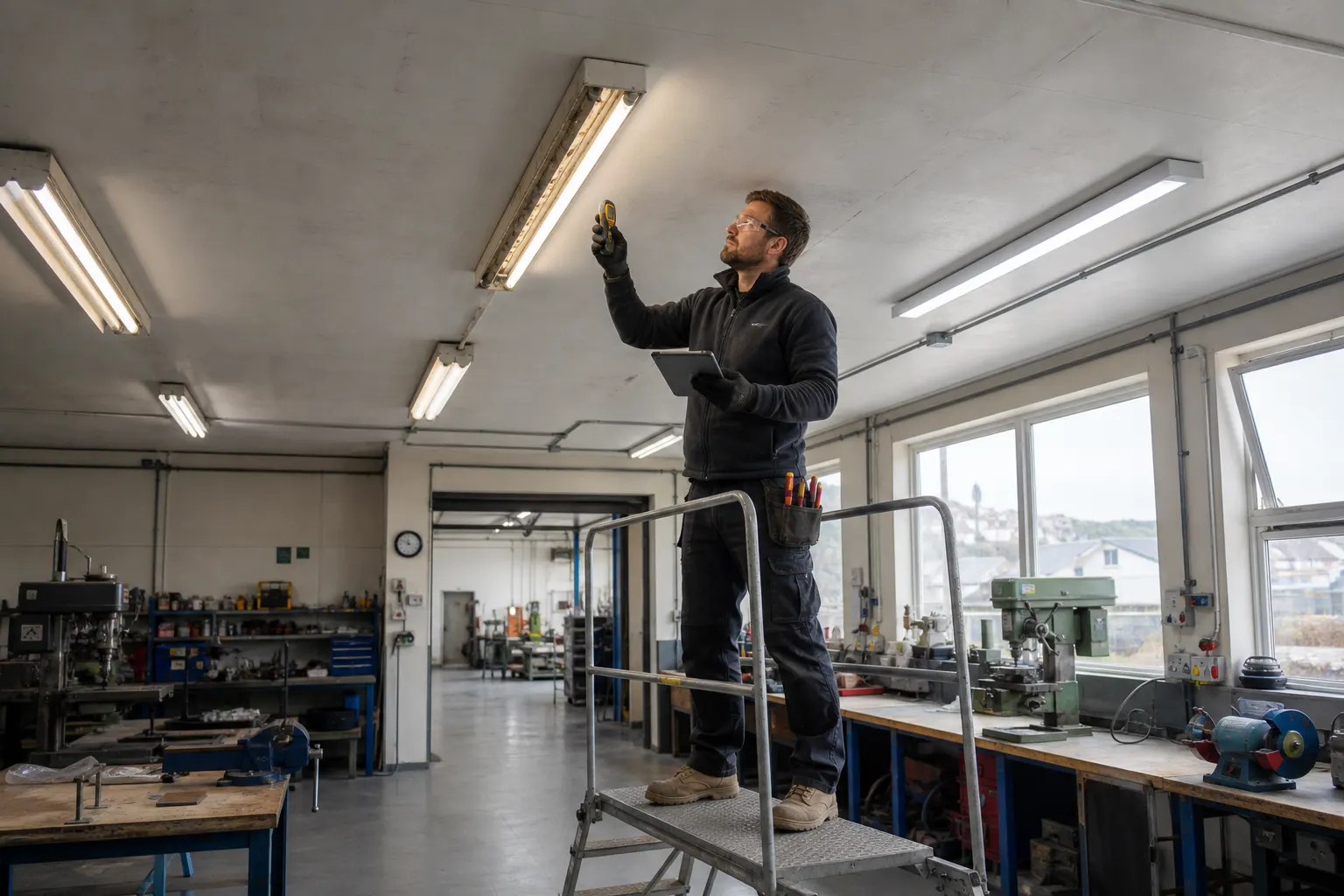
For many commercial and industrial premises, fluorescent lighting has been maintained one failed tube at a time. That approach becomes harder to justify when replacement lamps are less readily available, fittings are ageing and maintenance interruptions keep recurring.
Planning fluorescent lighting replacement in Falmouth does not, however, mean every working fitting must immediately be removed. The useful question is whether continued relamping, compatible LED tubes or replacement luminaires offer the most practical long-term result for the particular building and the work carried out there.
A sound decision starts with the installation itself. It should account for fitting condition, controls, light distribution, access, operating hours and any emergency-lighting function—not just the wattage printed on the old tube.
Why Falmouth sites are reassessing fluorescent lighting
The regulatory and supply position has changed. The relevant UK RoHS mercury exemptions for general-lighting T5 and T8 linear fluorescent lamps expired on 1 February 2024. This affects products placed on the market and is an important planning trigger for businesses that have relied on routine lamp replacement.
It is not a blanket prohibition on using an existing fluorescent installation. Working lights can remain in service where they are safe and suitable, while specialist and non-standard lamps may have different exemption positions. The precise lamp type therefore matters. The government’s RoHS exemption determinations provide the formal detail behind the change.
In practice, reduced availability can expose an existing maintenance problem. A site may hold several tube sizes and colour types, have fittings of different ages, or depend on increasingly difficult-to-source components. Reactive relamping can then become less predictable even if the individual repair still appears inexpensive.
First identify what is actually installed
A row of similar-looking fluorescent fittings is not necessarily a uniform installation. Alterations made over many years may have left different lamp types, control gear and wiring arrangements in the same area.
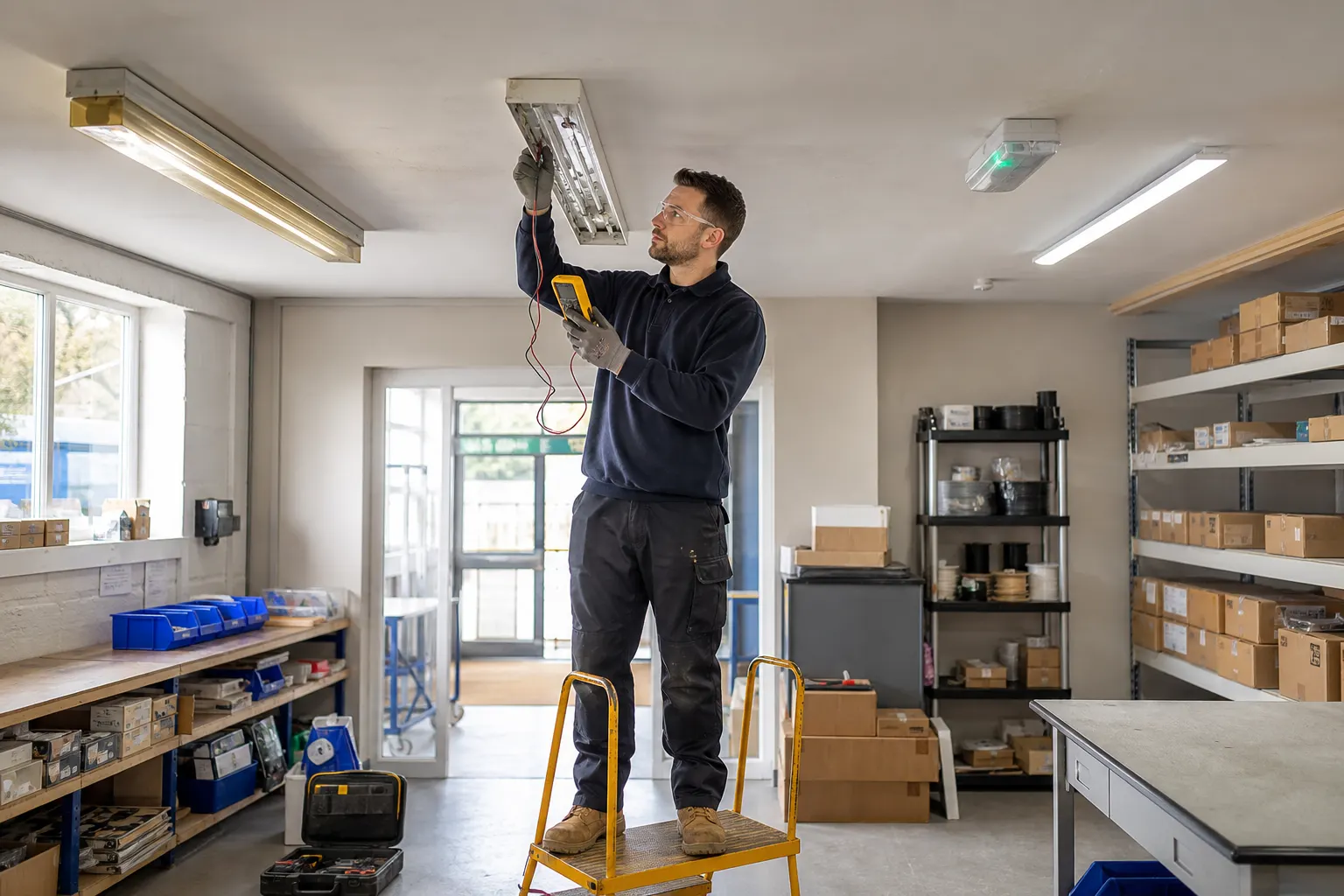
Before choosing a replacement strategy, a survey should establish:
- The lamp types, lengths, ratings and fitting configurations in use.
- Whether fittings use magnetic or electronic control gear.
- The physical condition of housings, diffusers, lampholders and internal wiring.
- Whether luminaires are dimmed or connected to occupancy or daylight controls.
- Which fittings have an emergency function or affect escape routes.
- The required ingress protection and environmental conditions.
- Ceiling heights, access restrictions and the disruption needed for maintenance.
- What activities take place beneath and around each group of lights.
This asset-level information prevents a purchasing decision from being based on tube shape alone. It also identifies where replacement can be phased and where a wider electrical or control issue needs attention.
Can you keep replacing fluorescent tubes?
Continued relamping may be reasonable for a limited period where suitable lamps remain available, fittings are in sound condition and the lighting still serves the space properly. It can help a business avoid unnecessary disruption while a larger project is planned.
The drawbacks become clearer when failures are frequent, lamp stocks are fragmented or safe access is costly. Replacing a tube does not renew brittle components, deteriorated diffusers or old control gear. Nor does it correct poor coverage, dark working areas or a layout that no longer matches current operations.
Businesses should therefore consider the cumulative maintenance burden rather than comparing only the price of one lamp with one new fitting. Operating hours, access equipment, production constraints and the condition of the wider installation all affect the decision.
LED tube retrofit or new fitting
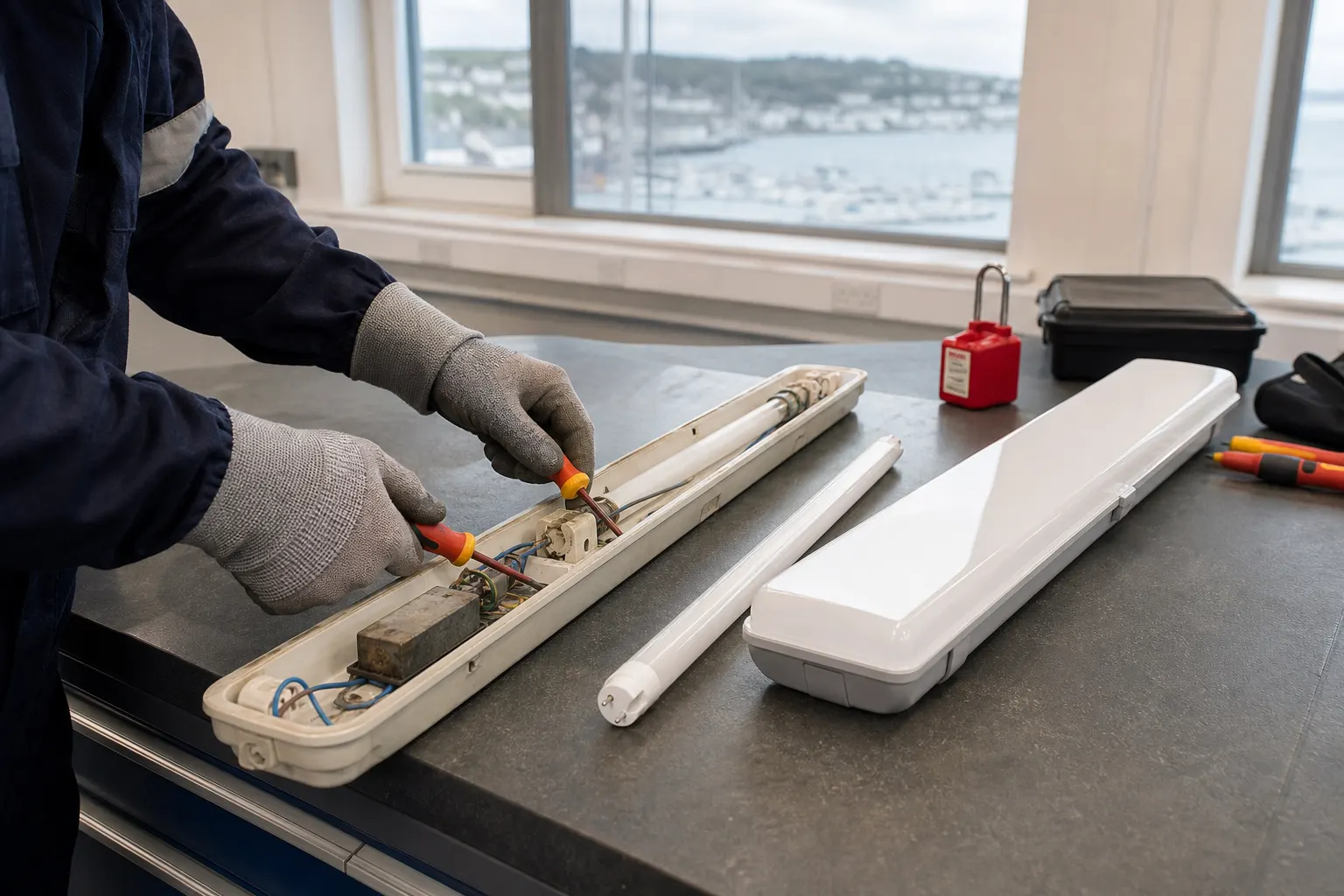
Retrofitting LED tubes
An LED tube can retain an existing fitting body, potentially reducing the physical work involved. It may be useful where housings are in good condition and a compatible, maintainable conversion can be established.
It is not automatically a direct or universal swap. Compatibility depends on the control gear, wiring arrangement, lampholders, emergency conversion equipment, dimming, sensors and the selected lamp. Heat and environmental exposure may also matter. Any alteration needs to leave a clear and safe arrangement for future maintenance.
Installing replacement luminaires
A new luminaire replaces the ageing fitting and allows the light output and distribution to be selected for the space. This can be more appropriate where housings are deteriorated, the existing layout performs poorly or repeated component failures are occurring.
Complete replacement may involve more initial work, especially in high or difficult-to-access areas. It also creates an opportunity to rationalise fitting types, review controls and plan maintenance across the site. Maenporth Electrical’s commercial lighting services cover the assessment and planning needed to compare these routes in context.
Neither option is inherently right for every building. A mixed approach can sometimes be sensible—for example, retaining serviceable fittings in a low-use area while replacing unreliable luminaires over critical workspaces.
Light levels, glare and shadows matter more than wattage
Replacing an old lamp with a product described as an equivalent does not confirm that the finished installation will suit the work. Output, beam pattern, mounting height, spacing, surface colours and obstructions influence where useful light reaches.
UK workplace guidance requires suitable and sufficient lighting. The requirement is practical: people need to perform their tasks and move around safely. Detailed bench work, machinery, stock handling, customer-facing areas and circulation routes can have very different needs.
A replacement should therefore assess the space rather than pursue a simple like-for-like wattage comparison. Excessive brightness can create glare, while poorly distributed light can leave strong shadows beside equipment or between storage areas. Damaged or discoloured diffusers may further reduce performance even where tubes still operate.
Extra checks for operational and outdoor sites
Workshops, factories and larger rural sites may combine high-bay areas, local task lighting and vehicle movement. Holiday parks, golf and leisure premises can add reception spaces, service buildings, paths and seasonal operating patterns. One replacement specification is unlikely to suit every part of such a site.
Yards, loading areas and workplace-transport routes need particular care. Junctions, building entrances, plant, pedestrian routes and regular vehicle movements should be visible without disabling glare or deep shadow. Abrupt changes between bright interiors and darker outdoor areas can also make hazards harder to see while people’s eyes adjust.
Environmental conditions must be considered too. Dust, damp, impact risk and outdoor exposure can determine the type of fitting required. On industrial premises, lighting work may also need coordination with machinery, distribution systems and safe isolation arrangements. This is where broader industrial electrical maintenance planning can prevent lighting work from being treated as an isolated task.
Plan around operations, testing and disposal
A commercial LED lighting upgrade in Cornwall should include more than ordering fittings. Access may require towers, platforms or other arrangements, while working areas might need to be released in stages. Shutdowns, isolations and post-work checks should be planned around production, visitors, deliveries and seasonal demand.
Normal lighting and emergency escape lighting must remain distinct within that plan. A fitting that appears to be part of the general installation may also contain emergency equipment. Changes affecting emergency luminaires, signs, test facilities, circuits or escape routes require separate consideration rather than an assumed tube substitution.
Removal is another project requirement. Linear fluorescent tubes arising from commercial and industrial premises are classified as hazardous, non-POP waste electrical and electronic equipment. Appropriate handling, storage and waste management should therefore form part of the work scope; tubes should not be treated as general waste.
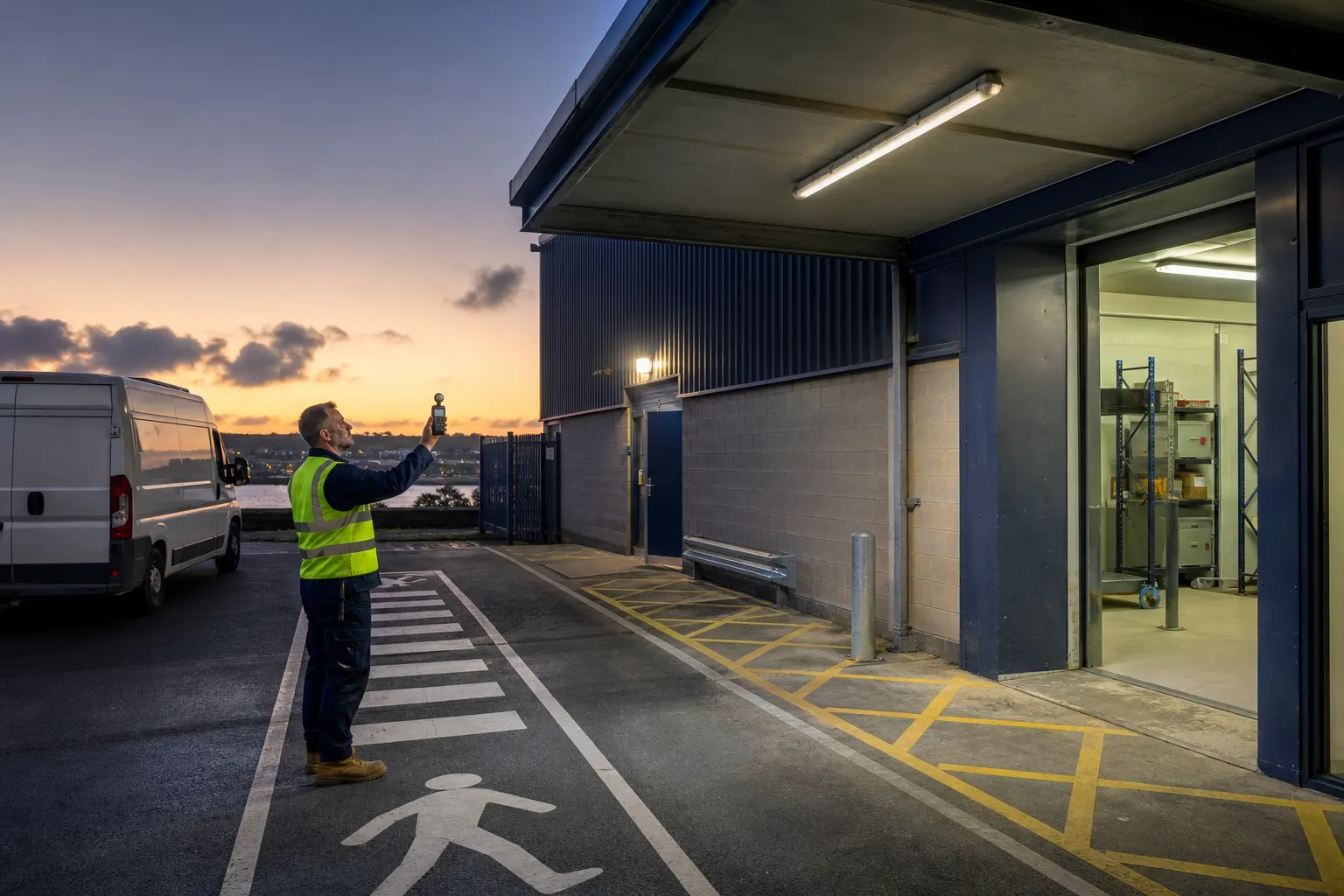
When a lighting survey is the sensible next step
A survey is worthwhile when failures are becoming frequent, replacement tubes are difficult to source, fitting types are unclear or the space has changed since the lighting was installed. It is also useful before budgeting, because it separates areas needing prompt attention from those that can remain in service or be upgraded later.
The result should be a site-specific decision: continue relamping for a defined period, use compatible retrofit lamps, replace complete luminaires or phase a combination of these options. It should also identify operational constraints, emergency-lighting interfaces and disposal requirements before installation begins.
Maenporth Electrical Ltd supports commercial and industrial sites in Falmouth, Penryn and the wider Cornwall area. To discuss ageing fluorescent lighting or arrange an assessment of the available replacement options, call 01326 250297.