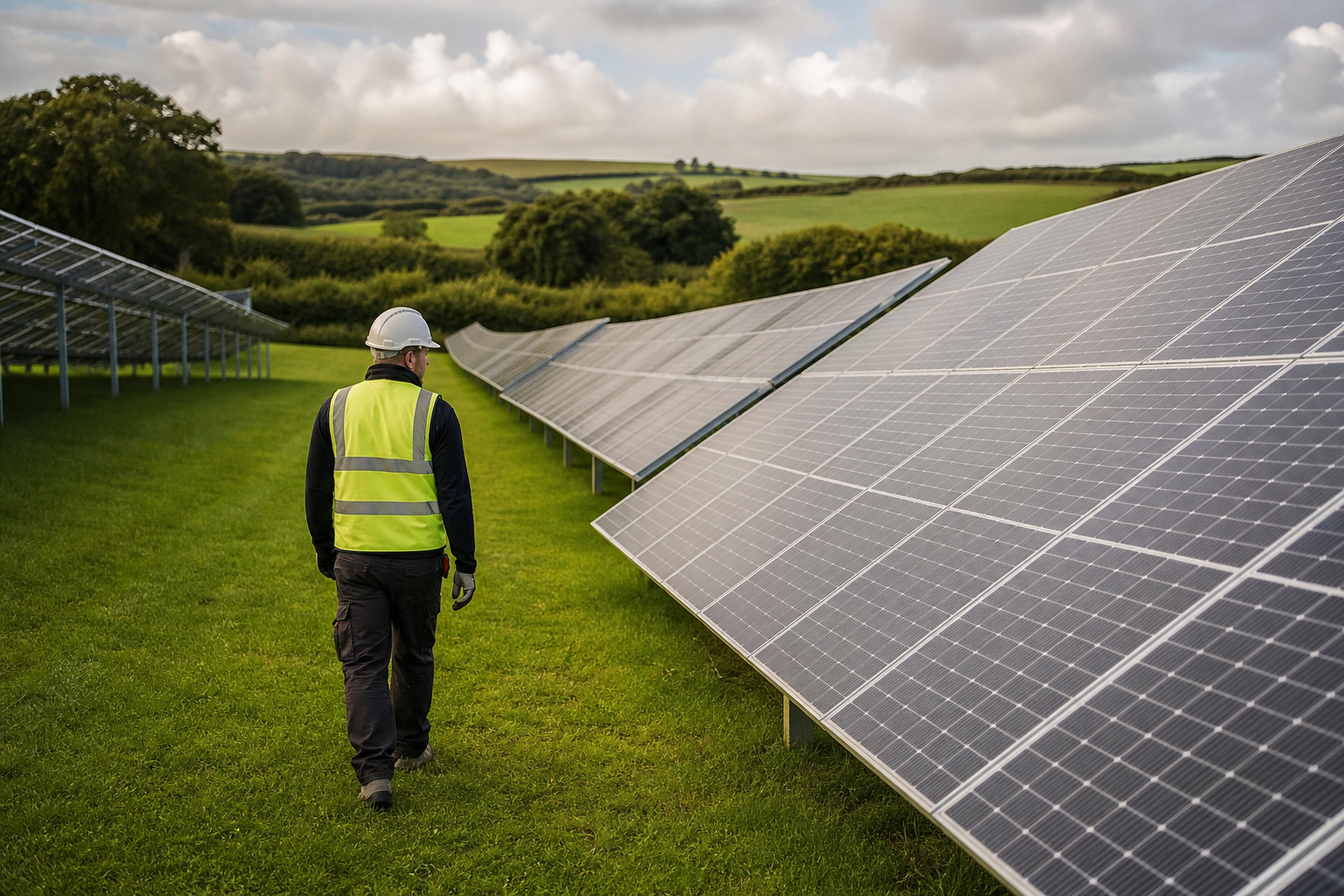
Ground-mounted solar panels are often easier to inspect, clean and repair than panels installed on a roof. Equipment can be reached without arranging roof access, and technicians may have more room to examine modules, cables, mounting systems and associated electrical equipment.
That does not automatically make ground mount solar the lower-maintenance option. Moving an array onto land introduces vegetation control, drainage, security and ground-condition issues that do not normally affect rooftop installations in the same way.
For related work and planning, see our ground-mounted solar services page.
The practical answer is therefore: ground mount solar can be better for maintenance, but only when access and ongoing upkeep are considered during the design. A poorly laid-out ground array can create years of avoidable work, while a well-designed system can be straightforward to inspect and service.
Why ground mount solar can be easier to maintain
Technicians can work without routine roof access
The most obvious advantage is accessibility. Ground-mounted modules can usually be approached from the front and rear, allowing technicians to inspect frames, module backs, visible cabling and mounting components from ground level.
With rooftop solar, access may involve edge protection, scaffolding, specialist access equipment or other controls appropriate to the building and task. Roof condition, fragile surfaces and the layout of other plant can also restrict movement. Ground mounting removes many roof-specific obstacles, although electrical work must still be completed by competent people using suitable safe systems of work.
Good access is not just convenient. Current government guidance for larger solar developments says site layouts should account for the access routes needed for operation and maintenance. The principle also matters on smaller commercial and rural systems: technicians need a practical way to reach the equipment throughout its working life.
Visual inspections and component replacement may be simpler
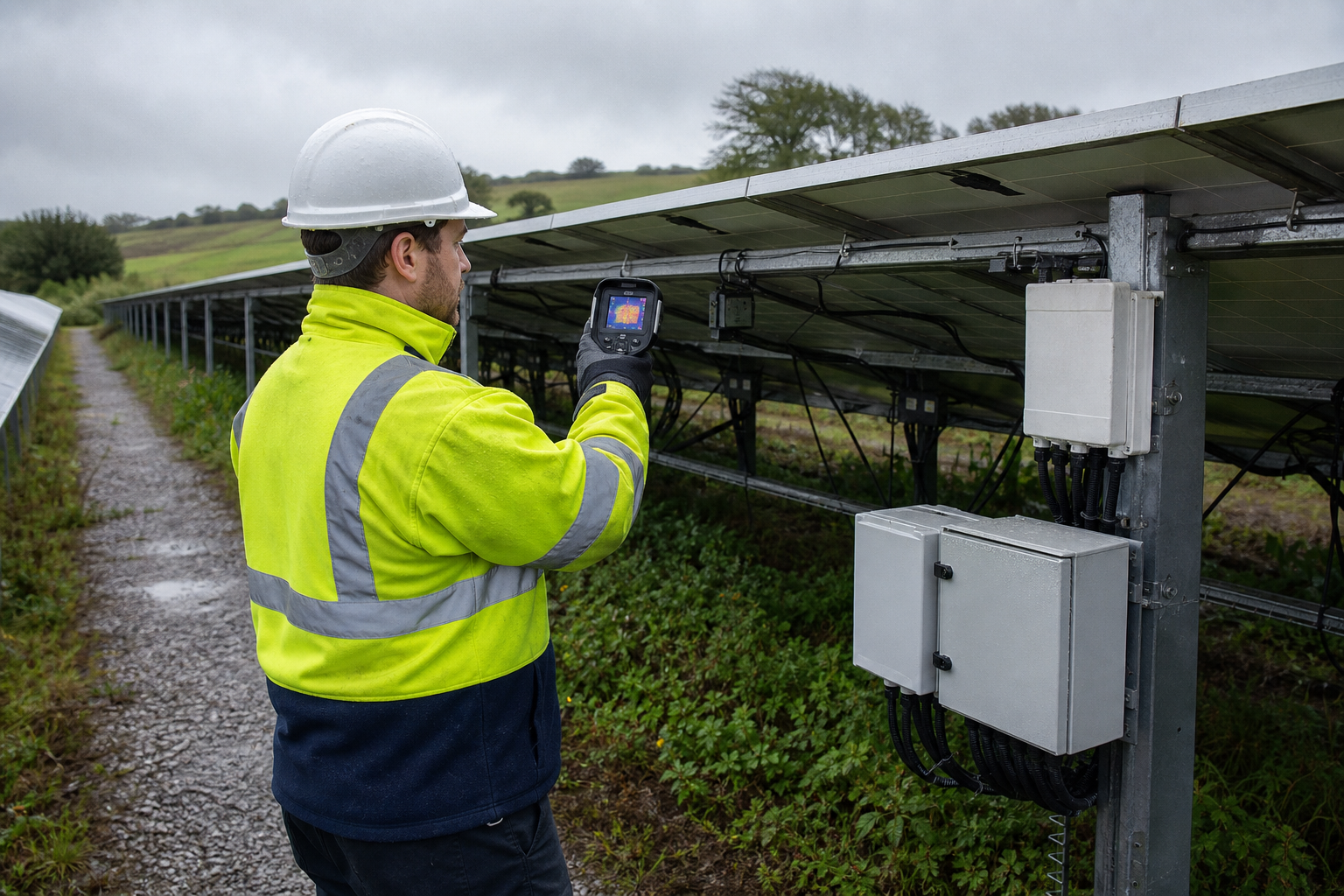
Solar PV systems are not maintenance-free. The IET identifies equipment damage, fixings, cleaning, performance monitoring and electrical testing as typical areas for inspection and maintenance.
Where rows have adequate clearance and spacing, a ground-mounted array can make those checks easier. A damaged module may be more accessible to remove, cable support can be viewed more readily, and mounting structures can be checked without working across a roof covering.
Inverters, isolators and monitoring equipment can also be positioned in a serviceable location, subject to environmental, electrical and manufacturer requirements. However, placing equipment at ground level does not mean it should be exposed or publicly accessible. Enclosures, locations and cable routes must be designed for the conditions and risks on the site.
Maintenance does not have to interfere with the roof
A rooftop system and the roof beneath it have linked maintenance requirements. Future roof repairs may require panels to be isolated, removed and later reinstated. This is one reason why roof condition and expected remaining service life should be assessed before installation.
A ground mount solar system avoids that particular conflict. It can be especially relevant where a commercial building has a complicated roof, limited safe access, shaded roof areas or plans for future alterations.
The maintenance work ground-mounted solar adds
Ground access solves some problems but creates others. These should be included in the operating budget and maintenance plan rather than treated as minor landscaping details.
Vegetation management: grass, weeds and scrub must not shade modules, obstruct access or interfere with equipment.
Drainage and erosion: water movement, soil condition and runoff need monitoring, particularly on sloping or exposed sites.
Security: the site may require controlled access, suitable boundaries and protection against interference or accidental damage.
Wildlife and livestock: cables, conduits and equipment must be protected from foreseeable contact or damage.
Ground and foundation checks: mounting posts, foundations and surrounding soil should be examined for movement, erosion or damage.
Access route upkeep: gates, tracks and working areas need to remain usable in wet weather and throughout the year.
Vegetation can become a significant cost if modules are mounted too close to the ground or rows leave insufficient space for the chosen maintenance method. Research into solar operations and maintenance has highlighted how low clearances can force more labour-intensive vegetation control.
Drainage also deserves early attention. Ground cover, soil compaction, slope and the spacing between arrays can all affect how water moves through a site. These factors should be assessed during design rather than after pooling, erosion or difficult access becomes apparent.
Design determines whether maintenance is genuinely easier
The mounting type alone does not decide the outcome. A maintainable array begins with a realistic understanding of how people, tools and grounds equipment will move around it.
Clearance beneath the modules
Very low modules may reduce visual prominence in some settings, but they can make it difficult to cut vegetation, inspect the lower frame or remove growth around posts. Clearance needs to balance landscape, structural and planning considerations with the practical maintenance method.
Spacing between rows
Rows must be positioned for solar performance, but service access also matters. There should be room to reach modules and electrical components without climbing on the structure or risking damage. If mechanical vegetation management is planned, the intended equipment and its safe operating space should be considered before the layout is fixed.
Sensible equipment and cable locations
Long, exposed or poorly protected cable routes can cancel out the access benefits of ground mounting. The design should consider mechanical protection, environmental exposure, identification, isolation and future testing. Equipment should not be positioned where standing water, vehicles, mowing equipment or unauthorised access create avoidable risks.
Monitoring and documentation
Physical access is only part of maintenance. Suitable system monitoring can help identify unexpected changes in generation and direct investigation towards a particular inverter, string or area.
Handover information should include system data, electrical diagrams, commissioning results, operating procedures and relevant maintenance and cleaning recommendations. MCS documentation identifies these as important parts of a solar PV handover pack.
When rooftop solar may still be the better choice
Ground mount solar should not be selected solely because panels are easier to reach. Rooftops make use of an existing surface and avoid taking up operational, agricultural or recreational land. For a factory, holiday park, golf facility or commercial premises with a suitable roof, a rooftop array may remain the most practical answer.
A roof installation may be preferable where:
usable land is limited or needed for business operations;
ground conditions, drainage or flood risk make construction difficult;
the proposed site would be hard to secure;
landscape or heritage effects are likely to be significant;
the roof is structurally suitable and has safe, planned maintenance access;
a short cable route to the main electrical infrastructure is available.
Conversely, ground mounting may be worth serious consideration where roof space is shaded, fragmented, structurally unsuitable or likely to need major work during the solar system's service life.
For related work and planning, see our solar maintenance services page.
Ground mount solar considerations in Cornwall
Cornwall's rural sites vary considerably. Topography, drainage, existing land use, landscape character, nearby properties and access for construction and maintenance all need site-specific assessment. Equipment selection and mounting design should also reflect the site's environmental exposure rather than relying on a standard layout.
Planning should be checked early. Cornwall Council publishes separate information for standalone domestic solar equipment, but larger commercial and rural proposals require their own assessment. The council also provides renewable energy planning guidance and a landscape sensitivity assessment. National policy asks decision-makers to consider agricultural land quality, landscape and visual effects, drainage, access and opportunities for biodiversity.
This does not mean a ground-mounted array is unsuitable for a Cornish business. It means that the electrical design, land use, planning position and maintenance strategy should be developed together.
What should a solar PV maintenance plan cover?
The appropriate inspection and maintenance regime depends on the system design, site conditions, equipment manufacturers and the electrical installation it connects to. It should not be reduced to an assumed annual panel wash.
A practical plan may cover:
review of generation and monitoring information;
visual inspection of modules, mounting systems and accessible cables;
checks on isolators, inverters, enclosures and warning labels;
appropriate electrical inspection and testing;
vegetation, drainage and access-route management;
condition-led cleaning where dirt or deposits are affecting the array;
recording defects, repairs, test results and replaced components;
review after storms, flooding, site works or reported damage.
The key is to keep the array safe, accessible and operating as intended, while identifying deterioration before it becomes a larger failure.
So, is ground mount solar better for maintenance?
It is often better for physical access, inspection and module replacement, but it is not automatically lower maintenance overall. The benefit depends on clearance, row spacing, cable protection, drainage, security and a workable vegetation strategy.
For larger rural and commercial sites, the right comparison is not simply ground versus roof. It is between two complete designs, including how each will be accessed, monitored and maintained over time.
Maenporth Electrical Ltd provides renewable and solar electrical services for commercial, industrial and larger rural sites in Cornwall. To discuss the electrical requirements and practical maintenance implications of a proposed solar installation, call 01326 250297.