
For businesses, industrial operations and larger rural properties, planning a solar installation involves more than selecting a number of panels. The array, mounting structure, inverters, battery capacity, electrical infrastructure, grid connection and monitoring platform all need to operate as one coordinated system.
A recent Maenporth Electrical installation in Cornwall illustrates this integrated approach. The professionally designed, installed and commissioned system combines a 48.8kWp ground-mounted solar array with 72.8kWh of battery storage and detailed energy monitoring. Although every site requires its own design, the project highlights several practical questions that decision-makers should address before committing to a substantial renewable energy system.
Start with the site’s wider energy objectives
Solar generation should not be considered in isolation. Begin by establishing what the installation needs to achieve. Relevant objectives might include greater energy independence, support for long-term savings and clearer visibility of how electricity is generated, stored and used.
On the Cornwall project, the requirement was not simply to install solar panels. The customer also needed battery storage and an accessible way to understand energy flows across the site. The resulting SolarEdge platform brings together live generation, battery charging and discharging, electricity import and export, and wider consumption trends.
This distinction matters because the objective influences the whole electrical design. A system focused only on generation is different from one intended to coordinate generation, storage, site demand and interaction with the grid. Businesses and property owners considering their options can learn more about Maenporth Electrical’s ground-mounted solar services.
Treat capacity as part of a complete design
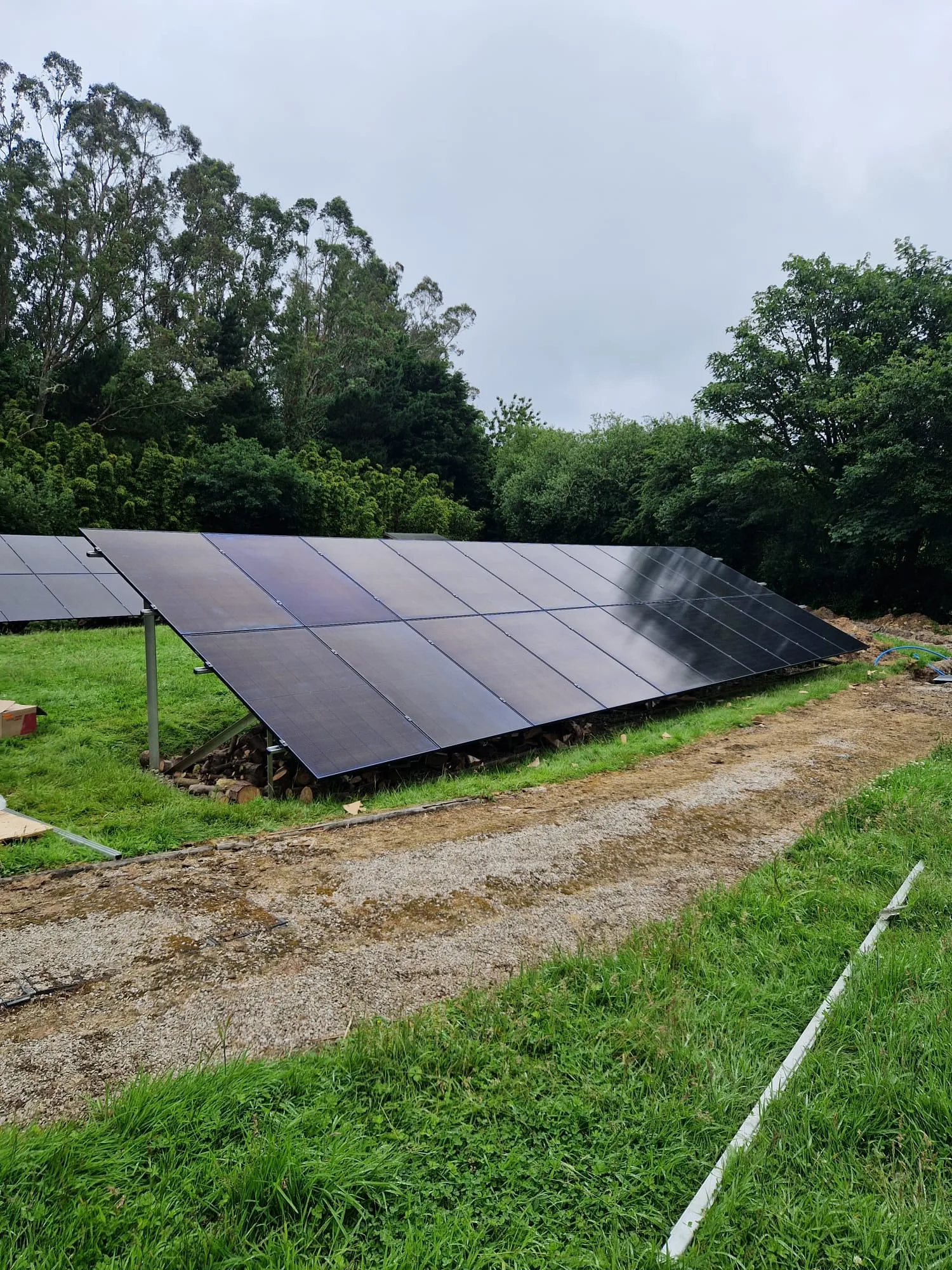
The Cornwall installation has a stated solar capacity of 48.8kWp, provided by 104 AIKO panels rated at 470W each. The panels are installed together on a dedicated, low-level metal ground-mounting structure within the Cornish site.
That headline capacity is only one part of the specification. The complete system includes:
- 104 × 470W AIKO solar panels;
- 104 × SolarEdge S440 power optimisers, with one paired to each panel;
- 1 × 20kW three-phase SolarEdge inverter;
- 2 × 10kW three-phase SolarEdge inverters;
- 1 × 8kW three-phase SolarEdge inverter;
- 15 × SolarEdge 48V Home Batteries; and
- 1 × SolarEdge Energy Meter.
The use of four three-phase inverters reflects the scale of the installation. Together, the panels, optimisers, inverters, batteries and meter form an integrated renewable energy system rather than a collection of separate products.
For a decision-maker, the practical lesson is to assess how every component supports the required capacity and operating strategy. Inverter capacity, storage and metering should be considered alongside the array from the beginning, not added as disconnected afterthoughts.
Decide whether ground-mounted solar suits the property
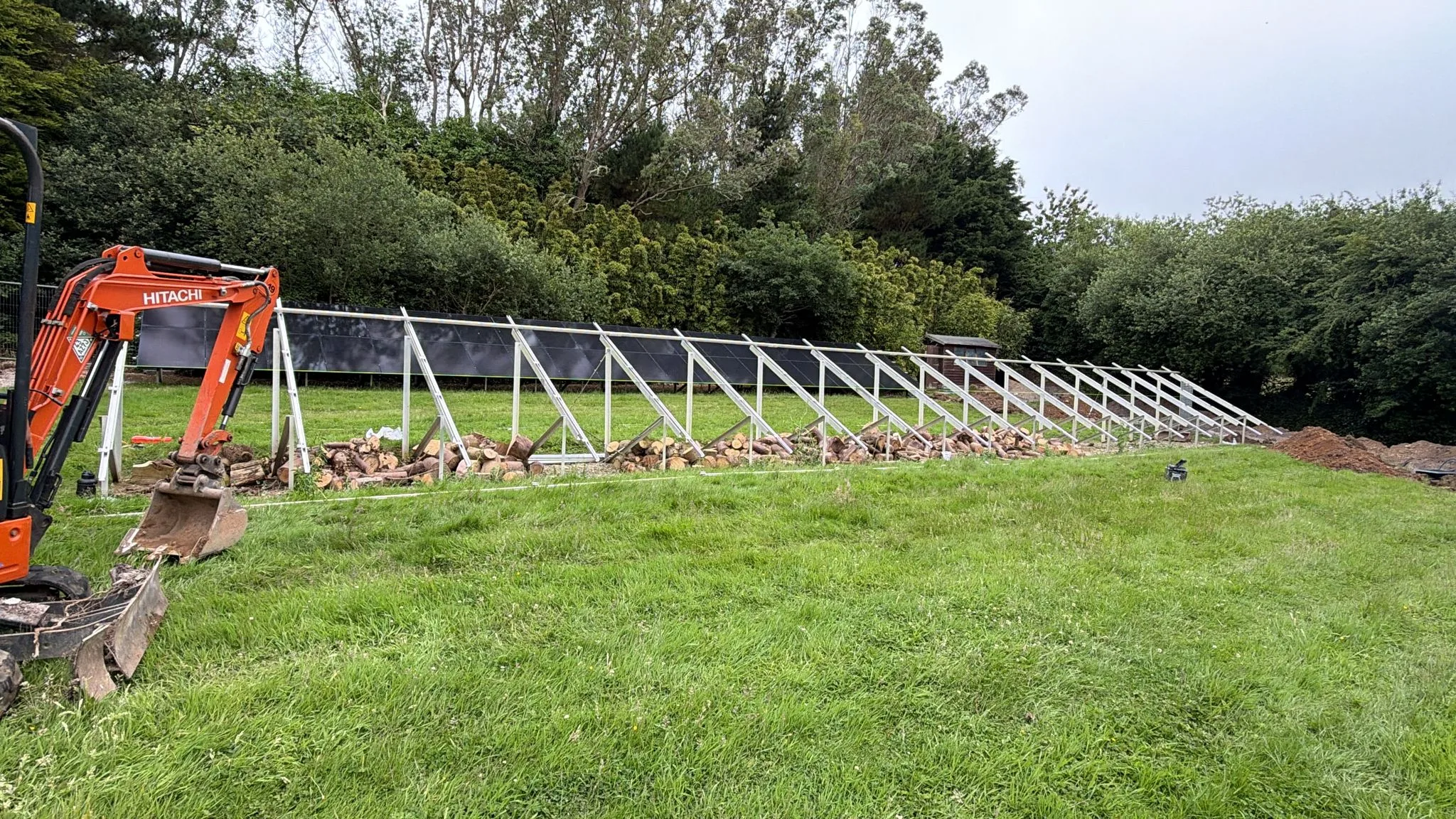
A ground-mounted arrangement allowed all 104 panels on this project to be brought together as a purpose-built generation system. The external installation included construction of the metal framework followed by the fitting of the complete panel array.
The project developed from exposed support posts and rails to partially populated rows and, finally, a broad completed array beside a gravel access track. This progression demonstrates that ground-mounted solar is both a construction and an electrical undertaking. The framework must accommodate the planned layout, while the array must connect into the optimisers, inverters, storage and monitoring equipment.
Site managers should therefore consider the whole working area, including the array location, framework and route to the associated electrical equipment. The suitability of any particular site must be established through a professional assessment and coordinated design.
Choose battery storage around its intended role
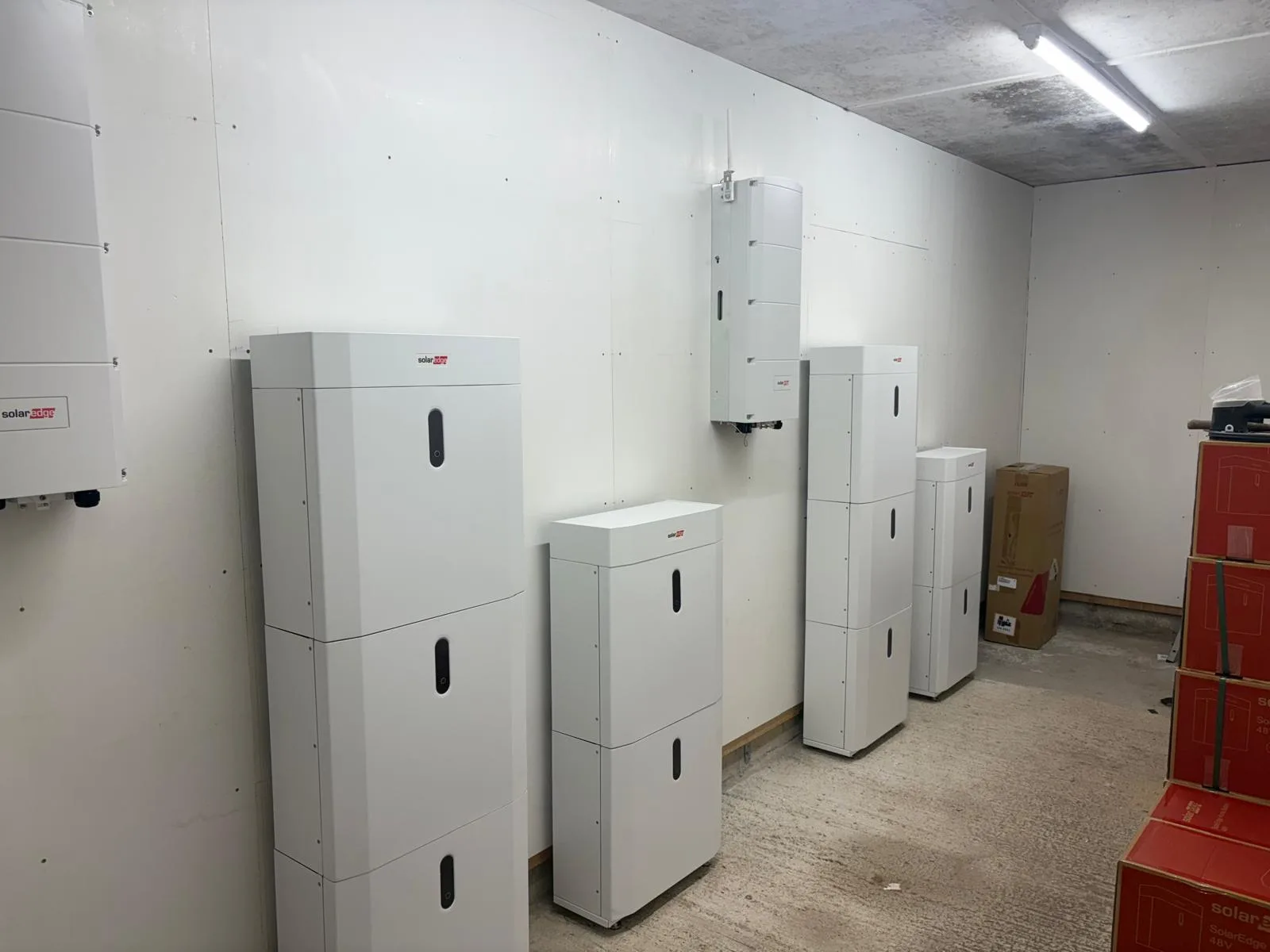
The Cornwall system includes 15 SolarEdge 48V Home Batteries with a total stated storage capacity of 72.8kWh. This storage element allows electricity generated by the array to be retained rather than relying solely on immediate consumption or export.
Battery capacity should be discussed in relation to the site’s wider energy requirements. Decision-makers need to understand what they want stored energy to contribute and how battery activity will be made visible. In this installation, the monitoring platform shows when the batteries are charging and discharging, helping the customer see the relationship between solar production, stored energy, electricity demand and the grid.
This makes storage a measurable part of the energy system. Maenporth Electrical’s battery storage services provide further information for organisations considering storage alongside renewable generation.
Make energy monitoring part of the specification
Generation figures alone do not show the complete energy picture. The SolarEdge Energy Meter installed on this project supplies the information needed to display electricity moving between the solar PV system, batteries, customer loads and the grid.
Through the SolarEdge monitoring platform, the customer can view:
- Live solar generation from the ground-mounted array;
- Grid import and export as electricity moves to or from the network;
- Battery activity, including charging and discharging;
- Energy consumption trends across the site; and
- Opportunities for further energy savings identified through clearer generation and consumption information.
Presenting this information in one accessible place helps the customer view generation, storage and consumption as connected parts of the same system. Live information can show how current solar production relates to site demand, while longer-term trends can support more informed decisions about electricity use.
Allow for plant-room layout and cable management
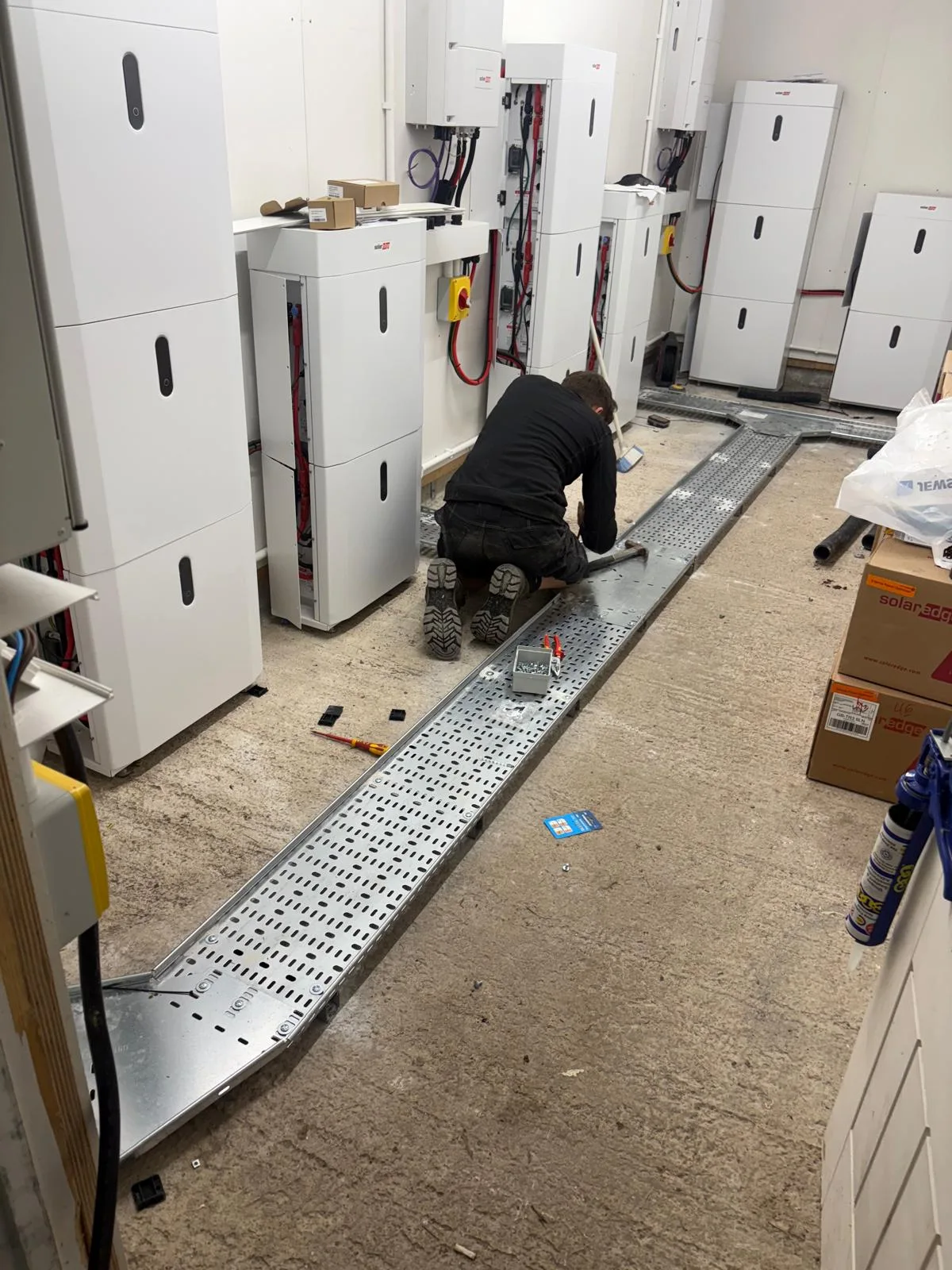
A large external array must be supported by a practical internal electrical installation. For the Cornwall project, the plant room accommodates the storage units and associated SolarEdge equipment. Metal cable tray was installed around the equipment as part of a structured approach to cable management.
This is particularly important where an installation includes multiple inverters, 15 batteries, an energy meter and connections from 104 optimised panels. Equipment arrangement and cable management form part of the finished system’s performance, practicality and long-term reliability; they are not merely cosmetic details.
When reviewing a proposal, decision-makers should look beyond the panel layout. The position of inverters, batteries, metering equipment and associated connections needs to be considered as part of the same design before installation and commissioning.
Address grid compliance, certification and commissioning
The completed Cornwall installation is G99 compliant. G99 requirements are relevant to generation equipment operating in parallel with the electricity network, making this an important consideration for a three-phase solar installation of this scale.
The project is also MCS certified. Maenporth Electrical professionally designed, installed and commissioned the complete solar PV and battery storage system.
Commissioning brought together the 104 AIKO panels, 104 SolarEdge S440 power optimisers, four three-phase inverters, 15 batteries, SolarEdge Energy Meter and monitoring platform as an operational system. At handover, the customer received the completed installation and the ability to monitor generation, import, export, battery activity and consumption.
Use an integrated brief when requesting a proposal
A useful project brief should cover more than a target solar capacity. It should explain the property’s energy objectives, the role expected of battery storage, the required level of monitoring and the need to coordinate the external array with the internal electrical installation.
This 48.8kWp Cornwall project shows the value of that complete-system approach. Its 104-panel ground-mounted array, 72.8kWh of storage, three-phase inverter arrangement, power optimisers, energy metering and monitoring platform were designed to work together with long-term performance, efficiency and reliability in mind.
For businesses, industrial operations and larger rural sites across Cornwall—including Falmouth, Penryn, Newquay, Truro and surrounding areas—the central lesson is clear: successful solar and battery planning begins with coordinated electrical design and ends with professional commissioning and usable energy information.