

A commercial unit can have the right location, floor area and rent while still being unsuitable for the business that plans to occupy it. The electrical supply may be too limited, the distribution equipment may not suit the proposed layout, or necessary cable routes and alterations may be difficult to agree.
These issues are easier to investigate before a lease is signed, equipment is ordered or a fit-out programme is fixed. A pre-lease assessment by a commercial electrician in Falmouth can help a prospective tenant, property owner or operator understand what is present, what information is missing and what further work may be required.
The purpose is not to diagnose every detail before design begins. It is to establish whether the premises provide a credible electrical starting point for the intended business.
Why a suitable-looking commercial unit may not be electrically ready
Connected power does not necessarily mean suitable power. A unit that has supported an office, shop or storage use may not be ready for catering equipment, workshop machinery, electric heating, refrigeration or vehicle charging.
Property particulars may give limited information about the electrical services, and those services may not have been tested as part of the marketing process. Visual clues can also be misleading. The presence of a three-phase distribution board, for example, does not confirm the usable capacity of the connection or the condition of the circuits.
The key question is therefore not simply whether electricity is available. It is whether the incoming supply, internal installation and proposed alterations can support the new operation safely and practically.
Start with the intended use and a realistic equipment list
A useful commercial electrical survey starts with the business plan rather than the distribution board. The assessor needs to understand how the premises will operate, which equipment will be installed and whether different loads are likely to run at the same time.
Prepare an initial schedule covering:
- fixed machinery, workshop tools or production equipment;
- commercial cooking, refrigeration and extraction systems;
- electric space heating, hot water and air conditioning;
- IT equipment, communications rooms and resilient power requirements;
- internal, external and emergency lighting;
- security, fire safety and access-control systems;
- EV charging, solar generation or battery storage under consideration;
- likely future equipment or expansion.
Nameplate ratings are useful, but they are not the whole assessment. Starting currents, operating patterns, load diversity, business-critical functions and future growth can all affect the eventual design.
Check the incoming supply and who controls it
The incoming supply should be considered separately from the wiring and distribution equipment inside the unit. Relevant information may include whether the supply is single-phase or three-phase, the metering arrangement, the known or agreed capacity and whether the unit has a direct or shared connection.
Do not infer capacity from the size of a main switch, the appearance of the meter or the fact that previous occupiers used the premises. Where available, request electricity bills, supply records, meter details and information held by the landlord or managing agent.
For units within a divided building or managed estate, it is also important to establish who controls the upstream electrical infrastructure. An apparent limitation inside the unit may originate elsewhere in the building, while alterations could require approval from more than one party.

Assess the condition and layout of the distribution system
A condition report and a capacity assessment answer different questions. An electrical installation may have satisfactory condition evidence without being suitably configured or adequately rated for a proposed fit-out.
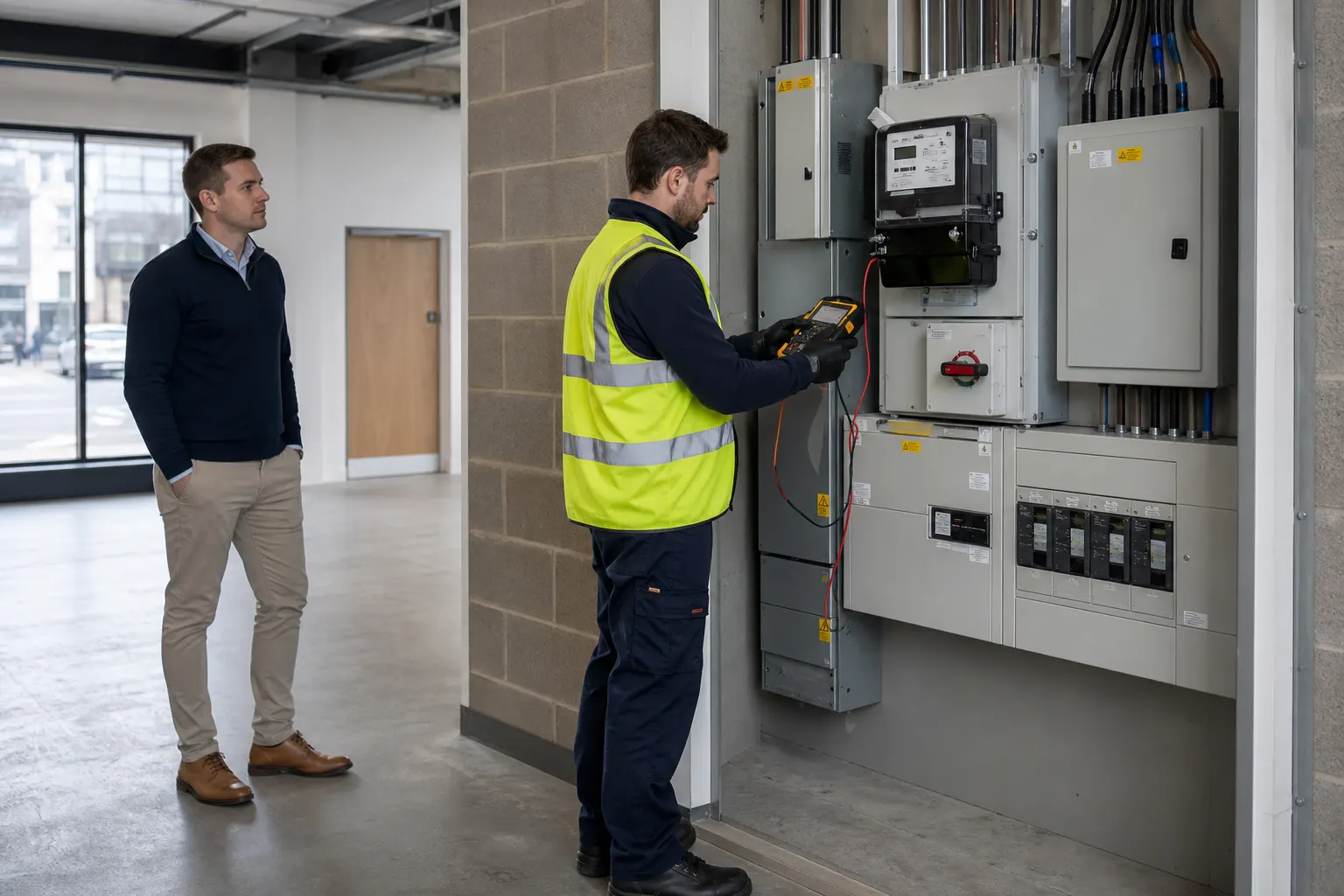
A commercial premises electrical inspection in Falmouth may need to consider the available records, distribution-board arrangements, circuit identification, protective measures, signs of alterations and the practicality of adapting the installation. Existing drawings and previous test documentation can be valuable, but they should be checked against what is actually present.
Electrical safety responsibilities depend on control of the system and work activities, rather than a blanket rule that every commercial property must have an EICR at one fixed interval. The HSE guidance on the Electricity at Work Regulations explains the duties relating to electrical systems used in work activities.
Identify the loads most likely to change the scope
Some proposed uses have a much greater effect on the electrical brief than their floor area suggests. A small food premises may require substantial cooking, water-heating, refrigeration and ventilation loads. A workshop may need supplies designed around motor starting, equipment positioning and safe isolation. An office may place more emphasis on cooling, communications equipment and continuity.
EV charging can also materially alter the demand assessment, particularly where several vehicles may charge during operating hours. If three-phase equipment is proposed, confirm what the machinery actually requires rather than assuming a three-phase board settles the issue. Our guide to when commercial premises need three-phase power explains the wider decision in more detail.
Check cable routes, access and the building fabric
Electrical capacity is only one part of fit-out feasibility. New circuits need practical routes from the relevant distribution point to the equipment they serve. Ceiling voids, floor construction, fire compartments, restricted service areas and finished surfaces can all affect the work.
The assessment should also consider access for installation and future maintenance. A technically possible route may still be disruptive, visually unsuitable or dependent on another occupier’s space.
Fire stopping must be addressed where services pass through fire-resisting construction. External equipment, new penetrations or visible alterations may also need landlord consent and wider planning consideration, depending on the site, its status and the proposal. Electrical work should therefore be coordinated with the property and fit-out plans rather than treated as an isolated package.
Clarify landlord, tenant and shared-building responsibilities
Before ordering work, establish in writing who is responsible for the incoming service, fixed installation, shared distribution equipment and alterations within the unit. The answer may be affected by the lease, estate arrangements and the physical supply configuration.
Questions worth raising include whether landlord consent is needed, who pays for permanent upgrades, what must be reinstated at the end of the term and who retains equipment installed during the tenancy. Service-charge implications and access to shared electrical rooms may also matter.
An electrical contractor can help define the likely technical scope, but cannot interpret commercial lease obligations. A commercial-property solicitor should review repair, alteration, compliance and reinstatement clauses before commitments are made.
Know when the network connection may need to change
If the proposed demand exceeds the available or agreed supply capacity, alterations within the unit alone will not solve the problem. A request to change the Maximum Import Capacity may need to be made through National Grid Electricity Distribution, the local distribution network operator.
The network operator may require details of the existing and proposed capacity before assessing whether connection or network work is necessary. Costs, approvals and timescales are specific to the site and should not be assumed during lease negotiations.
This distinction is important: a new distribution board or upgraded internal cable does not automatically increase the capacity available at the supply boundary. Establishing the likely network position early can prevent a fit-out being designed around power that the premises do not currently have.

Use a practical pre-lease information checklist
Before arranging a commercial electrical capacity assessment in Cornwall, ask the agent, landlord or current occupier for as much of the following as is available:
- recent electrical inspection and testing records;
- existing distribution and circuit drawings;
- electricity bills, meter details and supply information;
- details of any shared or landlord-controlled electrical infrastructure;
- records of previous alterations or known defects;
- requirements for consent to alter the premises;
- information about planned building or external changes;
- access arrangements for electrical rooms, risers and service routes.
Provide the electrical contractor with the proposed equipment list, layout and operating pattern. Flag future additions such as refrigeration, machinery, ventilation, EV charging, solar or battery storage, even if they are not part of the first fit-out phase.
Arrange the assessment before decisions become expensive
The best time to investigate the commercial unit electrical supply is while there is still scope to compare properties, negotiate responsibilities or revise the fit-out. Waiting until equipment has arrived can turn an information gap into a programme and cost problem.
Where the premises appear viable, the findings can inform the next stage of planning a commercial electrical fit-out, including design, distribution changes, lighting, equipment supplies and testing.
Maenporth Electrical Ltd supports commercial sites in Falmouth, Penryn and the wider Cornwall area. To discuss a pre-lease site assessment or the electrical requirements for a proposed unit, call 01326 250297.